

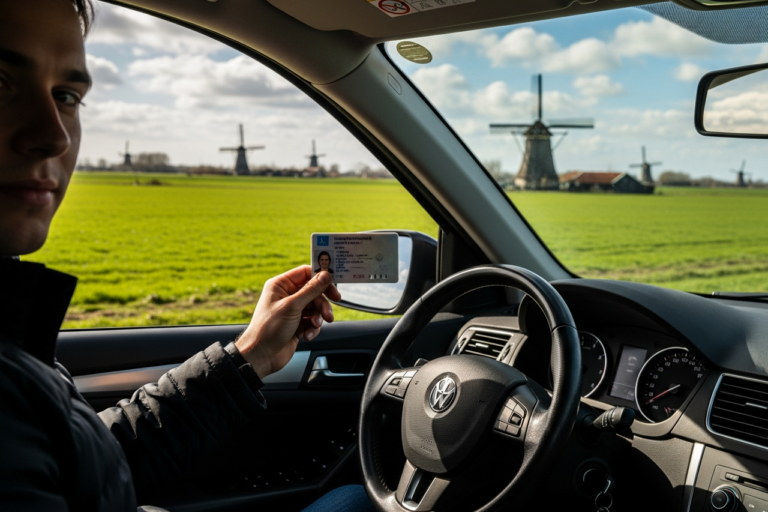
Key Highlights
Here are the main things you need to know about driving in the Netherlands with a foreign license:
-
Most people from other countries can drive here with a driving licence from their home country, but only for a short time.
-
You might need an International Driving Permit (IDP) if your driving license is not in English or is not like the EU or Vienna Convention format.
-
The rules are not the same for people from EU/EEA countries and those from outside. How long you can use your foreign driving license will depend on this.
-
If you want to live here for longer, you have to trade your foreign license for a Dutch driving licence.
-
You must be a certain minimum age and show some documents to rent a car.
Introduction
Are you getting ready for a trip to the Netherlands and want to know if you can drive there? Being able to see the Dutch countryside by car is a great way to travel. But there are important rules you need to know first. If you are a tourist or you are staying for more time, you must follow the rules about using your foreign driving license. In this guide, you will learn all you need about the rules for your driving licence. This includes how long your foreign driving license will be okay to use and when you will need to switch it for a Dutch driving licence.
Validity of Foreign Driving Licenses in the Netherlands
Can you use your current driving licence to drive in the Netherlands? For most travelers, the answer is yes. But this depends on your country of origin and how long you will stay there. The Dutch government lets many people use their valid driving licence from their own country for some time.
You should check the rules before you come. The Netherlands accepts a valid foreign driving licence from many places at first. But the rules might change if you plan to live there. Below, we will talk about what short term visitors need to know and explain when you need an International Driving Permit.
Short-term Stays: Using Your Home Country License
If you are going to the Netherlands for a short time, you can often use your driving licence from your home country. For a holiday or a short work trip, you do not need to get a Dutch licence right away. This makes it easy for people to rent a car and see the country.
But there is one thing you should know. Your driving licence must be valid. You must not use an expired licence, because it is not allowed. Driving with an expired one can lead to fines and you can have trouble with your insurance if you get into an accident. So, before you go, check that your licence is up to date.
This rule helps tourists and short-term visitors travel more easily in the Netherlands. If you have a valid driving licence, you are free to drive and go out to new places in the country. People from the US can also use their valid driving licence for a short stay.
Using an International Driving Permit (IDP)
If you have a foreign driving license, it might still be valid, but you could also need an International Driving Permit (IDP). The IDP is not a new license, but it is an official paper that puts your current driving license into many languages. This helps when you deal with local police or other people and they do not speak your language.
You may need an IDP for the Netherlands if your driving license:
-
Was not given in a European Union country.
-
Is not in English or does not use the Latin alphabet, like licenses in Chinese or Cyrillic.
-
Does not match the categories in the Vienna Convention on Road Traffic.
If you want to visit the Netherlands as a tourist, it is a good idea to check if you must get an IDP before you go. Many car rental companies will ask for one, even if the local law does not always say you have to have it to drive. Remember, you have to get your IDP in the same country where you got your driving license, and do this before leaving for the Netherlands.
Rules for EU/EEA vs. Non-EU/EEA Drivers
The rules for using a foreign driving license in the Netherlands are different for people from the European Union (EU) or European Economic Area (EEA). If you are from one of these places, there are simpler rules. It is easier for you to drive with your foreign driving license in the Netherlands.
People from outside the EU or EEA face stricter rules. The time that their foreign driving license is valid is usually shorter, and they must change to a Dutch driving license after some time. It is important to know the differences, so you follow the law. Below, we will look at the rules for people from both groups.
Driving License Requirements for EU/EEA Citizens
If you hold a valid driving licence from any European Union (EU) or European Free Trade Association (EFTA) country (Iceland, Liechtenstein, Norway, and Switzerland), you are in luck. You can use your existing driving licence in the Netherlands for as long as it is valid. There’s no need to exchange it for a Dutch license, even if you become a resident.
This applies to all categories on your license. Once your current license expires, you can simply exchange it for a Dutch driving licence without having to retake any driving tests. The process is straightforward and recognizes the standardized driving regulations across the EU and EEA.
However, be aware that if your EU license was originally an exchange from a non-EU country, some other EU nations might not recognize it. It’s always good to confirm with the local authorities if you plan to drive outside the Netherlands.
|
Country Group |
Can I use my license? |
Do I need to exchange it? |
|---|---|---|
|
EU/EEA/Switzerland |
Yes, until it expires |
No, but you can upon expiry |
Driving License Requirements for Non-EU/EEA Citizens
If you are from a non-EU or non-EFTA country, the rules are not the same. You can drive in the Netherlands with your valid foreign driving licence for only a short time after you sign up as a resident. This time is usually 185 days from when you get your registration.
After this time is over, your foreign driving licence stops being a valid driving license in the Netherlands. You will need to get a Dutch license to keep driving on the road. You can do this by swapping your old licence for a Dutch one, or by passing the Dutch driving theory and practical exams to get a brand new licence.
Whether you can trade in your old licence will depend on your country of origin. The Netherlands has deals with some countries that make swapping your licence easy. If your country is not on their list, you will have to start at the beginning and pass all the Dutch tests to get your driving license.
How Long Can Foreigners Use Their Driver’s License?
How long you can use your foreign driving license in the Netherlands depends on your nationality and where you live. If you are a tourist or here for a short visit, your valid driving license is usually fine for your whole stay. But when you become a resident, things change.
If you move to the Netherlands from outside the EU or EEA, you have about 185 days after registering with the local municipality before you need a Dutch driving license. After this time, you must get a Dutch license. Here, we will talk about how long you can use your old license and what you need to do when your allowed time is over.
Duration Limits by Nationality and Residency Status
The length of time you can drive on your foreign driver’s license is directly tied to your nationality and residency status. The rules are designed to accommodate everyone from short-term tourists to long-term residents.
For EU/EEA nationals, the rules are simple: you can use your home country’s license until its date of issue expires. If you are from a non-EU/EEA country and become a resident in the Netherlands, you can use your foreign license for 185 days from your registration date. This grace period gives you time to arrange for a Dutch license.
Highly skilled migrants may benefit from a special “30% ruling,” which can simplify the license exchange process, but the 185-day driving limit on a foreign license still generally applies after becoming a resident.
|
Driver Status |
Duration of Validity for Foreign License |
|---|---|
|
Tourist/Temporary Visitor (Any Nationality) |
For the duration of the temporary stay |
|
EU/EEA/Swiss Resident |
Until the license expires |
|
Non-EU/EEA Resident |
185 days from the date of registering as a resident |
What Happens When the Allowed Period Expires?
Once the time allowed for using your foreign license is over, you cannot drive in the Netherlands with it anymore. You must have a valid driving license to drive here. If you drive without one, you can get a fine. If you get into an accident, your insurance most likely will not cover you.
To keep driving in the Netherlands, take action before your grace period ends. What you need to do depends on your country of origin and your own case. Most people from outside the EU need to apply for a Dutch license.
Here are your main options:
-
License Exchange: If your country has an agreement with the Netherlands, you can ask for a license exchange.
-
Take the Dutch Driving Exams: If you cannot exchange your license, you have to pass both the theory exam and the practical test to get a Dutch license.
-
Stop Driving: If you do not have a valid Dutch license yet, you must not drive until you get one.
Converting a Foreign Driver’s License to a Dutch License
If you want to live in the Netherlands for a long time, you may need to change your foreign driver’s license to a Dutch license. Many people have to do this, and it is called a license exchange. With a license exchange, you can get a Dutch license without taking new driving tests at the CBR.
To do this, you fill out an application form and bring some things with you, like your passport photo and your current foreign driver’s license. You give these to the RDW (Netherlands Vehicle Authority) by going to your local municipality. Now, let’s see who can swap their license and how the steps go.
Eligibility to Exchange a Foreign Driver’s License
Not everyone can swap a foreign license for a Dutch license. If you want to do this, it depends on your country of origin. You also need to live in the Netherlands and have a valid residence permit before you can start your exchange application.
There are some countries where the Netherlands has a license exchange deal. If you got your foreign license in one of those countries, or if it came from a country in the EU or EFTA (like Switzerland), you can often just do a license exchange. This is also true for some places, such as Aruba.
You have to meet these rules to get a license exchange:
-
Your foreign license must still be valid when you apply.
-
You need to be on the Personal Records Database (BRP) as a resident.
-
Your country of origin needs to have a license exchange agreement with the Netherlands.
If you do not fit these rules, you usually have to take the Dutch driving tests.
Step-by-Step Process for Converting Your License
If you want to change your foreign license to a Dutch license, the Netherlands Vehicle Authority (RDW) will guide you through the steps. You must first get all the documents needed for your license exchange. You can check exactly what you need on the RDW website.
The process will start at your local municipality. You have to give them your exchange application for the Dutch license. The municipality will send your papers to the RDW. You will give up your foreign license during this time and you will not be able to drive until you get your new Dutch license.
Below is a brief overview of what to do:
-
Fill out a health declaration (Verklaring van geschiktheid) online.
-
Go to your local municipality with your foreign license, passport, residence permit, and a valid passport photo.
-
Turn in your application there and pay the necessary fees.
-
Wait until the RDW looks over your application and sends your Dutch license to your home address. This can take a few weeks.
Required Documents for Driving and Renting a Car
When you drive in the Netherlands, you have to carry certain paperwork with you. If the police ask, you need to show these documents. This is not just advice. It is the law in the Netherlands. You will need a valid driver’s license and an ID, like your passport.
If you want to rent a car, there will be more things you must have. Car rental companies often ask for extra papers besides what the law says. They each may have their own rules. Here, you can find out which papers you need for normal driving and for renting a car if you are not from the Netherlands.
Driving Documentation Checklist
To drive on Dutch roads, it is important to keep the right documents with you all the time. If you do not have the needed documents, you may face fines or other problems.
Always carry the original documents. Photocopies are usually not okay. If your driving licence is not in English or Dutch, you should bring an international driving licence. This will act as an official translation.
Here is a quick checklist for what to keep in your car:
-
A valid driving licence. This can be your foreign license, a Dutch license, or an EU/EEA licence.
-
An International Driving Permit (IDP), if you need it.
-
Your passport or another photo ID.
-
The car’s registration papers.
-
Proof that the car has insurance.
You only need a health certificate (Verklaring van Geschiktheid) if you are applying for a new Dutch license or renewing one. You do not need it for your daily driving.
Special Requirements for Car Rentals
Renting a car in the Netherlands is pretty simple for foreigners. However, the car rental companies each have their own rules. These rules are on top of the normal laws you need to follow when you drive. The rules help protect the car and also make sure that you are able to drive in the Netherlands.
A common rule most companies have is about the minimum age. This age is often higher than the age where you can legally drive. Usually, you need to have your driver’s license for at least one or two years before you can rent. It is a good idea to ask the car rental company about their rules before you book.
Key requirements for renting a car usually include:
-
A valid driver’s license and, if needed, an international driving permit.
-
A major credit card with the primary driver’s name on it for a security deposit.
-
Your passport for identification. Some car rental companies may also ask for proof of a return travel ticket or a residence permit.
Essential Road Rules and Regulations in the Netherlands
Before you drive on the roads in the Netherlands, you need to know the traffic rules and how people drive there. Many rules in the Netherlands are the same as other European places, but there are some that are just in this country. It is good to know the basic things, like how fast you can go or who gets to go first at an intersection. This helps you stay safe and keep you from getting fines.
The roads in the Netherlands are new and taken care of. But these roads can be full of cars, cyclists, and trams at the same time. It is important to learn the signs and traffic rules that are special to the Dutch roads. If you know these things, you can drive with more confidence. Let’s go through some of the traffic rules that are important to know in the Netherlands.
Speed Limits, Traffic Signs, and Right of Way
Understanding Dutch road rules is key for safe driving. One of the main rules is about speed limits. These are watched closely by cameras. On Dutch motorways, the daytime speed limit is usually 100 km/h. At night or on marked parts of roads, it goes up to 120 or 130 km/h.
Knowing who has the right of way can be tricky. Most of the time, traffic coming from the right at road crossings has the right of way. Some signs may show something different. It is important to always let trams go first. You might see special shapes called “shark’s teeth” on the road. These mean you must stop and let others go. The traffic signs in the Netherlands are easy to spot and simple to follow.
Here are the main rules to watch out for on Dutch public roads:
-
Speed Limits: In cities and towns, drive at 50 km/h. On rural public roads, drive at 80 km/h. On motorways, drive at 100-130 km/h.
-
Right of Way: Let traffic from the right go first at crossings if the roads are equal. Always give way to trams.
-
Driving is on the right side of the road.
Rules for Tourists and Temporary Visitors
As a tourist or someone staying for a short time, you have to follow the same traffic rules as people who live in the Netherlands. There are no special rules for you, so you should get ready before driving a rental car. Not knowing the law is not a good reason if you break it.
Before you come to the Netherlands, learn the main Dutch traffic rules. Pay extra attention to what you must do around cyclists, since the Netherlands is well-known for its bike paths. Bikes have their own lanes and at times, they even have the right of way. You should always stay alert and use your mirrors to look for bikes, especially when you want to turn.
Here are a few important tips for people visiting:
-
Always bring your valid license from your country of origin. Bring an International Driving Permit if you need one.
-
Look out for “woonerf” areas. These are spots where people live, and the speed limit is as slow as walking. People walking always come first here.
-
Parking rules are strict. Park only in marked spaces and make sure to pay at the meter or with a mobile app. This will help you avoid a fine or having your car towed.
Age Restrictions and Other Conditions for Foreign Drivers
Besides having a valid driving licence, you need to meet other conditions if you want to drive in the Netherlands. This includes age rules. The minimum age to drive a car is 18. The rules for renting a car may be different.
In some situations, you might have to do more, like giving a health declaration when you ask for a Dutch license. You need to know these rules to stay in line with what is needed. Let’s look at the minimum age and some other conditions you may face.
Minimum Age for Driving and Renting a Car
The legal minimum age to drive a car and get a full driving license in the Netherlands is 18. This rule is the same for people who live in the country and anyone with a foreign driving license. If you can drive at a younger age in your home country, you still need to wait until you are 18 to drive in the Netherlands.
If you want to rent a car, the rules are usually tougher. Even though the minimum age to drive is 18, most rental companies ask you to be at least 21 or sometimes 23. If you are under 25, you might have to pay a “young driver” fee.
Here’s a quick look at the age rules:
-
Minimum driving age: 18 years old for a car.
-
Minimum rental car age: Usually 21 or higher, but this can change from company to company.
-
Young driver fees: These fees are often charged if you are under 25.
Make sure you check with the car rental company for their rules about minimum age and how much experience you need before you book your car.
Keywords: driving license, foreign driving license, minimum age, home country, netherlands
Additional Conditions to Be Aware Of
Besides your age and if your license is valid, there are some other things that may be important for you as a foreign driver. One of the main things is the health declaration (Verklaring van Geschiktheid). You have to fill this out so they can check if you are healthy enough to drive. You need to do it when you apply for a Dutch license or, sometimes, if you exchange your foreign license.
If you can’t exchange your license directly, you must take both the Dutch theory exam and a practical test. You can do the theory exam in English. The exam is hard, so you really need to get ready for it.
Some other rules you should know about are:
-
Highly Skilled Migrants: People with the 30% tax rule can change their license in a quick way. It does not matter which country they are from.
-
License Categories: Your foreign license is good only for the categories written on it, like car or motorcycle (categories AM, A, B, and so on).
-
License Validity Period: To use your foreign license, you must have gotten it after living at least 185 days in the country that gave you the license.
Frequently Asked Questions
It can be hard to understand driving rules when you are new in the Netherlands. People often ask if they can use a foreign driving license. If you are just visiting for a short time, your valid driving license from your home country will often work. If you stay longer, you may need to get a Dutch driving license. Check if your license is from the European Union or the EFTA group. This can make it easier to swap your driving license for a Dutch one. You must also have a valid residence permit for this process.
Is my US driver’s license valid in the Netherlands?
Your US driver’s license works in the Netherlands if you are there for a short visit, like as a tourist. If you start living there, you can use your license for just 185 days. You should also take an international driving permit with your US license.
Do I need an international driving permit as a tourist?
If you come to the Netherlands as a tourist, you may need an International Driving Permit (IDP) if your foreign driving license is not in English. You will also need an IDP if your license does not match the EU model. Many car rental places ask for an IDP too. So, it is good to have an international driving permit with you.
Are there different rules for EU and non-EU driver’s licenses?
Yes, there are big differences. If you have a European Union (EU) driving licence, you can use it in the Netherlands until it ends. If you are not from the EU and you live here, you will have to swap your driving licence for a Dutch driving licence. Or you need to get a new Dutch driving licence after staying 185 days.
Conclusion
To sum up, it can feel hard to follow all the driving rules in the Netherlands if you are from another country. But if you know what you need to do, the process can be much easier. It is good to know if your home country’s license will work here, and what to do if you need to change it for a Dutch license. Make sure you check the different rules for EU and non-EU drivers. You should also know the age limits and paperwork needed when you want to rent a car. If you take time to learn about these things, you will have a better experience driving as you visit the Netherlands. If you want advice or help about the rules for driving in the Netherlands, you can contact us for a free consultation!



