Quick answer: Guru Nanak Gurpurab marks the birth of Guru Nanak, the founder of Sikhism, and is one of the most significant dates on the Sikh calendar. In New Zealand, the Sikh community celebrates with a nagar kirtan (street procession), prayers and readings at the gurdwara, and langar — a free community meal open to everyone, regardless of faith or background.
Guru Nanak Gurpurab, also called Guru Nanak Jayanti, falls on the full moon day of the Katak month in the Nanakshahi calendar, which typically lands in November. For New Zealand’s growing Sikh community, it’s a day of devotion, reflection, and generosity — values at the heart of Guru Nanak’s teachings. Across cities like Auckland, Hamilton, and Wellington, gurdwaras open their doors wide, streets fill with music and colour, and kitchens work around the clock to feed thousands.
Understanding how this celebration unfolds offers a window into one of New Zealand’s most vibrant and fast-growing faith communities. It also highlights something many migrant communities share: a deep commitment to welcoming others, no matter who they are.

Who Was Guru Nanak and Why Does His Birthday Matter?
Guru Nanak Dev Ji, born in 1469 in present-day Pakistan, founded Sikhism and became the first of ten Sikh Gurus. His teachings emphasised equality, honest living, and selfless service — principles that still guide Sikh communities worldwide today.
Guru Nanak Gurpurab honours his birth and is considered one of the holiest days in Sikhism, alongside the Gurpurabs of the other Sikh Gurus. For Sikhs in New Zealand, many of whom arrived as part of waves of migration from Punjab, India, over the past century, the day carries extra meaning. It’s a chance to pass down tradition, strengthen community ties, and share their faith with wider New Zealand society.
What Happens During a Nagar Kirtan Procession?
A nagar kirtan is a devotional procession that takes place in the days leading up to or on Guru Nanak Gurpurab itself. The word “nagar” means town or city, and “kirtan” refers to devotional singing — together describing a public parade of hymns and prayer.
In New Zealand, nagar kirtans typically include:
- The Panj Pyare, five baptised Sikhs dressed in saffron or blue robes, who lead the procession as a symbol of the first five disciples initiated by Guru Gobind Singh.
- The Guru Granth Sahib, the Sikh holy scripture, carried on a decorated float at the centre of the procession.
- Kirtan and shabads, hymns sung live by musicians accompanying the procession through the streets.
- Community floats and volunteers, often distributing water, snacks, and sweets to onlookers along the route.
Cities such as Auckland and Hamilton have seen nagar kirtans grow significantly in size over the past decade, reflecting the expansion of New Zealand’s Sikh population. The processions are open to the public, and non-Sikh neighbours are warmly encouraged to watch or join in.

What Role Does the Gurdwara Play on Guru Nanak Gurpurab?
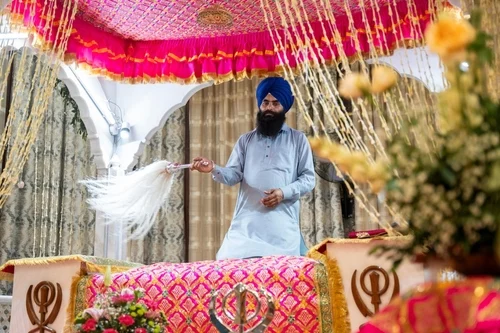
The gurdwara — the Sikh place of worship — is the spiritual centre of the Gurpurab celebrations. In the lead-up to the day, many gurdwaras in New Zealand hold an Akhand Path, a continuous 48-hour reading of the entire Guru Granth Sahib, completed in relay by groups of readers.
On the day itself, the gurdwara hosts:
- Asa di Var, early morning devotional hymns.
- Katha, discourses explaining Guru Nanak’s teachings and life story.
- Kirtan, musical renditions of hymns from the Guru Granth Sahib.
- Ardas, a formal community prayer marking the close of the main ceremony.
Gurdwaras such as the Supreme Sikh Society in Auckland and the Sikh Society of Hamilton play a central role in organising these events, drawing worshippers from across their regions.
Why Is Langar Such an Important Part of the Celebration?
Langar is the free community kitchen found at every gurdwara, and it takes on special significance during Guru Nanak Gurpurab. Guru Nanak himself established the tradition of langar to demonstrate that all people — regardless of caste, religion, gender, or economic status — are equal and deserve to sit and eat together.
On Gurpurab, volunteers prepare and serve vegetarian meals to thousands of people throughout the day. In New Zealand, this often means:
- Sikh families and volunteers cooking in shifts for hours, sometimes overnight.
- Meals served to anyone who attends, including non-Sikh visitors, with no expectation of payment or donation.
- A strong emphasis on seva, or selfless service, with volunteering seen as a spiritual act rather than a chore.
Choose to visit a gurdwara during Guru Nanak Gurpurab if you want to experience langar firsthand — it’s one of the most welcoming traditions you’ll find, and visitors are never turned away.

How Has the Sikh Community in New Zealand Grown?
New Zealand’s Sikh population has expanded considerably over recent decades, with significant communities established in Auckland, Hamilton, Wellington, and parts of the Waikato region. Many Sikh families have strong ties to Punjab, India, and continue to maintain close connections with relatives back home while building new lives in New Zealand.
This growth has meant larger, more elaborate Gurpurab celebrations each year, with increased participation from local councils and wider community groups who join the festivities or offer support with event logistics such as road closures for nagar kirtan processions.
Marking Guru Nanak Gurpurab With Respect and Curiosity
Guru Nanak Gurpurab is a celebration rooted in devotion, equality, and generosity — values that resonate well beyond the Sikh community itself. Whether you’re watching a nagar kirtan pass through your neighbourhood, visiting a gurdwara for the first time, or simply learning about the occasion, there’s something meaningful in witnessing a tradition built so firmly on service to others.
For those in New Zealand wanting to take part, local gurdwaras welcome visitors throughout the Gurpurab period. Checking in with your nearest Sikh Society or gurdwara ahead of time is a respectful way to find out when processions and langar will take place in your area.
Frequently Asked Questions About Guru Nanak Gurpurab
When is Guru Nanak Gurpurab celebrated?
Guru Nanak Gurpurab falls on the full moon day of the Katak month in the Nanakshahi calendar, which usually occurs in November. The exact date shifts slightly each year.
Can non-Sikhs attend Guru Nanak Gurpurab events in New Zealand?
Yes. Nagar kirtan processions take place in public streets and are open to everyone to watch or join. Gurdwaras also welcome visitors of all backgrounds, particularly to experience the langar meal.
What should I wear or do if I visit a gurdwara during Gurpurab?
Visitors should cover their heads (scarves are often provided at the entrance), remove their shoes before entering the prayer hall, and dress modestly. Sitting on the floor during prayers and the communal meal is customary.
What is langar and is it really free?
Langar is a community meal served at gurdwaras, and yes, it’s completely free. Guru Nanak established this tradition to promote equality, and no payment or donation is ever expected from those who eat.
Is Guru Nanak Gurpurab a public holiday in New Zealand?
No, Guru Nanak Gurpurab isn’t an official public holiday in New Zealand. Celebrations are organised by local Sikh communities and gurdwaras, often on weekends closest to the actual date to allow for wider participation.