Key Highlights
-
In Poland, the main meal of the day usually happens later than in Canada. People often have their biggest meal when it is late in the day.
-
Most people in Poland eat ‘obiad’, the main meal of the day, between 3:00 and 4:00 PM during weekdays.
-
At breakfast, people keep it light. Supper is often simple and might just be sandwiches.
-
Home cooking is an important part of Polish food life. Many families get together and have their main meal at home.
-
‘Obiad’ is important in Polish culture. It has two courses quite often, so it’s not like a fast Canadian lunch.
-
Some well-known Polish foods, like pierogi, are often on the table. But each day people eat different things, like grains and potatoes, not just these special foods.
Introduction
If you are a Canadian and want to go to Poland, you may look forward to the food. To enjoy polish meals, it is good to know when and how people in Poland eat. The right times for meals in Poland may not be what you expect. This simple guide shows you what people in Poland do at each meal. You will see what the first and last meal of the day are like in polish life. It can help you eat with more comfort, know your way around, and have a real taste of Poland.
Understanding Polish Daily Meal Schedule
The Polish daily meal routine is not the same as what you find in Canada. People in Poland start their day early and eat their main meal of the day late. On weekdays, most Poles go to work by 7 or 8 in the morning and finish by 3 or 4 in the afternoon.
This plan for work has a big impact on the time people eat. The main meal of the day is enjoyed after they get back home from work. Saturdays are different. The morning is for cleaning and after that, Poles relax. Sundays are about slow, family meals. There is also the “second breakfast.” This is just a snack that people eat in the middle of the morning. The times for each meal are not like what you see in Canadian days. Let’s take a better look at how these meal times compare and how people eat on weekdays and weekends in Poland.
Typical meal times for breakfast, lunch, and dinner
In Poland, meal timing is influenced by a workday that typically runs from 8 a.m. to 4 p.m. Breakfast is eaten early, before heading to work. The most significant meal, however, isn’t lunch at noon but a late-afternoon meal called ‘obiad’. This is the main meal of the day and is a hearty, often two-course affair enjoyed at home.
Dinner, or ‘kolacja’, is a much lighter meal eaten in the evening. This structure means the largest meal is consumed in the mid-afternoon, which is a key difference for many visitors. Here’s a general guide to when you can expect Poles to eat their main meals.
|
Meal |
Typical Time (Weekdays) |
Typical Time (Sundays) |
|---|---|---|
|
Breakfast (Śniadanie) |
6:00 AM – 8:00 AM |
Later, more relaxed |
|
Lunch/Obiad |
3:00 PM – 5:00 PM |
1:00 PM – 2:00 PM |
|
Dinner (Kolacja) |
7:00 PM – 8:00 PM |
Lighter, often leftovers |
Differences in meal timing compared to Canada
For a Canadian in Poland, meal times can seem a bit different. In Canada, we have a fast breakfast, a sandwich for lunch at noon, and then our biggest meal in the evening. In Poland, things shift when it comes to food times. Breakfast is quick, just like it is in Canada, before the day starts.
The real change comes at lunch and dinner. Where in Canada we have lunch, in Poland, you often just get a small snack, as there isn’t really a set lunch break. The main meal is called ‘obiad’ and it happens late in the afternoon. That’s when Canadians would usually have dinner.
Because of this, the polish evening meal is much lighter than what you might expect in Canada, and it happens earlier in the day. Putting the main meal in the afternoon with a lighter supper later on is the biggest thing that stands out when you look at how people eat in Poland compared to Canada.
Breakfast in Poland (Śniadanie)
Breakfast in Poland, called ‘śniadanie’, is a simple and tasty meal. People have this meal at home. It’s usually in the early part of the day before going to work or school, especially on weekdays. The food is not sweet. Most people in Poland do not have pastries or sweet food for breakfast. They eat those at other times.
There is also something called ‘drugie śniadanie,’ which means second breakfast. This is a small snack, like a sandwich or some yogurt. People take this to their work or school. This snack helps them wait for the main meal later in the day. When you know what people in Poland eat for breakfast and as a snack, you get a better idea of polish food and how people live in places like Krakow or in a small town.
Common foods and routines
The usual Polish breakfast is simple and easy. This meal is not like the first course of a main meal you may know. Here, breakfast is plain and all about giving people energy to start the day. The main part of the meal is good bread, which is a big thing in Polish food.
At breakfast, you will see a lot of savoury foods. Open-faced sandwiches, known as ‘kanapki’, show up a lot at tables. These are not just simple sandwiches. They are made in a neat way with fresh foods. You may hear about famous food in Krakow like pierogi, but those are not for breakfast.
Here are some foods you will find at a Polish breakfast:
-
Bread rolls or slices of bread with butter.
-
Cold cuts, cheese, and sliced tomatoes or cucumbers.
-
Scrambled or boiled eggs.
-
Yogurt or cottage cheese.
How early do Polish people eat their first meal?
Polish people usually get up early, especially on weekdays. They like to start their first meal, breakfast, very early in the day. Most folks begin work about 8 a.m., and with travel time, they might get up at 6 a.m. Breakfast happens soon after getting up.
This early routine is part of the Polish way of wanting to get work done fast. The aim is to finish the day early and be home by late afternoon. That’s when they eat their biggest meal with family. So, breakfast is made at home and is quick to help everyone start their day.
Not many people in Poland go to cafés for breakfast before work. The usual thing is to eat at home and then go straight to work. This has an effect on how people in Poland plan their eating on weekdays, with meals fitting into the 8 to 4 workday.
Lunch or Obiad? Clarifying the Terms
When you get to know Polish food, you’ll hear the word ‘obiad’ really often. Many people call it ‘lunch’ or ‘dinner’, but that’s not quite right. ‘Obiad’ is the main meal of the day in Poland. It has its own time and style. It’s not just a quick meal in the middle of the day. It’s a big, warm meal that most have in the late afternoon.
To see the difference between a Canadian lunch and a Polish ‘obiad’, you need to look at how people in Poland eat. This will help you understand their way of eating. Now, let’s take a look at what ‘obiad’ means in Polish culture, and the polish food you will get during this main meal of the day.
What is ‘obiad’ in Polish culture?
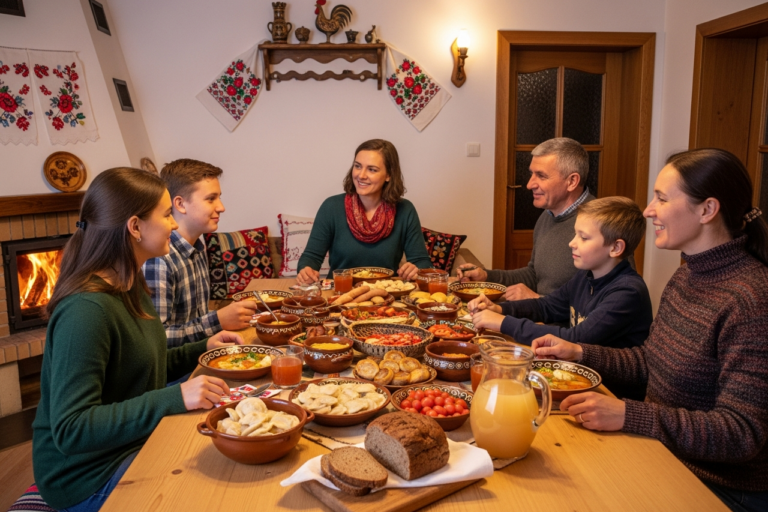
In Polish life, ‘obiad’ is not just food; it is the main meal of the day. This is when the family comes together after work and school, usually from 3 p.m. to 5 p.m. People share a warm, home-cooked meal and talk about their day. This time helps everyone reconnect.
A Polish ‘obiad’ often has two parts. First, you have soup, called ‘zupa.’ It can be clear broth or thick tomato soup. After soup, there is a big second course. Most eat at home, and not wanting a home-cooked ‘obiad’ can upset the host.
On Sunday, the main meal of the day is even more important. People eat around 1 p.m., after going to church. Cooking can take many hours. The Sunday ‘obiad’ starts with chicken broth and noodles, known as ‘rosół.’ This meal is a special tradition that many Polish families hold dear.
Foods served during obiad versus Canadian lunch
The food you get at a Polish ‘obiad’ is not like what you find at a typical Canadian lunch. In Canada, people might have a sandwich, some salad, or a bowl of soup. But the Polish ‘obiad’ is a hot meal, and it is the main meal of the day. People want energy after working hard all morning, so this meal is bigger.
A Polish ‘obiad’ almost always has both a first course and a main dish. People start with soup most of the time. After soup, you get the main dish. The main course usually has meat, potatoes, and a small salad. This can be very different from eating something quick at your work desk.
Here is what you get for a usual ‘obiad,’ and how it is different from a Canadian lunch:
-
First Course: There is almost always soup, like tomato soup or żurek. You do not see soup all the time with a Canadian lunch.
-
Main Dish: There is often a breaded cutlet, some kind of fish, or other meat, and this comes with potatoes and a salad on the side, called ‘surówka’.
-
One-Dish Meals: Sometimes, the main course is just one strong meal like pierogi, gołąbki (stuffed cabbage rolls), or bigos (hunter’s stew).
Conclusion
To sum up, learning about meal times in Poland helps you see the rich food culture of the country. In Poland, things like a filling breakfast and the way people value ‘obiad’ show a lot about their lives and old traditions. These mealtimes are not always the same as what you see in Canada. When you look into these different ways to eat, you can learn more about Polish culture and even get some new thoughts for your own family meals. When we accept and talk about these differences, we get more out of life and connect better with others. If you want to know more about polish food in poland or have something you want to ask, feel free to talk with us!
Frequently Asked Questions
Are snacks common between main meals in Poland?
Yes, snacks are common in Poland, mainly on weekdays. People there really like a “second breakfast,” or drugie śniadanie. This is a mid-morning snack. They usually have a sandwich or yogurt. It helps them keep going between an early breakfast and the late meal in the afternoon. But, snacking in Poland is not as often as in North America.
Keywords: second breakfast, Poland, snack, weekdays
What are the Polish words for the main meals of the day?
The main meals in Polish are called ‘śniadanie’ for breakfast, ‘obiad’ for the main meal of the day—which people eat in the late afternoon—and ‘kolacja’ for the lighter evening meal. ‘Kolacja’ can mean supper or dinner. It is good to know these names because they help you when looking at menus or talking about food.
Are there family traditions around dinner time in Poland?
The main family tradition is the ‘obiad’ and not the evening meal. The Sunday ‘obiad’ is the big one and it is a highlight for the family. It is a big meal with many courses and made with a lot of care. Families get together and spend a lot of time at the table. The evening meal, known as ‘kolacja’, is usually much more easy and informal.