Key Highlights
-
A khmer wedding brings together family members, special gifts, blessings, and acts with meaning in one rich wedding ceremony.
-
Many wedding customs in Cambodia start at the bride’s home and include both families right from the start.
-
The wedding celebration may have proposal talks, steps for the engagement, monks giving blessings, and knot tying to join the couple.
-
Family members are very important. They help plan, agree on, and give their blessing to the couple.
-
A khmer wedding now will often be a day and a half, but old wedding customs could last even longer.
-
The clothing, holy water, and red strings all mean something special for the wedding ceremony.
Introduction
If you are going to a wedding in Cambodia or joining one from Australia, it helps to know what you are about to see. Cambodian culture sees marriage as a family event with much respect and history. Wedding traditions in the country still follow old khmer wedding ways, even now when modern life has made the plans shorter. The main wedding traditions today have the family leading the proposal, there will be offerings, and blessings given by the elders and monks. There is also symbolic cleansing and knot tying. These things bring luck and strength, and they help two people have a good future together.
These khmer wedding customs and wedding traditions show how people come together for big moments in life and how much is shared in the family and the culture.
Overview of Cambodian Wedding Traditions
A traditional khmer wedding is much more than a short exchange of vows. The wedding brings many rituals together. These show respect for parents, ancestors, the couple’s new link, and the role of religion. That is the reason why khmer wedding traditions can feel deep and full of meaning.
The main steps in a khmer wedding ceremony are simple. First comes the proposal, then engagement customs, and then there are offerings and dowry gifts. You will get blessings from monks. After this, there is a special hair-cutting part and a knot tying ceremony. These days, most khmer wedding ceremonies last one and a half days instead of three. But the big ideas are still there. The next sections talk about where these wedding traditions started.
Historical and Cultural Roots of Khmer Weddings
For the khmer people, marriage is linked to their cultural heritage in a deep way. A khmer wedding ceremony shows the importance of family and respect for elders. Buddhist ideas are part of the event, too. The style of a traditional wedding may change between the city and the countryside. Even with these differences, a traditional wedding still means a lot.
One big story from these marriage customs is about Preah Thong and Neang Neak. In this story, Preah Thong is a prince from far away who marries Neang Neak, the daughter of the Naga King. People say that many khmer wedding customs come from this legend, and the wedding ceremony still honours those roots.
Because of the legend, some parts of a khmer wedding have special meaning. The groom, by holding the bride’s scarf, shows that he is joining her family. This part is different from some other Asian wedding traditions. For Australians, it helps to show how a khmer wedding is about more than the event. It is about identity, history, and belonging.
The Meaning Behind Cambodian Marriage Customs
Cambodian weddings are full of wedding customs that hold much more meaning than just looking nice. Each part stands for hopes and good wishes for the couple’s new life. These may be for family to get along, for good health, for safety, or for wealth. These special acts help make the ceremony both moving and set out in a clear order.
Some wedding customs show respect to those in the family who have passed away. Others are about saying thank you to parents. When the monks give their blessing, they ask for peace and spiritual protection. The symbolic haircut means the couple is ready for a fresh start. When people tie knots for the pair, they join the couple in front of close friends and family. This knot-tying is seen as a sign of everlasting love.
There are some usual ways guests wish the couple good luck during Cambodian weddings. Guests and family might tie red strings around the couple’s wrists. They will offer blessings and pour flowered water as part of the ceremony. These moments in the wedding invite everyone to share in wishing happiness, health, and a good future for the couple.
The Marriage Proposal Process in Cambodia
In Cambodian culture, marriage proposals are usually handled by the family and are not private surprises. When a possible match is okay, a go-between will talk with the parents about the couple getting together. It is not just about the two people; the families also want to see if they are a good match.
The groom’s parents are active from the start. Both families will get to know each other first before they decide what to do next, and they give each other gifts when they agree. After there is agreement, an achar can help pick out the wedding date. These steps lead up to the formal proposal.
Steps to Proposing in Cambodian Tradition
A traditional proposal is done in a respectful and formal way. The family leads this process. When the families find a possible match, a go-between talks to the bride’s family to bring up marriage. If both sides are happy with that, they swap gifts. After that, it all starts to move towards the wedding.
At the start of the ceremony, the groom’s side makes their way to the bride’s home. They bring offerings with them. In some places, people in the group hold gold trays of fruits and other nice gifts while they walk in. This part is meant to show how the groom will be joining the bride’s family.
-
The groom offer tea or gives respect in a formal way. He does this with family rituals that honour the elders and those who’ve gone before.
-
The bride’s family gets gifts as well. These gifts might have fruits, pastries, drinks, meats, and other dowry items.
-
During the ceremony, wedding rings get exchanged to show that the couple, and also their families, are now together.
Role of Families in Arranging the Wedding
Family members play a key role at every part of Cambodian weddings. They often help find and choose a partner, agree to the match, swap gifts, and arrange the big day. Many times, the wedding starts at the bride’s home, so her family’s part is clear from the very beginning.
Parents in Cambodian weddings do more than just put on the event. They look into the other family, talk over what is needed, and later give their blessings. The groom’s elders also join in, mainly when gifts are given out and family respect is shown in front of all the guests.
As the ceremony goes on, certain family members join in for special acts. The family matriarch often gets the first go during the hair-cutting part. After that, close family and friends join in with their good wishes and blessings. So, family members at Cambodian weddings are not just invited. They help plan, take part in, and keep the tradition strong.
Pre-Wedding Rituals and Ceremonies
Before the main ceremony gets started, there are a few pre-wedding rituals. These traditions help the couple and their families get ready for marriage. They are not just parties or big get-togethers. The customs are a way to connect the wedding to family roots, to show respect, and to include everyone. These things are at the heart of Cambodian wedding customs.
One of the most well-known early traditions is sien doan taa. People often call this a tea ceremony. It’s all about honouring ancestors. There are other customs as well, like giving gifts and having formal family meetings. To understand what happens before the wedding, it’s good to look at each of these steps one at a time.
Engagement Party (Sien Doan Taa)
Sien doan taa is called a tea ceremony by some people, but it is really more like an engagement party with special meaning. In this part of the wedding, the couple honours the spirits of those in their family who have died. They also remember loved ones who are no longer here. It is a quiet and thoughtful part of getting married, but it means a lot to everyone.
The sien doan taa isn’t just for the couple who will be married. This event puts the new marriage into the bigger family story. That is why sien doan taa is so important in Khmer life and culture. It lets family spirits join in and sets a respectful mood for the day.
There are wedding stories and old tales in Khmer history, and they sometimes talk about the full moon night. This comes up mostly in the story of Preah Thong and Neang Neak. The famous full moon night comes from the legend and does not need to happen in modern life. But this part of the wedding does keep that feeling of family history, memory, and respect. Dowry gifts and offerings also help to show what an important day this is.
Hair-Cutting Ceremony (Gaat Sah) and Its Significance
Gaat sah is an old and well-known tradition in Cambodian weddings. In the past, the groom’s hair was cut for real. These days, it’s a symbolic haircut. This means the couple is being cleaned of the past and are ready for a fresh start in married life.
That’s the main reason why this ritual is so important. It shows the couple are moving out of their old lives and into a future together as a new couple. Most times, a respected elder such as the family matriarch leads the ceremony. After that, other loved ones join in to take part.
When each person joins the gaat sah, they bring good wishes for happiness, peace, and good health for the new couple. So, if you want to know what the hair-cutting ceremony means in a Cambodian wedding, the answer is clear. Gaat sah is about cleaning, starting over, and being ready for the couple’s new life together.
Main Events of a Cambodian Wedding Ceremony
The main steps in a Cambodian wedding ceremony bring together religion, the family’s blessing, and the act of joining two people. In a traditional Cambodian wedding ceremony, these often include monk prayers, special cleansing steps, tying thread, and some other things that mean the families want the couple to have a good marriage.
A Khmer wedding ceremony can seem like a lot at first, but each key part of the wedding ceremony is easy to follow after you know what they mean. Buddhist monks may give the couple a blessing with prayers and holy water, and then the family will lead the next few steps. Two important parts of the ceremony are when the monks bless the couple and when the families do the knot-tying. These are explained below.
Monk Blessing and Religious Rituals
A religious blessing is a big part of many Cambodian weddings. In these weddings, Buddhist monks give a short talk, say prayers, and bless the couple. The couple sits quietly. They bow their heads and press their hands together in prayer. This gives the whole wedding a serious and respectful feel.
These acts are seen as a way to ask for spiritual protection and peace for the married life ahead. Families want the couple to begin this new life with help not only from family but also with a religious blessing. This is why the presence of monks is still important, even when Cambodian weddings are shorter than before.
Holy water or flowered water is often used for good luck. During the blessing, the monks may sprinkle this water on the couple. So, if you wonder whether Cambodian weddings have good luck rituals, the answer is yes. The blessing from Buddhist monks is one of the most common ways to wish the couple health, harmony, and protection.
Knot-Tying Ceremony (Sompeas Ptem) and Symbolic Acts
Sompeas Ptem is the knot tying ceremony. It stands out as one of the most memorable parts of the wedding. In it, the couple sit close with their hands on a pillow, and a gold sword is placed between their joined hands. This is a key part of this special moment.
Next, family and friends tie red strings around both the bride and groom’s wrists. They do this while giving blessings. The red strings show two people coming together. People see this act as connecting deeply with good health, happiness, prosperity, and everlasting love. Many guests feel it is the heart of the day.
-
Knot tying brings the couple together in front of all. It also shows the start of marriage.
-
Red strings stand for blessing, protection, and hoping for lasting unity.
-
This ceremony gives a space for the couple’s gratitude, as loved ones take part in sharing blessings and support.
Traditional Clothing and Wedding Attire
Traditional Cambodian wedding attire is the first thing people see when they go to a wedding. The bride and groom often put on formal silk clothes with jewellery. They might change their outfits many times during the day, as this goes with the different parts of the ceremony.
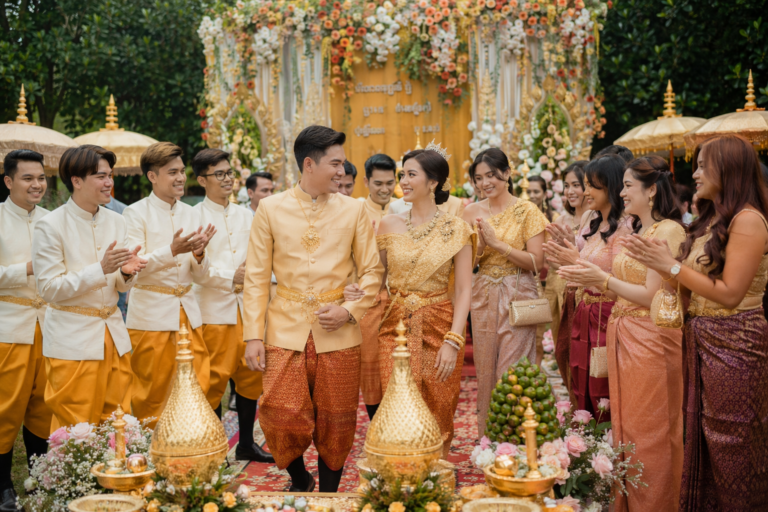
At many weddings, the couple’s costumes match in colour and look. The gold silk outfit is very well known, and most of the bridal group will wear the same shades. The clothes are not only for show. The outfits also show care and respect for parents and in-laws. The next parts tell how this works for both the couple and the guests.
Cambodian Bride and Groom Outfits
Cambodian bride and groom outfits are rich in colour, silk, and jewellery. The bride may wear a tube skirt with a front fold and a fitted top, while the groom wears trousers styled with sampot-inspired draping. Because there are several rituals, the pair often change clothing many times.
A gold silk outfit is especially common in formal ceremonies. Matching colours help present the couple as one unit, and the clothing is also a sign of respect to parents, including the bride’s family. Even in contemporary wedding ceremonies, many couples keep these visual traditions.
The legend of Preah Thong and Neang Neak also shapes wedding symbolism, especially the idea of the groom joining the bride’s side.
|
Outfit Element |
Details |
|---|---|
|
Bride’s attire |
Silk garments, jewellery, and styled hair that may change with each ritual |
|
Groom’s attire |
Formal trousers with traditional styling, often coordinated with the bride |
|
Shared look |
Matching colours, rich fabrics, and a gold silk outfit for key moments |
|
Cultural meaning |
Respect for parents, family honour, and links to Preah Thong and Neang Neak |
Family and Guest Attire Traditions
Family members and people in the wedding party often wear colours that match the couple. Groomsmen and bridesmaids can wear clothes that go with the style of the event. This helps make the day look organised, especially if there are a lot of relatives and friends.
At Cambodian weddings, guests are expected to wear formal clothes and show respect. This is because family honour and tradition are very important to the couple and their families. What people wear plays a big part in making the wedding look special and well-planned.
There may be some differences in how people dress between rural communities and urban areas. Weddings in the city can have more Western touches, but they still keep strong Khmer traditions. You will still see different outfits for different parts of the ceremony. For Australians going to a wedding, one thing matters: you should be neat, respect the style of the event, and look for family groups wearing matching colours and plenty of jewellery.
Conclusion
To sum up, knowing about Cambodian wedding traditions helps Australians see the rich cultural heritage of this Southeast Asian country. The history behind these wedding customs, the steps before the big day, and the bright clothes each have a key part in showing love and coming together. These traditions are not just about the couple. They show how much family means, and the strong respect for culture and beliefs. Learning about these practices can help Australians feel closer to their Cambodian friends and loved ones. If you want to plan a wedding that honors these traditions or want to know more, feel free to ask for help!
Frequently Asked Questions
What foods are typically served at Cambodian weddings?
At a traditional wedding, the food you get at Cambodian weddings can be fish, meat, fruit, veggies, and sweets. Most of these dishes are served after the main wedding ceremony, during the later wedding celebration. Good food helps show hospitality, and it is still one of the most well-known parts of traditional Cambodian wedding customs.
How long does a Cambodian wedding usually last?
A cambodian wedding ceremony used to last three days and three nights. Now, they are often about a day and a half long. In urban areas, this shorter wedding celebration is common. Still, khmer wedding customs are kept. The group of people takes part in all the main rituals.
How do traditional and modern Cambodian weddings compare?
A traditional khmer wedding would go on for a longer time and have more parts. It would often last a few days, and in that time, be quite full of detail. A modern cambodian wedding ceremony is not as long now, but some of the older wedding customs still remain. Family members are a big part of the khmer wedding. Blessings happen, and there are symbolic rituals, too. Even now, a khmer wedding ceremony shows respect for tradition. These things help shape what a contemporary wedding ceremony in Cambodia looks like.