
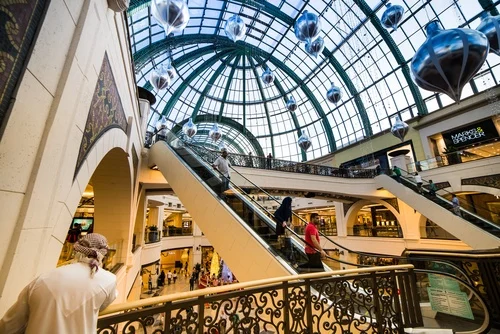
Architecture in Dubai is a combination of Emirati and Islamic design cues that includes courtyards, shading screens, and wind towers, with supertall engineering and ambitious urban planning. The city’s architecture responds to desert climate, regional culture, international design, and a long-term programme of city-making that continues to reshape districts across Dubai.
If you’ve recently arrived in the UAE, getting to know Dubai’s buildings is a useful way to understand the city around you. At Remitly, we’re glad to help with the practical side of settling in, like sending money home, while you explore a city that treats architecture as part of everyday life.
In this guide:
- The five design ideas that shape most buildings in Dubai
- A quick-reference table of the city’s main architectural styles
- What to notice at five landmark buildings, and where to view each one
- Six areas to see it all in person, plus a metro-friendly route
TL,DR:
- Dubai’s architecture combines Emirati and Islamic design cues with supertall engineering, climate-responsive features, and master-planned districts.
- Five recurring ideas help explain the city, climate design, geometric pattern work, supertall structures, master planning, and more sustainable building practice.
- Five useful landmark case studies are Burj Khalifa, Burj Al Arab, the Museum of the Future, Dubai Frame, and Palm Jumeirah.
- Al Fahidi, Downtown Dubai, DIFC, Dubai Marina and JBR, Sheikh Zayed Road, and Expo City each reveal different architectural approaches.
- Dubai 2040, led by Dubai Municipality, aims to improve green and open space, accessibility, environmental resilience, and protection of heritage areas. See the Dubai 2040 Urban Master Plan

What makes architecture in Dubai unique?
Five ideas keep recurring across Dubai, and they connect the city’s local building traditions with its modern skyline. For wider context on how architecture developed across the country, see our architecture of the Emirates guide.
- Desert climate design. Deep overhangs, shaded walkways, courtyards, and controlled openings are practical responses to heat and sun. Modern projects continue that approach through shading systems, efficient glazing, and district planning that prioritises greener and more accessible public spaces. Dubai Municipality’s Dubai 2040 Urban Master Plan sets goals around parks, open space, accessibility, environmental resilience, and heritage protection.
- Islamic and regional geometry. Arches, domes, tessellation, calligraphy, and screened openings remain visible across Dubai, sometimes interpreted through contemporary materials and construction. Mashrabiya-inspired screens can combine shade, privacy, and patterned facades, rather than being purely decorative. If you want some cultural context, check out Remitly’s Dubai culture guide.
- Supertall engineering. Dubai is home to Burj Khalifa, the world’s tallest building at 828 metres. Its Y-shaped plan and setbacks respond directly to structural and wind loads, while official project material records more than 40 wind-tunnel tests during design and construction.
- Master-planned districts. Downtown Dubai, Dubai Marina, DIFC, and newer mixed-use districts show how whole areas can be planned around transport, public space, land use, and major destinations. Dubai 2040 provides a long-term spatial framework, while more recent municipality projects continue to apply that planning approach across the emirate.
- Sustainability and efficient buildings. Dubai’s current sustainability story is less about one universal building style and more about programmes, technologies, and retrofit work. The UAE’s Net Zero by 2050 strategy includes buildings as a priority sector, while Etihad ESCO works on existing buildings to improve performance and reduce energy and water use.

Key styles and influences you’ll see in Dubai
Once you know the visual cues, Dubai’s buildings are easier to read. Use the table as a spotter’s guide, then look for how each idea changes with the neighbourhood around it.
| Style/influence | Recognisable cues | Where to see it | Why it matters |
| Emirati heritage | Wind towers (barjeel), coral-stone walls, shaded courtyards | Al Fahidi Historical Neighbourhood, Al Shindagha | Shows how local buildings responded to heat, privacy, and airflow before mechanical cooling |
| Islamic and regional design language | Arches, domes, geometric tessellation, calligraphy, screened openings | Jumeirah Mosque, older souks, contemporary facades | Connects current architecture with a wider regional visual language |
| International modernism | Glass curtain walls, rectilinear towers, large floorplates | Sheikh Zayed Road, DIFC | Shows the shift towards high-rise commercial and mixed-use development |
| Supertall and starchitect buildings | Record-breaking height, sculptural silhouettes, engineered structural systems | Burj Khalifa, Burj Al Arab | Shows how engineering and distinctive form became part of Dubai’s global identity |
| Parametric and computational design | Fluid curves, complex surfaces, non-rectilinear geometry, digitally driven forms | The Opus by Zaha Hadid, ME Dubai | Shows how digital modelling can turn complex geometry into buildable architecture |
| Sustainable, passive desert design | Solar shading, efficient glazing, shaded public space, energy and water efficiency measures | Sustainable City, Expo City Dubai, selected newer developments | Shows how climate and resource efficiency are increasingly considered in design and district planning |
| Master-planned districts | Coordinated towers, public spaces, transport links, mixed uses, planned streetscapes | Downtown Dubai, Dubai Marina, DIFC | Shows the scale at which Dubai plans neighbourhoods, not just individual buildings |
Spotter’s checklist, mashrabiya vs. a decorative pattern:
- Mashrabiya: a repeating, perforated screen that allows filtered light and airflow, often positioned over a window, balcony, or facade.
- Decorative pattern: a solid geometric motif cut, printed, or moulded into a surface, with no deliberate opening for airflow.
Dubai’s iconic architectural landmarks
Burj Khalifa

At 828 metres, Burj Khalifa is still the world’s tallest building. Its triple-lobed footprint and Y-shaped plan were inspired by the desert flower Hymenocallis, while the tower’s setbacks and structural system help manage wind forces. Its cladding also uses energy-saving silver coating to limit solar heat gain.
- Architectural highlights, triple-lobed base, Y-shaped floor plan, 40-plus wind-tunnel tests, solar-heat-conscious cladding
- Best viewpoint, At the Top observation decks, or Burj Park at ground level
Burj Al Arab

Built on a man-made island about 280 metres from the coastline, Jumeirah Burj Al Arab takes its sail-like form from Dubai’s maritime setting. Architect Tom Wright drew on the shape of an Arabian dhow sail, giving the building a recognisable silhouette linked to the Gulf.
- Architectural highlights, sail-like facade, double-skin membrane, man-made island setting
- Best viewpoint, Jumeirah Beach, looking towards the island
Museum of the Future

Opened in 2022, the Museum of the Future is a torus-shaped building clad in stainless steel and wrapped in Arabic calligraphy. The quotations on its facade form part of the architecture rather than being added as a separate decorative layer, creating a strong contrast with the surrounding glass towers.
- Architectural highlights, torus form, Arabic calligraphy facade, column-free interior areas
- Best viewpoint, the pedestrian bridge and roadside approaches along Sheikh Zayed Road
Dubai Frame

Dubai Frame is a 150-metre-high structure in Zabeel Park that creates a visual link between older and newer parts of the city. Its rectangular form was inspired by the golden ratio, while the exterior uses gold-coloured stainless steel and incorporates a pattern linked to the Expo 2020 Dubai logo.
- Architectural highlights, large-scale rectangular frame, panoramic bridge, gold-coloured stainless-steel exterior
- Best viewpoint, Zabeel Park, where the Frame stands
Palm Jumeirah

Palm Jumeirah is a man-made island planned in the shape of a palm tree, combining large-scale coastal engineering with residential and hospitality development. The architectural point is the contrast between the engineered island form and the varied buildings placed along its fronds, crescent, and trunk.
- Architectural highlights, palm-shaped master planning, coastal engineering, villas and high-rise hospitality buildings
- Best viewpoint, Palm Jumeirah Boardwalk, or The View at The Palm for an elevated overview
Where to see the best architecture in Dubai: 6 areas to explore
Al Fahidi and Dubai Creek

- Wander Al Fahidi Historical Neighbourhood‘s wind-tower lanes and courtyard houses, then compare the proportions of shaded passages and enclosed spaces. Dubai Culture’s heritage programme also provides context for Al Shindagha and the city’s older built environment.
- Cross Dubai Creek on an abra for a ground-level view of older Deira shopfronts, where the scale is very different from Downtown’s towers.
- Look for barjeel towers, shaded courtyards, coral-stone walls, and narrow lanes that reduce direct sun exposure.
Downtown Dubai

If you want stop-by-stop tips beyond the architecture itself, our Downtown Dubai travel guide covers the wider neighbourhood.
- Stand in Burj Park to understand Burj Khalifa’s scale from ground level and compare the tower with the surrounding low-rise public realm.
- Walk around Dubai Fountain to see how the tower’s tapering profile changes as you move around the water.
- Use Dubai Mall and the surrounding pedestrian routes to compare contemporary retail architecture with the more monumental tower forms nearby.
DIFC

- Compare the glass-and-steel towers along the district edge with lower and more set-back buildings within DIFC.
- Look for public art, landscaped spaces, and the relationship between tower entrances, plazas, and pedestrian routes.
- Notice where cafes, covered walkways, and ground-floor activity meet the larger tower blocks, especially around Gate Avenue and the central district streets.
Dubai Marina and JBR

- See how Cayan Tower’s twisting form changes the rhythm of the Marina skyline.
- Walk The Walk at JBR to compare beachfront low-rise buildings with the dense cluster of towers around the Marina.
- Look across the water for the relationship between towers, promenades, marinas, and the coastline, rather than focusing on one building at a time.
Sheikh Zayed Road

- Ride the Dubai Metro’s Red Line for an elevated view of the Sheikh Zayed Road corridor. The current RTA station map confirms Financial Centre and Burj Khalifa/Dubai Mall on the Red Line.
- Spot the Museum of the Future’s torus shape against the surrounding towers as the train moves along the corridor.
- Compare the more rectilinear towers around the Trade Centre area with newer buildings that use more sculptural forms further south.
Expo City Dubai

- Visit Al Wasl Plaza’s large steel dome, a defining legacy feature of Expo 2020 and a year-round part of Expo City Dubai.
- Look for Expo City’s sustainability-led public realm, including shaded walkways, parks, and buildings carried forward or adapted from the Expo site. If you want the current district plan and year-round uses, have a look at Expo City Dubai and our UAE smart city initiatives guide.
- Notice the wide shaded walkways and the way the district links buildings, plazas, landscaping, and public movement.
Metro-friendly half-day itinerary:
- Start at Al Fahidi Historical Neighbourhood for heritage architecture, then cross Dubai Creek by abra.
- Take the Green Line from Al Fahidi to BurJuman, change to the Red Line, then travel to Burj Khalifa/Dubai Mall for Downtown Dubai.
- Continue by Red Line to Financial Centre for a quick look at DIFC and the high-rise corridor.
- Finish at Dubai Marina Mall or The Walk at JBR. Check the RTA timetable before travelling, especially on public holidays.
Weekend circuit for residents: add Sheikh Zayed Road as a separate metro-based trip, then give Expo City Dubai more time if you want to explore its pavilions, public spaces, and newer development areas.
FAQs about architecture in Dubai
What is the architecture in Dubai known for?
Dubai’s architecture is known for combining Islamic and Emirati design cues, such as arches, geometric patterns, and wind towers, with supertall skyscrapers and master-planned districts. The mix reflects both the city’s desert climate and its push to stand out on the global stage.
What makes Burj Khalifa architecturally significant?
Burj Khalifa is the world’s tallest building at 828 metres, with a tapering, Y-shaped design loosely based on a desert flower. Its reflective glass and steel cladding, along with wind-tunnel-tested engineering, help it withstand strong desert winds and heat.
What are wind towers, and are they still used in Dubai?
Wind towers, or barjeel, are tall, open-sided structures that pull air down into a building for natural cooling, common in Al Fahidi’s older houses. Modern buildings rarely rely on them alone, but many still borrow the same shading and airflow ideas.
Where can I see traditional Emirati architecture in Dubai?
Al Fahidi Historical Neighbourhood and Al Shindagha, both along Dubai Creek, have some of the city’s best-preserved coral-stone houses, courtyards, and wind towers. Both areas are walkable and sit close to abra crossing points.
Is Dubai’s architecture becoming more sustainable?
Yes. Newer buildings increasingly use solar panels, passive shading, and sensor-based cooling, supported by the UAE’s Net Zero by 2050 strategy. Programmes like Etihad ESCO’s retrofit work are also upgrading older towers rather than replacing them.
What’s the best way to see Dubai’s architecture without a car?
The Dubai Metro’s Red Line runs alongside Sheikh Zayed Road, giving an elevated view of the supertall corridor, and connects easily to Downtown Dubai and DIFC. Pair it with an abra ride across Dubai Creek for the older, low-rise side of the city.
Key takeaways
- Dubai’s architecture blends Emirati and Islamic design roots with modern engineering, climate response, and large-scale urban planning.
- Useful landmark case studies include Burj Khalifa, Burj Al Arab, the Museum of the Future, Dubai Frame, and Palm Jumeirah.
- Al Fahidi Historical Neighbourhood and Al Shindagha provide the clearest heritage examples, while Downtown Dubai, DIFC, Sheikh Zayed Road, Dubai Marina, and Expo City show different modern planning and design approaches.
- Dubai 2040, the UAE’s Net Zero 2050 strategy, and building retrofit programmes provide the policy context for greener, more resilient urban development.
How to appreciate Dubai’s architecture more deeply
Dubai’s buildings tell a story through four connected lenses, climate, culture, engineering, and planning. Early courtyard houses and wind towers show how architecture responded to heat and privacy, while later towers turned structural engineering into part of the city’s visual identity. Today, district-scale planning and sustainability programmes add another layer, linking individual buildings to broader urban goals.
If you only have time for two stops, pair one heritage area, like Al Fahidi, with one modern district, like Downtown Dubai or DIFC, to see how different architectural ideas sit within the same city. Slow down enough to notice the details, an arch, a shaded walkway, a repeated pattern, or a change in scale between street and skyline. Save this guide for your next weekend out, and use the route to explore more of the city by foot and metro.
Last reviewed: November 2026, against current information from Dubai Municipality, Dubai Culture, the UAE Government, Etihad ESCO, RTA, Visit Dubai, Expo City Dubai, and official landmark operators.