
TL;DR: Christmas traditions in the Philippines include star-shaped parol lanterns, caroling, gift exchanges, and the family feast known as Noche Buena. Many Catholics also observe Simbang Gabi, a series of nine Masses before Christmas. The festive atmosphere often begins in September, though customs vary between communities and families.
Streets lined with glowing star lanterns. Familiar carols drifting from open windows. Families gathering around a table loaded with favorite dishes. This is the scene that unfolds across the Philippines each holiday season, though no two households celebrate in quite the same way.
For Filipino Americans and anyone with ties to Filipino culture, understanding these traditions offers a window into values that run deeper than decorations: faith, community, and family connection. Some customs trace back to Spanish colonial influence, while others have grown and shifted with each new generation. Whether you grew up with these traditions or you’re learning about them for the first time, this guide walks through what makes Christmas in the Philippines distinct, from the earliest signs of the season to the family feasts that cap it off.
Why does the Christmas atmosphere begin in September?
Filipinos often refer to September, October, November, and December as the “ber months,” a nod to how each one ends in those three letters. Once September 1 arrives, shopping malls and supermarkets start playing Christmas carols over their sound systems, and seasonal decorations begin appearing on store shelves.
This early start is a cultural phenomenon, not a religious one. The liturgical Christmas season for Catholics doesn’t begin until Advent, which typically falls in late November or early December. The “ber months” tradition reflects a cultural anticipation that builds gradually rather than a continuous four-month celebration. Not every household starts decorating in September, and many families wait until closer to December to put up their own trees and lights. Learn more about the Philippines’ September Christmas preparations.
Important dates for Christmas in the Philippines
While customs vary by region and household, here’s a general calendar of key dates for the 2026 holiday season:
| Date or period | Tradition or occasion | What to expect |
| From September 2026 | “Ber months” festivities | Seasonal music and decorations appear gradually in stores and public spaces |
| December 16–24, 2026 | Traditional dawn Simbang Gabi Masses | A series of nine Masses held in preparation for Christmas |
| December 15–23, 2026 | Anticipated evening celebrations | Offered in some parishes as an alternative to dawn Masses; schedules vary |
| Night of December 24–25, 2026 | Noche Buena | The Christmas Eve family feast |
| December 25, 2026 | Christmas Day | Worship, family visits, meals, and gift-giving, depending on the household |
| Night of December 31, 2026–January 1, 2027 | Media Noche | A separate New Year’s Eve feast |
It’s worth noting that the final dawn Mass on December 24 is distinct from any Christmas Eve Mass held later that same day. Families also don’t share one single “end date” for their festivities. Some take down decorations right after New Year’s Day, while others leave them up through early January.
Parol lanterns: A recognizable symbol of Filipino Christmas

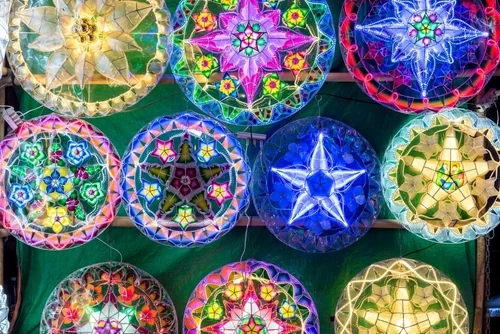
A parol is a Filipino Christmas lantern, most often shaped like a five-pointed star. The design represents the Star of Bethlehem, the star said to have guided the Three Kings to the birthplace of Jesus Christ.
Parols come in an impressive range of styles. Some are simple frames of bamboo wrapped in colored paper, while others use capiz shells or materials like plastic and metallic foil to create more elaborate designs. Many families make their own parols as a shared activity, while others buy ready-made versions from local vendors. You’ll see them displayed in homes, outside churches, and on public buildings throughout the season. Some displays also include a belen, a small Nativity scene that depicts the birth of Jesus. Discover the meaning of the Filipino parol and how its symbolism continues to inspire public art installations today.
Simbang Gabi: Nine Masses before Christmas
Simbang Gabi is a Filipino Catholic tradition made up of nine Masses held in the days leading up to Christmas. Traditionally, these Masses take place at dawn between December 16 and 24, though many parishes now also offer anticipated celebrations in the evening to accommodate different schedules. Some Filipinos aim to attend all nine Masses, while others attend when they can, treating the tradition as a flexible expression of faith rather than a strict requirement.
Simbang Gabi carries a spirit of community as much as devotion. Families and neighbors gather in the early morning hours, often followed by shared snacks outside the church. Schedules and customs can differ meaningfully between parishes, so it’s worth checking with your local church for specific Mass times. Find the dates and meaning of Simbang Gabi for additional context on how this tradition is observed.
How Filipino communities observe Simbang Gabi in the US
Filipino American communities across the United States keep this tradition alive through their local parishes. Many churches in cities with large Filipino populations organize their own Simbang Gabi series, often adapting Mass times to fit daily work and school schedules. If you’d like to participate, your best option is to reach out to a nearby Catholic parish and ask whether they hold Simbang Gabi services, since not every community follows the same calendar.
Noche Buena: Gathering around the Christmas table
Noche Buena refers to the family feast held on Christmas Eve, typically after any evening Mass or family gathering concludes. It’s considered one of the most meaningful family traditions of the Filipino Christmas season, bringing together parents, grandparents, cousins, and extended family around a shared table.
The scale of the meal varies widely. Some families prepare an elaborate spread, while others keep things simple with a few favorite dishes. There’s no requirement for an elaborate feast. What matters most is the time spent together. Explore Filipino Noche Buena traditions to see how one family describes the meaning behind this gathering.
Noche Buena versus Media Noche
These two feasts are easy to mix up, but they mark different occasions:
- Noche Buena is the Christmas Eve feast, celebrated on the night of December 24 into December 25.
- Media Noche is a separate feast held on New Year’s Eve, welcoming the new year with family and food.
While both center on shared meals, Media Noche belongs to New Year’s celebrations rather than the Christmas season itself.
What foods are associated with Christmas in the Philippines?

Rather than a single fixed menu, Filipino Christmas tables often feature a mix of the following dishes, with plenty of regional and family variation:
| Food | What it is |
| Bibingka | A rice cake made with rice flour and coconut cream, often associated with gatherings around Simbang Gabi |
| Puto bumbong | A purple rice delicacy traditionally steamed in bamboo tubes |
| Hamón | Holiday ham, often served at larger family gatherings |
| Queso de bola | A round cheese commonly presented in a red wax coating |
| Lechon | Roast pork served at some bigger celebrations |
| Pancit | Noodle dishes with many regional and household variations |

Bibingka and puto bumbong are frequently sold near churches and enjoyed as a snack after Simbang Gabi, while dishes like hamón, queso de bola, and lechon tend to appear at the main Noche Buena feast. Not every family serves all of these dishes, and none of them are exclusive to the Christmas season. Budget, region, and personal taste all shape what ends up on the table.
Caroling, gifts, and visits to relatives
Christmas caroling
Groups of carolers, often children, go from house to house in their neighborhoods singing Christmas songs, sometimes with homemade instruments. Many households offer a small amount of money or treats in appreciation, though this isn’t a strict obligation. It’s simply a friendly, long-standing way for communities to share in the holiday spirit.
Aguinaldo or pamasko
Aguinaldo, also called pamasko, refers to Christmas gifts, often in the form of cash, given to children by relatives and godparents. There’s no fixed or expected amount; the gesture matters more than the sum. Many children show respect by taking the hand of an elder and touching it to their forehead, a gesture known as “mano po,” before receiving their gift.
Monito Monita
Monito Monita is a Filipino gift exchange similar to Secret Santa. Participants are assigned a person to give a gift to, often within a set budget or theme, and gifts are typically revealed at a group gathering. Rules, timing, and budgets vary widely depending on the group, whether it’s a family, a classroom, or a workplace.
Keeping Filipino Christmas traditions alive in the US
Living far from the Philippines doesn’t mean giving up these traditions. Many Filipino American families find ways to adapt them to life abroad:
- Display or make your own parol as a family project.
- Cook a family recipe together, even over a video call with relatives overseas.
- Attend a local Simbang Gabi celebration if your parish offers one.
- Organize a Monito Monita gift exchange with friends or coworkers, using an agreed-upon budget.
- Share songs, foods, and family stories with younger generations to keep the traditions meaningful.
- Schedule a call with family back home around Noche Buena, keeping time zone differences in mind.
There’s no single correct way to celebrate Filipino heritage. What matters is finding what feels meaningful for your own family.
Sending a Christmas gift to the Philippines with Remitly
Staying connected often means finding small ways to contribute to a loved one’s celebration, even from a distance. Sending money is one option worth considering if you’d like to help with Noche Buena groceries, a gift, or a little extra for the holidays.
With Remitly, you can select the Philippines as your destination and enter the amount you’d like to send. From there, review your available payment and delivery methods, check the fees, exchange rate, recipient amount, and estimated delivery time, then confirm your recipient’s details and track your transfer from start to finish.
Want to contribute to your family’s celebration? Explore your options for sending money to the Philippines with Remitly.
Frequently asked questions
Why does the Christmas season begin so early in the Philippines?
The “ber months” (September through December) mark a cultural anticipation of Christmas, with carols and decorations appearing gradually in stores and public spaces. This is a cultural tradition rather than the religious start of the Christmas season.
What is a parol lantern?
A parol is a traditional Filipino Christmas lantern, usually shaped like a five-pointed star. It represents the Star of Bethlehem and is displayed in homes, churches, and public spaces throughout the season.
When is Simbang Gabi in 2026?
Traditional dawn Simbang Gabi Masses are held December 16–24, 2026, while some parishes also offer anticipated evening celebrations from December 15–23. Exact schedules vary by parish, so check with your local church.
What is Noche Buena?
Noche Buena is the family feast held on Christmas Eve, usually shared with extended family after any evening Mass. The size and style of the meal varies from household to household.
What do Filipino families eat at Christmas?
Common dishes include bibingka, puto bumbong, hamón, queso de bola, lechon, and pancit, though menus vary widely by family and region. These foods aren’t exclusive to Christmas and aren’t always served together.
What is the difference between Noche Buena and Media Noche?
Noche Buena is the Christmas Eve feast, while Media Noche is a separate feast held on New Year’s Eve. Both center on gathering with family, but they mark different occasions.
How do you say “Merry Christmas” in the Philippines?
“Maligayang Pasko!” is the common greeting in Tagalog, one of the Philippines’ widely spoken languages. The country is home to many regional languages, so other greetings exist depending on where you are.