
Quick answer: Christmas traditions in Nigeria often include church services, family reunions, festive meals, and sharing gifts or food with others. Some people travel to their hometowns, while others celebrate where they live. Christmas rice, new outfits, decorations, and visits from Father Christmas are familiar parts of the season for many families, but customs vary widely.
In homes across Nigeria, December brings a familiar rhythm. Relatives start arriving from the city or from abroad, suitcases in hand. Pots of rice simmer on the stove while someone hums an old carol in the next room. Children wait for a glimpse of new clothes laid out for Christmas morning.
Nigeria is a large and diverse country, home to hundreds of ethnic groups, languages, and religious communities. Christmas traditions in Nigeria reflect that diversity. Christmas is primarily a Christian celebration marking the birth of Jesus Christ, but many of its social customs—family gatherings, festive meals, and gift-giving—are embraced by people of other faiths too, especially in households and communities where Christian and non-Christian families live side by side.
This guide walks through how Nigerians celebrate Christmas: the homecomings, the church services, the food, and the small gestures of generosity that define the season for many families. It also looks at ways Nigerian Americans and others with ties to Nigeria can keep these traditions alive, wherever they’re celebrating.
When is Christmas celebrated in Nigeria?
Christmas Day falls on December 25, but the celebration rarely stays contained to a single day. Preparations often begin weeks earlier, and festivities can extend well into the new year.
| Date or period | Occasion | What to expect |
| Throughout December | Christmas preparations | Carol services, decorations, shopping, and gatherings—timing and traditions vary by community |
| December 24, 2026 | Christmas Eve | Family activities and worship services in some Christian communities |
| December 25, 2026 | Christmas Day | Religious observances, festive meals, and visits with family and neighbors |
| December 26, 2026 | Boxing Day | The day following Christmas |
| December 31, 2026 | New Year’s Eve | A separate celebration, including crossover services held by some churches |
| January 1, 2027 | New Year’s Day | The start of the new calendar year |
This calendar reflects common patterns, not a confirmed schedule of business closures or public holidays. As the Union of Campus Journalists at the University of Nigeria, Nsukka notes, celebrations can look quite different from one household to the next.
Traveling home for Christmas: why family reunions matter
For many Nigerians, Christmas means a journey home. Some travel from Lagos, Abuja, or other cities back to their family’s hometown or ancestral village, reconnecting with grandparents, cousins, and extended relatives they may not see the rest of the year. Others celebrate right where they live, organizing smaller gatherings with friends and nearby family instead.
Relatives living overseas often join the festivities too, whether by flying in for the holidays or connecting with family back home through phone and video calls. Not everyone travels, and not every family exchanges expensive gifts. The heart of the tradition is reconnection, not obligation.
This pattern of traveling home for Christmas in Nigeria is one of the most recognizable parts of the season, according to Pulse Nigeria (2025).
How do church services shape Christmas in Nigeria?

What happens at Christmas carol services?
In the weeks leading up to Christmas, many churches hold carol services featuring Christmas songs and readings from the Gospels. Choirs rehearse for weeks, and congregations often join in singing familiar hymns. Some schools and community organizations host their own carol events, separate from church-led services.
These Christmas carol services in Nigeria bring communities together in anticipation of the holiday, according to PUNCH.
What’s the difference between Christmas Eve worship and New Year’s crossover services?
Worship practices vary between denominations and individual congregations. Some churches hold a midnight Mass or late-evening service on Christmas Eve, though this is just one example rather than a universal practice. It’s worth keeping this distinct from the crossover services many churches hold on December 31—those mark the transition into the new year and are a separate tradition from Christmas worship itself.
What do people eat at Christmas in Nigeria?

There’s no single Nigerian Christmas menu. What ends up on the table depends on the family, the region, and the budget, but a few dishes show up again and again during the season.
| Food | What it is |
| Jollof rice | Rice cooked in a seasoned tomato-and-pepper base |
| Nigerian fried rice | A rice dish commonly prepared with vegetables and other additions |
| Chicken or turkey | Festive accompaniments prepared according to family preference |
| Dodo | Fried ripe plantain |
| Chin-chin | Small fried dough snacks |
| Puff-puff | Fried dough balls served as a snack |
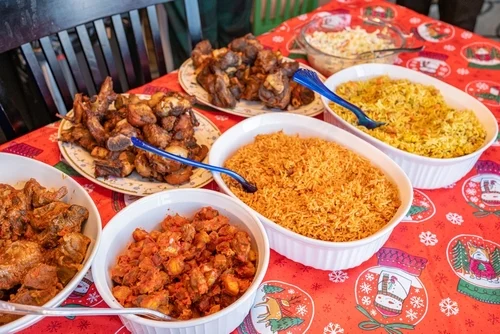
“Christmas rice” is a phrase many Nigerians use, but it doesn’t refer to one fixed recipe. It simply describes the rice dish—often jollof or fried rice—prepared and shared with visitors during the festive season. Families cook for relatives and friends who stop by, and the specific dishes on the table often reflect regional influences, personal taste, and what the household can afford. None of these foods are exclusive to Christmas, and no single dish is considered mandatory.
BusinessDay Nigeria describes the tradition of Christmas rice in Nigeria as a near-universal talking point each December, with friends often joking about where they’ll get their share. Families also prepare homemade snacks like chin-chin and plantain dishes in large batches to share with visitors, a practice also noted by Pulse Nigeria.
Sharing food, hampers, and gifts at Christmas
Generosity is woven into Nigerian Christmas traditions in Nigeria, though it looks different from household to household. Many families prepare extra plates of food to share with neighbors, relatives, or friends who stop by during the season. A hamper—a gift basket or package containing items like biscuits, drinks, or festive snacks—is another common way people express goodwill, whether between coworkers, neighbors, or extended family.
Some children receive small gifts of money from visiting relatives, a gesture that’s more about thoughtfulness than the amount given. None of this is a financial obligation. The spirit behind these gestures matters more than their value.
Father Christmas, festive outfits, and decorations
Who is Father Christmas in Nigeria?
Father Christmas is simply a familiar name for the Santa Claus figure recognized elsewhere. Children often look forward to seeing Father Christmas at school events, church programs, workplace parties, or community gatherings. There’s no single costume, story, or event format—appearances vary widely depending on where a family celebrates.
Why do people wear new clothes at Christmas?
For many families, buying new clothes, shoes, or a special outfit for Christmas Day is part of the tradition. Some parents set aside money throughout the year specifically for this purpose. Choices vary based on family preferences and budgets, and there’s no single standard for what “Christmas clothes” should look like.
How do Nigerian families decorate for Christmas?
Decorating for the season often includes lights, Christmas trees, and other seasonal touches in homes, churches, and workplaces. While decorations are common across many communities, there’s no single nationwide decorating style—families and businesses approach it in their own way.
Why do Christmas celebrations differ across Nigeria?
Nigeria isn’t culturally uniform, and neither is its Christmas season. Religious practices and household traditions vary from family to family. Celebrations in major cities can look quite different from those in smaller hometowns, where extended family networks and local customs play a bigger role. Some communities incorporate local performances or gatherings as part of their festivities, and contemporary celebrations often exist alongside longstanding family customs passed down for generations.
These different ways Christmas is celebrated in Nigeria reflect the country’s broader religious, ethnic, and regional diversity, according to the Union of Campus Journalists at the University of Nigeria, Nsukka.
How can Nigerian Americans keep these traditions alive?
Distance doesn’t have to mean disconnection. Here are a few ways families in the US maintain ties to Nigerian Christmas traditions:
- Prepare a family recipe, like jollof rice or chin-chin, and ask relatives about their own variations.
- Schedule a video call during a family gathering back home.
- Share favorite Christmas songs and old family photographs with younger relatives.
- Attend a local Nigerian community event or church service, if one is available nearby.
- Ask older relatives to record their memories of past Christmas celebrations.
- Adapt the celebration to fit work schedules, budgets, and mixed-cultural households.
Staying connected to these traditions doesn’t require reproducing every custom exactly or spending beyond your means. Small gestures carry plenty of meaning.
Sending a Christmas gift to Nigeria with Remitly
Staying connected across the distance sometimes means helping contribute to a family celebration back home. Sending money is one option, not a requirement—but if it’s part of your plans, here’s how it works.
With Remitly, you can choose Nigeria as your destination and enter the amount you’d like to send. From there, you’ll review the available payment and delivery options and check the details that matter most: fees, the exchange rate where applicable, the amount your recipient will receive, and the estimated delivery time. Once everything looks right, confirm your recipient’s details and track your transfer from start to finish.
Delivery times and available options can vary, so it’s worth reviewing them before you send.
Want to contribute to your family’s celebration? Explore your options for sending money to Nigeria with Remitly.
Frequently asked questions
How is Christmas celebrated in Nigeria?
Christmas in Nigeria often involves church services, family reunions, festive meals, and gift-giving. Many people travel to their hometowns, while others celebrate where they currently live. Customs vary significantly depending on the family, religion, and region.
What do Nigerians eat at Christmas?
Common Christmas foods include jollof rice, Nigerian fried rice, chicken or turkey, fried plantain (dodo), chin-chin, and puff-puff. There’s no single required menu—dishes vary by family, region, and budget.
What does “Christmas rice” mean?
“Christmas rice” refers to rice, often jollof or fried rice, prepared and shared with guests during the holiday season. It’s not one fixed recipe but rather a tradition of having rice ready for visitors who stop by.
Who is Father Christmas in Nigeria?
Father Christmas is a familiar name for the Santa Claus figure. He may appear at schools, churches, workplaces, or community events, though the costume and format vary depending on where a family celebrates.
Why do some Nigerians travel home for Christmas?
Many people travel to their hometowns or family villages to reconnect with grandparents, cousins, and extended relatives they may not see throughout the year. Others celebrate in the cities where they live, so homecoming isn’t universal.
Do all Nigerians celebrate Christmas?
Christmas is primarily a Christian holiday, and not everyone in Nigeria observes it religiously. However, many non-Christians join in the season’s social traditions, such as family gatherings and festive meals, given the holiday’s broader cultural presence.
What is the difference between a Christmas service and a crossover service?
A Christmas service, such as a carol service or Christmas Eve worship, centers on celebrating the birth of Jesus Christ. A crossover service, held on December 31, marks the transition into the new year and is considered a separate New Year’s tradition.