Key Highlights
-
A traditional Taiwanese wedding ceremony includes many steps that have deep meaning, starting with betrothal gifts and ending with a big banquet.
-
Picking an auspicious date for the wedding day is important. This helps make sure the couple will have prosperity and be happy in the years to come.
-
The tea ceremony is a key moment at the wedding. In this ritual, the couple shows respect to their elders. They also become part of their new family during this event.
-
Lively traditions, such as door games, red envelopes (hongbao), and changing into several outfits, make the wedding day fun and help people remember it.
-
Food is a big part of the celebration. There is a large banquet feast at the wedding, full of dishes that bring good luck and blessings for the newlyweds.
Introduction
Taking part in Taiwanese wedding traditions is like being a part of a bright story with a lot of history. Many people in Canada may find these things different, but they are fun and full of meaning. From the big wedding day plans to the last party, each step is there to bring good things to the newlyweds and wish them a good life with lots of luck. When you see more of Taiwanese culture, you get to know how people show love and respect for their family in special ways that go back a long time.
Exploring Wedding Traditions in Taiwan Through a Canadian Lens
From a Canadian viewpoint, it is truly amazing to see how much family is involved and how many rituals there are in Taiwanese culture. The wedding day is much more than the two people coming together. It is the coming together of two families, and there are special ways to show respect to their ancestors and elders.
People in Taiwan also have many traditions like giving gifts and bowing. These things have deep meaning, and they help the new couple start their married life with lots of good luck. Now, let’s look at some of the most interesting traditions that make a Taiwanese wedding stand out.
1. The Significance of Guo Da Li (Betrothal Gifts)
The path to a Taiwanese wedding usually starts with the Guo Da Li, which is also called the betrothal gift ceremony. This tradition is a key event in which the groom’s family gives gifts to the bride’s family. The gesture shows respect and is meant to let the bride’s family know the groom is serious and his family can take care of her.
These gifts are picked for what they mean. The gifts often have items like dragon and phoenix cakes, sweets, and money. They are given with hopes for prosperity, happiness, and a good future for the couple. The bride’s family will often give some gifts back. This is done to show goodwill and making clear they do not see marriage as selling their daughter.
A family friend, or someone close to both families, can help with this event. Their job is to be sure that the whole process is smooth and everyone feels respected. This tradition puts the focus on family approval and how both families join together. It helps build a base of respect that is strong and will last as the two families go forward.
2. Choosing Auspicious Wedding Dates
In Taiwanese culture, choosing the right time for a wedding is very important. You can’t just choose any sunny Saturday. The couple needs to pick an auspicious date. People often ask a fortune teller or feng shui master for help. The couple checks the Chinese lunar calendar. The goal is to choose a day and time that brings the most blessings.
The process starts with looking at the bride’s and groom’s birth dates and times. The chosen date needs to match well with their astrological signs. This helps the couple have harmony in their marriage. An auspicious date is said to bring a happy, healthy, and lucky life together.
Here are some key things to think about when picking the wedding date:
-
Do not choose dates that are inauspicious like the Ghost Month.
-
Try to pick dates that mean good fortune and wealth.
-
Make sure the date supports fertility and a lasting marriage.
-
Think about the zodiac signs for the couple and their parents. This can help bring balance.
This long-standing tradition in Taiwanese culture shows that people believe choosing the right day helps set up a path for the groom and bride to have a good life and prosperity.
3. The Role of Matchmakers and Parental Blessings
Many modern couples in Taiwan meet on their own, but the role of a matchmaker is still important in the culture. In the past, the matchmaker would help pick out good partners. They also helped with talks between the two families. Now, this role can be filled by a respected family friend or an elder. They can help with first meetings and help with talks before the wedding.
In Taiwan, a marriage can’t move forward without parents saying yes. The meeting is not just between the groom and bride. It is between two families. The groom and his family need to show respect. They must show the bride’s parents they are honest about this new family.
This focus on family support helps the couple begin their life together with love from all sides. It shows people that marriage is about the groom and bride starting a new family that brings both groups together. The way is made smooth when elders and tradition are given respect in this process.
4. Traditional Bride’s and Groom’s Attire
The traditional attire worn by the bride and groom is a stunning display of culture and symbolism. For the bride, a red qipao or a layered gown is common. Red is the colour of luck, joy, and happiness in Taiwanese culture, making it the perfect choice for a wedding. The bride often wears an elaborate, heavy headdress and ornate necklaces, with each piece of jewelry representing blessings for prosperity.
The groom’s traditional attire is equally impressive, often consisting of a long gown or a suit that complements the bride’s outfit. Even the groom may wear makeup to look his best for the significant day. The layers and intricate details of their clothing are not just for show; they are steeped in tradition and meaning.
Here’s a look at some common elements of their attire:
|
Attire Element |
Symbolism/Purpose |
|---|---|
|
Red Colour |
Represents good luck, happiness, and prosperity for the couple. |
|
Headdress |
A symbol of the bride’s new status and is often heavy, signifying the weight of her new role. |
|
Ornate Jewelry |
Such as necklaces and bracelets, these items are often gifts and represent wealth and blessings. |
|
Layered Garments |
Symbolize the richness and complexity of the new life the couple is embarking on together. |
5. Unique Door Games and Groom’s Challenges
Before the groom gets to see his bride on the wedding day, he has to show that he is ready and willing. He does this by taking part in “door games.” The bridesmaids plan these games and try to keep the groom away from the bride for a while. The groom, and sometimes his groomsmen, need to finish these tasks to prove how much he means it.
The games can be things like doing simple tasks, answering wedding day questions about the bride, or singing a song. Everyone has a good time, and there is a lot of laughter and talk between the groups. It helps people relax and cheer the groom on before he says his vows.
Some of these door games are:
-
Doing simple things like push-ups to show how strong he is.
-
Answering fun questions about the couple and how much he knows about the wedding day.
-
Dancing or singing a song for the bridesmaids to make them smile.
If he does all the games well, it shows he is ready. This lets him step in, see his bride, and move forward with their vows.
6. The Hair Combing Ceremony: Welcoming Adulthood
The hair combing ceremony is a quiet and special custom. It happens the night before the wedding or early in the morning on the wedding day. This act shows that the groom and bride are ready to take on married life. It means they are stepping into a new part of life as newlyweds. Most times, the ceremony is done for the bride at her home and for the groom at his home.
Someone who is seen as lucky does the combing. It is often a parent or a close relative. This person usually has a happy marriage and healthy children. While they use the comb, they offer spoken wishes for a good and long marriage. Every time the comb moves, it stands for a hope, like never-ending love, having many children, and living with peace.
This old custom gives the couple time to think before the happy wedding day starts. It lets loved ones, like parents, wish good things for the bride and groom as they get ready. It shows the bride and the groom that all their family stands with them. The groom and bride can start their married life with this support and all the good wishes around them.
7. The Importance of the Tea Ceremony
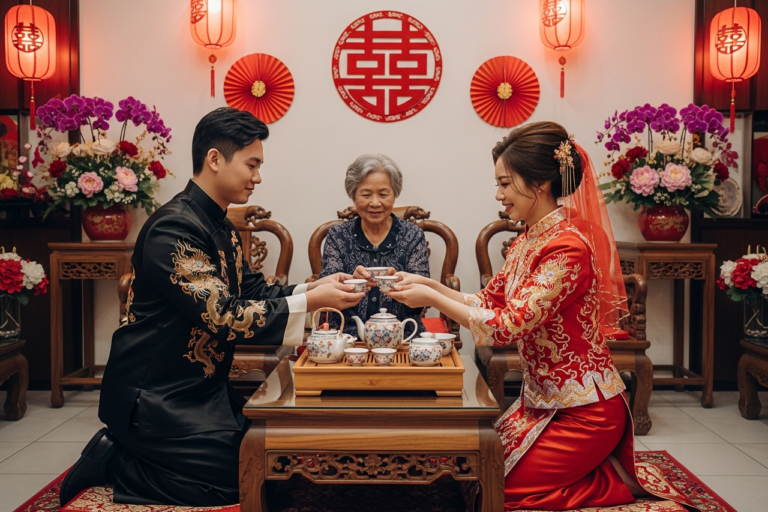
One of the most important parts of a Taiwanese wedding is the tea ceremony. This is a time when the bride is first introduced to the groom’s family. It is a way to show respect and to thank the people in the family. The couple will serve tea to their parents, grandparents, and other older family members.
At the tea ceremony, the bride and groom kneel before each person and offer tea. When this is done, the elders give the couple their good wishes. They may also give red envelopes with money or some gold jewelry inside. This shows that the new family is welcoming the bride and the groom is being accepted by his in-laws.
Sometimes, a family friend will help the couple with what to do, making sure the right steps and rules are followed. The tea ceremony is a key tradition that brings the two families together. It is a special time that joins the couple and also strengthens their connection with their new family, especially the husband’s family.
8. Bowing Rituals and Honouring Ancestors
Respect for elders and ancestors is very important in Taiwanese culture, especially on the wedding day. You can see this respect as the couple takes part in the bowing ritual. This is a big moment in the ceremony. Here, the couple stops to thank heaven and earth, their parents, and their ancestors. They show how grateful they are for their lives and for the families who took care of them.
The couple usually bows three times. The first bow is for the heavens and earth. They want to give thanks for all the things in the world. The second bow is for their ancestors, as they hope for blessings from those who came before them. The third bow is for their parents. This one shows how thankful they are for their parents’ love and care. Sometimes, the couple also bows to each other, which means they have respect for one another.
This wedding day tradition helps tie the past to the present. It allows the new couple to feel the blessing and support of all those who came before them. It’s a quiet and powerful act full of meaning. It roots the wedding day in family history and makes everyone think about how important it is to honour your family and where you come from. This is a big part of Taiwanese culture.
9. Red Envelopes (Hongbao) and Symbolic Gifts
No Taiwanese wedding is complete without red envelopes, called hongbao. Guests give these envelopes filled with money to the couple. They want the couple to have wealth and good luck. The red colour stands for luck and keeps away bad spirits. The money is usually an even number because odd numbers are linked to funerals.
Symbolic gifts are also a big part of the traditions. During the tea ceremony and other events, elders give hongbao or gold jewelry to the couple. It shows their blessing and supports the couple’s future in a real way. The groom’s family also gives special gifts that have important meaning.
Here are some examples of symbolic gifts:
-
Sweets and cakes for wishing the couple a sweet life.
-
Nuts and beans, like dates, tossed on the marriage bed for fertility and a long life.
-
Gold jewelry to stand for wealth and a strong future.
-
Alcohol to celebrate and hope for a rich life.
These exchanges are much more than giving things. They show goodwill, love, and hope for a bright future and long prosperity.
10. Taiwanese Wedding Banquet Essentials
The wedding banquet is the big finish of a Taiwanese wedding celebration. It is a huge feast to thank all the guests for coming and to celebrate the couple’s new life together. This banquet can be in a busy city like Taipei or in a quiet area. No matter where, the banquet is always grand, and usually takes place in a big hall with round tables. The round tables help to bring people closer and make everyone feel part of the event.
The food at the wedding banquet is chosen with great care. The menu has many courses and each dish means something special. There are a lot of dishes, and the food is brought out on Lazy Susans so people can share and get what they want easily. The feeling in the room is happy and full of energy. There are often speeches, toasts, and sometimes games. Everyone has a good time.
Essential elements of a Taiwanese wedding banquet include:
-
An impressive spread of at least 10 courses.
-
An emphasis on seafood delicacies, especially in coastal regions, symbolizing abundance.
-
Symbolic dishes like whole fish for surplus and chicken for completeness.
This big wedding banquet shows how generous the families are, and is a strong blessing for the new couple as they start this new part of their lives.
11. Sweets, Distilled Spirits, and Special Wedding Foods
Food that you see at a Taiwanese wedding has a lot of meaning. This is true not just for the main banquet or feast, but for the sweets, strong drinks, and special foods chosen for the day. Each one is picked for what it stands for, so all these wedding foods are there to bring good fortune, happiness, and prosperity to the couple.
Sweet things like sweet soup with glutinous rice balls, called tangyuan, are served to wish them a sweet and peaceful life together. You will see this during the tea ceremony or at the end of the banquet. People also trade wedding cakes and pastries to hope for a good and easy future.
Here are some other important foods and what they mean:
-
A whole chicken, which stands for a complete and happy family.
-
A whole fish, with the head and tail still there, which means a good start, a good finish, and also extra.
-
Noodles, which are given so the couple will have a long life together.
These food customs make the meal not just a feast, but a time to wish the couple lots of luck and prosperity. Every piece helps the couple have a good future.
12. Outfit Changes and Grand Entrances
A Taiwanese wedding banquet is kind of like a fashion show. The bride makes big entrances in different outfits. She shows off many styles, like the traditional red dress, a modern white wedding gown, and fancy evening dresses for the banquet. Each time she changes clothes, it feels like a special moment.
The couple comes in together for the first main entrance after the procession. As the night goes on and after some courses are served, the bride goes out to change into another outfit. The groom might change his suit or tie too, so they match. Guests clap each time the bride comes back in with a new look.
The tradition of switching outfits makes the wedding banquet more lively and fun. People love to take pictures, and it keeps everyone excited. It’s nice for everyone to wonder about which dress or look the bride will show next as she enjoys her big day in style with the groom and all the guests.
13. Postwedding Farewell and Sweet Treats
As the wedding banquet comes to an end, the party finishes with a warm, postwedding goodbye. The newlyweds and their parents stand at the door to thank everyone for coming. This lets the couple and guests share a special moment and is a final sign of good hosting.
When people go home, they do not leave with just memories. Each guest gets a favour bag with candy or a small cake. This is a nice way for the couple to share their happiness with all the guests. It helps everyone leave the banquet with a smile and a little bit of the couple’s good luck.
This caring goodbye is a wonderful way to end the wedding day. It shows how important family, friends, and thanks are at the event. From the start of the banquet to the last hug, every moment helps give blessings to the newlyweds and everyone there.
Modern Influences and Regional Variations in Taiwanese Weddings
Taiwanese weddings have a long history. Still, they are not stuck in the past. Many couples these days mix old customs with new ideas. Their ceremonies become special to them and also show their culture. You can see Western touches in what people wear, how they take photos, and in the fun at the party.
The way weddings look can be different depending on where they happen. In big cities, weddings are often simple and modern. In the country, you may see more classic and detailed rituals. These changes show how different people are across Taiwan.
Blending Tradition with Modern Wedding Trends
Today’s couples in Taiwan are mixing old and new when it comes to weddings. Many want to keep some main things, like the tea ceremony and getting blessings from their parents. At the same time, they also add their own ideas or memories. For example, they may decide to have a wedding in another place, but they still make sure the tea ceremony is part of the day.
You can really see this blend in how things look during the wedding. A bride will sometimes start out in a white dress for the start of the day. Later, she might change into a red qipao for the banquet. Now, many couples like to have photos taken before the big day. These photos often show both the simple style and the old traditions in what they wear.
When couples mix old and new, the day has something special. It helps them show respect for their families and history. At the same time, they are able to celebrate their love in a way that feels right for them before starting their married life. This changing mix shows that tradition can stay alive, even as people do new things in today’s world.
Differences Between Urban and Rural Wedding Customs
The setting of a Taiwanese wedding plays a big role in how the day goes. You can see big changes between weddings in busy cities like Taipei and those in smaller towns or the country. City weddings happen in smaller spaces and often bring in more Western ways of doing things.
Weddings in the country usually stick closer to old customs and can be much bigger. Many people there may get involved, and it is common to see a loud and colourful procession through the streets. The banquet might also take place outside, under big tents, making a fun and lively feast for all.
Here are a few key ways weddings can be different:
-
Venue: City weddings in places like Taipei usually happen in hotels or halls. Country weddings may be outdoors or at a community centre.
-
Guest List: Rural weddings often welcome more people, including everyone from the local area.
-
Rituals: At a rural wedding, people may see a longer procession and more old customs, while these might be shorter in the city.
-
Atmosphere: Weddings in the city can feel more serious and neat, while those in the country are more easy-going and full of energy.
Conclusion
Exploring Taiwanese wedding traditions from a Canadian view shows us how special these customs are. They focus on family, culture, and love. Many traditions, like Guo Da Li, have deep roots. There is also a lively traditional banquet that makes the day feel festive. Each tradition adds something important to the celebration.
When you learn about these customs, you start to understand Taiwanese culture better. You also begin to value the things that bring us together, like love and unity. If you want to know more about how to mix different wedding traditions or need help planning a wedding, you can ask for a free consultation.
Frequently Asked Questions
What are common taboos to avoid during a Taiwanese wedding?
In Taiwanese culture, people follow some rules on the wedding day. For example, they do not give money in odd numbers in red envelopes. People feel this is linked to funerals, so they avoid it. There is also a belief that the bride’s bed should not be empty on her wedding night. To help the couple with fertility, a young boy might jump on the bed for the newlyweds.
How do families participate in Taiwanese wedding rituals?
Families are important in Taiwanese wedding rituals. Parents give their blessings. They join the tea ceremony to welcome the new son- or daughter-in-law. They also help with the banquet. From talks before the wedding to showing respect to the husband’s family, their help is needed for a good start to married life.
What symbolic meanings do key Taiwanese wedding customs hold?
Key customs have a lot of meaning. Picking an auspicious date is done to get a good start for the couple. The tea ceremony shows respect and welcomes a new family. Red envelopes are given. There is special food served. The couple also makes vows. All these are meant to bring prosperity, fertility, and happiness for life.