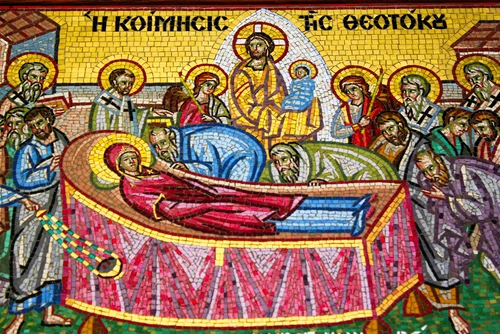
Quick answer: The Dormition of the Theotokos is observed on 15 August each year by Orthodox Christians worldwide. It commemorates the falling asleep and bodily assumption of the Virgin Mary and is one of the twelve Great Feasts of the Orthodox Church. In Canada, the feast is central to Greek, Ukrainian, Romanian, Serbian, and Coptic communities, and is preceded by a two-week fast.
Every summer, on 15 August, Orthodox Christian communities across Canada pause to observe one of the most sacred dates in the liturgical calendar. Streets around Greek Orthodox churches in Toronto, Ukrainian parishes in Winnipeg, and Coptic congregations in Montreal fill with worshippers marking a feast that stretches back more than a millennium. Yet outside these communities, the Dormition of the Theotokos remains relatively unknown to many Canadians.
This guide explains what the feast is, why it matters, how different communities observe it, and what to expect in 2026.

What Is the Dormition of the Theotokos?
The word dormition comes from the Latin dormitio, meaning “falling asleep.” Theotokos is a Greek title for the Virgin Mary, translating roughly as “God-bearer” or “Mother of God.” Together, the feast name describes the Orthodox belief that Mary did not die in an ordinary sense, but fell into a peaceful sleep before being bodily taken up to heaven by Christ.
The Dormition is the Orthodox counterpart of the Catholic Feast of the Assumption. While both traditions share the core belief in Mary’s bodily assumption, they approach it with different theological emphases. The Orthodox tradition stresses the mystery of her gentle departure—her falling asleep—while also affirming her bodily glorification.
In the Orthodox liturgical calendar, the Dormition holds a place among the twelve Great Feasts, the most important celebrations of the church year outside of Pascha (Easter). Its theological weight is comparable to Christmas, Pentecost, and the Transfiguration.
When Is the Dormition of the Theotokos in 2026?
The Dormition of the Theotokos falls on 15 August 2026. For most Orthodox churches in Canada—including Greek, Antiochian, Romanian, and Serbian communities—this date follows the New Calendar (Revised Julian Calendar), which aligns with the Gregorian calendar.
Some communities, particularly certain Ukrainian and Russian Orthodox parishes, observe the feast according to the Old Calendar (Julian Calendar), placing it on 28 August 2026 by the Gregorian reckoning.
If you are attending a service with a specific parish, confirming which calendar they follow is always a good idea.

The Dormition Fast: Two Weeks of Preparation
One of the features that sets the Dormition apart from many Western Christian observances is the fast that precedes it. The Dormition Fast runs from 1 August to 14 August, spanning two full weeks.
During this period, observant Orthodox Christians abstain from meat, dairy, fish (on most days), oil, and wine. The fast follows a strict schedule similar to Great Lent, though it is shorter in duration. Spiritually, it is understood as a period of intensified prayer, repentance, and preparation for the feast.
For many Canadian families with Orthodox roots, the Dormition Fast is woven into the rhythm of late summer. Grandparents pass on fasting recipes to grandchildren; parish communities gather for weekday services that are less common at other times of year.
How Orthodox Communities in Canada Observe the Feast
Canada’s Orthodox communities are remarkably diverse, and each tradition brings its own cultural texture to the feast while sharing a common theological core.
Greek Orthodox Communities
Greek Orthodox parishes—found in cities including Toronto, Vancouver, Montreal, and Calgary—typically hold a Paraklesis service on evenings throughout the fast, followed by a full Divine Liturgy on 15 August itself. Many parishes honour their community’s patron feast if it coincides with the Dormition. Church festivals (paniyiri) often accompany the feast, drawing families together for food, music, and celebration after the liturgy.
Ukrainian Orthodox and Greek Catholic Communities
In Ukrainian tradition, the Dormition (known as Uspinnia Presvyatoyi Bohorodytsi) carries deep national and spiritual significance. Ukrainian Canadian communities—particularly in Manitoba, Saskatchewan, and Alberta—observe the feast with solemn services and, in some rural areas, with the blessing of flowers and herbs, a folk tradition that links the harvest season to the feast day.

Romanian Orthodox Communities
Romanian parishes in Ontario and Quebec celebrate the Dormition (Adormirea Maicii Domnului) as a major community gathering. Services are often followed by communal meals, and the feast is considered a significant name day for women named Maria or similar variants.
Serbian Orthodox Communities
Serbian Orthodox parishes observe the Dormition (Uspenje Presvete Bogorodice) with full liturgical solemnity. The feast serves as the patron celebration of several Serbian churches across Canada, making 15 August a particularly significant day in the calendar of those congregations.
Coptic Orthodox Communities
Canada’s Coptic Orthodox community—concentrated in Ontario, Alberta, and British Columbia—observes the feast according to the Coptic calendar, which can place it at a slightly different date. Regardless of calendar differences, the Dormition holds deep meaning in Coptic spirituality, and large urban parishes often mark the occasion with overnight vigils and extended liturgical celebrations.
What Happens During a Dormition Service?
For those attending a Dormition service for the first time, knowing what to expect can help you engage more meaningfully with the experience.
A typical Dormition liturgy includes:
- Great Vespers on the eve of the feast, 14 August, introducing the celebration
- Orthros (Matins) and Divine Liturgy on the morning of 15 August
- A procession in many parishes, where an icon or epitaphios (a decorated bier representing the body of Mary) is carried around the church
- Blessing of flowers in certain traditions, particularly Ukrainian
- Congregational singing of feast-specific hymns, including the Apolytikion (troparion) of the feast
Services are often long by Western standards. Arriving early and following along with a printed service booklet—available at most Orthodox parishes—will enrich the experience considerably.

Why the Dormition Matters to Canadian Orthodox Communities
For Orthodox Christians in Canada, the Dormition of the Theotokos is far more than a liturgical obligation. It is a gathering point for communities that often live far from their ancestral homelands. A Greek Canadian family in Edmonton, a Romanian Canadian family in Hamilton, or a Coptic Canadian family in Mississauga all find in this feast a moment to reconnect—with faith, with cultural heritage, and with one another.
The feast also carries a universal message that resonates beyond any single ethnic tradition. At its heart, the Dormition is a proclamation that death is not the final word. The Orthodox Church teaches that Mary’s gentle falling asleep and her bodily glorification offer a sign of the resurrection hope that all Christians hold.
Start of the Church Year: What Comes After the Dormition?
The Dormition on 15 August is also significant because it falls just weeks before the Orthodox New Year, which begins on 1 September. Shortly after, on 8 September, the Church celebrates the Nativity of the Theotokos—the birth of the Virgin Mary. Together, these feasts create a natural rhythm: the end of Mary’s earthly life in August, and the remembrance of
FAQs About the Dormition of the Theotokos in Canada
When is the Dormition of the Theotokos in 2026?
The Dormition of the Theotokos is observed on 15 August 2026 by Orthodox churches following the New Calendar. Parishes using the Old (Julian) Calendar observe the feast on 28 August 2026.
Is the Dormition of the Theotokos the same as the Catholic Feast of the Assumption?
They share the same theological belief—that the Virgin Mary was bodily taken up to heaven—but they are distinct celebrations. The Catholic Church calls it the Assumption and defined it as dogma in 1950. The Orthodox feast, observed on the same date, is called the Dormition and emphasises Mary’s peaceful “falling asleep” before her glorification.
Is 15 August a public holiday in Canada?
No, 15 August is not a federal statutory holiday in Canada. It is a civic holiday in some provinces—Ontario, for example, observes the Ontario Civic Holiday on the first Monday of August—but these have no direct connection to the Dormition feast.
How long does the Dormition Fast last?
The Dormition Fast lasts 14 days, from 1 August to 14 August. It is one of the four major fasting periods in the Orthodox calendar and is stricter than some other fasts, with rules similar to those of Great Lent.
Which Canadian cities have large Orthodox communities that observe the Dormition?
Major Orthodox communities observing the Dormition can be found in Toronto, Montreal, Vancouver, Calgary, Edmonton, Ottawa, Winnipeg, and Mississauga, among other cities. Greek, Ukrainian, Romanian, Serbian, and Coptic parishes are present across most major Canadian urban centres.
Can non-Orthodox Canadians attend a Dormition service?
Most Orthodox parishes welcome respectful visitors. It is customary to dress modestly, refrain from receiving Holy Communion unless you are Orthodox, and follow the lead of those around you during the service. Calling the parish ahead of time is a thoughtful way to confirm any specific guidelines.