Quick answer: The Hungry Ghost Festival (Zhongyuan) in 2026 falls on August 20th. Observed on the fifteenth day of the seventh lunar month, the festival honours ancestors and wandering spirits through food offerings, burning joss paper, and community ceremonies. Chinese communities across Vancouver, Toronto, and Richmond mark the occasion each year.
The seventh lunar month carries a quiet weight in many Chinese households across Canada. Doors are opened, tables are set with food that no living person will eat, and the air outside fills with the smell of burning paper. This is Zhongyuan—the Hungry Ghost Festival—a tradition that connects the living with those who have passed, and one that remains deeply meaningful for Chinese communities from Vancouver’s Richmond district to Toronto’s east end.
For those encountering the festival for the first time, it can seem mysterious. For those who grew up with it, it is simply part of the rhythm of late summer—a time to remember, to honour, and to show respect across the boundary between worlds.
This guide covers everything you need to know about the Hungry Ghost Festival in 2026: when it falls, what the traditions involve, and how Chinese communities across Canada observe it today.

When Is the Hungry Ghost Festival in 2026?
The Hungry Ghost Festival falls on the fifteenth day of the seventh lunar month each year. In 2026, that date corresponds to August 20th on the Gregorian calendar.
The entire seventh lunar month—known as Ghost Month—is considered a spiritually significant period. The gates of the underworld are believed to open on the first day of the month, allowing spirits to roam the earth. The fifteenth day, which is the festival’s peak, marks the full moon and the height of spiritual activity. The gates close again at the end of the month.
In 2026, Ghost Month begins on August 6th and concludes on September 3rd.
What Is the Hungry Ghost Festival?
The Hungry Ghost Festival, or Zhongyuan (中元節), is a traditional Chinese observance rooted in both Taoist and Buddhist practice. At its heart, the festival is about filial piety—the deep respect for one’s ancestors that runs through much of Chinese cultural and religious life.
According to tradition, the souls of the deceased return to the living world during the seventh lunar month. Some are well cared for by their descendants. Others—the “hungry ghosts”—have no family to tend to them, or have died under difficult circumstances and wander without peace. The festival offers the living a chance to pay their respects to both.
It is worth noting that Zhongyuan is distinct from, though related to, the Taoist festival of the same name and the Buddhist observance of Ullambana (盂蘭盆節). All three are observed during the seventh lunar month and share common themes of ancestral reverence, but each carries its own religious character. In Chinese-Canadian communities, these observances often blend together in practice.

Core Traditions of Zhongyuan
Food Offerings and Ancestral Tables
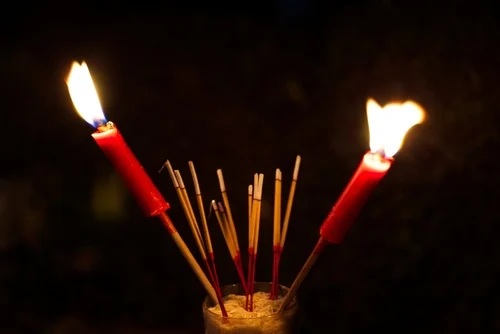
Preparing food for ancestors is one of the most universal practices of the festival. Families set out dishes—often the favourite foods of deceased relatives—along with chopsticks, incense, and sometimes a place setting at the table. The offering is both practical and symbolic: it ensures that ancestors are fed and that they know they are remembered.
Burning Joss Paper and Spirit Money
Burning joss paper (金紙) is among the most visible rituals of Ghost Month. Families burn paper representations of money, clothing, electronics, and other goods so that these items pass into the spirit world for their ancestors to use. In Chinese communities across Canada, designated burning bins are often provided at temples and community centres to allow for safe, communal burning.
Floating Lanterns
In some communities, paper lanterns are floated on water to guide wandering spirits and help them find their way. This practice is especially common in coastal and riverside communities and adds a visual dimension to the festival that many find moving.
Ritual Performances and Getai
Getai (歌台) performances—live shows featuring singing, comedy, and opera—are staged for both the living and the dead. Traditionally, the front row of seats is left empty for the spirits. In Singapore and Malaysia, getai is a large-scale community event. In Canada, smaller ceremonial performances take place at select temples and cultural centres.
Street Prayers and Temple Ceremonies
Community temples play a central role during Ghost Month. Taoist and Buddhist temples hold ceremonies to pray for wandering spirits and to facilitate the transfer of offerings. Many temples offer guided participation for community members who want to observe or take part in the rituals.

How Chinese Communities in Canada Observe the Festival
Vancouver and Richmond
The Greater Vancouver area—particularly the city of Richmond, which has one of the highest concentrations of Chinese Canadians in the country—sees some of the most active Hungry Ghost Festival observances outside of Asia.
Richmond’s Taoist and Buddhist temples typically hold ceremonies throughout Ghost Month, with the full moon on the fifteenth day drawing the largest gatherings. Community associations organise communal burning sessions where families can safely burn joss paper and offerings. Local businesses, many of which are Chinese-owned, may also set out small offering tables near their entrances during this period.
Vancouver’s Chinatown, one of the oldest in North America, observes the festival with a quieter but no less meaningful character. Many families observe privately at home, maintaining customs passed down through generations.
Toronto
Toronto’s Chinese community—spread across the city’s downtown Chinatown, the eastern suburb of Scarborough, and the northern hubs of Markham and Mississauga—marks the festival in a range of ways. Larger temples, including those in Scarborough and Markham, hold formal ceremonies open to the public. Community centres and cultural associations sometimes organise group observances that make the rituals accessible to newer generations who may not have grown up with them.
Toronto’s multicultural character means the festival is increasingly understood beyond the Chinese community. Public libraries and cultural institutions have in recent years offered programming during Ghost Month to help broader audiences understand its significance.
Other Canadian Cities
Chinese communities in Calgary, Edmonton, and Montreal also observe the Hungry Ghost Festival, primarily through temple ceremonies and private family rituals. The scale is smaller than in Vancouver and Toronto, but the traditions are no less present.

Practical Considerations During Ghost Month
For those living in or near Chinese communities in Canada, Ghost Month comes with a set of informal customs worth knowing—whether you observe them yourself or simply want to be respectful of those who do.
Common practices during Ghost Month include:
- Avoiding swimming at night, which is associated with attracting wandering spirits
- Not stepping on or over offerings left on the street
- Refraining from moving house, starting a new business, or major life changes during the month (though many Canadian families observe this selectively)
- Returning home before dark, particularly on the fifteenth day
These customs vary by family, region of origin, and degree of religious observance. There is no single “correct” way to observe Ghost Month—practices differ between Cantonese, Hokkien, Hakka, and other Chinese communities, as well as between those with Taoist, Buddhist, or secular orientations.
The Meaning Behind the Festival
It would be easy to focus only on the supernatural elements of Zhongyuan and miss its deeper significance. At its core, the festival is about memory. It insists that the dead are not simply gone—that they remain connected to the living through family, through ritual, and through the small, repeated acts of remembrance.
For Chinese Canadians, particularly those who immigrated as adults, the festival also carries a dimension of distance and longing. Burning offerings in Richmond or lighting incense in a Toronto temple is, in part, a way of maintaining a thread back to family members and ancestors who are far away—whether in another country or in another world entirely.
For younger generations raised in Canada, Zhongyuan can serve as a point of connection to heritage and identity. Many community organisations use the festival as an opportunity to engage young people in cultural education, helping them understand the meanings behind rituals that their grandparents observed without question.

Participating Respectfully as a Non-Chinese Canadian
The Hungry Ghost Festival is not a closed tradition—many temples and community organisations welcome respectful visitors who want to observe or learn. If you plan to attend a ceremony or visit a temple during Ghost Month in 2026, a few simple guidelines will help:
- Dress modestly and remove shoes if asked
- Do not step over or move offerings placed on the ground
- Ask before photographing rituals or individuals
- Follow the lead of organisers regarding participation
Understanding the context before attending goes a long way. This guide is a starting point; temple staff and community organisations are usually glad to answer questions from curious and respectful visitors.
Keeping the Tradition Alive in Canada
The Hungry Ghost Festival has adapted over generations without losing its essential character. In Canadian cities, that adaptation continues. Temples find ways to conduct safe burning ceremonies that comply with municipal fire regulations. Community associations translate ritual meanings into English for second-generation members. Cultural centres create programming that introduces the festival to neighbours and newcomers.
None of this diminishes the tradition. If anything, the effort required to maintain Zhongyuan in a diaspora context makes the observance more intentional. Families who set out offerings in a Richmond home or attend a Toronto temple ceremony in August 2026 are making a deliberate choice to remember—and to pass that act of remembering on.
Frequently Asked Questions About the Hungry Ghost Festival in Canada
When is the Hungry Ghost Festival in 2026 in Canada?
The Hungry Ghost Festival falls on August 20, 2026. This is the fifteenth day of the seventh lunar month. Ghost Month itself runs from August 6 to September 3, 2026.
What is the difference between the Hungry Ghost Festival and Qingming?
Both festivals involve honouring ancestors, but they occur at different times and carry different characters. Qingming (清明節), or Tomb-Sweeping Day, takes place in early April and centres on visiting and tending to graves. The Hungry Ghost Festival in the seventh lunar month is focused on appeasing wandering spirits and making offerings more broadly—not only to one’s own ancestors, but to all souls who may be without care.
Where can I observe or participate in Hungry Ghost Festival events in Canada?
In Vancouver and Richmond, Taoist and Buddhist temples hold ceremonies throughout Ghost Month, with major observances on August 20, 2026. In Toronto, temples in Scarborough and Markham typically hold public ceremonies. Check directly with your local Chinese cultural centre or temple for event schedules, as these are confirmed closer to the date.
Is it disrespectful to walk through areas where offerings are being made?
Accidentally passing near offering sites is generally not considered disrespectful, but it is courteous to step around rather than through them. Do not move, kick, or touch offerings placed on the ground. If you are unsure, observe how others nearby are navigating the space.
Do all Chinese Canadians observe the Hungry Ghost Festival?
No. Observance varies widely depending on family background, regional heritage, religion, and personal belief. Some families observe all aspects of Ghost Month carefully; others mark only the fifteenth day; and some do not observe the festival at all. The Chinese-Canadian community is not monolithic, and cultural practices differ considerably between, for example, Cantonese families from Hong Kong and Hokkien families from Southeast Asia.
Is it safe to burn joss paper in Canada?
Burning joss paper outdoors without a designated burning container is subject to local fire bylaws in most Canadian cities. Many temples and community organisations provide proper burning bins for communal use. Check with your local temple or cultural association for safe, compliant options before burning at home.