Key Highlights
-
Find out about the lively and special wedding traditions that are important in Romanian culture.
-
Learn about the roles of godparents, called “Nasi,” who be spiritual parents to the couple.
-
Hear about interesting customs, like the kidnapping of the bride, where wedding guests take part in this fun game.
-
Taste the rich flavours in a traditional wedding feast, with dishes like cabbage rolls, or sarmale, and a big wedding cake.
-
A Romanian wedding ceremony mixes Orthodox religious rituals with many acts full of meaning.
-
Get ready for a full day and night of celebrating, because a traditional wedding often goes on until early morning.
Introduction
Have you ever thought about what it is like to go to a Romanian wedding? If you are a Canadian and you get an invite to one, you are in for something you will always remember. There will be a lot of energy, lots of old customs, and a party that does not stop. The wedding traditions show off the rich cultural heritage of Romania. You will find both serious moments from the church and times that are happy or even a little funny. This guide will tell you what to expect, from things people do before the wedding right up to the last dance. It will help you feel just right as you celebrate with your Romanian friends.
Romanian Wedding Traditions Overview
A traditional wedding in Romania is a big event where customs go way back. The whole day is about being with family and friends, and everyone takes part. Picking “Nasi” or spiritual parents is key. The wedding ceremony has a deep meaning, and the wedding party often goes on through the night.
These wedding customs show why a romanian tradition is so special. At a romanian wedding ceremony, you see both serious vows and fun games. All these things help welcome the couple into their new life. You’ll see lots of emotion, dancing, and good food at a wedding party in romania.
Historical Roots and Cultural Influences
The wedding traditions you will see in Romania have deep roots. They come from old stories and tales, the Orthodox faith, and local customs. It makes the experience one-of-a-kind, and different from other weddings in Europe. Many of these wedding traditions are meant to bring good luck, fertility, and to wish the couple a happy life together.
When you know something about the ethnic background in Romania, you can see why these traditional wedding ways are still around. They mean more than just a ceremony. They are part of romanian culture and who the people are. Big groups and noisy car horns during the celebrations show how much family and friends care about the newlyweds.
These traditions stay strong even as things change over time. The important parts of a traditional wedding are still there. They help a couple feel connected to their family past. They remind everyone about the rich cultural heritage of romania, and show that the day is more than just a party – it’s about family, community, and values.
Modern Adaptations for Canadian Guests
While many couples stick to tradition, you will see these modern Romanian weddings mix old customs with new trends. The personal preferences of the couple have a big impact on their wedding day. This means you might spot some old rituals, but they can be changed for a modern crowd. It’s good news for Canadian wedding guests.
For example, not every couple follows every tradition exactly. They may decide to make some ceremonies shorter or to choose modern music along with Romanian folk songs. The goal is to make the wedding day feel right for them.
Here are a few modern changes you might see:
-
A DJ takes the place of a live band, with the wedding day playlist mixing Romanian and international music.
-
The menu may include both Romanian classics and dishes from other countries.
-
Ceremonies might be shorter and simpler to help all wedding guests enjoy, no matter their background.
-
The couple gives clear explanations for some traditions, so international guests know what’s happening.
Unique Pre-Wedding Rituals in Romania
The excitement of a Romanian wedding day starts way before the ceremony. Many of the most fun traditional wedding customs happen in the morning at the bride’s house. These rituals mean a lot and include the wedding party and family.
Getting the groom ready for his new life as a husband and watching the bride’s last moments before she’s ready, these pre-wedding events are special. They shape the day, and there is usually music, laughter, and some happy tears.
Choosing Godparents (“Nasi”) and Their Role
One of the key things in a romanian wedding is the role of the godparents, known as the “Nasi.” They are not the same as bridesmaids or groomsmen. The godparents are the couple’s spiritual parents, picked to help and guide them in their married life. The couple often chooses an older, respected married pair to be their godparents because they are seen as role models.
The godfather and godmother play an important role during the whole romanian wedding. They help with the church ceremony, hold candles, and take part in special moments with the couple. Their job is more than just for the wedding day. The godparents are there to guide and support the couple for years to come.
Choosing who will be the godparents is a big decision for any romanians who are planning to get married. It is a great honour to be asked, and this choice shows trust and deep respect. The godparents are at the heart of the wedding, and everyone gives them much respect.
The Shaving of the Groom & Bridal Preparations
On the morning of the wedding, the groom goes through a special ritual. His male friends or the godfather act like they are shaving him. This custom shows he is moving from being a young man on his own to becoming a husband. It is a fun and symbolic time for the men before they head to the bride’s house.
At the bride’s house, what the bride does before the wedding is just as important. These are big moments that bring out a lot of feeling, and there are some superstitions, too. The godmother helps the bride put on her wedding dress and puts the veil over the bride’s head. This means the bride is about to become a wife.
Other important moments for the bride can be:
-
The “Hora de la Mireasa” (Bride’s Dance). This is a last dance with her family in her home.
-
Breaking a cake over the bride’s head to bring good luck and fertility.
-
A procession from the bride’s house to the church with music.
Traditional Romanian Wedding Ceremony Customs
The heart of a Romanian wedding is the ceremony on the wedding day. This usually has two parts. First is the civil ceremony, and then there is the religious ceremony. The religious part happens in an Orthodox church. It is full of old customs and symbols. It’s quiet and nice, and the couple comes together in front of God.
In the religious ceremony, you see things from the past. People have done these things for a long time. The couple swap wedding rings. They also have a crowning. Every part has a strong meaning. This event is beautiful to watch. It is important to all who want a traditional wedding and is key to a romanian wedding.
Religious Ceremony Highlights
The Orthodox religious ceremony is a big part of a romanian wedding. There are no personal vows exchanged like in many western weddings. Instead, the priest handles a set of special rituals that show the couple’s promise to each other.
One special point of the ceremony is when crowns are placed on the bride and groom. The priest puts the crowns on their heads. This means they are now the king and queen for their family and home. The godparents stand on each side. They hold large candles with decorations. These candles are a sign of the light of Christ showing them the way.
The groom and bride will also drink wine from the same cup. This means they will share their life together. The priest leads the couple around the altar three times. That walk is a “dance” to show their new steps as husband and wife. The church is there to support them. During this ceremony, the wedding rings are given to the couple.
Typical Procession and Symbolic Acts
The entire wedding day is a type of procession, moving from one location and one ritual to the next. It often begins at the groom’s home, moves to the bride’s home, then to the church for the wedding ceremony, and finally to the reception venue. This journey involves the entire wedding party and is often accompanied by a noisy, honking car cortege to announce the celebration to the world.
Throughout the day, many symbolic acts take place. These are not just traditions but are believed to bring the couple good fortune, happiness, and a prosperous life together. From breaking a cake to the specific steps in the church, every action is filled with meaning.
Here are some of the key symbolic acts you might witness during the wedding day:
|
Symbolic Act |
Meaning |
|---|---|
|
The Shaving of the Groom |
Symbolizes the groom’s transition from a bachelor to a married man. |
|
Placing the Veil |
The godmother places the veil on the bride, signifying her becoming a wife. |
|
Crowning Ceremony |
The bride and groom are crowned king and queen of their new household. |
|
Walking Around the Altar |
Represents the couple’s first steps together in their married life, guided by the church. |
Romanian Wedding Reception Traditions
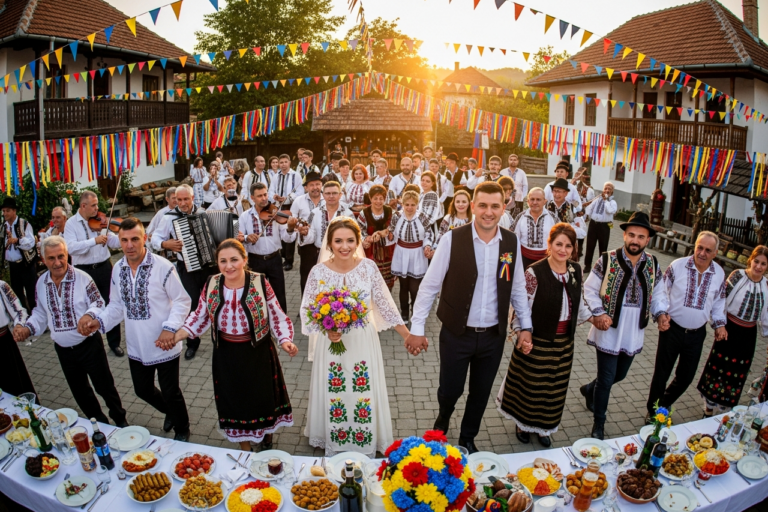
After the formal part is done, the party starts for real. A romanian wedding reception is a big event. People come together from evening to dawn. There is traditional music all night and the dance floor is always busy. Wedding guests eat many courses of tasty food. Everyone works hard so that people have a great time.
At a romanian wedding, you see some special wedding games. The most well-known game is the kidnapping of the bride. It is a fun thing where people play and enjoy the moment. Then the wedding cake makes a big entrance. There are lively folk dances. The whole wedding reception is all about joy and fun, with something happening all the time.
Signature Foods, Music, and Dancing
Get ready for a romanian wedding, because food will not stop coming. This party has many courses that go all night. You start with a big plate of appetizers, then comes fish, and after that, steak. The best dish is sarmale, which are cabbage rolls, filled with meat and rice. These are something you have to try.
Music brings everyone to the dance floor in a romanian wedding. You will hear modern songs and traditional music. Be ready to jump into the Hora. It is a circle dance all the wedding guests can take part in. You don’t need to know much, it is easy and a fun way to join in.
The party is lively with lots of drinks and ends with a wonderful dessert. Here’s what you can expect:
-
Hearty sarmale (cabbage rolls) served late at night.
-
The lucky wedding cake comes in with a big, bold entrance, sometimes even with fireworks.
-
There will be plenty of local wines as well as plum brandy (tuica) so people can celebrate the couple.
-
You get both DJ sets and live bands playing different types of traditional music, including folk.
-
The dancing never stops, and the Hora is a big part of it.
Everyone will get to eat, drink, and have a good time dancing together at this romanian celebration.
The Bride’s Attire and Fashion Traditions
The bride’s attire is the main part of the wedding day. In Romania, most brides pick a white wedding dress now, just like you see in Canada. Still, there are parts of the old ways that remain. The veil is important. The godmother puts the veil on the bride’s head. This small moment means a lot to the couple.
In some romanian villages, or for couples who are after a traditional wedding, the bride may wear a special costume. These traditional costumes are covered with beautiful embroidery. They are full of colour. They show where the bride’s family comes from and what region it is.
Meaning Behind Traditional Garments
When a bride picks traditional costumes for her wedding, the attire holds special meaning. Often, these clothes are made by hand and passed down from family over the years. The embroidery shows patterns from her area. Colours and designs are not just for looks, but can be about things like fertility, keeping away bad luck, and having good fortune.
The outfit at a traditional wedding is more than just a dress. It has a fancy blouse called an “ie.” There’s a woven skirt, a belt with decoration, and a big headdress. When the ceremony is done, there’s a tradition where the bride’s veil is taken off and replaced with a headscarf. This shows she is now a married woman.
Picking this attire ties the bride to her heritage. It says who she is and shows she respects the old ways. The wedding dress becomes that strong link from the past to their future.
Contemporary Wedding Styles in Romania
Today, most Romanian brides go with modern looks for their wedding day. You can see many different styles out there. Some pick classic ball gowns with long trains, and others choose dresses with a simple, modern shape. Like in Canada, picking a wedding dress is a special choice for each bride. It shows personal taste and fits the feel of the wedding.
The personal preferences of the couple really matter. Brides usually spend lots of time finding the dress that is right for them. They get ideas from their mother, godmother, and close friends. That moment when you “say yes to the dress” is a big deal and feels exciting.
Even if the dress looks new and trendy, there are often traditional touches added. The bride may wear a modern gown at the wedding, but still take part in the traditional veiling ritual. This mix of old and new lets couples honour where they come from. It is also a way for them to show their love in a way that fits who they are.
Family Roles and Regional Variations
In a Romanian wedding, family means more than just showing up. They take a big role in the wedding day. Parents, siblings, and godparents all have jobs they must do. The wedding party helps make sure everything works out well, beginning with getting ready at the bride’s house.
It’s interesting to see how wedding customs can change by place. Romania has many cultures in it, and things people do for weddings in one region may be different from those in another. This gives every Romanian wedding its own special touch.
Duties of Close Relatives and Friends
Beyond the bride and groom, many people have an important role in a Romanian wedding. The family and the wedding party help plan and run the events on the big day. Their work makes the wedding feel like a big community celebration.
The most important role belongs to the godparents, called Nasi. They guide the couple through the religious ceremony. They also support the newlyweds for life. Other family members and friends are part of making the day happy and successful, each with their own tasks.
Here are some key duties you’ll see at a romanian wedding:
-
The godparents (Nasi) guide the couple through the religious ceremony and offer their help for life.
-
The groom’s friends might take part in the traditional “shaving of the groom.”
-
The groom’s close male friends often act as “kidnappers,” pretending to steal the bride during the party.
-
The parents welcome guests and help plan the day as hosts.
The romanian wedding brings everyone together. Each person in the wedding party has an important role to make the day special for the groom, bride, and their families.
Distinct Customs Across Romanian Regions
While lots of wedding traditions are found across Romania, many customs come from certain areas. The country has a history that gives it many diverse wedding traditions. Each region—like Transylvania, Moldavia, or Maramures—has its own way to celebrate. They use unique rituals, dress, and wedding songs. The different regions help make every romanian wedding something special.
In some romanian villages, before the wedding, the whole community might join in a procession. Neighbours come out to wish the couple good luck. In other places, the look of the traditional dress or the kinds of food served will be different. These ways from local people bring a rich sense of authentic celebration to romanian wedding traditions.
If you go to a romanian wedding in one area, don’t think you’ve seen all there is. Seeing a wedding in another part of romania will bring you new customs and show off the amazing diversity in the country. There’s so much more to discover at weddings across different regions.
Gift-Giving and Etiquette at Romanian Weddings
At a romanian wedding, the rules around gift-giving are different from what you see in Canada. Here, you don’t need to use a gift registry. The main gift is money. That makes things simple, and it helps the newlyweds pay the wedding costs. It also gives them a good start for their married life.
For wedding guests, you should put cash in an envelope. That is what people do in romania. Giving money is the best way to help the couple out. If you get this part right, you will make things easy for the newlyweds and for yourself as a guest. Knowing about this romanian tradition is important before you go to a romanian wedding.
Appropriate Gifts for Canadian Attendees
For wedding guests in Canada, giving gifts is not like what some people might be used to. Most guests give cash. This is the usual and well-liked choice. People put the cash in an envelope and write their name on it. That way, the couple can know who gives them the gift and thank them later.
How much money you give depends on how close you are with the couple and how fancy the venue is. People say that you should cover at least the cost of your plate. If you are close to the bride or groom, you can give more. There might also be a money dance, where guests put money on the bride’s dress.
To help with the gift process, think about these tips:
-
Cash is what most people give.
-
Put your gift in an envelope and write your name on the front.
-
Try to make sure your gift pays for your dinner and drinks at the wedding.
-
If you do not know what to give, watch other guests. You can ask a friend or family member for advice.
Cultural Expectations and Traditions
Besides the gift, there are other things to remember to show respect for Romanian culture. You need to be on time for the ceremony. The reception will last a long time — sometimes until morning. Be ready to join in. Do not feel shy about doing the Hora dance or clapping along with the music.
You will see many traditions and superstitions meant to bring good luck or keep bad luck away. For example, honking car horns is thought to scare off evil spirits. As a guest, it is best to join in these customs with good spirit and an open mind.
The biggest thing people want is for you to celebrate with real joy. A traditional wedding in Romania is a huge, happy party. When you eat, dance, and celebrate with the couple, it gives them the best gift. You help make their special day feel full of joy and togetherness.
Frequently Asked Questions
Are you curious about the lively customs at a Romanian wedding? People often ask about why things like the bride’s shoe matter or what the spiritual parents do at the wedding day. Many also want to know about the fun wedding games that help guests get involved and bring everyone together. Lots of folks wonder about what the bride, groom, and even the veil and attire look like. It’s a good idea to focus on what you like, so the wedding day is all about the couple, their love, and their Romanian culture.
How long does a Romanian wedding celebration usually last?
A traditional Romanian wedding is not easy! The wedding day is long, and it goes on for 12 to 18 hours. You start with pre-wedding rituals, then have the wedding ceremony, and later, there is the big reception. Most of the time, the party kicks off in the evening. It lasts until the sun comes up. Wedding guests dance and celebrate all night at a Romanian wedding.
What are common Romanian wedding foods served at the reception?
The food at a Romanian wedding is a big meal. You get a large appetizer platter, fish, and steak. The main dish is cabbage rolls, called sarmale. These are served late at night. The party ends with a big wedding cake and lots of local wines.
How does a Romanian wedding compare to other European weddings?
A romanian wedding is special because it mixes the orthodox religious rules with fun parties that last all night. People there follow certain ways like the “kidnapping of the bride.” The godparents are very important at the wedding. You can find some things that look like weddings in other places in Europe. Still, the romanian style stands out by using its own ethnic background and traditions from different regions. This makes it different from others.
Conclusion
Exploring Romanian wedding traditions lets you see a bright mix of old and new ways. The pre-wedding steps and the ceremony customs are special. Every part brings more depth to the day. If you are a Canadian guest, knowing these makes the experience better. You start to understand the meaning behind each act. The choice of godparents and what happens in the ceremony will stick with you. These wedding traditions help make memories you will not forget. They bring people together.
To enjoy your romanian wedding or to be a good guest, take time to notice these small but important things. They make the wedding more special. When you look at these traditions, you find joy and make your day or night even better for everyone. Remember the wedding traditions and let them show you the value in every step.