Key Highlights
Here are the key highlights of Nepali wedding traditions:
-
A Nepali wedding ceremony is not just one day. It lasts for many days, and it is full of Nepali culture and old traditions.
-
The wedding process has a few steps. It starts with the Janti procession. At one point, there is Kanyadaan, which is when the bride’s family gives her to the groom and his family.
-
There are some things that have a deeper meaning. Sindoor, which is a red powder, and Dubo Ko Mala, a grass garland, are both important in Nepali wedding traditions.
-
The groom and his group go to the bride’s home first. Later, the bride goes to the groom’s home, so she can start a new life with him.
-
Wedding customs are not the same everywhere in Nepal. There are different ways to do weddings for many ethnic groups in Nepal, like Hindu, Newari, and Sherpa communities. Each group has its own style.
Introduction
Welcome to the bright and colourful world of the Nepali wedding! A wedding is a big moment in anyone’s life. In Nepal, it is even more, as the day is marked with special customs and has a lot of meaning. The wedding traditions of Nepal often last for many days. The Nepali wedding includes old ways and happy celebrations that show the rich culture of the land. If you are in Canada and want to know about other cultures, looking into a nepali wedding is a great start. You will get a good look into the life of people in Nepal and see what makes their wedding traditions so different and special. Let’s see what these Nepali wedding traditions are all about and learn why they make the day so important for the people, their families and friends.
Traditional Wedding Rituals in Nepal
A traditional wedding ceremony in Nepal is full of meaning and careful planning. The wedding process is led by customs that are important in Nepali culture. These customs have been followed by people for many years. The families of both the bride and the groom are very much involved. They make sure all the parts of the wedding are done well, with care and respect, during the many days of this celebration.
The process starts with choosing the right wedding date, often with help from an astrologer. It ends with the final farewell. Each step during these days carries meaning for everyone involved. On the wedding day, there are many important events and customs. These bring the families and the couple closer together and show what Nepali culture values. In the next part, we will talk about the key steps and main rituals that make this traditional wedding so special.
Main Stages of a Nepali Wedding Ceremony
The Nepali marriage ceremony starts before the real wedding day happens. In an arranged marriage, parents often look for a good partner for their child. They get help from a “Lami,” who is a matchmaker. Astrologers check the star signs of the couple. This is to see if they match well. They also choose the best dates for the wedding, usually in January-February and April-June.
The wedding process begins with an engagement. At this event, the couple gives rings and garlands to each other. Then comes the Swayambar ceremony, which is held on the wedding day. The couple gives rings and a special garland made from Doobo grass. This garland stands for a bond that is strong, as this grass never dries up.
Many of the rituals take place around a sacred fire. The fire is seen as something that watches over the marriage. The entire ceremony is very well planned, and is full of meaning. There are a lot of cultural and spiritual moments. It all leads to the joining of two people and their families through the marriage ceremony.
Essential Steps and Customs Observed
There are some important customs in a Nepali wedding. Each one means a lot. One of the most special moments is the Kanyadaan ceremony. In this part, the bride’s parents put the hands of the bride into the groom’s hands. They trust their daughter to him for the rest of her life.
This act shows when the bride becomes a part of her new family. After this ceremony, she puts on “sindoor” and “pote.” These tell people she is now married. The bride and groom will also make vows to each other. They promise to build their life together with love and respect.
Here are a few key steps in a Nepali wedding:
-
Janti Procession: The groom’s group travels to the bride’s family home.
-
Kanyadaan: The bride’s parents formally hand over their daughter.
-
Sindoor and Pote: The groom puts sindoor on the bride’s hair parting.
-
Farewell: The bride says goodbye to her family before she leaves for the groom’s home.
Symbolic Elements of Nepali Weddings
A Nepali wedding is full of symbols that show the start of a married couple’s new path. Things like the red powder, called sindoor, and a special garland named Dubo Ko Mala are more than just for show. They have deep meaning in Nepali culture and beliefs. The sindoor and garland are very important parts of the day. They stand for the life-long promise that the couple makes to each other.
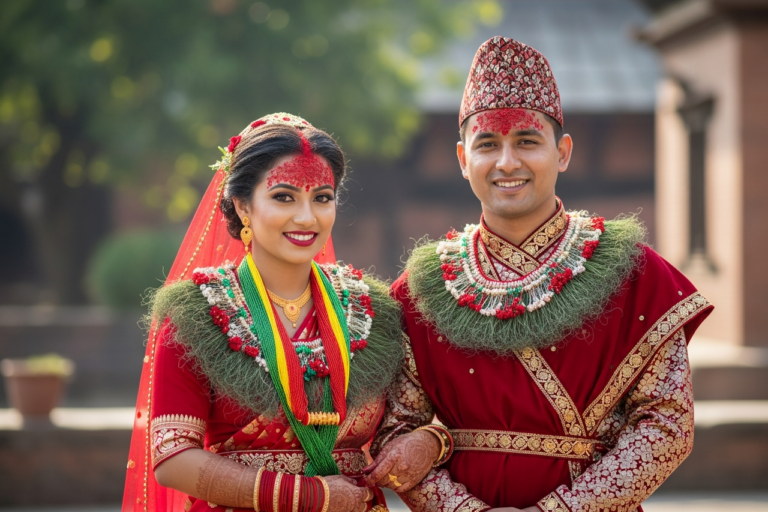
Bright colours, special fabrics, and detailed jewellery help tell the story of coming together in a Nepali wedding. Out of all the things used, the sindoor and Dubo Ko Mala are known the most. Both of these items must be there for the marriage to be complete.
The Significance of Sindoor and Dubo Ko Mala
The moment when sindoor is put on is a key part of a Nepali wedding. The groom takes this red sindoor and puts it on the bride’s hair part. This shows that she is in a married couple now. It also means he is wishing for his wife to have a long life and for them to have good luck and prosperity together. In Nepali culture, seeing sindoor on a woman shows she is married.
The Dubo Ko Mala is also important in Nepali weddings. This special garland is shared by the groom and bride during the Swayambar part.
-
Dubo Grass: The garland is made with this kind of grass. People pick it because the grass does not dry, which shows that the bond between them will last and will not break.
-
Symbol of Good Luck: When they put the garland on each other, it is said to give them good luck. It also stands for a relationship that will stay strong and not fade away.
Bridal Attire, Jewellery, and Tilhari
The bridal clothes at a traditional wedding in Nepal catch everyone’s eye. The bride often wears a bright red sari and blouse. Red is seen as a good colour for luck and happy times. She may also have a shiny veil called a “Ghoomto” over her face. This keeps her a bit hidden and shows respect to the old ways until the main part of the ceremony is done.
The bride wears heavy gold jewellery too. Her family often gives her these pieces, and they are kept in the family for years. The small details you see in the jewellery show all the history and care in the family. They give her well wishes for her new life as she starts out with her husband.
One special piece that a married nepali woman wears is the Tilhari. It is worn with the “pote,” which is a beaded necklace. The Tilhari is a long dangly piece, usually made of gold, and it tells everyone she is married now. When she puts this on with her other jewellery, you can really see the beauty of a Nepali bride at a traditional wedding.
Unique Rituals That Distinguish Nepali Weddings
Beyond the main parts of a Nepali wedding, you find many different rituals that are both fun and full of meaning. These customs give the event a special touch, making it stand out from other wedding traditions. There is usually a musical band that goes along with the ceremony. They play traditional instruments and happy songs, filling the air with excitement and joy.
All of these unique customs help people join in the fun. There are playful moments, but also times for respect. Each ritual helps make the nepali wedding a great and memorable experience for everyone who comes.
Bowing to Elders and Circling the Groom
Respect for elders takes a big place in Nepali culture. You see this so much during the wedding process. One important part is when the couple bows to their elders. They touch the feet of their parents, grandparents, and other older family members. By doing this, they ask for blessings for a long and happy married life.
This bow is a gentle way to thank and show respect. It is loved by many. In addition to this, some groups have their own special ways to honour the day.
-
Circling the Groom: In some families, the bride walks around the groom a few times. This shows she now takes him as the centre of her new world.
-
Seeking Blessings: The bow is done again and again through the wedding events. This point helps the people remember how big family support and advice is in Nepali weddings and all through married life.
Stealing the Groom’s Shoes and Janti Procession
The Janti procession is one of the most colourful parts of a Nepali wedding. This is when the groom, along with his family members, his friends, and a musical band, goes to the bride’s home. The procession is a lively parade with a lot of music and dancing. It is a happy time that lets people know the groom is coming.
Even with all the important things to do, there is still space for some fun. One of the funniest and best-known things that happens is when someone steals the groom’s shoes.
-
Playful Theft: The bride’s younger siblings or cousins try to grab the groom’s shoes. They then ask for some kind of payment, or ransom, to give them back. It is a fun way for the two sides of the family to get to know each other.
-
Bargaining: This starts a round of laughter and talking. Family members joke and try to make deals to get the shoes back. This old tradition is still done at most nepali wedding events, and young people in the family really like it.
Cultural Diversity in Nepali Wedding Traditions
Nepal is a place with a lot of diversity. There are over 125 ethnic groups in the country. You can really see this mix in wedding traditions. Some parts of these weddings are the same, but many customs are different for each group. These differences show up in everything, from the Himalayan region where the Sherpa people live, to the Kathmandu Valley where you find the Newari community.
When you look at how wedding traditions change between different ethnic groups, you can learn about their history and what they believe. The Hindu, Newari, Sherpa, and many other groups each be part of nepal in their own way. Their wedding rituals are not the same, and this make them stand out. So, in Kathmandu and across Nepal, weddings are full of colour and have so much meaning for each community.
Hindu Nepali Wedding Customs
The majority of Nepalis are Hindus, and their wedding customs form the basis of what many consider a “typical” Nepali wedding tradition. For Hindus, marriage is a sacred sacrament, and the marriage ceremony is elaborate and deeply religious. A crucial first step is consulting an astrologer to determine the most auspicious wedding date and time.
The ceremony is conducted by a priest who chants Vedic mantras, with the sacred fire as a witness. Each part of the ceremony, from the Janti procession to the Kanyadaan, is steeped in religious significance. These traditions are still very much alive and practised throughout Nepal today.
Here are some core Hindu wedding rituals:
|
Ritual |
Description |
|---|---|
|
Chheka |
The formal engagement ceremony where the wedding date is fixed. |
|
Janti |
The groom’s wedding procession to the bride’s home. |
|
Swayambar |
The couple exchanges rings and garlands of Dubo grass. |
|
Kanyadaan |
The bride’s father gives her away to the groom. |
|
Sindoor Pote |
The groom applies sindoor to the bride’s hair, marking her as married. |
Newari, Sherpa, and Other Ethnic Ceremonies
Beyond Hindu customs, other ethnic groups in Nepal have their own wedding traditions. The Newari people, who live in the Kathmandu Valley, carry out many rituals for marriage. For young girls, there is a special ceremony where they get married to a bel fruit. This is called Ihi.
The Sherpa people live in the Himalayan part of Nepal. They also have wedding traditions that come from Tibetan Buddhism. They may use a few traditional instruments, also there is a big community meal and group celebration.
Here are some examples of these wedding traditions:
-
Newari Weddings: There is a long procession, and big meals that might go on for many days.
-
Sherpa Weddings: Marked by special cultural practices made for the high places where they live.
-
Polyandry: In far-away areas like Dolpo and Humla, there was a rare practice where one wife married a few brothers, so that family land would not split up. Now, this is not common and is not accepted by the law.
These customs show just how rich the wedding traditions are for different ethnic groups in Nepal, especially around Kathmandu valley. Some weddings use traditional instruments, involve young girls, a procession, and times for the community to get together.
Modern Changes and Influences on Nepali Weddings
Nepali weddings still value tradition, but life today is changing how couples come together. Things like growing use of social media and new ways of seeing family are now shaping the way people get married. The nepali wedding has started blending old rituals with new trends. Couples now want a wedding that feels personal and special to them.
People now have new ways to pick venues. They also have new ways to share the day, with photos and videos going out fast on the internet. The nepali wedding is finding ways to fit in with this new time. We can see that family roles are shifting and planning the event can look different now. It is clear that changes in Nepali life are shaping how everyone enjoys and remembers a wedding.
Evolving Marriage Systems and Family Roles
Marriage systems in Nepal are changing. Many people still go for arranged marriage, but now more young people want to choose their own partners. Love marriages happen more often today. If both families say yes, the couple can have all the usual ceremonies. If families do not agree, some couples choose elopement for their marriage. But now, this is not as popular as it was, because people are more open to love marriages.
Family roles are also changing in Nepal. Parents and elders still help make big choices, but the couple can speak up more now. The age of marriage is also getting higher. Laws do not allow polygamy, and people are not okay with it anymore. This is a big change compared to old times.
People now see marriage more as a partnership. They want both sides to have a say in what happens. Education and ideas from the world are helping people in Nepal have more choices in marriage and family life. This makes arranged marriage, the age of marriage, and ideas about elopement and polygamy different than before.
Social Media, Contemporary Practices, and Venues
Social media has changed the way people in Nepal celebrate and share weddings. This includes platforms like Facebook and Instagram. Many Nepali post pre-wedding photos, show live ceremonies, and use creative wedding hashtags. Now, couples can share their joy with more friends and family who may live far away.
A lot of new ways to celebrate have come in too. Some couples hire event planners for help. Many now want themed parties or pick modern places instead of having the event at home. It is common to use a party palace or hotel if you want both convenience and good accommodation for your guests, especially in Kathmandu.
If you want to keep old traditions but still feel grand, many places offer both. Here are some examples:
-
Heritage Hotels: If you get one near a world heritage site, you will have a beautiful view around you.
-
Party Palaces: These spots in Kathmandu are made for big groups and give you food and decoration help.
-
Resorts: You get nice views and rooms, so you can have a fun, destination wedding and everyone will be comfortable.
Conclusion
Nepali wedding traditions are full of color and meaning. The rituals, the clothes, and all the customs show the rich Nepali culture. Every part, from the ceremonies to the special outfits and symbols, helps bring families together and celebrates love. Changes do come with time, but the heart of these wedding traditions is still about togetherness and community.
People in Canada who want to know more about a nepali wedding will find a lot to like. There are many details and a real sense of celebration in a nepali wedding. If you want to see how these wedding traditions might add something special to your life, you can always read and learn more.
Frequently Asked Questions
Are traditional Nepali wedding rituals still practised today?
Yes, that is true. Some things have changed, but the main parts of a traditional wedding ceremony are still done in Nepal. Families are proud to keep Nepali culture alive. These customs are still very important in the Nepali wedding for many ethnic groups. Many people in Nepal still hold on to these traditions at their weddings.
How do family members participate in Nepali wedding customs?
Family members play a big role in Nepali wedding traditions. The bride’s family and the groom’s family both take part in every stage of the wedding process. This goes from finding a match and making plans, to doing the main rituals. The older people in the family give their blessings. Younger family members join in the fun parts. All of this makes the Nepali wedding a real family event.
What makes Nepali weddings unique compared to others?
A Nepali wedding is special because it mixes both Hindu and Buddhist ways of doing things. There are many different wedding traditions from different cultures. The wedding process often goes on for more than one day. Some special things in the marriage ceremony include the Kanyadaan, using a Dubo Ko Mala, and fun traditions like trying to steal the groom’s shoes. All these things help make a Nepali wedding something people remember.