Key Highlights
-
The Catholic Church used to have a major role in Spain. Now, there is a big drop in the number of people linked to it. At the same time, more people do not follow any religion.
-
The Spanish population now has many different religious beliefs. Some religious communities, like those of minority religions such as Islam, are getting bigger.
-
Spain’s constitution has a rule for religious freedom. This protects both people of all faiths and people with no faith.
-
Even though there are not as many Catholics now, Catholic traditions still form a major part of Spanish culture. You see them in festivals and holidays in the country.
-
Surveys done in recent years say people here are turning more towards religious diversity. More people also say they are atheist or agnostic.
Introduction
Are you planning to visit Spain? Or maybe thinking about moving there? It helps to know how the catholic church and different religious beliefs play a part in the country. The catholic church has been at the centre of Spanish life for a long time. It has shaped art, holidays, and the way people live. Now, the spanish population still has ties to these traditions, but you will also see more variety with beliefs and ways of living. People say Spain is more open and has a mix of religious ideas. In this guide, you will see how faith and culture in Spain have changed over time. It gives a clear look from a Canadian point of view about this interesting part of Spain’s identity.
Understanding Spain’s Religious Landscape
The religious landscape in Spain is changing a lot. Many people still say they are part of the Catholic Church. But now, Spain does not have an official state religion. This change lets there be more religious diversity in the country. It is a trend that you can see across Europe, but the way it happens in Spain is special.
People’s religious beliefs in Spain are very different. Some are strong Catholics. Others are non-believers or say they are atheists, and that number is growing. This guide will look at the history of this religious landscape. It will also talk about new trends that shape how people feel about spirituality in Spain today.
Historical Roots of Religion in Spain
Spain has a long and complicated religious history. It goes all the way back to the Roman Empire, which brought Roman Catholicism to the Iberian Peninsula. For many years, this became the ruling force in Spain. The faith became a big part of who people were, and you can see its mark on the country’s power and life every day. The Spanish Inquisition was a tough time. People faced a lot of trouble if they did not follow Catholic ideas. This time still affects how people in Spain think about religion now.
For a long time, if you were from Spain, people expected you to be Catholic. The church’s hold was very strong. It reached into all parts of life—from laws, to what you could do at home, and how people acted in public. It shaped their culture and views for good and bad. Knowing this link helps people see why today’s religious beliefs and the way Spain works with religion come from this long history.
In the 20th century, things started to shift. The Spanish Constitution, made in 1978, set out new rules. It said the church and state had to be separate. People got religious freedom, meaning they could choose what to believe or what faith to join. This big change let other religions grow and gave people the space to not follow any at all. This was a new way for the country, showing how much had changed since the days of the Roman Empire and strong Roman Catholicism. Now, there is more room for
Modern Trends in Spanish Spirituality
In the past few decades, the people in Spain have seen a big wave of change called generalized secularization. This change has not just happened in Spain, but also in other parts of Western Europe. Sociological research shows there are now fewer people who feel close to the Catholic Church. At the same time, there are more people who say they are not part of any faith. This is more than just people leaving their church. It is about the way people in Spain think about religious beliefs now.
One big part of this is how levels of atheism and agnosticism are going up. This is especially seen in young people. Many people in Spain were baptized in the Catholic Church, but now, they do not practice it or believe in it as much. Because of this, their way of looking at faith and what they talk about is changing a lot.
At the same time, as more people move to Spain from other places, they have brought new religious communities with them. Islam is now the second most widely practiced religion in Spain. This change has made Spain a place with many religions and cultures. This new mix of ideas and backgrounds is now a very important part of what makes the people in Spain who they are today.
Catholicism in Spain Today
Yes, Catholicism is still the top religion in Spain. Most people there say they are Roman Catholic Christians. But the word “dominant” does not mean the same thing it used to. The catholic church’s influence is much less now in daily life. There are also fewer people who go to church and take part in church events.
Many people in Spain still say they are Catholic, but for a lot of them, it is more a part of their culture. It is not always about strong religious beliefs. Catholic ways and church events are still an important part of Spain’s culture. But now, faith is often seen as something people keep to themselves, instead of something ruled by groups like the catholic church. In the next sections, we will talk about how this change can be seen around Spain and during its well-known festivals.
Presence and Practice Across the Country
The Catholic Church can still be seen all over Spain. You see big cathedrals in cities and small chapels in country towns. But fewer people are active in the church these days. There are not as many people going to church as you might see in countries like Poland or Italy. Many beautiful and old churches have only a few people coming to mass on Sundays.
Recent numbers say that over 48% of people who call themselves Catholic rarely or never go to mass. The number of parish priests is also going down. This makes it hard for the church to keep up its work and connect with people in different parts of Spain.
There are also some new things happening with how the Catholic Church is part of public life. Some regional governments still give money to help care for historic church buildings. But people are also talking about how much religious beliefs should be taught in public schools. Now, many people in Spain see religious beliefs as something private and not something to be part of public life or run by an institution.
Important Catholic Traditions and Festivals
Even as more people in Spain say religion is not a big part of life, Catholic ways still shape the country. These traditional cultural practices are in the hearts of the people and bring everyone together. The people take part in these customs, even if they are not strong followers. These events show the story, art, and spirit of the people as one group.
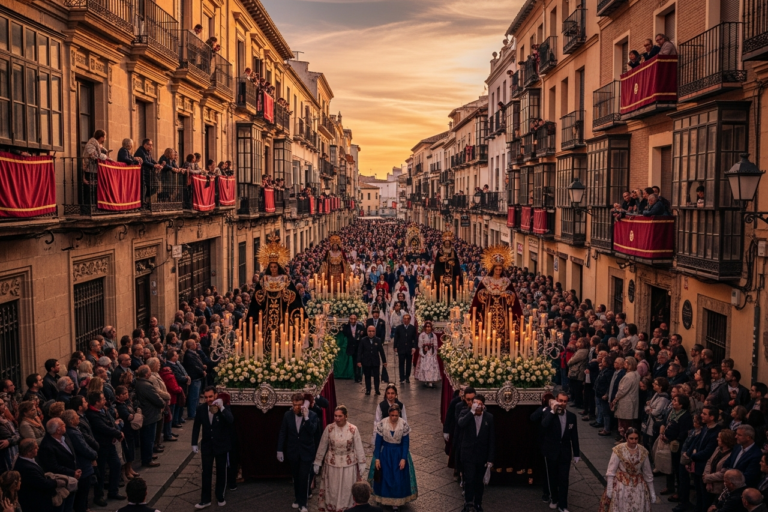
The most famous is Holy Week, which people also call ‘Semana Santa’. In this time, towns and cities all across Spain put on big and bright processions with large floats and music that is both beautiful and serious. Locals and people from other places all come to take part. Holy Week is a good example of how faith and show can come together as one.
Other important traditions also show how faith and Spanish culture mix:
-
Corpus Christi: The people enjoy walks through the streets, and the roads get a layer of fresh flowers.
-
Local Patron Saint Festivals: Every city and town has a big day for its own patron saint. There are parades, fun fairs, and people go to church together.
-
Christmas (Navidad): There are nativity scenes called ‘Belenes’, special church times, and a big Three Kings Parade that shines at night.
-
All Saints’ Day (Día de Todos los Santos): On this day, families go to see their loved ones who are gone. They bring flowers and spend some time thinking about good people from the past.
The mix of these
The Rise of Secularism and Non-Religious Identities
One big change in Spain in recent years is the quick rise of people leaving religious beliefs behind. Now, more people do not belong to an organized religion. Many like to call themselves non-believers, agnostics, or atheists. This shift is a big deal for a country that used to be known for its strong Catholic faith.
Leaving old religious beliefs behind is more than just a number. It shows a real change in how people live and think in Spain. As you will see, having more people without religious beliefs now affects things like public policy. It also changes the way people in Spain talk and spend time with each other each day.
Growth of Atheism and Agnosticism
The increase in atheism and agnosticism is one of the most striking trends in Spain’s modern religious landscape. Data from sources like the Centro de Investigaciones Sociológicas (CIS) survey consistently highlights this shift. The most recent data from April 2024 shows a significant percentage of the population identifying outside of any religious framework.
According to a recent CIS survey, about 17% of Spaniards now identify as atheists, while another 12.1% define themselves as non-believers. Combined, these groups represent nearly a third of the population, a figure that has grown steadily over the past few decades, particularly among younger Spaniards.
This trend is backed by broader studies like the Survey of European Values, which situate Spain within a larger European pattern of secularization. The most recent data reveals a clear and consistent move away from institutional religion.
|
Religious Identification (April 2024) |
Percentage of Population |
|---|---|
|
Catholic |
58.4% |
|
Atheist |
17.0% |
|
Non-believer |
12.1% |
|
Believer in another religion |
Approx. 3.0% |
Influence on Everyday Spanish Life
The rise of secularism can be seen in the everyday life of people in Spain. Many people still enjoy the big religious festivals. But for a lot of them, these days are less about faith and more about being with family, eating good food, and seeing their community. These are now more like cultural holidays, not so much about deep religious beliefs.
This change can also be seen when people talk about things in public. Now, public authorities must be neutral and not take sides on questions about religion. When there are big talks about things like marriage, education, or human rights, people are using more secular ideas instead of looking only at religious ones. Most people no longer just do what the church says.
This new way of thinking is clear in how people handle important moments in life too. Some parents still choose baptisms or church weddings. Even so, more and more people are picking civil ceremonies or not having special religious rites when a baby is born. This shows that people think personal choice and what they believe matters more than old religious rules.
Minority Religions and Multiculturalism
Spain’s religious life is about more than just Catholicism or secularism. Now, there are more minority religions in the country, thanks to large waves of immigrants. Over the last few decades, these people have brought their own ways of believing. This move has made the country more multicultural. Minority religions and their followers are now seen more. They are also an important part of life in Spain.
This new religious diversity can change the way communities feel and act across Spain. We will talk about some major religious groups. This will include Islam, Judaism, and different kinds of Protestants. We will look at how these religious minorities fit into modern Spain.
Islam and Muslim Communities
Islam has been part of Spain for a long time. This started with the arab invasion in the 8th century. Now, Islam is the second-biggest religion in the country. This is mostly because many people have come from North Africa and other countries where most people are Muslim. There are Muslim communities all over Spain today. Many live in Catalonia, Andalusia, and Madrid.
These communities have help from groups like the Union of Islamic Communities of Spain (UCIDE). This group speaks for Muslims and works with the Spanish government. They talk about religious rights and help with ways to fit in better. Mosques and prayer rooms are becoming easier to find now. These places are not just for prayer. They are also where people can meet and talk together.
Muslims are now one of the biggest religious groups in Spain after Catholicism. Muslims are a big part of Spain’s new mix of faiths. There are more cultures and ways of life here now. This shows how Spain is becoming pluralistic and open. Still, some challenges remain. People are working on ways to make social integration easier and help others see Muslims as part of everyday life.
Judaism and Jewish Heritage Sites
Judaism has a long and rich history in Spain. Long ago, before 1492, Jewish people played an important role in the culture and ideas of the area. After they were forced to leave, only a small number stayed. The Jewish community in Spain today is small but very active. They are brought together by the federation of jewish communities.
If you visit Spain, you can see the old Jewish heritage that is still alive in many places. Lots of cities have old Jewish neighbourhoods called ‘juderías.’ These areas can show you what life was like then. They are more than simple tourist spots. They stand as signs of Spain’s effort to know more about its past with many cultures.
There are some Jewish sites you might want to see:
-
The Jewish Quarter of Girona: You can walk through a maze of old, narrow roads and stone buildings.
-
Synagogues in Toledo and Córdoba: These were once important temples, and even after many years, they stand now as museums and reminders of another time.
-
The Network of Spanish Jewish Quarters (Red de Juderías de España): This is a group of towns that want to save and share their Jewish history.
Protestant, Orthodox, and Other Christian Groups
Spain is not only known for Catholicism. There are many other Christian groups here. Protestant Christianity is one that has grown a lot in the last few years. This is mostly because of people moving to Spain from Latin America. Many new evangelical churches are now set up and the Federation of Evangelical Religious Entities helps bring these groups together.
There are also more Orthodox Christians in Spain now. This growth comes from people who moved here from Eastern European countries such as Romania and Ukraine. They have built their own churches and parishes, adding something new to the mix of faiths in Spain.
Some other religious groups are here too, like Jehovah’s Witnesses and The Church of Jesus Christ of Latter-day Saints. These groups are small but still active. They help add to the many different faiths you can find in Spain. All of them get to take part in religious freedom, which is important for the country.
Religion’s Impact on Spanish Culture and Society
Religion has a big effect on Spanish culture. You can still see this, even if people’s religious beliefs have changed over time. The country’s story is shown in its cathedrals. The calendar is full of days that come from religion. You also find religious pictures and symbols in a lot of Spanish art. These traditional cultural practices are still important and help people feel like they are part of the country.
You can spot faith in a lot of places. You might see it in the grand buildings that Gaudí made. You also feel it when you take part in, or see, the lively processions during Holy Week. The next parts will look at how religion has helped shape Spain’s art and its big national events. All of these come together to make a culture that’s only found in Spain.
Faith in Art, Architecture, and Literature
Spain’s art and buildings have always shown strong religious beliefs. This goes back many years because of the country’s long history with the Catholic church. Some of the world’s best-known artists, like El Greco, Velázquez, and Goya, made paintings full of religious themes. People still look at and talk about their art today. Their paintings of saints, miracles, and stories from the Bible have set the style for Spanish art for years.
You can see this same idea in Spain’s buildings. Many of their great works are places of worship. For example, big Gothic churches in Burgos and Seville, or the famous Sagrada Familia in Barcelona built by Gaudí, are some of the best-known buildings in the country. These places are important both as houses of prayer and as pieces of art. They give us the story of how faith and art grew together in Spain.
Old Spanish books and poems also show strong ties to religion. Stories like El Cid or the poetry of St. John of the Cross often talk about religious beliefs and feelings. Because of this long tradition, even when fewer people go to church today, faith and art still go hand in hand for most people in Spain. This keeps their culture strong and full of history.
Role of Religion in National Holidays and Celebrations
Many of Spain’s national celebrations come from the Catholic calendar. This goes back to when the Catholic Church was the official state religion. Today, these holidays are so much a part of the way people live that many who are not religious join in. People in Spain see them as part of the culture, not just something for church.
You can see how much the Catholic Church still means to Spain when you look at these big holidays. They happen all through the year. Families and people in each place gather together. Everyone gets to share both quiet, church-going times and loud, fun times outdoors. For lots of people, these events are now a big part of how they think about the year and what makes them who they are.
Key national celebrations with religious origins include:
-
Epiphany (Día de Reyes): On January 6th, this is when most Spanish kids get gifts. It is now even bigger than Christmas for many families.
-
Assumption Day (Asunción de la Virgen): Spain celebrates this on August 15th. There are festivals for it in many towns.
-
All Saints’ Day (Día de Todos los Santos): This is on November 1st. Many people use this day to remember and honour those who have died.
-
Immaculate Conception (Inmaculada Concepción): This happens on December 8th and is a country-wide day off. Many towns also use it as
Religious Freedom and Legal Perspectives in Spain
Spain has strong laws that protect religious freedom. This right is set out in the 1978 constitution. The law says that people and groups can follow any faith, change their religion, or choose not to believe, and no one can treat them unfairly for it. The Ministry of Justice is the group in charge of watching over the legal status of different religious groups.
This focus on religious liberty marks a big change from how things were in the past. The constitution sets a rule that the only reason the government can limit religious expression is to protect public order. The next parts will talk more about these constitutional rights and look at how people in Spain feel about them.
Constitutional Rights and Government Policy
The Spanish Constitution of 1978 says that no religion can be set as the state religion. This plan makes Spain a country with no main faith. Article 16 is there to make sure people have the right to pick and follow any belief they like. It is a basic right for all people and every religious community. So, the public authorities in Spain must respect and guard these rights. They need to look after all different types of faith.
Government policy in Spain tries to grow good connections with the catholic church and other religious groups in the country. The state has deals with the catholic church. It also has formal plans with federations that speak for Protestant, Jewish, and Muslim religious communities. These formal deals give some legal, tax, and school-related help to them. In this way, all main faiths can have benefits and fair treatment.
For foreigners, being part of religious work can help them get a residency visa. The government has ways for religious workers and leaders from other places to get the right papers. That means they have a way to live in Spain in line with the law. It does this so both citizens and new people in the country can really use their religious freedom in daily life.
Social Attitudes Towards Different Faiths
People in Spain are, for the most part, open and welcoming about religious diversity. Most people in the country are in favor of religious freedom. They want everyone in different religious groups to be able to follow their faith out in the open. This way of thinking is a big part of what makes Spain a modern and democratic country.
But, like other places, there are still a few problems. In recent years, more people from different religions have come to Spain. Sometimes this causes tension or a bit of misunderstanding. Some religious groups, especially Muslims, have faced unfair treatment. There can be trouble when they ask to build new places of worship.
Even with these problems, things are slowly moving toward more acceptance and understanding. There are civil society organizations, as well as human rights groups, that work hard to help people from all faiths talk to each other. They also fight against discrimination. As Spain moves forward, it’s important to keep building up good social attitudes about every faith. This is needed if the country is going to stay peaceful and welcoming to all.
Insights for Canadians Travelling or Living in Spain
For people from Canada who travel or live in Spain, it helps a lot to know how religion fits into life there. Most days, you will see that the people in Spain live in a way that does not show much religion, but old customs and events linked to religion are still a big part of their culture. When you know about such things, it will be easier for you to be friendly, kind, and fair to others.
No matter if you are at a local party, inside an old church, or talking with new Spanish friends, it is a good idea to know about their religious beliefs and know a bit about what matters to them. The tips below will show you the best ways to act during religious events and will also help you see how things in Spain compare to how we do things with religion back home.
Navigating Religious Events and Etiquette
When you see religious events in Spain, try to be curious and respectful. Many of these festivals, such as Holy Week, mean a lot to the people who take part in them. Even if the streets seem fun and busy, to many these moments are about faith. When you come to watch, people will like that you respect what is going on.
There is some simple advice to follow in places of worship. If you visit a church or cathedral, it is good to keep quiet and care about those around you—especially if there is a service happening. Some things in Spain are quite relaxed, but people like when visitors dress modestly for houses of faith. Doing this is a small way to show you care about local religious communities.
Some things to help you move through these times:
-
Dress Modestly: When you enter churches, be sure the knees and shoulders are covered. You may find some cathedrals check this.
-
Be a Respectful Observer: Watch in silence during processions and services, don’t use your camera’s flash, and go along with what the crowd does.
-
Check Opening Hours: Remember, churches are not just places for visits—they are there for prayer and services, so they could be closed to tourists when something is on.
-
Ask Before Participating: If you are not Catholic but want to see a tradition, ask first how you can do so properly.
The people in Spain will enjoy sharing their holy week
Comparing Spanish and Canadian Approaches to Religion
Looking at Spain and Canada shows us some clear differences in how religion and society work together. Both countries call themselves secular and their laws protect religious freedom. But, because of its past, Spain has a special setup where one religion, the Catholic Church, still has a strong role in culture, even if it’s not official.
In Canada, there is more religious diversity. Multiculturalism means the country is used to having many religious beliefs around. No one church, like the Catholic Church in Spain, has played a big part for all the years. In Canadian public schools, a lot of talks are about how to work with different faiths. In Spain, the biggest talks are more about if and how Catholic teaching should still be in schools.
Both countries are moving toward being more secular. In Spain, this is a big change from one old way and a shared religious identity. Canada’s story is more about handling many religious beliefs at one time. Because of this, the way Spain is changing is a good way to see how a country can figure out a new link with its past and what role the Catholic Church and religious freedom will have now.
Conclusion
To sum up, knowing about the different religions in Spain is important for Canadians who want to learn about the culture and get the most out of their visit. Spain has strong Catholic roots, but there is also a move toward a life with less religion and the growth of minority religions. All of these are a big part of life in this country. When you are in Spain, paying attention to local religious events, customs, and ways of life is helpful. It can help you respect and understand others more. These things can make your time in Spain even better. If you want to know more or need tips about dealing with faith and culture in Spain, you can always ask!
Frequently Asked Questions
Is Catholicism still the dominant religion in Spain?
Yes, the Catholic Church is still the most widely practiced religion in Spain. Over half of the Spanish population say they are Catholic. But, the Catholic Church does not have as much influence as before. Now, Spain does not have an official state religion. For many people, their connection with the Catholic Church is more about culture than deep religious beliefs.
How has the religious landscape in Spain changed recently?
In recent years, the way people in Spain see religion has changed a lot. There is more religious diversity now, and more people are becoming non-believers. Sociological research shows there are not as many Catholics as before. At the same time, more people say they are atheists or do not believe in any god. Immigration also brings new faiths, like Islam, which is now more common in the country.
What should Canadians know about religious customs in Spain?
Canadians should know that while many people in Spain are not active in religion, Catholic customs still shape public life. When you go to a church or a religious event, be sure to show respect. Dress in a simple way. Stay quiet, and know that these traditions mean a lot to the religious communities there.