Key Highlights
-
Nigeria’s population is split between a muslim population in the north and a christian population in the south.
-
The country has a lot of religious diversity. Islam, Christianity, and traditional religion all have a big role in life and culture.
-
Religious beliefs are part of daily life for most people. These beliefs shape how people act, run politics, and even how the family works.
-
The law gives everyone religious freedom. But, there can be some problems and tension, mostly in the middle belt area.
-
As well as the main religions, many people add parts of traditional religion and native beliefs to what they do.
-
If you learn about these religious beliefs and how people use them, you will get to see how complex and full of life Nigerian society is.
Introduction
Welcome to a look at religion in Nigeria. Nigeria is in West Africa and is full of life. It is a place where faith is a big part of every day. Nigeria’s population shows many religious beliefs. Most people follow either Islam or Christianity. Still, there are people who practice traditional ways, too. The law says there is no state religion. But, you can see the effect of these faiths everywhere. They are part of culture, politics, and even how people live with their families. Do you want to know more about the main religions in Nigeria? Let’s get started.
Overview of Religion in Nigeria
Nigeria is the biggest country in West Africa when it comes to people. It has a long and mixed history with faith and belief. The two main religions are Islam and Christianity. There are about the same number of people who follow each faith. These two main religions can be seen in the way people live. They both have a big part in the country’s culture and the way people are with each other.
But it’s not just the main religions that matter in Nigeria. Many people still keep to older beliefs from before Islam or Christianity came. Some people mix these older ways with the newer faiths. This gives a lot of Nigerians their own kind of religious identity. It lets them bring together old ways and the way they worship now. Here, we will talk about where these main faiths came from. We will also talk about how many people now follow each one, and how people with different faiths live together in Nigeria.
Historical Roots of Faith Communities
The story of religion in Nigeria changed slowly over time. Islam came to the north in the 11th century. People from North Africa brought it through trade. The new belief systems started to shape the area long before any colonial groups showed up.
Christianity got to Nigeria much later. Most of it came in the 19th century. European missionaries came and set up schools, churches, and missions, especially in the southern areas. Many people began to follow this new faith. They kept some parts of their old religions at the same time.
These changes made people form many religious groups and associations. The constitution of Nigeria supports the formation of associations. It lets people use faith to help the country come together. Over the years, all these belief systems built the mix of religions that Nigerians see now.
Current Religious Diversity in Nigeria
Today, Nigeria shows what religious diversity can look like. The country is full of many religious communities. Each one adds something special to the nation’s culture. The main belief systems are Christianity and Islam. But inside each one, there are many groups and many ways to practice faith.
There is also traditional religion that still holds a big place for many people. A lot of Nigerians, whether they are Christian or Muslim, bring traditional beliefs and rituals into their everyday life. This mix of old ways and newer faiths is an important part of the country. It shows that faith in Nigeria is flexible and open.
Having all these different belief systems creates a lively and changing social space. There are times when it can bring problems, but it also helps build a new culture where all these religious communities talk to and learn from each other. They influence one another in a way that makes this place truly welcoming for all, and lets everyone share who they are.
Key Statistics on Religious Adherence
Understanding the numbers helps paint a clearer picture of Nigeria’s religious makeup. While estimates can vary, data from sources like the World Religion Database and analyses similar to those from the Pew Research Center provide valuable insights. Nigeria’s population is generally considered to be about 50% Muslim and 40% Christian, with the remaining 10% adhering to traditional indigenous beliefs or other faiths.
This breakdown highlights the near-even split between the Muslim population and the Christian population. This balance is a defining characteristic of the country’s demographics. The total population of Nigeria is over 200 million people, making it home to one of the largest Christian and Muslim populations in Africa.
Here is a more detailed look at the religious adherents in Nigeria based on 2025 estimates:
|
Religion |
Percentage of Population |
|---|---|
|
Muslims |
46.27% |
|
Christians |
45.83% |
|
Ethnic religionists |
7.56% |
|
Agnostics |
0.25% |
|
Other (Baha’i, Hindu, etc.) |
<0.1% |
Christianity in Nigeria
Christianity has a big place in Nigeria, especially in the south and middle parts of the country. There is a large christian population there, and many people are very dedicated to the faith. People show their faith in different ways because there are many christian denominations, like the old catholic church and the fast-growing Pentecostal movement. Church services bring people together and are a very important part of life for millions.
In places such as Anambra State in the east, Christianity is the main religion. This can be seen in the way people live day to day and how the culture grows. There are many churches, lots of church services, and people come together for religious events all the time. Christian values also show up a lot in how people act and live with each other. This all shows how much Christianity shapes life there. Next, we will talk more about the main christian denominations and movements you can find in Nigerian Christianity.
Main Christian Denominations
The Christian background in Nigeria has many groups and is really varied. It has lots of christian denominations. Big churches are the mainline Protestant churches and the Catholic Church. These churches have been in the country for a long time. There is a big number of people who go to them.
The Church of Nigeria of the Anglican Communion is one of the largest types of Anglican churches in the world. The catholic church also has many members. You will see it the most in the southeastern areas where people speak Igbo. Other christian denominations with many followers are Baptists, Methodists, and Presbyterians. Every group has its own way of doing things and how they organize their people.
There is the fast rise of Pentecostalism too. Churches like the Assemblies of God are now big names in Nigeria’s religion world. Their worship is lively, and they focus on the personal feelings of faith. Old and new denominations together make Nigeria’s christian life full of energy and changing ideas.
Catholic, Anglican, and Pentecostal Movements
The major Christian groups in Nigeria each add their own touch to the country’s faith life. The Catholic Church has a clear structure and focuses on sacraments. It is deep in the community and gives support through schools and hospitals. It is part of everyday life for many.
The Church of Nigeria, which stands for Anglicanism, is important too. Church services and community events mean a lot to the people who go there.
Pentecostal movements have grown the most in the last few years. These churches show lively worship, believe in faith healing, and work hard to share their message.
Each of these Christian groups do more than just guide people on faith. They shape the way people in Nigeria think about what is right or wrong. They do this with religious instruction and by reaching out to help their communities.
-
Catholic Church: Offers a big chain of schools and hospitals.
-
Anglican Communion: Is a well-established group with lots of people.
-
Pentecostal Movements: Grow fast and use lively styles in worship.
Regional Patterns of Christianity
Christianity in Nigeria shows clear patterns on the map. The faith is strongest in Southern Nigeria. In this area, most people are Christian. The southeast states are known for having many Christians. The southwest has both Christians and Muslims living in almost equal numbers.
In the southeast, places such as Anambra State have many people in the Catholic Church and the Church of Nigeria (Anglican Communion). The east is mostly Igbo. This is an ethnic group where most people are Christian. Day-to-day life in this part of the country is mixed with Christian traditions and events.
The Middle Belt region, including places like Plateau State, has many people of different backgrounds. The Christian population is large, and they live side by side with Muslim communities. The Middle Belt is sometimes called the point where the Muslim north and Christian south meet. This gives the region its own mix of people and ways of life.
Islam in Nigeria
Islam has been a big part of Nigeria for a long time. The muslim population in Nigeria is slightly bigger than the christian one. Most of the muslims there are sunni muslims, and they follow the maliki school of jurisprudence. There are also shia muslims in the country, and people who follow different sufi orders.
In the northern states, sharia law is used for both criminal and civil matters. This means that Islamic rules have a strong effect on daily life and how laws work for muslims. The way Islamic ideas are a part of daily life and government is a big part of these places. The next parts will talk about the different Islamic groups and where they live in Nigeria.
Sunni, Shia, and Other Islamic Sects
Most Muslims in Nigeria are Sunni Muslims. This branch is strong in the north and among Yoruba Muslims in the southwest. There are different Sufi orders, like the Tijaniyya and Qadiriyya, which have been important for spreading the faith and shaping how people live out their beliefs.
In the past few years, there is a well-known group of Shia Muslims who live mostly in the northern states. These Shia Muslims are known to follow the Islamic Movement in Nigeria, which is led by Ibrahim Zakzaky. They are a small part of the country’s muslim population but are important.
Other Islamic groups can be found in Nigeria as well. The Ahmadiyya Movement, for example, has its own communities in cities like Lagos and Abuja. These groups are not as big, but they help make Islamic life in Nigeria more varied and interesting.
Geographical Distribution of Muslims
The Muslim population in Nigeria is heavily concentrated in the northern part of the country. Northern Nigeria is the historical and cultural heartland of Islam in the nation. This region is dominated by ethnic groups like the Hausa-Fulani and Kanuri, who are predominantly Muslim.
States such as Sokoto State and Kano State are epicentres of Islamic life and scholarship. In these northern states, Islam is not just a religion but a complete way of life that influences law, culture, and politics. The cities of Kano and Sokoto have been important centres of Islamic learning for centuries.
While the north is the main stronghold, there is also a very large Muslim population in the southwest among the Yoruba people, who are roughly evenly divided between Christianity and Islam.
|
Region |
Primary Religion |
Key States with Muslim Majorities |
|---|---|---|
|
Northern Nigeria |
Islam |
Sokoto, Kano, Katsina, Borno, Zamfara |
|
Middle Belt |
Mixed |
Significant Muslim minorities |
|
Southern Nigeria |
Christianity |
Significant Muslim population in the Southwest (Yoruba areas) |
Islamic Festivals and Rituals
Islamic festivals are big events in Nigeria. They are celebrated with excitement by the Muslim community. These moments are special for prayer, family time, and acts of charity. The two main Islamic festivals, Eid al-Fitr and Eid al-Adha, are national holidays.
Eid al-Fitr shows the end of Ramadan. Ramadan is a month of fasting and thinking about faith. People celebrate with special prayers, big meals, and gifts. Eid al-Adha is called the “Festival of Sacrifice.” It remembers how Prophet Ibrahim was ready to sacrifice his son. People mark the day by sacrificing animals and share the meat with family, friends, and those who need help.
These celebrations are a lively religious practice. They are also a key part of the cultural calendar in Nigeria. Besides these festivals, many Muslims follow practices based on Islam every day. In some states, sharia courts deal with legal matters based on Islamic principles.
-
Eid al-Fitr: A happy religious ceremony to celebrate the end of Ramadan’s fast.
-
Eid al-Adha: A festival of sacrifice with prayer and charity.
-
Mawlid an-Nabi: The ceremony for the Prophet Muhammad’s birthday.
Traditional Religions of Nigeria
Long ago, before Islam and Christianity were in Nigeria, the country had many african traditional religions. These indigenous religion groups belong to certain ethnic groups and their own lands. Even today, some people practice these traditional beliefs. Many people have them alongside Christianity or Islam.
In Nigeria, it is normal for people to mix religions. Not many people say they only follow a traditional religion. Still, the power of these traditional beliefs can be seen all over culture, art, and the way people live. Let’s look at some of the main spiritual systems found in traditional religion in Nigeria.
Core Indigenous Spiritual Systems
Nigeria has many different indigenous religion traditions. Every ethnic group in the country has its own traditional belief system. Most of these belief systems believe in many gods or spirits. They focus on deities, ancestral spirits, and forces of nature. There is often a supreme creator god, but people mostly worship lesser spirits or others who act as go-betweens.
For the people, these belief systems are more than just prayers or worship. They help people think about life, rules for right or wrong, and how the community should work together. Rituals, ceremonies, and sacrifices are key parts of their religion. These actions help keep peace between people and the spiritual world. Ancestors are given a lot of respect. Many believe that their ancestors give advice and protect their families.
Some practices, like spirit possession and divination, are found in many indigenous religions. These are ways to talk with spiritual beings. Even today, these old belief systems are still very important. They have a big impact on art, music, and how people in Nigeria interact with each other.
[Keywords: ethnic group, belief systems, spirit possession, traditional belief system, indigenous religion]
Yoruba Religion: Beliefs and Practices
The Yoruba religion is one of the biggest and most well-known native faiths you will find in Nigeria. Many Yoruba people in the southwest take part in this religion. The system may seem difficult to understand, but it has also made its way to other countries. This includes some places in the Americas, where it helped shape other religions like Santería and Candomblé. The faith is centred on many gods called Orishas.
These Orishas show up as parts of the main creator called Olodumare. Each one looks after something in nature or in human lives. People build strong ties with different Orishas and show respect by doing rituals, making offerings, and joining in festivals. Priests and priestesses in the Yoruba religion—called Babalawos and Iyaloshas—stand as go-betweens. They use special methods like divination to guide others.
Traditional practices stay a big part of Yoruba people lives, even if someone is Christian or Muslim.
-
Orishas: There is a group of gods. This includes ones like Shango, the god of thunder, and Oshun, the goddess of rivers and love.
-
Divination: The Ifá system is used when people want to know what the gods think or want.
-
Spirit Possession: In some events, people might go into a trance. This is thought to be a form of spirit possession by an Orisha.
Igbo and Other Ethnic Traditions
Just like the Yoruba have their own way of understanding the spiritual world, the Igbo people in southeastern Nigeria follow a traditional religion called Odinani. This belief centers around a main creator called Chukwu. He is thought to be far away, so most people pray to many smaller spirits known as Alusi instead. These spirits’ jobs include watching over the earth, rivers, and markets.
Ancestors, called Ndichie, are very important in Igbo belief systems. They help protect good behavior and keep old ways alive. If someone wants advice or to talk to spirits, they go to a diviner called a Dibia. Even though most Igbo people are Christian now, you can still find many traditional beliefs and customs in their daily lives.
Besides the Igbo, almost every other ethnic group in Nigeria has their own indigenous religion. For example, the Hausa people have the Bori spirit-possession group. In the Middle Belt and Niger Delta areas, there are also different traditional faiths. All these belief systems give Nigeria its special and rich mix of cultures.
Minorities and Lesser-Known Religions
Islam and Christianity have the most followers in Nigeria. But, the other faiths and some new religious groups are also there. Even if there are not many people in these groups, they help shape the spiritual life of the country. The fact that they are there shows the country also supports having many views.
These smaller faiths include big world religions like the Baháʼí Faith, Hinduism, and Judaism. There are also new groups that mix teachings from both Christianity and Islam. If you know about these smaller groups, it helps you get the full picture of what religion is like in Nigeria.
Baháʼí Faith, Judaism, and Hinduism in Nigeria
The Baháʼí Faith is one of the smaller religious communities in Nigeria, but it is well-known. This faith teaches that all people are spiritually connected. People who follow this faith in the country come from many different backgrounds. Baháʼí groups are found in different parts of Nigeria, and they now help bring people of different religions together.
Judaism is followed by a small group in Nigeria. This includes some people from outside of Nigeria and some Igbo-Jews who think they are from the old Israelite tribes. Even though there are not many Jewish people in the country, this religion is an interesting part of Nigeria’s religious communities.
There is also Hinduism, which is not very common. People from India who live in Nigeria and some local people who changed their religion practice Hinduism. These smaller religious communities are not large, but they show how Nigeria is tied to many other parts of the world. They all add to the many religious communities found in the country.
Chrislam and Religious Syncretism
One of the most different religious things in Nigeria is Chrislam. This faith mixes Christian and Islamic beliefs and ways of worship. People who follow Chrislam do not see any problem with reading both the Bible and the Quran. They can go to a service and join in things from both faiths.
This way of mixing different beliefs shows the long history of different faiths living together in Nigeria. It is found mostly in the southwest, where the Yoruba people speak their own language. Christians and Muslims have lived side by side there for a lot of years. Chrislam grew up from the people and helps support the idea of religious tolerance. It is one way people try to bring the two main faiths closer together.
Chrislam is not followed by most people. But it shows how many in Nigeria like to mix belief systems from each other.
-
Shared Worship: Chrislam services can have parts from both the Bible and the Quran.
-
Founders: A few different people started this movement, and there are a few branches.
-
Symbol of Coexistence: Chrislam is a sign that people in Nigeria can live together with peace when it comes to faith.
Other Emerging Faith Communities
Besides the well-known religions, Nigeria also has many other small and new religious communities. These groups are often made up of a few people and are found in certain areas. Still, they add a lot to the country’s religious identity and are part of what makes religious communities in Nigeria so lively. The groups can go from new faith ideas to new branches of older religions.
A lot of these smaller religious communities come together because they follow someone strong who leads them. Sometimes these groups focus on helping people grow or in finding their own path. Other groups have their own set ways and rules. Their rise shows that, while things change fast in the country, people want to find meaning in life.
Having so many different types of faith groups shows that religious identity in Nigeria can change and does not stay the same. This means the spiritual world in the country is growing and changing all the time. New religious communities keep popping up to join the big religions and old traditions.
Religion and Regional Diversity
Nigeria’s religious layout is split mostly by region. Northern Nigeria has more people who follow Islam, while southern Nigeria has more people who follow Christianity. But, the line is not always clear. There is a lot of change and mix, mostly in the centre of the country.
The Middle Belt sits in the middle area, where both main religions meet. This area has people from both groups, and there is much mixing. Some towns have more Muslims, and some have more Christians. To understand the way people act and think about faith in the country, you need to know about northern Nigeria, southern Nigeria, and the Middle Belt. In the coming parts, we will talk about the religious life in each place.
Northern Nigeria: Islamic Strongholds
Northern Nigeria is the main area for Islam in the country. The muslim population here is very high. The religion is a big part of the way people live, their culture, and their rules. Some states, like Sokoto State—known for the Sokoto Caliphate—and Kano State, are important for Islamic teaching and history.
The Hausa-Fulani are the biggest ethnic group in northern nigeria. Almost all are Muslim. For many years, this part of west africa has been known for islamic education and ways of life. Islamic ideas can be seen in the social rules and the laws here.
But, this area has seen a lot of problems, like religious fights and the actions of boko haram. Despite this, northern nigeria is still a key place for the islamic faith and culture in the country.
Southern Nigeria: Christian Majorities
Southern Nigeria is not like the north. Most people here are part of the christian population. Christian faith is very important to the people. You will see it in both public and private life. This area has many cultures. The Yoruba live in the southwest, the Igbo are in the southeast, and there are other groups around the Niger Delta.
The southeast, where the Igbo are from, has a very strong christian population. In places like Anambra State, there are many Catholics and Anglicans. Most people celebrate Christian holidays. The church is a big part of community life. When there is a religious ceremony like a wedding or a funeral, it always follows Christian ways and songs.
In the southwest, you will find the Yoruba people. Here, there is more of a mix. Some are Christian and some are Muslim. The two groups live together in peace most of the time. Because of this, Southern Nigeria is an important place for Christianity in Africa. You will find many lively churches. The christians here are proud and very active.
Middle Belt: Religious Mixing and Pluralism
The Middle Belt is a part of Nigeria where the north meets the south. Here, people from many religions live together. There is no single group or faith that is bigger than all the others. You will find Christians, Muslims, and people who follow local customs all living in this area.
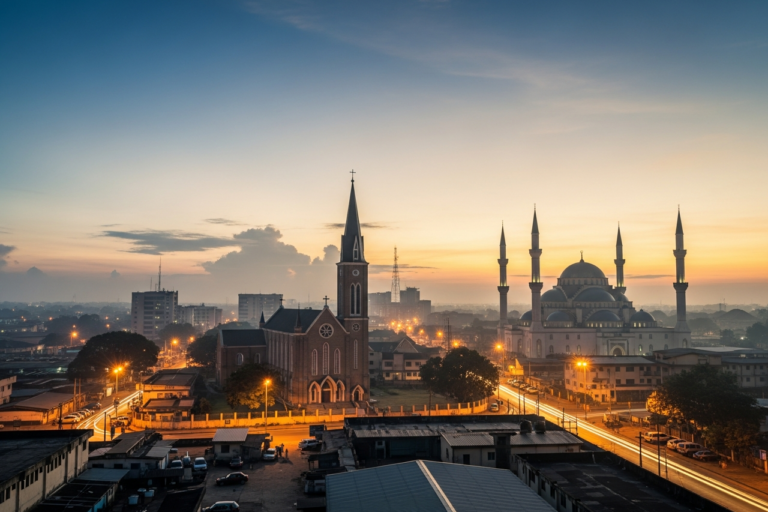
Because of this, the middle belt is a great place to look at how different faiths live together. In towns and cities, you might see a church next to a mosque. People from all different groups talk and spend time with each other every day. This brings a mix of culture and ways of life.
But this diversity can also lead to problems. People argue about resources, land, and who gets power, and these fights sometimes take on a religious side. This can cause tension, especially in places like Plateau State. Even with these problems, the middle belt still shows how many religions can mix in Nigeria.
Religion’s Role in Nigerian Society
Religion in Nigeria is a big part of life. It is not just about what people believe. The way people live, act, and see others comes from their faith. The rules people follow, and how families and groups act, come from religion. Faith helps give people in Nigeria a sense of right and wrong. It also shows people how to act with others.
Many children learn about faith early. Most people go to a religious ceremony many times as part of growing up. Religious instruction also plays a big role because it shapes how people see themselves and others. It helps guide how people behave and how they act in groups or as a family. In the next part, we will look at how religion is a strong part of life for people in Nigeria.
Influence on Social Norms and Ethics
In Nigeria, the way people live is shaped a lot by religious teachings. Christianity and Islam give people a strong set of rules and ideas about how to act right. These faiths also help people know what is fair and how to treat others with care. Many Nigerians look to their religious identity for advice on what is good or bad.
This idea of religious identity affects many parts of life, like how business is done or how friends and families treat each other. People there learn to be honest, to show respect for older people, and to care for their community. These ideas are shared often in talks, at places of worship, and in group chat.
You can see how religion matters in Nigeria’s public life, too. Those who lead the faith are often the first to talk on what is right or wrong. They can change what many people think because what they say is important. The values people share from their religions help keep peace and bring everyone together, all over the country.
Role in Community and Family Life
Religion is at the heart of family and community life in Nigeria. Churches and mosques are more than places for people to worship. They are the main spots where people meet, talk, and help each other. These places give everyone a way to connect, share what they go through, and give support when someone is finding it hard.
Inside each family, religious beliefs are very important. Big moments like having a baby, weddings, or when a loved one dies are all marked by things tied to religious instruction and faith. Passing their beliefs on to their children is a big part of being a parent. It’s how parents pass faith and their ways to the next group growing up. Everyone having the same beliefs helps people in the family to feel close.
The role of churches and mosques in each community is bigger than just faith.
-
Social Services: Lots of churches and mosques run schools, clinics, and help those who are having a hard time making ends meet.
-
Community Cohesion: Big prayer meetings and get-togethers help make everyone feel they belong to one group.
-
Moral Guidance: Leaders at these places help when people don’t agree in families or in the community, giving support and advice on what to do.
Religion and Gender Roles
Religious beliefs shape how people in Nigeria see and talk about gender roles. That includes both Christianity and Islam, and the traditional practices that people follow. These beliefs teach that men and women should have different jobs and roles in the family and in their community.
In many cases, these religious beliefs support a system where men are the head of the house. Men also make most of the big choices. Women often take care of the home and the children. People see these roles as something that comes from God. Over many years, these ideas have become part of the way people live.
But religion’s effect on gender is not always the same. Some women are religious leaders in their area. Some people even use religious texts to support the idea of men and women being more equal. Today, ideas from the modern world mix with old ways and with religious beliefs. Because of this, gender roles in Nigeria keep changing and growing in new ways.
Religion and Nigerian Politics
Nigeria’s constitution says that the government of the federation cannot make any state religion official. But in the country, you can see how religion still shapes politics. Religion plays a big role in getting people together, in how people vote, and in laws and policy. Politicians often talk about what people believe to get support from them.
When you mix religion and government, it is not simple. Religious leaders have a lot of influence. They often get involved in political matters and can change what people think. The government has to work harder to serve everyone well, since there are so many different beliefs. In the next sections, you will see more about how religion and politics connect in Nigeria.
Religious Influence on Political Parties
Religious ideas play a big part in the political parties in Nigeria and shape how things work in the country’s government. The rules say the parties can’t use religious words or images in their names or logos. But there are still strong links between religion and politics that you can see, just not always in the open.
Most parties try for what some people call a “balanced ticket.” This is when the president and vice president come from different religious groups. Usually, you will see a Muslim from the north picked with a Christian from the south. Many believe doing it this way keeps the country together and helps the party reach more people.
Religious leaders and their groups also hold a lot of power in politics. They often tell people who to vote for, and their support can change a lot on election day. Many times, they talk to the government to stand up for the needs of their members. Because of all this, you can’t leave out religion when talking about any big political party in Nigeria.
Laws and Secularism
Nigeria’s legal system reflects its religious complexity. The country officially operates as a secular state, with a constitution that guarantees freedom of religion. However, the legal framework is a hybrid system that incorporates different legal traditions, including common law, customary law, and Islamic law.
The most notable aspect of this is the implementation of Sharia law in 12 northern states. These states have incorporated Islamic legal principles into their penal codes, applying them to civil and, in some cases, criminal matters for Muslims. The constitution allows for Sharia Courts of Appeal to handle questions of Islamic personal law, with the Supreme Court as the final arbiter.
This dual legal system creates a unique balance between secularism and religious law.
|
Legal System |
Jurisdiction |
Key Features |
|---|---|---|
|
Common Law |
Nationwide |
Based on the English legal system; applies to all citizens. |
|
Sharia Law |
12 Northern States |
Applies to Muslims in civil and some criminal cases. |
|
Customary Law |
Nationwide (often at local level) |
Based on traditional ethnic norms and practices. |
Church, Mosque, and Government Relations
The links between church services and the government of the federation can be hard to understand. The government says it wants to stay neutral. Still, it works with Christian and Muslim leaders when there are big problems in the country. This teamwork helps keep people calm and safe.
Big church groups and mosque leaders often help share ideas between the people and the government. They talk about what the government is doing and stand up for their groups. Sometimes, the government gives support to make things like pilgrimages possible.
But things do not always go well. Religious leaders often speak out when there is corruption or things are not fair. The way the government and religions work together changes all the time. This shows how much church services and mosque events matter to people in Nigeria.
Religious Festivals and Cultural Traditions
Religious festivals are an important part of life in Nigeria. These events are lively and bring people together. Both big Christian and Muslim celebrations are seen as public holidays. This means everyone in the country can join or show respect for the religious ceremony. These are not just about faith. They are also a time for family, friends, and showing culture.
There are also traditional holidays. People still celebrate these, mostly in their home areas. These events honour those who came before, spirits, and the old gods. This shows that Nigeria’s first beliefs are still strong. The next parts will share some of these main celebrations.
Major Christian Celebrations
For Nigeria, Christmas and Easter are the biggest days of the year for its christian population. People mark these holidays with special church services, getting together with family, and eating good food. The whole country, no matter their faith, often wants to be part of the fun.
Christmas in Nigeria is full of colour and happiness. People decorate their homes and streets. Many families travel back to the place where their family comes from to celebrate with their loved ones. There is lots of music, events, and acts of giving during the season. On Christmas Eve and Christmas Day, church services are a big part of the holiday for everyone.
Easter is also a time people in Nigeria honour with much thought. It is about looking back on the life, death, and return to life of Jesus Christ. The week before Easter Sunday is spent in deep thought and prayer. For many, these holidays are both religious events and important parts of the country’s culture that bring people together.
-
Christmas: Held on December 25th. It has special church services and big dinners with family.
-
Easter: Lasts a whole week and ends with celebrations on Easter Sunday.
-
Good Friday: A public holiday in Nigeria. It remembers when Jesus was put on the cross.
Key Islamic Festivities
The muslim population in Nigeria comes together to celebrate important Islamic festivals every year. People enjoy these events with a lot of joy and devotion. These are big moments in the Islamic calendar and are marked as public holidays across the country. The two main festivals for the muslim population are Eid al-Fitr and Eid al-Adha.
Eid al-Fitr is known as “Small Sallah” in Nigeria. It shows the end of Ramadan, which is a month of fasting. During this time, many go to the mosque early in the morning for prayers. After prayer, families meet for special meals, give each other gifts, and visit friends or family.
Eid al-Adha, called “Big Sallah,” is a festival about sacrifice. It honours the story of Prophet Ibrahim, who was ready to give up his son. Many muslims with enough money will sacrifice an animal, often a ram. They share the meat with family, those who live nearby, and people who have less. These two big festivals are times of deep faith and bring everyone closer as a community.
Traditional Religious Holidays
Beyond Christian and Islamic celebrations, Nigeria has many traditional holidays. These come from its indigenous religion and the cultures of different groups. Most of these festivals are linked to farming, respect for ancestors, or the worship of certain gods. They may not be national holidays, but they are big events in their local areas.
For example, the Yoruba people hold many festivals for their Orishas. One of the most famous is the Osun-Osogbo festival. It draws visitors and worshippers from all over the world. The Igbo have the New Yam Festival, called Iri Ji. This is a harvest event where people thank the gods for a good year and celebrate the start of a new one.
These traditional holidays are colourful shows of culture and traditional beliefs. There are fancy outfits, music, dancing, and masquerades. They keep people connected to their roots, and they help keep old customs strong in Nigeria today.
Religious Conflicts and Tensions in Nigeria
Nigeria is known for people living together, but the country has faced violent conflict where religious tension is a big part. Some places in Nigeria, especially the middle belt, have seen religious violence between Christian and Muslim groups.
The violent conflict is not about religion alone. It often comes from ethnic rivalries, political fights, and problems over land or resources. To know what makes Nigeria struggle for peace, you have to see how deep and wide the history of conflict goes. Understanding this helps us see why building a peaceful, mixed society is hard.
Historical Overview of Conflict Zones
Nigeria has had a lot of trouble with violent conflict in some key places. The Middle Belt, including Plateau State and southern Kaduna, often sees problems. People call these places hotspots because fights between Christian farming groups and Muslim pastoralist groups happen a lot. The farming communities say they are “indigenous,” and the pastoralist groups are seen as “settlers.”
Most of these violent conflict events are about who gets land, resources, and control over politics in the area. But soon, they become a fight about religion. Churches and mosques are sometimes attacked. For example, Jos in Plateau State has had several big rounds of violence since the early 2000s.
In the northeast part of Nigeria, there is one of the worst conflict zones. The Boko Haram group has brought a lot of pain. This group is Islamist, but its attacks have hurt both Muslims and Christians. Because of Boko Haram, many families have been forced to leave their homes. This is one of the most extreme bad moments of religious violence in Nigeria in the past years.
Root Causes of Religious Violence
The root causes of religious violence in Nigeria are not just about beliefs. They are deep and come from many sides. Things like poverty, economic inequality, and high youth unemployment make people feel angry and left out. Leaders who want power can use this anger to push their own goals.
Different ethnic groups fight over land, resources, and power. In Nigeria, religion and ethnicity often mix together, so these fights can turn into religious violence fast. If one group feels not listened to, or treated unfairly, it adds to the anger.
Social media makes things worse now, too. Lies and hate get shared very quickly, so it becomes easy for problems between communities to grow.
-
Socio-economic factors: Poverty and fighting for resources that are not enough for everyone.
-
Political manipulation: Powerful people use religious identity to get more support and push away others.
-
Historical grievances: Old fights between ethnic and religious communities that still matter today.
[Keywords: religious identity, religious violence, social media, religious communities]
Peace Initiatives and Interfaith Dialogue
Many peace efforts and talks between different faith groups have started in Nigeria because of religious tensions. These groups bring Christian and Muslim leaders, along with youth and women, to meet and talk. The aim is for people to build a better understanding of each other. By doing this, they want religious tolerance to grow from the local level.
Groups such as the Interfaith Mediation Centre in Kaduna play a big part here. They teach community leaders how to solve problems and create chances for people from all sides to work together. The formation of associations that connect people from different religions is thought to be one of the best ways to help everyone live in peace.
These efforts also show what people have in common. They ask the community to work as one team, especially on projects that help make life better for all. There are still some difficulties, but the large push for more interfaith dialogue and the formation of associations is bringing hope. It gives many Nigerians the idea that a peaceful future can still happen, as people learn to live and work together.
Religion, Human Rights, and Freedoms
Nigeria’s constitution gives strong support to religious freedom. The government of the federation must follow these rules to make sure every person in the country can have the right to their own thoughts, beliefs, and religion. This means people can choose their faith, change it, and follow their beliefs as they want.
But, putting these freedoms into action can be hard. People may face pressure from others, or deal with unfair treatment in their area. In some places, rules based on religion can also make it tough for people to use their full rights. The next parts will look at these rights in the constitution and what can get in the way of using them.
Constitutional Guarantees
The 1999 Constitution of Nigeria gives clear rights for religious freedom. Section 38 gives every person the right to have their own thoughts, beliefs, and religion. People can change their religion or what they believe in, and they can show and share their faith in worship, teaching, and daily practice.
In addition, the constitution does not let the Government of the Federation or any state pick a state religion. This shows that Nigeria is a country where all religions are meant to be equal. The law also says people cannot be treated badly because of their religion, which should help everyone get the same rights and chances, no matter what they believe.
These promises in the law give strong support for religious freedom. People and groups can practice their religion openly and without the state getting in the way. This is the base for the different beliefs people have in Nigeria. The government is required to stand up for these rights for all the people in the country.
Challenges to Freedom of Worship
Even though the constitution gives strong support for religious freedom in Nigeria, this right still faces some problems. One big problem comes from the use of two different kinds of courts. The Sharia courts in the northern states are allowed for Islamic personal law. But, this setup can lead to trouble. Sometimes their decisions are seen as going against the rights of people from other religions or even some Muslims who do not want to follow these laws.
People also feel a lot of pressure from others in their everyday lives. In places where one faith is the main one, those with a different religion might find it hard to get a job, a place to live, or even talk with people around them. If someone decides to change their religion, this can mean being shut out by family and friends.
Nigeria does not have a state religion, but sometimes politicians work closely with religious leaders. This can make people think the government picks sides. Because of these things, the fight for true religious freedom, the role of sharia courts in northern states, and not having a state religion, all face a lot of real-life challenges.
Conclusion
Religion in Nigeria is made up of many beliefs and traditions. These different ways of life play a big part in shaping the country’s identity. When you look at how Christianity, Islam, and traditional religions mix and work together, you learn a lot about the people and how they live. As Canadians, when you learn about these faiths, it is good to be open, aware, and to respect how things are done there. By knowing the small details, you can enjoy your time in Nigeria more and connect better with others. If you want to visit or just learn more, try to accept and understand these differences. It will help you enjoy Nigeria’s culture even more. If you want to talk about this or have questions, you can reach out anytime!
Frequently Asked Questions
Are traditional religions still practiced alongside Christianity and Islam?
Yes, that’s true. Many people in the Muslim population and Christian community still use parts of traditional religion in their lives. In Nigeria, you will often see this mixing of faiths. The old indigenous religion and the newer beliefs live side by side. This shows there is a good amount of religious tolerance in the country.
How do religious demographics in Nigeria compare to other African countries?
Nigeria stands out in West Africa. The country has almost the same number of Christians and Muslims. With its large total population, Nigeria is home to one of the largest Muslim populations and one of the largest Christian populations in the area. Some other countries in West Africa have more people following one religion, but Nigeria’s mix is different from most.
What should Canadians know about religious etiquette when visiting Nigeria?
When you visit Nigeria, you need to respect the different religious beliefs and practices. Wear modest clothes when you are at places of worship or in areas where people are more conservative. Be careful during a religious ceremony and show religious tolerance. For example, know about prayer times if you are in Muslim areas, and understand social customs in every community.