
Filipino traditions in Canada include Simbang Gabi, Flores de Mayo, Santacruzan, and Filipino Independence Day, observed by more than 900,000 Filipino-Canadians in cities including Toronto, Vancouver, and Winnipeg. Parish groups and community organizations coordinate most events, from pre-dawn Christmas Masses to June flag-raising ceremonies.
What Are Filipino Traditions — and Why Do They Thrive in Canada?
Filipino traditions in Canada are the religious, cultural, and community customs that Filipino-Canadians carry from the Philippines and adapt to Canadian life. They include Simbang Gabi, Flores de Mayo, Santacruzan, Filipino Independence Day, and All Saints’ Day observances. Parishes, cultural centres, and consulates across the country help keep them going.
According to the 2021 Census, Statistics Canada counted more than 957,000 people of Filipino origin in Canada, a fourfold increase since 1996, making Filipino-Canadians the country’s fourth-largest racialized group. Filipino-Canadians live across the country, with the largest communities in Metro Toronto, Metro Vancouver, Calgary, and Winnipeg. Winnipeg has the highest share of any major city, at just over one in ten residents.
Canada’s Multiculturalism Act, passed in 1988, recognizes and encourages Canadians to preserve and share their cultural heritage, which gives communities like this one room to keep their traditions visible rather than setting them aside. It’s the same spirit behind occasions like Canadian Multiculturalism Day. For many Filipino-Canadians, these traditions aren’t just about looking back. They’re a way of staying connected to family, faith, and identity while building a life here, and second-generation Filipino-Canadians can use them to understand where their parents or grandparents came from.

Simbang Gabi: The Filipino Christmas Dawn Masses Celebrated Across Canada

Simbang Gabi is a novena of nine dawn Masses held from December 16 to Christmas Eve, and it’s one of the traditions Filipino-Canadians hold onto most closely. In the Philippines, the Masses typically start around 5 a.m. In Canada, many parishes move them to early evening or a more manageable pre-dawn hour so people can get to work afterward, though some communities keep the original early-morning start out of devotion.
Parishes with large Filipino congregations host Simbang Gabi across the country. Holy Cross Parish in Toronto and St. Jospeh Parish in Vancouver are among the Canadian parishes known for hosting the novena Masses each December. The services are held in Tagalog and English so that both older and Canadian-born family members can follow along. After Mass, many parishes serve bibingka (a rice cake baked with coconut milk) and puto bumbong (a purple rice cake steamed in bamboo tubes); foods that show up almost nowhere else during the year, which is part of why the post-Mass fellowship matters as much as the service itself.
Attending nine Masses in a Canadian December means contending with snow, ice, and early darkness that simply doesn’t come up in the Philippines. That adjustment is part of what makes the Canadian version of Simbang Gabi its own thing, but communities show up anyway, year after year. If you’d rather make bibingka or puto bumbong at home between Masses, Canada’s multicultural food markets are often the easiest place to find glutinous rice, coconut milk, and banana leaves.
Flores de Mayo and Santacruzan: Spring Celebrations in the Filipino-Canadian Calendar

Flores de Mayo is a month-long Marian devotion held throughout May, and Santacruzan is the procession that closes it. Together, they’re some of the most visually striking Filipino traditions Canadians see in spring. Flores de Mayo involves daily prayers and flower offerings to the Virgin Mary, often led by children. Santacruzan re-enacts the story of Reyna Elena (Queen Helena) finding the True Cross, with a procession of sagalas (young women in formal dress) representing different biblical and historical figures, each paired with an escort.
In Canada, both traditions usually move indoors, into parish halls, community centres, or gymnasiums, since May weather is unpredictable and outdoor processions aren’t always practical. St. James Parish in Abbotsford, British Columbia, has hosted a Santacruzan procession in which children carried flowers and signs honouring Mary, a smaller-scale version of the elaborate processions held in the Philippines, but one that keeps the core of the tradition intact.
Children and teenagers usually take the lead roles in both events, which makes them a natural entry point for second-generation Filipino-Canadians who may not have grown up with the Catholic devotions that shape so much of Filipino life the way their parents did. Grandparents and parents often help with costumes and rehearsal, turning the celebrations into one of the few traditions that reliably brings three generations of a family into the same room.
Filipino Independence Day in Canada: June 12 Celebrations

Philippine Independence Day falls on June 12, marking the day in 1898 that the Philippines declared independence from Spain. In 2026, that’s the 128th anniversary. Filipino-Canadian communities mark it with flag-raising ceremonies, parades, cultural performances, and community festivals rather than a day off work, since it isn’t a Canadian statutory holiday.
The Philippine Consulate Generals in Toronto and Vancouver typically coordinate the largest official observances, including flag-raisings at city halls and community events. The Toronto consulate has held Independence Day festivities at parks such as Earl Bales Park, with music, dance, and food organized around the anniversary. Local cultural associations and parishes often run their own smaller events the same week.
June is also Filipino Heritage Month in Canada, a designation the House of Commons adopted in 2018 through a motion recognizing the contributions of Filipino-Canadians. The two occasions overlap deliberately. Independence Day festivities often double as the highest-profile events of Filipino Heritage Month, and many cities schedule their biggest cultural programming around June 12 rather than earlier in the month. You can find a fuller rundown of how communities mark the occasion in our guide to Filipino Heritage Month in Canada.
All Saints’ Day and the Filipino Practice of Remembrance in Canada

In the Philippines, All Saints’ Day and All Souls’ Day (November 1 and 2) are spent at the cemetery. Families clean gravesites, light candles, bring flowers, and often stay for hours, sharing food and stories about the person they’re visiting. It’s less a solemn duty than a family reunion that happens to take place among headstones.
Filipino-Canadians keep the core of the practice while adapting it to Canadian cemeteries and colder November weather. Visits tend to happen during the day rather than the overnight vigils common in the Philippines, and some parishes hold a special Filipino All Saints’ Day Mass around the same weekend for people who want a communal observance alongside the cemetery visit.
For Filipino-Canadians whose parents, grandparents, or other family members are buried in the Philippines rather than in Canada, the day carries an added layer. There’s no grave to visit here, so the observance becomes a phone call home, a Mass dedicated to that person, or a family meal held in their memory instead.
Other Filipino Traditions and Festivals Observed in Canada

A handful of other Philippine festivals show up in Canada, though less consistently than Simbang Gabi or Independence Day.
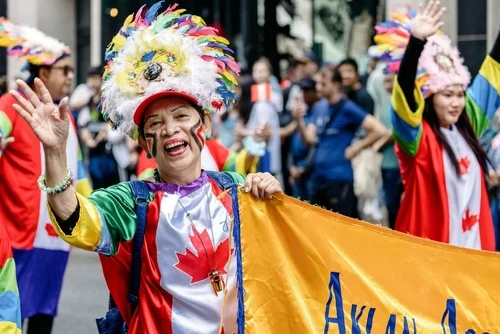
Pista ng Nayon (village fiesta) celebrations have found a Canadian foothold. The United Filipino-Canadians of British Columbia organizes Pista ng Bayan Vancouver, a fiesta-style event with food, performances, and vendors modelled on the town fiestas held across the Philippines each year. Ati-Atihan, the tribal-costume festival that originated in Kalibo, Aklan, appears in Canada mainly through smaller cultural-association showcases rather than a citywide festival. What you’ll typically find here is a performance segment within a larger event rather than a full Ati-Atihan celebration. General community fiestas, often tied to a specific hometown or patron saint back in the Philippines, are also common and tend to be organized by regional associations rather than one national body.
That regional layer is easy to miss if you’re not looking for it. The Filipino-Canadian community life is often organized around where in the Philippines a family is from. Ilocano, Visayan, Bicolano, Kapampangan, and other regional associations run their own gatherings, dialects, and food traditions alongside the pan-Filipino events. For someone new to a city, a regional association can sometimes be an easier way in, than a large citywide festival.
How to Find Filipino Cultural Events Near You in Canada

Finding out what’s happening near you takes a bit more digging than checking a single citywide calendar. Availability varies a lot by city size, and Toronto or Vancouver will simply have more going on than a smaller centre. A few starting points:
- Philippine Consulate General event calendars. The consulates in Toronto and Vancouver post flag-raisings, Independence Day festivities, and other official events on their websites and social media.
- Filipino-Canadian cultural organizations. Groups such as Kapisanan Philippine Centre for Arts & Culture in Toronto, the Philippine Canadian Centre of Manitoba in Winnipeg, and the United Filipino-Canadians of British Columbia run their own calendars of festivals, classes, and community gatherings.
- Parish bulletins and websites. Catholic parishes with large Filipino congregations, like Holy Cross Parish in Toronto and St. Joseph’s Parish in Vancouver, list Simbang Gabi schedules, Santacruzan dates, and Filipino Masses well in advance.
- Community Facebook groups. Most cities have at least one active Filipino-Canadian Facebook group where people share event listings, ask questions, and post photos afterward. These are often the fastest way to hear about smaller gatherings that don’t make it onto an official calendar.
- Regional and hometown associations. If your family traces back to a specific region or province, searching for that region’s association (Ilocano, Visayan, Bicolano, and similar groups) can turn up smaller, more personal gatherings than the big citywide events.
FAQ: Filipino Traditions in Canada
What is Simbang Gabi and why do Filipino-Canadians celebrate it?
Simbang Gabi is a nine-day novena of dawn Masses held from December 16 to Christmas Eve, rooted in a Spanish colonial-era Philippine tradition. Filipino-Canadian parishes hold their own versions each December, often in the early morning or early evening, followed by bibingka and puto bumbong. It’s a way of keeping faith and food traditions connected through the Christmas season.
What are the most popular Filipino festivals celebrated in Canada?
Simbang Gabi, Flores de Mayo and Santacruzan, and Philippine Independence Day on June 12 are the most widely observed. All Saints’ Day is marked more privately, through cemetery visits and family gatherings, while smaller festivals like Pista ng Nayon and Ati-Atihan appear mainly through specific cultural associations rather than citywide events.
When is Philippine Independence Day celebrated in Canada?
Philippine Independence Day is June 12 every year, marking independence from Spain in 1898. It isn’t a Canadian statutory holiday, so communities mark it with flag-raisings, parades, and cultural festivals organized by the Philippine Consulate Generals in Toronto and Vancouver, local associations, and parishes, usually on or around the date itself.
How do Filipino-Canadians observe All Saints’ Day?
Filipino-Canadians visit cemeteries on or around November 1 and 2 to clean gravesites, light candles, and share food with family, usually adapted to daytime visits given Canadian winter weather. Some parishes hold a Filipino All Saints’ Day Mass. Families with relatives buried in the Philippines often mark the day with a phone call or a dedicated Mass instead.
What is Santacruzan and how is it celebrated in Canada?
Santacruzan is a religious procession re-enacting Reyna Elena’s discovery of the True Cross, featuring sagalas in formal dress. In Canada it usually moves indoors, into parish halls or community centres, and often runs alongside Flores de Mayo in May. Children and teens typically take the lead roles, making it a family-centred event across generations.
How can I find Filipino cultural events near me in Canada?
Check the Philippine Consulate General’s event calendar for your region, look up Filipino-Canadian cultural organizations and parishes in your city, and search for a local Filipino-Canadian Facebook group. Availability varies by city size, so larger centres like Toronto and Vancouver will generally have more events than smaller ones.
Conclusion
Filipino traditions in Canada aren’t frozen versions of what happens in the Philippines. They’ve been adjusted for Canadian winters, indoor venues, workday schedules, and family members who’ve never set foot in the Philippines at all. That adaptation is exactly what makes them worth understanding, whether you’re Filipino-Canadian yourself, related to someone who is, or just curious about a community that’s now the fourth-largest racialized group in the country.
If you want to see one of these traditions in person, the easiest starting point is usually the nearest parish with a Filipino congregation or your regional Philippine Consulate General. Both keep calendars of what’s coming up, from December’s Simbang Gabi through June’s Independence Day festivities.
Key Takeaways
- More than 957,000 people in Canada reported Filipino origin in the 2021 Census, making Filipino-Canadians the country’s fourth-largest racialized group, concentrated in Metro Toronto, Metro Vancouver, Calgary, and Winnipeg.
- Simbang Gabi, a novena of nine dawn Masses from December 16 to Christmas Eve, is one of the most widely observed Filipino traditions in Canada, often followed by bibingka and puto bumbong.
- Philippine Independence Day falls on June 12 and is marked in Canada with flag-raisings and festivals coordinated by the Philippine Consulate Generals in Toronto and Vancouver, often alongside June’s Filipino Heritage Month.
- All Saints’ Day (November 1–2) is observed through cemetery visits and family gatherings, adapted to daytime visits in Canada’s colder climate.
- Philippine Consulate General calendars, Filipino-Canadian cultural organizations, parish bulletins, and community Facebook groups are the most reliable ways to find local events.
Many Filipino-Canadians also stay connected to family back home by sending money for holidays, tuition, or everyday support. If that’s part of how you mark occasions like Christmas or Independence Day, our guide on how Remitly makes it easy for mom to receive money walks through what that can look like.
This guide draws on Statistics Canada’s 2021 Census, the Philippine Consulate Generals in Toronto and Vancouver, and publicly available information from Canadian parishes and Filipino-Canadian cultural organizations.
Last reviewed: November 2026