Key Highlights
-
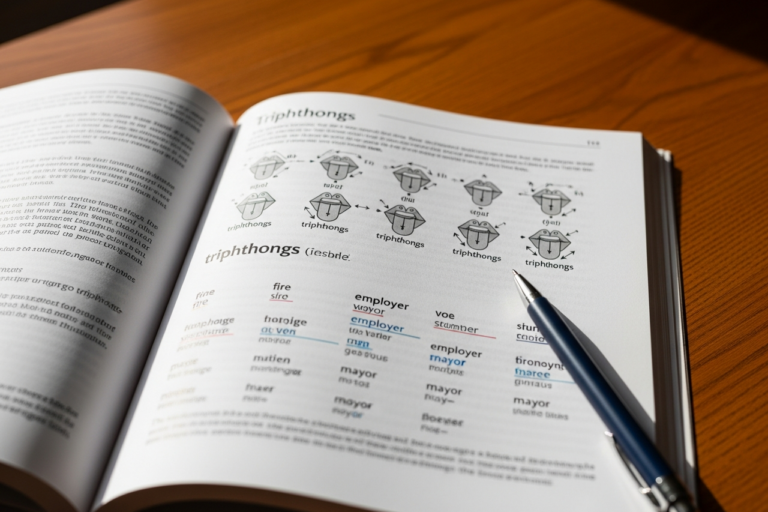
A triphthong is a vowel sound in english that moves fast through three vowel shapes in one syllable.
-
In phonetics, a triphthong can be made when you add a schwa /ə/ sound to the end of a closing diphthong.
-
Unlike monophthongs, which are single vowel sounds, and diphthongs, which move between two vowels, a triphthong slides through three parts.
-
You can hear triphthongs in words like “power” (/aʊə/) and “fire” (/aɪə/), where the vowel sound is changing fast.
-
Knowing about triphthongs is important if you want to get a good handle on the small details of english pronunciation and phonology.
-
When you say these sounds, your tongue and lips keep moving without a break.
Introduction
Have you ever seen how some vowel sounds in English move and change inside a word? You might know about single vowels, but the world of phonology is bigger than that. In this guide, we will show you the triphthong. The triphthong is a fun triple vowel sound. This sound happens when we glide from one vowel to the next, and then to a third one, fast and without stopping. We will talk about what these sounds are, how people make them, and where you can hear them in everyday English.
Understanding Triphthongs and Their Characteristics
At its core, a triphthong is a special kind of vowel sound. This sound goes through three clear parts. It is like a smooth, quick glide from one vowel quality to another one, and then to the last one. This all happens in just one syllable. The way the sound moves fast is what makes the triphthong stand out in phonology.
The triphthong is different from simple vowel sounds. Making this sound is not easy. It takes more work from your mouth. Picture it as a small trip your mouth has to take. For example, in the word “hour,” you start with the ‘ɑ:’ sound, switch to ‘ʊ’, and end with ‘ə’. This goes by fast. Let’s look at what makes them different from other vowels and how each one is shown in phonetics.
What Sets Triphthongs Apart from Diphthongs and Monophthongs
The main difference between these types of vowels is how simple or complex they are. A monophthong is the most basic kind. It is a one-part vowel sound that does not change. The sound stays the same from start to finish, like the “e” in “pet.” When you say this sound, your tongue and lips do not move.
Diphthongs are more complex than monophthongs. With diphthongs, there is a glide from one vowel to another in the same syllable. This glide creates two sounds that come together. The first sound, called the nucleus, is usually stronger and lasts longer than the second sound. The “oi” in “coin” is a good example of a diphthong.
A triphthong goes one step further. With a triphthong, there is a glide through three vowel sounds. It feels like a diphthong, but with one more part at the end. This makes a triphthong the hardest to say of the three. Your mouth, tongue, and lips have to move fast and smoothly from one sound to the next, all in one syllable.
How Triphthongs are Produced and Represented in Phonetics
The production of a triphthong is a dynamic process within the mouth. It involves a rapid, uninterrupted glide from one vowel position to a second, and finally to a third. In English phonology, all triphthongs are “centering,” which means they end with the neutral schwa sound, represented as /ə/. This happens so quickly that the three sounds are perceived as part of a single syllable.
Essentially, English triphthongs are formed by taking one of the five closing diphthongs and adding the /ə/ sound to it. This structure is key to their phonetic makeup. For example, the diphthong /aɪ/ (as in “buy”) becomes the triphthong /aɪə/ when the schwa is added, creating the sound in “fire.”
In phonetic transcription, triphthongs are represented by combining the symbols of the three vowel sounds. Understanding these symbols helps learners visualize the glide and pronounce the word correctly. Here are the five common triphthongs in English and how they are formed:
|
Diphthong |
+ Schwa (/ə/) |
Triphthong |
Example Word |
|---|---|---|---|
|
eɪ |
+ ə |
eɪə |
layer, player |
|
aɪ |
+ ə |
aɪə |
fire, liar |
|
ɔɪ |
+ ə |
ɔɪə |
loyal, royal |
|
əʊ |
+ ə |
əʊə |
lower, mower |
|
aʊ |
+ ə |
aʊə |
power, hour |
Triphthongs in English: Usage, Examples, and Pronunciation
Triphthongs are found often in the way people speak English, even if many of us never get a lesson about them. You see them inside a word, but they can also show up when you say some words together out loud. The sound and way to say a triphthong can change a lot in different varieties of English. Some types of English use them more than others.
The vowel quality in a triphthong is not always easy, so a lot of people make these sounds simpler, especially when talking fast or with friends. But if you learn how to say triphthongs well, your way of speaking and how clearly you say words can get a lot better. Now, let’s check out some usual words where you will hear these vowel sounds and talk about what makes them hard to say.
Common English Words and Dialects Featuring Triphthongs
You might not know it, but triphthongs show up a lot in English. They can be found in many words you use all the time. In some varieties of English, like Received Pronunciation, which is a well-known British accent, these vowel sounds are more clear and used more often. In American English, though, these sounds get simpler and are not as easy to hear.
Some people say a triphthong is just a diphthong with a schwa sound after it (/ə/). This makes sense, but in many words, you can hear all the sounds together. This is why it is good to notice them. You can find triphthong examples in words and sometimes even when two words come together in normal talk. An example of this in English is when you say “I know a…”.
Here are some words in English that have triphthongs:
-
Player: You can hear the /eɪə/ sound.
-
Fire: It has the /aɪə/ sound.
-
Royal: This word uses the /ɔɪə/ sound.
-
Slower: It has the /əʊə/ sound.
-
Power: You can hear the /aʊə/ sound.
Pronunciation Challenges and the Process of Smoothing
For many people who want to learn English, triphthongs can be hard to say. A triphthong moves the mouth quickly through three vowels in one syllable. This is not as easy as the diphthongs that triphthong sounds come from. Because of this, some people and teachers just do not use them much.
A lot of times, this problem results in something called “smoothing.” Smoothing happens when the triphthong is made simpler. One of the vowel sounds gets dropped or said much shorter. For example, the triphthong /aʊə/ in the word “power” can be smoothed so it sounds like “par” with a long vowel instead. This takes place in many kinds of English, and people only use the full triphthong when they are speaking in a slow, careful way.
Knowing what smoothing is will help learners and people who listen to English speakers. It helps you see why the same word does not always sound the same when it is said by other people or in different situations. Here are the most important things to know about these vowel, syllable, diphthongs, and glide problems:
-
Triphthongs need your tongue, lips, and jaw to move fast and just right.
-
The last /ə/ sound often gets weak or goes away when you talk quickly.
-
Smoothing makes it easier to say a triphthong by changing it
Conclusion
To sum up, knowing about triphthongs is important for anyone who wants to get better at saying words in English. A triphthong is a sound where three vowel sounds come together in one syllable. These sounds give our speech more variety, but they can be hard to get right, especially for new learners. If you get to know the usual triphthong sounds and keep practicing them, you will get much better at speaking. Be patient with yourself, as this takes time and practice. If you want to know more about triphthongs, how to use them, or have any questions about English vowel sounds and syllables, feel free to ask for help!
Frequently Asked Questions
What makes triphthongs difficult for English learners?
Triphthongs are hard for people learning English. This is because you have to move your mouth fast through three vowel sounds in a single syllable. This can feel strange and tough to do. Many people, even those who speak English as their first language, make it easier by not gliding through all three sounds. They end up making a diphthong instead. This is often how people speak, especially when they talk in a casual way.
Are there specific rules for identifying triphthongs in English?
There are not set spelling rules to spot a triphthong in English. The best way is to learn with phonology and phonetics. In spoken English, a triphthong often comes as a closing diphthong with a schwa sound (/ə/) in the same syllable. Listen for this three-part vowel glide because that works best to tell if there is a triphthong.
Do triphthongs occur in languages other than English?
Yes, triphthongs are found in languages other than English. You can hear them in the phonology of Spanish, Portuguese, and Romanian as well. The vowel quality and how often these triple vowel sounds come up will be different in each language. Still, the main idea is the same. People everywhere can say a three-part vowel in one syllable.