Key Highlights
-
The Uzbek language stands out in the Turkic languages. Its sound system comes from Persian and Russian influence.
-
One big difference about Uzbek is it does not use much vowel harmony. This makes it different from many Turkic languages.
-
Uzbek has used Arabic, Latin, and Cyrillic scripts to write words. Each script shows Uzbek sounds in its own way.
-
You need to learn the Uzbek vowel and consonant sounds well to master pronunciation.
-
It is important to know stress in Uzbek words. Stress most often goes on the last syllable. This helps you say words the right way.
Introduction
Welcome to the amazing world of the Uzbek language! Uzbek is part of the Turkic language family. It is the official language of Uzbekistan, and many people speak it in Central Asia. The history of Uzbek is shaped by Persian, Arabic, and Russian. This mix gives the sound of Uzbek something special. If you love languages, want to travel to Uzbekistan, or just feel curious, this guide will help you learn about the sounds and pronunciation of this language from Central Asia.
Understanding Uzbek Phonology: An Overview
Uzbek phonology is the study of how sounds work in the Uzbek language. Uzbek is one of the Turkic languages. So, it is like other languages in this group, but it still is a bit different in its own way. People use this language mainly in Central Asia. Its sounds have changed because of many years of mixing cultures.
If you want to speak Uzbek well, getting to know these sounds is really important. The way the vowels and consonants work, the stress, and old changes all help make the Uzbek language sound the way it does. Here, we will talk about the main things that shape the sounds in Uzbek and how they have changed over time.
These ideas will help you know more about Uzbek, its phonology, and its place in Turkic languages and Central Asia.
Main Features of Uzbek Phonology
The Uzbek language stands out in the Turkic language family because of a few important sound features. One big thing that makes Uzbek different is that it does not follow vowel harmony. This is a rule found in most Turkic languages where vowels in a word match each other. Leaving out this rule gives Uzbek its own sound.
The vocabulary in Uzbek comes from many places, including Persian and Arabic. This mix has shaped how the language sounds. Here are some main points about Uzbek phonology:
-
Agglutinative structure: You add endings to the root of a word. This can make one long word that means what a whole English sentence would say.
-
Lack of vowel harmony: In standard Uzbek, words do not have to match vowels like they do in most other Turkic languages.
-
No grammatical gender: There is not a need for thinking about words as masculine, feminine, or neuter.
-
Consistent grammar: The grammar of Uzbek is easy to learn since there are no irregular verbs.
All of these things make the Uzbek language interesting for those who like to study language. These rules can also help people who want to learn Uzbek. The clear grammar and not having grammatical gender can make learning some parts of Uzbek easier than those in other languages.
Historical Development and Influences on Uzbek Sounds
The sounds you hear in Uzbek come from a long and interesting history. This language grew at the center of Central Asia. Long ago, many people used Persian to talk with others. Later, Arabic spread once Islam came to the area. You can see these old links in the many loanwords that fill the Uzbek vocabulary.
In the Soviet era, the Uzbek language faced some big changes. The main Uzbek dialect, the one people speak in cities like Tashkent, became the standard. At this time, lots of Russian words came into Uzbek, too. People started to use words like ‘telefon’ for telephone and ‘mashina’ for car. Uzbek speakers talk much about this use of new words from Russian, especially when it comes to modern things or ideas.
The way Uzbek is written also changed again and again. At first, people wrote it using the Arabic script. In 1929, they started using Latin letters. Then, in 1940, the Cyrillic alphabet took its place. Every shift changed how sounds looked and, over time, how people said them. These changes in script affected pronunciation for every new group of learners. Now, Uzbek has a very special sound that shows how much it has changed over the years.
Writing Systems and Sound Representation in Uzbek
The Uzbek language has a long story when it comes to changing its writing methods. These changes really show up in how you write and say its words. At different times, people wrote Uzbek in the arabic script, the latin script, and the cyrillic script. After the soviet union broke up, uzbekistan started to move back to a new kind of latin alphabet.
Because of these shifts, you can find uzbek written in many ways. Often, which one you see depends on the time it was made or where it is from. Learning about the arabic, latin, and cyrillic scripts is important if you want to say the words right. This can help you match written uzbek words with their sounds. Up next, we will talk about the different scripts and how using the International Phonetic Alphabet can clear things up with uzbek pronunciation.
Latin, Cyrillic, and Arabic Scripts Compared
The Uzbek alphabet has undergone several transformations. Before 1928, the traditional Perso-Arabic script was used. During the early years of the former Soviet Union, this was replaced by a Latin alphabet in 1929. Then, in 1940, the Cyrillic alphabet was enforced, aligning Uzbek with most other languages of the USSR.
After independence in 1991, Uzbekistan began a gradual return to the Latin script. Today, the official script is Latin, but Cyrillic is still widely used, especially by older generations and in many publications. The transition is ongoing, so it’s common to see both scripts.
Here is a comparison of some letters in the modern Latin and Cyrillic Uzbek alphabets:
|
Uzbek Latin |
Uzbek Cyrillic |
Pronunciation Guide |
|---|---|---|
|
O’ o’ |
Ў ў |
A long “oo” sound |
|
G’ g’ |
Ғ ғ |
A guttural ‘gh’ |
|
Sh sh |
Ш ш |
“sh” as in ‘shoe’ |
|
Ch ch |
Ч ч |
“ch” as in ‘chair’ |
|
X x |
Х х |
“kh” as in ‘loch’ |
This table shows how different scripts represent some of the unique sounds in the Uzbek language.
Using the International Phonetic Alphabet (IPA) for Uzbek
The International Phonetic Alphabet (IPA) is a great tool for anyone learning a language. This is true for the Uzbek language too. Uzbek has used more than one alphabet over time, and it has some sounds that you will not hear in English. The IPA offers a simple and clear way to show the sound of each letter. This lets you learn the real way to say a word, not just how it is written.
For example, in the Uzbek Latin alphabet, the letter ‘x’ makes a sound that does not show up in English words. It is a rough ‘h’ sound, and in the IPA, it looks like [χ]. You can hear this sound at the end of ‘loch’ in Scottish English. The letter ‘q’ in Uzbek stands for another sound that is not in common English use. It is a hard sound deep in the throat, written as [q] in IPA.
When you learn IPA symbols for the uzbek language, you get to understand its different phonetic features. This means that you can get better at pronunciation and learn how to say each uzbek word the right way. For example, in the greeting “Yaxshimisiz?” (which means “How are you?”), IPA shows it as [jaχˈʃimisiz]. Looking at IPA charts made for the uzbek language helps you see and hear its sounds. It is a good way to work on your skills and grow more sure when speaking uzbek
Vowel System in Uzbek
The vowel system in the Uzbek language is simple when you compare it to English. Standard Uzbek has six vowels, and each one has its own sound. These vowels are shown by the letters A, E, I, O, U, and O’ in the modern Uzbek Latin alphabet.
Uzbek, which is one of the Turkic languages, does not use vowel harmony as much now. This makes learning standard Uzbek much easier. Still, knowing the difference between front vowels and back vowels helps you with correct pronunciation. Let’s talk about the types of vowels and what is left of vowel harmony in the Uzbek language.
Types of Vowels and Their Pronunciation
Uzbek vowels are spoken in a clear and sharp way. In the past, Uzbek made a difference between short vowels and long vowels. Today, modern standard Uzbek does not clearly show this difference. Still, there is one vowel, ‘o’’, that is longer than the rest.
There are six vowels in Uzbek, and they can be put into groups by the place in the mouth where you say them. Knowing these spots helps you move your mouth in the right way, so you can make the vowel sounds the way they should sound. Here are the vowels:
-
A – like the ‘a’ in “father”
-
E – usually like the ‘e’ in “get”
-
I – like the ‘i’ in “machine”
-
O – like the ‘o’ in “lot”
-
U – like the ‘oo’ in “boot”
-
O’ – a long “oo” sound, like the ‘o’ in “go” but with the lips more rounded. This vowel comes from the Cyrillic letter Ў.
Getting these simple vowel sounds right is important for your spoken Uzbek to make sense. It helps others know what you say. The best way to get better is to listen to people speak standard Uzbek and copy the way they say Uzbek words. This will help with your vowel pronunciation.
Vowel Harmony in Uzbek Language
Vowel harmony is a key part of most Turkic languages. In these languages, all the vowels in a word are expected to be from the same group, like all front vowels or all back vowels. However, the Uzbek language is different when it comes to this rule. Standard Uzbek, based on the Tashkent dialect, does not use vowel harmony much. This change happened because Persian had a strong effect on the language.
Because of this, you do not have to change the endings of words to match the root word’s vowels as you would in other Turkic languages. This is a big difference in Uzbek grammar and helps make learning easier for many people.
Even though standard Uzbek does not use vowel harmony, some local dialects keep parts of it, especially those near other Turkic-speaking places. But, if you learn standard Uzbek, you will find that making words with suffixes is more simple than in languages like Turkish or Kazakh. This makes standard Uzbek grammar easy to pick up in this way.
Consonant System in Uzbek
The Uzbek language has many consonant sounds that most English speakers will know. But, there are also a few sounds that come from turkic languages or have been taken from arabic and Persian. The uzbek alphabet has 23 consonants. Each letter stands for a special sound. In uzbek, you will not see a lot of consonant clusters like in english.
It’s important to know these uzbek consonants, especially the ones you do not get in english. This will help with your pronunciation. In the next part, we will look at some of the unique consonant sounds in uzbek. We will also talk about the problems that most people have when they try to say these sounds.
Unique Uzbek Consonant Sounds
While most Uzbek consonants are easy for speakers of English, some of them need extra care. These special sounds help make the Uzbek language sound different from English. If you learn how to say them, your accent will get better and you will sound more natural.
Some of these sounds are made at the back of the throat. For example, ‘q’, ‘x’, and ‘g” are found in the latin alphabet, and they are important for correct pronunciation of many Uzbek words.
Here are a few unique consonants:
-
Q q: This is a hard ‘k’ sound made deep in your throat. You can hear it in words like qayerda (where?).
-
X x: This sounds like the ‘ch’ in the Scottish word ‘loch’. For example, in yaxshi (good).
-
G’ g’: This is a ‘g’ sound that is like gargling. It is found in words like tog’ (mountain).
It helps to practice these sounds alone before you try them in new Uzbek words. This will make it easier to get them right.
Common Pronunciation Challenges for Learners
If you are new to the Uzbek language, you may find some parts of pronunciation a bit hard. The grammar in Uzbek is steady and there is no gender, so that helps. But getting the sounds right takes time and practice. The biggest problems often come from sounds that are not found in your native language.
The first thing you might struggle with is the unique consonants. For example, knowing the difference between ‘k’ and ‘q’, or ‘h’ and ‘x’, can be hard. It’s also tricky to tell apart the vowel ‘o” and ‘u’. You need to listen to Uzbek speakers to hear the small changes in sounds.
Here are some common pronunciation challenges:
-
Knowing the velar ‘k’ and the uvular ‘q’.
-
Saying the fricative sounds ‘x’ and ‘g” in the right way.
-
Making sure the vowel ‘o” (Ў in Cyrillic) sounds long and different from other vowels.
-
Not using English habits, such as adding extra vowel sounds.
To get past these parts, you need to be aware and practice often. This will help you move forward in language learning.
Key Phonological Processes in Uzbek
Uzbek phonology is not just about basic sounds. The language has rules that say how sounds work together in words and sentences. These rules help uzbek have its rhythm and smoothness. Two main things to look at are where the stress falls and how uzbek changes loanwords.
If you know where to put stress in uzbek words, you sound clearer. This can help people get what you say. Also, if you learn how uzbek adapts words from russian and arabic, you get a better idea of how the language works.
Let’s take a closer look at these two big topics.
Stress Placement and Syllable Structure
In the Uzbek language, it is easy to see where the stress goes in most words. The main rule is to put the stress on the last sound of the word. This counts for words that stand alone and words with extra endings called suffixes. For example, in the word kitob (book), stress goes on -tob. If you add a suffix, like in kitoblar (books), then stress is on -lar, the new last sound.
This simple and steady pattern gives the Uzbek language a unique beat and flow. Some Uzbek words, like those taken from other languages and some grammatical parts, do not follow this rule. But most native Uzbek words fit it.
If you know this one rule of phonology, your Uzbek pronunciation will sound much more natural. Unlike English, where you often need to guess where the stress should be, you can use this idea with confidence in most Uzbek words.
How Loanwords Are Adapted in Uzbek
The Uzbek lexicon has many loanwords from Persian, Arabic, and Russian. When these words come into the Uzbek language, they change to fit how Uzbek sounds. That way, they match the language and are easier for people to say. This process is called nativization.
For example, the Uzbek language may add a vowel to Russian words with consonant clusters that are not used in Uzbek. Uzbek also changes sounds that it does not have to the closest sound in its system. Words like ‘garage’ and ‘telephone’ became garaj and telefon as they entered Uzbek from Russian.
These changes seem to have a plan. When you look at how loanwords go into the Uzbek language, you get to know the phonology rules better. This shows how the Uzbek lexicon stays true to its own sound structure but still grows its vocabulary.
Beginner’s Guide: How to Master Uzbek Pronunciation
Ready to speak Uzbek? You can learn Uzbek pronunciation, even if you are new to the language. The trick is to start simple and add more as you go. Begin with easy sounds and move on to speaking whole sentences.
Don’t worry if you make mistakes. They are part of how you learn a language.
The best method is to listen to real Uzbek speakers. Try to copy how they talk. This guide will show you steps and helpful tips for getting better with Uzbek pronunciation. You will find out what you need to start your language learning. Let’s jump in!
What You Need to Get Started with Uzbek Sounds
To start your journey with Uzbek pronunciation, you do not need a lot. But there are some key resources that will make language learning much easier. The first thing to do is get to know the Uzbek alphabet. This alphabet uses the Latin script, so it is easy for English speakers to read. Still, you need to learn the sounds of letters like ‘x’, ‘q’, and ‘o”.
It is important to have audio. You can not learn pronunciation just from text. Look for resources where you can listen to a native speaker say the sounds, words, and phrases you are working on. This listening helps you build a strong foundation for pronunciation.
Here’s a short list of what will help you get started:
-
An Uzbek alphabet chart that shows how to say the letters (especially one with IPA).
-
Audio or video clips from native speakers. Language exchange apps, online videos, and Uzbek music are good places to find these.
-
A microphone or a voice recording app on your phone. You can record yourself and check your pronunciation against native speakers.
With these tools, you will be ready to practice and get better at Uzbek sounds.
Step-by-Step Guide to Practicing Uzbek Pronunciation
Learning the pronunciation of a new language like Uzbek is easier if you do it step by step. This guide has clear steps that can help you build a strong base. If you follow the steps, you will move from simple sounds to full sentences.
The main idea is to go from small things to bigger things. Start with letters, then learn words, and later practice going from words to sentences. Each step helps you remember what you have learned. Don’t hurry. Take your time at each stage until you feel good about it, and then go to the next one.
Here is a simple way to practice your Uzbek pronunciation:
-
Step 1: Listen to simple sounds. Repeat them. Focus on the vowels and different consonants in Uzbek.
-
Step 2: Work with pairs of words that sound almost the same. This helps you hear small changes in sounds.
-
Step 3: Start saying basic and useful words. When you are comfortable, try short sentences.
-
Step 4: Record your voice. Listen to the recording and see what you can do better.
This plan will help make your language learning easy, useful, and fun.
Step 1: Listening and Repeating Basic Sounds
The first thing you need to do to learn how to speak the Uzbek language is to work on the sounds. You should start by practicing the vowels and consonants that make up the words. This step is mostly about listening and copying what you hear.
Find audio clips that show the sounds of the Uzbek alphabet one by one. Listen to each sound many times. If you have a video, watch how the person moves their mouth. Try saying the sound yourself. Record what you say and play it back to compare it to the original.
You do not need to get it right at once. The main idea is to help your mouth get used to making these sounds and your ear to notice new noises. Focus more on tricky sounds in Uzbek that you will not find in English, such as ‘q’, ‘x’, ‘g”, and ‘o”. Keep practicing these basics to make a good start in your language learning. This strong base will help you as you learn more Uzbek.
Step 2: Practicing Minimal Pairs and Word Stress
After you feel good with the basic sounds, it is time to work with words. Minimal pairs are great for this. These are pairs of words that change by only one sound, and they help you get better at hearing and saying sounds. This helps your pronunciation and listening.
As an example, you could try to spot the difference in the uzbek language between ‘k’ and ‘q’ by saying words like kul (laugh) and qul (slave). Saying these, and hearing the difference, helps you understand how these sounds are not the same.
You should also watch out for which part of the word gets stress. In uzbek, it is common to stress the last part of the word. As you practice words, make sure to put the stress at the end.
Here are some things you can do:
-
Look for lists of uzbek minimal pairs online, or make your own.
-
Say these pairs out loud, and make the different sound strong at first.
-
Record yourself and listen. Try to notice if you can spot the difference.
-
Use the rule about the stress at the end when practicing full words.
Doing this kind of practice will help you have better pronunciation in uzbek.
Step 3: Speaking Simple Words and Sentences
Now that you have worked on sounds and minimal pairs, it’s time to use them together. Choose easy, common Uzbek words to start. Try greetings, numbers, and everyday nouns first. Say each word out loud. Listen to how you say each vowel and consonant. Notice where the word is stressed.
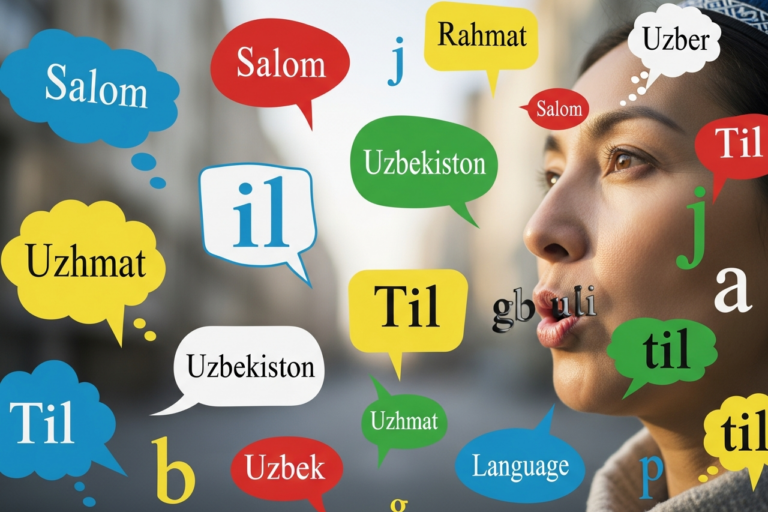
It’s good to begin with important phrases. Practice words like Salom (Hello), Rahmat (Thank you), and Yaxshimisiz? (How are you?). These are helpful and will boost your confidence. Once you feel better with single words, start putting them into short sentences.
The goal is to move from repeating words to speaking more naturally. Use simple uzbek grammar to make basic sentences. Don’t worry about being perfect. Try for clear speech. This step helps you change from someone who learns the language to someone who uses it.
Comparing Uzbek Phonology with Other Languages
If you try to learn how a new language sounds, it can help to think about languages you already know. The sounds in Uzbek share a lot with other Turkic languages, like Kazakh. Uzbek also has parts that are not like Russian and English at all. Where Uzbek is spoken and how people lived shaped how it sounds.
When we look at the sound systems side by side, we see what makes Uzbek special. We can compare the way Uzbek sounds with the way English sounds. After that, we can talk about the changes in Uzbek across its different dialects.
Differences Between Uzbek and English Sounds
When you look at Uzbek and English phonology, you see that there are some clear differences. If you speak English and you want to learn the Uzbek language, these things will be the main reason why you find pronunciation hard. One of the best ways to see how the two sound is to check the vowel systems. English has a big group of vowel sounds. There are about 20 different vowel types and many of these are gliding vowels, called diphthongs. But in Uzbek, it is not like that. Uzbek has only six vowels, and these are simple, pure sounds.
The way consonants work is also different in the two. While many sounds can be found in both, Uzbek has some phonetic features that English does not have. The uvular and velar fricative sounds are the best examples here.
Here are some major differences:
-
Uvular Consonants: Uzbek has the uvular stop ‘q’. This sound does not appear in English.
-
Vowel Simplicity: The vowels in Uzbek are pure monophthongs and do not blend. English, on the other hand, has a lot of diphthongs. These are sounds like ‘oi’ in ‘boy’ and ‘ay’ in ‘my’.
-
Stress: Stress in Uzbek is easy to guess (it is usually on the last part), while in English, it is not stable and can change how a word is understood (for example,
Phonological Variations Across Uzbek Dialects
Standard Uzbek is the official language. It follows the Tashkent dialect. But, there are many different ways of speaking Uzbek in the different areas of Uzbekistan. Uzbek-speaking people in other Central Asian states also have their own styles. Each dialect sounds a bit different. This comes from how people live near other languages and what happened in history.
Some dialects in the south, which are closer to Afghanistan, still keep parts of Persian phonology. The Karluk dialect makes up most of the written form of Uzbek. It has its own features. One big difference between dialects is vowel harmony. Standard Uzbek has lost this, but a few other dialects still use this Turkic vowel feature.
You will notice that Uzbek spoken in Samarkand is a little different from the Uzbek used in the Fergana Valley. If you want to learn the Uzbek language, it is good to start with the standard dialect. But knowing about these changes from region to region will help you to really know how Uzbek sounds and how people use it everywhere.
Conclusion
To learn Uzbek pronunciation well, you need to know about Uzbek phonology. Knowing the vowel and consonant sounds of the language helps you say words in the right way. By looking into these sounds and the way they work in Uzbek, you can understand how to use your voice to speak better. Doing practice every day, such as listening and talking, makes you get better at it.
When you start learning this language, remember to stay patient and keep practicing. If you want more help with Uzbek pronunciation, you can ask for support. If you like, you can get in touch for a free consultation to get personal help.
Frequently Asked Questions
How are Uzbek vowels different from English vowels?
Uzbek vowels are easier than English vowels. The uzbek language has six clear vowel sounds. These sounds stay the same every time you say them. In english, there are about 20 vowel sounds, and many of them mix together. This makes english vowel pronunciation harder to figure out. The phonology of uzbek feels more simple and clear. It is not hard or confusing when you say a vowel in uzbek.
What are some examples of minimal pairs in Uzbek?
Minimal pairs in Uzbek help you tell sounds that are almost the same apart. For example, in the uzbek alphabet, the ‘k’ and ‘q’ sounds make a big change in words. Kul means, “laugh,” but qul means, “slave.” Another set is bil, which is “know,” and bel, which means “waist.” If you practice these, you get better at pronunciation and hearing words the right way in uzbek phonology.
Do all Uzbek dialects sound the same?
No, Uzbek dialects can sound different from each other. Standard Uzbek comes from the Tashkent dialect, but there are many other ways people speak Uzbek in Central Asia. In some places, their dialects still use vowel harmony, but standard Uzbek does not have it anymore. This shows the wide range in how Uzbek speakers speak. It also points to the history of Uzbek people in the region.
What makes Uzbek pronunciation challenging for beginners?
The biggest problem for people who start with the Uzbek language is that some sounds are not found in English. For example, there is the uvular ‘q’ sound. There are also the fricative sounds ‘x’ and ‘g”. You need to learn how to say and hear the difference between these and other sounds you know from English. This is an important step in Uzbek language learning.