Key Highlights
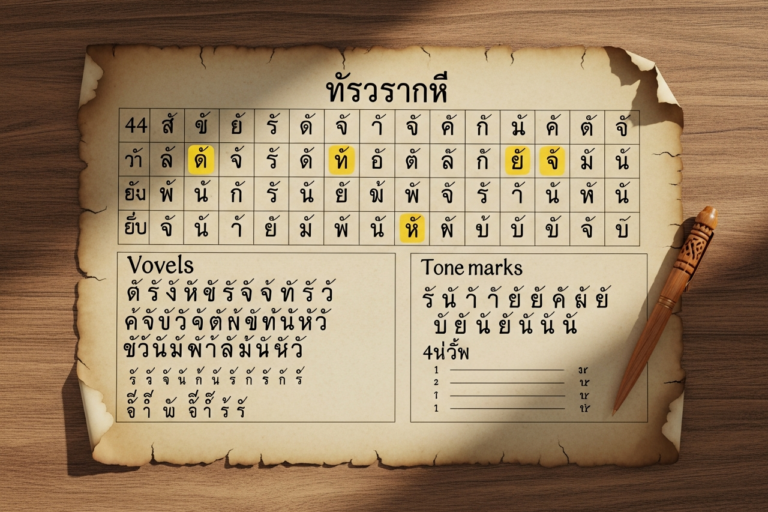
Here are the key things to know from our guide to Thai phonology:
-
The Thai language is a tonal language. The pitch in your voice can change what the word means.
-
Thai has five tones. These are mid, low, high, rising, and falling.
-
Vowel length matters a lot. A short vowel sound and a long one can make two words mean different things.
-
The Thai script has its own set of consonants and vowels. These do not always sound the same as letters in English.
-
You have to use the right pronunciation for consonants, vowels, and tones to speak Thai clearly.
If you want to get good at Thai, you will want to practice phonology, thai script, vowels, and tones. This will help people understand you well.
Introduction
Welcome to the world of the Thai language. More than 65 million people in Thailand and some other places talk in Thai. The language is special in Southeast Asia and is known for its beauty. If you want to learn Thai, you should know about its sounds first. This guide will help you learn the basics of Thai phonology, such as the tones and the sounds of each consonant and vowel. If you start with these basics, you will have a good base to talk with Thai speakers.
Core Features of Thai Phonology
The Thai language is the official language spoken in Thailand. It has a sound system, or phonology, that is very different from many other languages. The most well-known thing about Thai is that it is a tonal language. This means the pitch you use when saying a word can change its meaning. This is something that is seen a lot in Southeast Asian languages, but it can be new and hard for people who speak English.
Thai phonology is about more than just tones. It also has its own set of consonant and vowel sounds. Many of these sounds are not found in English, so they might be tricky at first. If you want clear and correct Thai pronunciation, you need to know these basic things. In the next parts, we will talk about the consonants, vowels, and tones that you hear in the Thai language.
Overview of Consonant Sounds in Thai
When you start to learn the thai language, you will hear many consonant sounds. Some of these come from the thai script. There will be some sounds that feel like english. There are also many that are very new. It is important in thai to know the difference between sounds made with a strong puff of air. These are called aspirated sounds, like the “p” you hear in “pin.” There are also unaspirated sounds. This is like the “p” in “spin” where you do not use much air.
Many native thai words begin with aspirated or unaspirated sounds. You have to tell them apart to speak clearly. There are some consonant sounds both thai and english share. These are sounds like /p/, /t/, and /m/. There are other sounds in the thai language you do not hear in english. These are important and make the sound of thai words different and special.
The following are examples of thai consonant sounds you will not find in english:
-
/kʰ/ (this is an airy “k” sound)
-
/pʰ/ (this is an airy “p” sound)
-
/tʰ/ (this is an airy “t” sound)
-
/ʔ/ (this is a glottal stop, which you can hear in the short break in “uh-oh”)
Understanding Vowel Sounds and Variations
In the Thai language, vowels play a double role. Not only do you need to learn the correct vowel sound, but you also need to pay close attention to its length. Thai features a system where each vowel has both a short and a long version, and this difference in vowel length can change the meaning of a word. For example, a word spoken with a short ‘a’ sound might mean something completely different from the same word spoken with a long ‘a’ sound.
This distinction between short and long vowels is a fundamental aspect of Thai phonology. The Thai script has specific characters to represent these different vowel lengths, making it an essential part of reading and writing correctly. While some vowel sounds like /a/, /i/, and /u/ are shared with English, many are unique.
Here’s a look at some Thai vowel sounds not found in English:
|
Short Vowel |
Long Vowel |
|---|---|
|
/ɯ/ |
/ɯː/ |
|
/ɤ/ |
/ɤː/ |
|
/aː/ |
|
|
/eː/ |
The Importance and Nature of Tones in Thai
Thai is a tonal language. This means that using different tones is the most important part of speaking Thai well. One short word in Thai can mean five different things. It all depends on the way you use your voice. For people who speak English, this idea can be tough at first. In English, we use our voice to show feeling or stress, not to change what a word means. If you want people to understand you in standard Thai, you need to learn all five tones.
Let’s take the thai language word “mai” as an example. The way you say it can mean “new,” “burn,” “wood,” “not,” or it can be a question particle. So if you do not learn the right tone, the meaning will change. This is why it is so important to listen to native speakers. You want to copy the way they say things in thai. People say that the tones are what make the thai language sound nice and full of expression.
In thai, the five tones are:
-
Mid tone (your voice stays flat and steady)
-
Low tone (your voice stays deep and flat)
-
Falling tone (your voice starts high and then drops down)
-
High tone (your voice starts and stays high)
-
Rising tone (your voice starts low and then goes up)
Structure and Challenges in Thai Pronunciation
Knowing how syllables work in the Thai language is key for good pronunciation. The Thai language follows clear rules, called phonotactics, about how sounds fit together to make words. Many native Thai words are made up of just one syllable. There are also rules about which consonant sounds can go at the end of a syllable.
If you speak English, you may find these rules hard at first. The final consonants you can use, and the way you put consonants together, is not the same in Thai as in English. By learning these patterns in Thai words, you can speak more clearly, and you will sound more like a Thai person.
Next, we will look at the most common syllable patterns in Thai. We will also talk about the main problems people have when learning to say Thai words the right way.
Typical Syllable Patterns and Phonotactics
The structure of syllables in the Thai language follows a fairly predictable pattern. Most native Thai words consist of a single syllable. The rules for which consonants can start a syllable (the onset) are more flexible than the rules for which consonants can end one (the coda position). This is a key difference from English, where many different consonants can end a word.
Another interesting rule is that only long vowels can appear in open syllables (syllables without a final consonant). Consonant clusters also exist in Thai, but they are limited to specific combinations, mostly involving /r/, /l/, or /w/ as the second sound. Understanding this structure helps you anticipate how words should sound.
Here are the permitted consonant clusters at the beginning of a syllable:
|
Initial Consonant |
Permitted Clusters |
|---|---|
|
/k/ |
/kr/, /kl/, /kw/ |
|
/kʰ/ |
/kʰr/, /kʰl/, /kʰw/ |
|
/p/ |
/pr/, /pl/ |
|
/pʰ/ |
/pʰr/, /pʰl/ |
|
/t/ |
/tr/ |
Common Pronunciation Challenges for English Speakers
For people who speak English and want to learn Thai, there are some parts of the thai pronunciation that can be hard to get right. The hardest thing for most is learning the five tones. A small change in the sound of your voice can make the word mean something else. English does not use tones in the same way, so this will be new for you. To do well, you will need to train your ear and your voice in a new way to pick out every small change in pitch.
Another thing that can be tough is making thai consonant sounds that are not used in english. Native speakers of English often have a hard time hearing the difference between an aspirated consonant like /pʰ/ and one that is not aspirated like /p/. Making these sounds on your own can also be tricky. There are also some vowel sounds used in thai that do not exist in english, along with the idea of vowel length (some vowels in thai are long, while some are short). You will need to practice both to say words the right way.
Here are some usual problems for english native speakers:
-
Distinguishing between the five tones.
-
Pronouncing aspirated vs. unaspirated consonants correctly.
-
Mastering vowel sounds unique to thai and being able to tell long vowels from short vowels.
-
Making the glottal stop /ʔ/ sound at the end of some syllables.
Conclusion
To sum up, learning Thai phonology is key if you want to speak and understand Thai well. It helps a lot to know the different consonant and vowel sounds, and why tones matter so much when you work on your pronunciation. The truth is, there be some hard parts, especially if you talk English most of the time. But if you practice the thai sounds every day, you will see real progress. Try to enjoy the process of learning Thai pronunciation. You will become a more sure speaker and also understand more about the rich culture in the language. If you want to get even better, you can set up a free talk and work on your skills.