Key Highlights
-
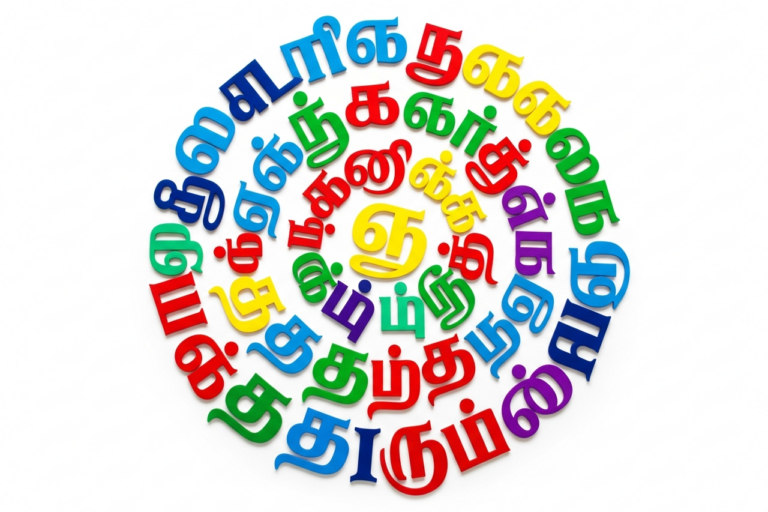
The Tamil alphabet is one of the oldest writing systems in the world. It has 12 vowels and 18 consonants.
-
In the tamil script, each consonant has a vowel sound built into it.
-
These consonants, called Mei Ezhuthukkal, are the main “body” letters of the tamil alphabet.
-
Tamil has unique retroflex consonants, like the “zh” (ழ்) sound. This sound is not found in most other languages.
-
Each consonant can mix with vowels to make 216 compound letters. This is what gives the tamil script its syllabic form.
-
Grantha letters are used in the tamil script to show sounds from other languages, like Sanskrit.
Introduction
Do you want to visit Tamil Nadu or learn something new? Learning the Tamil language starts by getting to know its lovely alphabet. The Tamil script, called Eluttukkal, has a long story. It helps you to read and speak the language well. This guide is here to help you understand the basics of the Tamil script. You will learn about vowels and Tamil consonants, and how they work together to make sounds. Let’s start your Tamil learning journey and build a good base for it.
Understanding the Tamil Script Structure
The Tamil script is a type of writing system called abugida. This means its letters stand for small syllables. Every consonant in the Tamil alphabet already has a short “a” vowel sound in it. This built-in vowel is a big part of how consonants work in the script.
If you want to change this vowel sound, you add special marks to the Tamil letters. This way of writing helps match the spoken Tamil words to how you write them, so the system is very phonetic.
Now, let’s talk about what parts make up this alphabet and look at how they work together.
Components of Tamil Alphabet: Vowels and Consonants
The modern Tamil script has a total of 247 letters. There are 12 vowels, called Uyir Ezhuthukkal or “soul letters,” and 18 pure consonants, called Mei Ezhuthukkal or “body letters.” These pure consonants and vowels are the building blocks of the Tamil script.
There is a difference between Tamil vowels and consonants. Tamil vowels, which have both short vowels and long vowels, can stand alone. These vowels give the sound or the “soul” to the language. Consonants, on the other hand, are seen as the “body.” Tamil consonants often need a vowel to form full syllables. The consonant is the base, and the vowel sound is added to it.
When Tamil vowels and pure consonants come together, they make 216 compound letters. These are called Uyirmei Ezhuthukkal. You can think of the vowels as what brings the consonants to life. They work together to make the syllables in words. There is also a special character in the Tamil script called Aayutha Ezhuthu (ஃ). This special character changes sounds, but it is not a vowel or a consonant.
The Tamil alphabet uses all these different parts to help people read and write in the language.
How Consonants Fit in Tamil Writing
In Tamil writing, consonants make up the heart of words. Each consonant in Tamil has a built-in vowel sound, most often a short ‘a’. This idea is very important in how the written language works, and ties back to how the abugida script is set up.
If you want the consonant to have a different vowel, you do not write a whole new vowel letter next to it. You add a vowel mark right to the consonant. This mark might be above, under, on the left, or on the right side of the consonant. When you write it this way, you get one character that stands for the full sound of the syllable.
This way of using vowel marks helps keep the written language short and easy to read. You can still see the shape of the consonant, and the vowel mark helps you know the right pronunciation. Joining the consonant and vowel mark together is an important thing you have to learn to read and write Tamil well.
The Foundations of Tamil Consonants (Mei Ezhuthukkal)
The 18 pure consonants, called Mei Ezhuthukkal, make up the main part of the Tamil script. Tamil script is one of the oldest writing systems still used today. These pure consonants are the building blocks of the Tamil language. They join with vowels to create most of the sounds in Tamil.
When these consonants stand alone, they have a dot above them, called a puLLi. This dot shows the usual ‘a’ sound is not there. Learning these 18 main sounds is the first thing you should do when you want to get the right Tamil pronunciation. Now, let’s look at these consonants and see how to say them.
What Are the 18 Basic Tamil Consonants?
The 18 basic Tamil consonants are the building blocks of the language’s sound system. Each of these Tamil letters has a distinct sound and role in forming words. They are categorized into three groups based on their hardness: Vallinam (hard), Mellinam (soft), and Idaiyinam (medium).
Learning to recognize and pronounce these consonants is crucial for any beginner. They are the foundation upon which you’ll build your vocabulary and reading skills. Some of these consonants even appear in “family” pairs, like க்-ங் and ச்-ஞ், which often occur together in words.
Here is a list of the 18 pure consonants in the Tamil alphabet:
|
Tamil Consonant |
Transliteration |
Pronunciation Guide |
|---|---|---|
|
க் |
k |
as in king |
|
ங் |
ng |
as in king |
|
ச் |
ch |
as in match |
|
ஞ் |
ng |
as in plunge |
|
ட் |
t |
as in top |
|
ண் |
n |
as in cinder |
|
த் |
th |
as in bath |
|
ந் |
n |
as in pan |
|
ப் |
p |
as in puck |
|
ம் |
m |
as in from |
|
ய் |
y |
as in yak |
|
ர் |
r |
as in fur |
|
ல் |
l |
as in lump |
|
வ் |
v |
as in vice |
|
ழ் |
zh |
a unique sound, retract tongue to produce “zh” |
|
ள் |
l |
as in marble |
|
ற் |
tr |
as in trick |
|
ன் |
n |
as in fin |
Pronunciation Patterns and Articulation
Mastering the pronunciation of Tamil sounds means you have to learn exactly how to move your mouth and tongue for every consonant. Tamil is not like English, where one letter can sound in many ways. Tamil is a very phonetic language. One thing that makes it different is the use of retroflex sounds.
To say these retroflex consonants, you need to curl the tongue tip back so it touches the roof of your mouth. This is how you get sounds heard mostly in Tamil and some other Indian languages. If you look at the letters ‘ல்’ (l) and ‘ள்’ (ḷ), their difference depends on where you put your tongue.
Here are some key points regarding the method of articulation for tamil sounds:
-
Dental vs. Retroflex: Focus on the difference between ‘ந்’ (n) and ‘ண்’ (ṇ). The first one is dental, with the tongue tip on your teeth. The second is retroflex, with the tongue tip on the roof of your mouth.
-
The ‘zh’ sound (ழ்): This well-known Tamil sound is not the same as ‘r’ or ‘l’ in English. To say it, you move your tongue toward your throat. There is no sound like this one in English.
-
Hard vs. Soft ‘r’: Tamil uses ‘ர்’ (r) for a plain r sound, but ‘ற்’ (ṟ) is harder and rolled more
Special Consonant Sounds and Grantha Letters
Besides the 18 basic consonants, the tamil script has some sounds that are not from the original language. The script does this with a few new consonants and some letters taken from another writing system. These help add to the modern vocabulary in tamil.
When tamil needs to show sounds from other languages, like sanskrit, it uses special grantha letters. These consonant characters make sure you get the right pronunciation for words taken from other languages. Now, we will look at these sounds and see how grantha letters are used in modern tamil.
Unique Tamil Consonant Sounds
Tamil has some unique retroflex consonants. These help create the special sounds in tamil. To make these sounds, the tongue moves in a way that may be new for english speakers. The retroflex consonants are a big part of what gives tamil its one-of-a-kind phonetics.
One well-known example is the letter ‘ழ’ (ḻa). This sound is somewhere between an ‘r’ and an ‘l’. English does not have this sound at all. If you get this pronunciation right, you will sound more fluent in tamil. The modern tamil script also has other characters. These make a good number of special sounds.
You will find these unique tamil sounds:
-
ழ (ḻa): This is the classic retroflex sound, known as the approximant.
-
ள (ḷa): This is a retroflex ‘l’ sound. The tongue curls back, much like in the word ‘marble’.
-
ற (ṟa): This is a tough, trilled ‘r’ sound. It is different from the softer ‘ர’ (ra).
-
ன (ṉa): This is a dental ‘n’ sound, which is not the same as the retroflex ‘ண’ (ṇa).
Grantha Consonants Used in Modern Tamil
To bring in sounds from other languages, mainly Sanskrit, the Tamil language started to use some letters from the Grantha script. These Grantha letters are now part of modern Tamil. People use them to write new words and names that have sounds which were not in old Tamil. You can see this is true for Malayalam script as well.
These Grantha letters help to show fricative sounds found in languages like English and Sanskrit. Classical Tamil did not have original sounds like ‘sh’, ‘s’, ‘h’, or ‘j’. When Grantha script letters became part of Tamil, this problem went away.
The main Grantha letters used in Tamil are: ஜ (ja), ஷ (sha), ஸ (sa), ஹ (ha), and the mix க்ஷ (ksha). With these letters, Tamil language can show foreign and new words in a more clear way. For example, ‘sh’ is written with ‘ஷ’. The ‘s’ sound uses ‘ஸ’, and for ‘h’, the letter ‘ஹ’ is used.
Combining Tamil Consonants with Vowels
The real beauty in the tamil script shows when you put the consonants and vowels together. These types of combinations of consonants and vowels make special compound letters. In tamil, they call these uyirmei ezhuthukkal, which means “soul-body letters.” There are 216 of these letters in total.
In tamil, people do not write a consonant and a vowel next to each other. Instead, there is a vowel sign that joins the consonant and changes its shape a bit. This is how you get the main syllables of the tamil script. Let’s see how these syllables are made with some examples.
Syllable Formation in Tamil Script
Syllable formation in the Tamil script follows a clear and simple process. Most of the time, you get a syllable by putting one of the 18 consonants together with one of the 12 vowels. This will give you a single, new character called a compound letter.
The main part of each compound letter is the consonant. The vowel comes as a vowel mark. You add this mark to the consonant. The vowel mark can go to the left, the right, on top, or underneath the consonant. This depends on what vowel sound you want.
For example, let’s look at a consonant by itself. If you see ‘க’, it already has the ‘a’ vowel sound with it. To make it say ‘ki’, you put the ‘i’ vowel mark on top. Once you know the vowel marks, it is easy to use them with any consonant in tamil script to make compound letters. In this way, there are 216 compound letters you can make in tamil.
Examples of Consonant-Vowel Letter Combinations
Understanding how consonants and vowels work together is easier when you look at examples. Use the consonant ‘க்’ (k). See how it changes with different vowels to form Uyirmei Ezhuthukkal. This pattern is found in the whole new script. That helps people learn the Tamil writing system.
When you notice these patterns, you will start to read basic words. The main look of the consonant stays the same. The vowel sign shows with each word, so you can spot the change in vowel sound. This setup is a big part of the Tamil writing system.
Here are some examples with the consonant ‘க’ (ka):
-
க் + அ = க (ka) – This is the basic form with the vowel sound ‘a’.
-
க் + ஆ = கா (kā) – A line goes down to show the long ‘ā’ sound.
-
க் + இ = கி (ki) – A small mark is placed on top for the short ‘i’ sound.
-
க் + ஈ = கீ (kī) – A different mark on top shows the long ‘ī’ sound.
-
க் + உ = கு (ku) – A shape like a hook is added at the bottom for the ‘u’ sound.
-
க் + ஊ = கூ (kū) – A different mark at the bottom shows the long ‘ū’ sound.
Pronunciation and Sound Mapping
Getting the pronunciation right is very important if you want to speak Tamil well. Tamil is a language where the way a word is written is a lot like how it sounds. Each letter often matches up with a sound, so spoken Tamil often follows the Tamil alphabet closely. Still, if you speak English, using sound mapping can help you with Tamil sounds a lot.
Sound mapping lets you use the sounds you know from English to connect with the letters in the Tamil alphabet. There is not always an exact match for every sound. But this method helps you get started. In the next part, we will talk about how you can map English sounds to Tamil consonants. We will also give you some tips to help your pronunciation get better.
Mapping English Sounds to Tamil Consonants
For English speakers learning the Tamil alphabet, sound mapping can simplify the pronunciation process. It involves finding the closest English sound to a specific Tamil consonant. While this method is helpful, remember that Tamil has unique sounds that don’t exist in English.
This approach is a bridge to help you get started. As you advance, you’ll want to listen to native speakers to refine your pronunciation and capture the subtle nuances of the language. For now, using familiar English words as a guide is an effective strategy.
Here is a simple sound mapping table to connect English sounds with Tamil consonants:
|
Tamil Consonant |
Approximate English Sound |
Example Word |
|---|---|---|
|
ப் (p) |
‘p’ |
pan |
|
ட் (t) |
‘t’ |
top |
|
க் (k) |
‘k’ |
kite |
|
ம் (m) |
‘m’ |
map |
|
ன் (n) |
‘n’ |
net |
|
ல் (l) |
‘l’ |
lamp |
|
வ் (v) |
‘v’ |
van |
|
ய் (y) |
‘y’ |
yes |
Important Tips for Correct Tamil Pronunciation
Getting a real Tamil pronunciation is not just about knowing the letters. It is about the method of articulation and how you use the tongue tip and the roof of your mouth. You need to listen to Tamil speakers closely. This will help you train your ear for the language.
A lot of people be confused by similar consonants in Tamil. The different ‘n’ and ‘l’ sounds can be tricky. The muscle memory that you need comes with time and practice. Keep working at it for a more natural way of speaking Tamil.
Here are some tips to help you with pronunciation:
-
Listen and repeat: Use audio of Tamil speakers. Try to say it the same way they do.
-
Record yourself: When you hear your own voice, you can see what needs fixing.
-
Focus on retroflex sounds: Practice curling your tongue tip back. This is how you say ‘ட’, ‘ண’, and ‘ள’.
-
Tell hard and soft sounds apart: Notice the difference between ‘ர’ and ‘ற’.
-
Practice with a language partner: Speak with someone who is a fluent Tamil speaker. You get live feedback this way.
-
Don’t rush: Take your time. Speak slowly so you form each sound right.
Keep trying, and use your tongue tip and roof of your mouth as you work on every new Tamil consonant. Good muscle memory will come with more practice and paying attention to how the sounds are made.
Tips and Techniques for Learning Tamil Consonants
Learning Tamil consonants can look hard when you start. But, with some good ways, you get better at remembering them. The goal is to help you get used to the letters. You want to build muscle memory, so you know the letters and write them without thinking too much.
To learn well, you need to do more than just look at a chart. Try working with the letters in different ways. This makes it fun and helps you learn better. Here are some ways to remember Tamil consonants and some resources to use if you are a beginner.
Memorization Methods and Mnemonics
Using mnemonics is a smart way to learn the tamil alphabet, especially its consonants. This method lets you make a simple link in your mind between a letter’s shape and its sound. It makes your first lesson in tamil feel more fun and helps you get things faster.
For instance, you can match the shape of a letter to something you know well. The letter ‘எ’ might remind you of an elephant’s trunk. If you use a visual cue, you remember the letter and how to say it with less trouble.
Here are some easy ways to make learning stick:
-
Create flashcards: Write the consonant on one side. Put its pronunciation on the other side.
-
Use visual associations: Match letter shapes to objects or pictures. For example, ‘ப’ can look like a puck.
-
Group similar letters: Practice letters that look or sound like each other. This will help you tell them apart.
-
Start with basic words: Try simple words first. See the consonants used so you learn them in real-life tamil.
-
Write them out: Write the letters often. This helps build muscle memory in your hand.
-
Sing the alphabet song: Listen to tamil alphabet songs online. These songs make learning easy and fun.
Printable Charts and Practice Resources
Visual aids can be great to use when you learn a new script like the Tamil script. Printable charts and practice tools help set up a clear way to study. Most of these show the Tamil alphabet in table lists, so you can see all the letters in order and spot patterns.
It is good to have a chart that you can hold or look at as you work. Lots of sites online let you download PDF charts that you can print. You can use them every day for practice and to remember the Tamil alphabet. In the past, people wrote Tamil on palm leaves, and that led to the rounded look the letters have. Now, we use easier things to learn the script.
If you want resources to learn Tamil, here are some points to look at:
-
University websites: They often have free printable charts and practice sheets for learning the Tamil script.
-
Educational blogs and websites: Find sites about teaching Tamil. Most times they have a section with helpful tools.
-
Language learning apps: Some apps offer printable practice pages that go along with digital lessons.
-
Online video platforms: You can find video lessons for Tamil that give you charts or sheets to print and use.
Conclusion
To sum up, it is important to know Tamil consonants if you want to get better at the Tamil language. When you get used to their sounds and how they work, you will improve your pronunciation and writing with tamil script a lot. Try to use the tips for practice, like ways to remember tamil consonants and printable tools, as often as you can. This helps you feel sure about your skills and makes your hold on tamil script stronger. Go ahead and learn tamil consonants, and you will find it is a good experience. You will get to see more of what the language and the culture have to offer. Happy learning!
Frequently Asked Questions
What is the main difference between Tamil vowels and consonants?
The main difference is how they work in the tamil script. Tamil vowels make the main vowel sound and stand alone. The tamil vowels act as the “soul” of the alphabet. Consonants are like the “body” of the tamil script. And consonants usually need to join with a vowel to make a full syllable.
Are there easy ways to practice writing Tamil consonants?
Yes, one simple way is to use tracing worksheets. By writing the Tamil letters many times, you help your hand remember the shapes. This also helps you get used to how the letters look and feel. You can try writing basic words to see the Tamil consonants in action. It will make the writing system clearer and help you with your muscle memory.
What are common mistakes learners make when studying Tamil consonants?
One thing many beginners do is mix up Tamil sounds that seem the same. This happens with the different ‘n’ and ‘l’ consonants. Some people also say the retroflex sounds wrong. This can be because they do not curl their tongue as needed. It is also easy to forget that the way you say a Tamil letter can change based on where it is in the word.