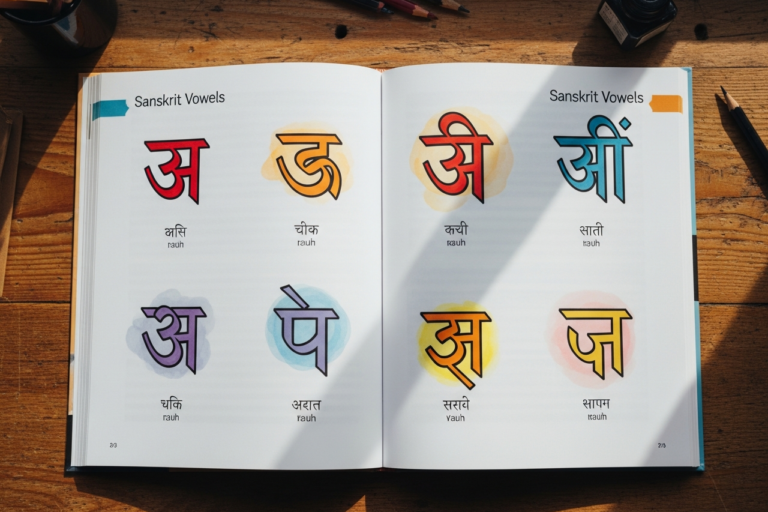
Key Highlights
Here’s a quick look at what you will get to know about Sanskrit vowels:
-
The Sanskrit alphabet, called Devanagari, is made in a specific way for its vowel sounds.
-
Each Sanskrit vowel matches just one sound, unlike the English alphabet. This makes it easy to get the correct pronunciation every time.
-
Sanskrit vowels are put into short (hrasva) and long (dīrgha) groups. This changes the rhythm when people speak the language.
-
The main vowels are ‘a’, ‘i’, and ‘u’. You get all other simple or compound vowels from these.
-
It is important to use the right mouth position. This helps you say each vowel the correct way.
-
This guide will help you with pronunciation, show you how to write in Devanagari, and explain why vowels are important in Sanskrit.
Introduction
Welcome to the world of the Sanskrit language. If you are just starting out, it is good to first learn the vowels. The vowels in Sanskrit, also known as ‘svara’, are the base for all the sounds and grammar rules in the language. In Sanskrit, each vowel has one clear sound. This is not like English, which can have one letter making many sounds. Learning the sound of each vowel will help you read, speak, and enjoy this old language in the best way. Understanding the pronunciation and grammar of Sanskrit starts here.
Overview of Sanskrit Vowels in the Alphabet
The Sanskrit alphabet is put together in a very clear and smart way. Its vowels are set in order with great care. These basic vowels are very important. They help make up every word in the language. The vowels are not just letters on the page. In Sanskrit, each vowel is a pure sound, called ‘svara’, and these sounds give life to the other letters, or consonants.
In the Sanskrit alphabet, you will see that there are short, long, and even much longer vowel sounds. Sometimes, people use numerals when writing out these sounds in a different script. In this guide, we will talk about how many basic vowels there are. We will also look into the different kinds of vowel sounds you can find and see why they are so important when making words in Sanskrit.
Number and Types of Vowels in Sanskrit
The Sanskrit alphabet includes a set of fourteen vowels, which are divided into simple vowels and compound vowels (also known as diphthongs). The simple vowels have both short (hrasva) and long (dīrgha) versions. There is also a prolonged (pluta) measure, mainly found in Vedic Sanskrit, which is held for three counts.
Among the simple vowels are the more obscure sounds like ऋ (ṛ), ॠ (ṝ), ऌ (ḷ), and ॡ (ḹ). To pronounce ṛ, you start with an ‘i’ sound and raise the tip of your tongue toward the roof of your mouth without touching it. The sound for ḷ is similar, but the tongue tip moves toward the back of the upper front teeth.
These vowels, along with two other sounds, form the sixteen ‘mātṛkā’ or powers. Here is a breakdown of the main vowel types:
|
Vowel Type |
Sanskrit Vowels |
Description |
|---|---|---|
|
Simple Vowels |
a, ā, i, ī, u, ū, ṛ, ṝ, ḷ, ḹ |
These are the five basic vowels, each with a short and long form. |
|
Compound Vowels |
e, ai, o, au |
These are formed by combining the ‘a’ sound with ‘i’ and ‘u’. They are naturally long. |
Importance of Vowels in Sanskrit Language Formation
In Sanskrit, vowels are not just sounds. They are the heart of each syllable and word. A consonant, or ‘vyañjana’, is known as an “adornment” to the vowel, or ‘svara’. This means that the vowel is the main part that brings out the sound. A consonant cannot be fully spoken without the vowel.
The system of Sanskrit grammar starts with these basic sounds. Vowels are crucial to make verbal roots, called ‘dhātu’. Many words come from these roots, such as nouns, adjectives, and verbs. When the vowel inside a root changes, it can change the meaning of the whole root. This shows how important vowels are in Sanskrit.
The exact pronunciation in Sanskrit matters a lot. If you change a vowel sound just a little bit, the meaning of a word or how it works may also change. This is why people learning Sanskrit need to pay close attention to the vowels from the start. Vowels are the key to understanding the complex system of the language.
Short and Long Vowel Sounds Explained
One important thing in Sanskrit pronunciation is how you tell short vowels from long vowels. The main thing to know is how long you say the sound. You hold a short vowel for a short time. You say a long vowel for about twice as long. This is very important in how poems work and how the language feels when you speak it.
The simple vowels are ‘a’, ‘i’, ‘u’, ‘ṛ’, and ‘ḷ’. Each of these has both a short and a long vowel form. You need to get this timing right so that your Sanskrit sounds clear and correct. Next, we will talk about how you say these vowels at different lengths and how each one is used.
Pronunciation Differences Between Short and Long Vowels
The main difference in the pronunciation of Sanskrit short vowels and long vowels is how long you say the sound. A long vowel is held for twice as long as a short vowel. You can think about it like a music beat. A short vowel has one beat. A long vowel has two beats. This changes the rhythm of each syllable and how the whole word sounds.
For the short ‘a’, there is a little tension in the throat. The long ‘ā’ uses a more loose throat. There is a small change in the way you make the sound besides the time. It is important to keep the sound steady for the whole length of the vowel and don’t let it change.
Here are some examples to help you hear the difference:
-
a sounds like the ‘u’ in “but,” while ā sounds like the ‘a’ in “harm.”
-
i is close to the ‘i’ in “pink,” and ī is like the ‘ee’ in “peep.”
-
u sounds like the ‘u’ in “put,” and ū is like the ‘oo’ in “boot.”
These differences play a big part in Sanskrit pronunciation of vowels and the way each syllable sounds in the language.
Common Usage in Spoken Sanskrit and Everyday Contexts
Some Sanskrit vowels may look strange at first. But a lot of them show up often in chants, prayers, and old books like the Bhagavad Gita. The main vowels are ‘a’, ‘ā’, ‘i’, ‘ī’, ‘u’, and ‘ū’. There are also compound vowels like ‘e’, ‘ai’, ‘o’, and ‘au’. These vowel sounds make up most of the words you will see or hear in Sanskrit. You need to know these for any kind of daily talk or reciting.
If you are starting to learn, using flashcards is a good way to remember these vowels. You can make cards that show the Devanagari script on one side. On the other side, you write the Roman letter version. This helps you link the script, the Roman letter, and the sound together.
It is good to take 15-20 minutes each day to write these out and use the flashcards. If you do this a lot in one day, you and your mind will get used to the vowels. This simple habit works better than trying to cram all the vowel sounds at once. This way, learning Sanskrit vowels will feel calm and not as hard as learning English.
Writing Sanskrit Vowels in Devanagari Script
Writing vowels in Sanskrit with the Devanagari script is an organized way to show sounds. Devanagari stands for “city of the immortals.” You will use it to write Sanskrit. The script does not have big letters like capitals. Each letter stands for one clear sound. This makes the system easy to follow.
There are sounds called nasal ‘anusvāra’ (ṃ) and breathy ‘visarga’ (ḥ). You add these after vowels in this system. In the next steps, you will see how to write each vowel character. There will be tips to help you draw them the right way.
vowels, sanskrit, visarga, devanagari
Step-by-Step Guide to Writing Each Vowel Symbol
Learning to write the Devanagari alphabet gets easier when you keep practicing. Be sure to link the shape of each letter with the sound of the vowel it goes with. When you practice, try to write the whole letter from your memory after you look at it. Don’t copy it bit by bit. If you forget how it looks before you finish, go back and start again. This simple act will help you remember the sound and the full shape of each one.
It is a good idea to start by learning the first three vowels and their long forms. These letters are the main part of the Sanskrit alphabet. Work on making the size right and draw the straight line at the top, as this line joins the letters together.
Here’s how you can start practicing the Devanagari vowels from the Sanskrit alphabet:
-
अ (a) and आ (ā): Begin with ‘a’. It looks much like the number ‘3’ and has a straight line down. To make ‘ā’, just add another straight line next to it.
-
इ (i) and ई (ī): The short sound ‘i’ is a little like an ‘S’ with a small loop at the bottom. For the long ‘ī’, draw a curved line or strike across the top.
-
उ (u) and ऊ (ū): The sound ‘u’ is made like the start of the ‘a’ but without the straight lines. For the
Tips for Avoiding Common Learner Mistakes
One of the big hurdles for people learning the Sanskrit language is breaking old speaking habits from their first language. For those who speak English, this can mean that they do not open their mouth wide enough. In the Sanskrit language, people need to open their mouths more than in English. This makes the sounds of Sanskrit richer and more clear.
A lot of English speakers also have trouble when they need to say vowels that do not sound like English vowels, such as ‘ṛ’ and ‘ḷ’. Many people say ‘ṛ’ like ‘ri’, but in Sanskrit, you want to make a pure vowel sound with no other sound attached. There are compound vowels too, like ‘ai’ and ‘au’. You need to say these as one smooth sound instead of sliding from one vowel to the next.
To help you get better with pronunciation in Sanskrit and skip these common mistakes:
-
Open your mouth: Make sure to open your mouth wider than you would for English. Use two fingers to measure how wide you should go.
-
Practice with long sounds: Try holding a vowel like ‘a’ for as long as your breath lasts (known as a ‘pluta’ measure). Hear how the sound changes as you open your mouth more.
-
Use flashcards: Practice the sounds over and over. Flashcards work well to help you learn the right sound for every symbol and vowel.
-
Focus on mouth position: Follow the rules for where your tongue and lips go
Conclusion
To sum up, if you want to get better at Sanskrit, it is important to know the vowels. Vowels help form words and also carry many small details in how things sound. There are both short and long vowel sounds in Sanskrit. You will need to know both to be good at this language. Learning how to write these vowels in Devanagari will also help you a lot. When you get to know all these vowel sounds and how to say them, you will understand Sanskrit much better. Try to enjoy the sound and feel of this old language. This will make your time with Sanskrit more fun. If you want to learn more or need help, reach out for personal tips and useful tools!