Key Highlights
Here are the main points you should know from this guide to Samoan vowels:
-
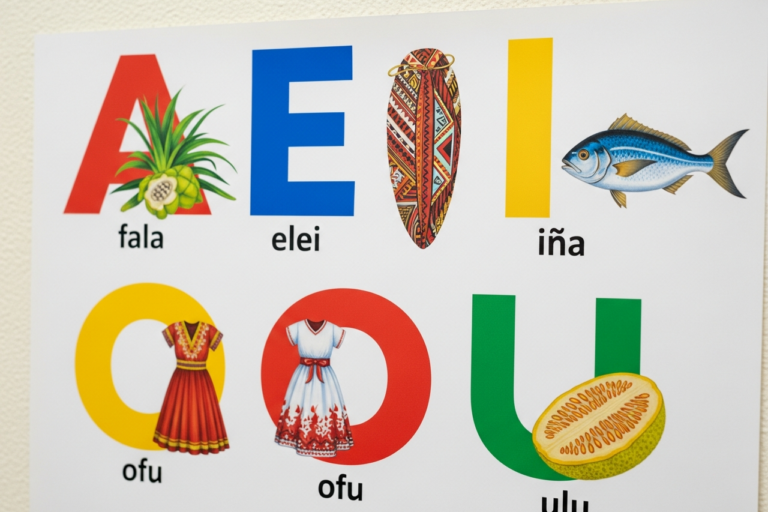
The Samoan alphabet uses five main vowels: A, E, I, O, U. Each one has just one sound and it always stays the same.
-
When you learn how to say these vowels, you are taking your first step with the Samoan language.
-
If a vowel has a straight line over it (called a macron), the word has a new meaning.
-
A glottal stop, shown by an apostrophe or an inverted comma, is an important sound in the Samoan alphabet. It gives a short break in the word.
-
In Samoan, vowels sound clear and do not mix. This is not like English, where the sound of a vowel might change within a word.
Introduction
Welcome to the world of the Samoan language, or gagana Samoa. This is one of the oldest languages in Polynesia, and many people speak it around the world. At the center of this beautiful language, you will find the Samoan alphabet, also called the pi faitau. To learn its vowels is not just for school or study—it helps you feel close to Samoan culture. It lets you show respect for the fa’a Samoa, or the Samoan way of life. This guide will help you know every sound in the Samoan alphabet and understand how important they are in the Samoan language.
Overview of Samoan Vowels in the Samoan Alphabet
The Samoan alphabet has just 14 main letters. This is not a lot, so it’s easy to remember. There are five main vowels in the Samoan language: A, E, I, O, and U. These vowels are very important in Samoan. You will see them in almost every word, and they often show up together in the same word.
In the Samoan alphabet, the vowel sounds do not change. Each vowel has its own sound that stays the same, so it’s not hard to learn them if you know the simple rules. These vowels in the Samoan language are simpler to get. Now, let’s look at how these important vowel sounds work and compare them to ones you might already know.
The Five Core Samoan Vowel Letters and Their Sounds
Getting the hang of Samoan vowels is simple because each one has a single, pure sound. Think of them as more straightforward than English vowels. Once you learn the sound for each of the five vowels in the Samoan alphabet, you can apply that pronunciation consistently across all Samoan words.
This consistency is a huge help for learners. You won’t have to guess how a vowel should sound based on the letters around it. Even in compound words or when vowels appear next to each other, like in the word “Samoa,” each vowel keeps its individual sound.
Here is a simple table to guide your pronunciation:
|
Vowel |
Sound |
Example Sound in English |
|---|---|---|
|
A |
ah |
as in “father” |
|
E |
eh |
as in “bed” |
|
I |
ee |
as in “machine” |
|
O |
oh |
as in “go” |
|
U |
oo |
as in “moon” |
How Samoan Vowels Compare to English Vowels
For people who speak English, the biggest thing to know about Samoan vowels is how stable they are. In English, one vowel can sound many ways. For example, the letter ‘a’ does not sound the same in the words “cat,” “cake,” and “car.” But in Samoan, this does not happen.
The vowels in Samoan words always keep their special sound. It does not matter where the vowel is in the word or what letters are around it. This is a big help for people who are learning how to say Samoan words. Linguists say that these are “pure” vowels, since they are not mixed or changed into other sounds.
Here are the main ways they are different:
-
Consistency: A Samoan ‘A’ will always sound like “ah.” The ‘a’ in an English word can be said in different ways.
-
Purity: In Samoan, vowels have just one clear sound. Many English vowels are diphthongs, which means they move from one sound to another, like the ‘i’ in “ice.”
-
No Silent Vowels: In Samoan words, you always say every vowel. In English, like in the word “cake,” there is a silent vowel.
Learning these things helps English speakers when they are working on Samoan pronunciation.
Mastering Samoan Vowel Pronunciation
Are you ready to speak Samoan? The best thing you can do to get good at Samoan vowel pronunciation is to listen and say the sounds back. The rules in Samoan are easy to follow, so you will feel sure of yourself soon. For the first time, try to say each vowel out loud: ah, eh, ee, oh, oo. Focusing on these five simple sounds will help native speakers understand you.
Keep in mind that practice is important. Listen to Samoan speakers and try to copy what you hear. At first, this may feel new or different, but your mouth and tongue will get used to it. Now, let’s look at vowel length and other features that matter for Samoan pronunciation.
Vowel Length: Short versus Long Vowels in Samoan
One thing you should know about Samoan pronunciation is vowel length. The length of the vowel sound can change the meaning of a word. The macron helps you see this. The macron is a small line over the vowel, like ā, ē, ī, ō, or ū.
If there is a macron, you should say the vowel sound longer than usual. For example, tama means “boy.” When you put a macron on the “a” (tamā), it means “father.” Another example is mama, which means “light in weight,” but māmā means “mother.”
It is very important to notice long vowels for clear Samoan communication. Many people do not write out macrons when they are sending quick messages online. Still, in formal writing and when you want to learn the correct pronunciation and vowel length, macrons really matter. If you start to spot the macron and use the long vowel sound every time, you will get better at Samoan speaking and understanding words.
The use of long vowel sound, long vowels, vowel length, and the macron are all important parts of Samoan pronunciation. Learning how to say and hear them helps a lot when you want to get good at this language.
The Role of the Macron and Glottal Stop in Vowel Pronunciation
Besides the macron, the glottal stop is very important in Samoan pronunciation. In Samoan, people call it the koma liliu. It is shown by an inverted comma or an apostrophe (ʻ). The glottal stop is a consonant, but it has a strong effect on how the vowels sound. It makes a quick, sharp pause between vowels.
You can think about how people say “uh-oh” in English. The pause you hear in the middle is a glottal stop. In Samoan, using or not using the glottal stop can change the meaning of words. For example, the word mai means “come.” If you add the glottal stop, it becomes maʻi, which means “sick.” There is also a difference between ala, meaning “road,” and aʻa, meaning “root.”
These marks are not there just for looks; they are important for the meaning of words. A macron will make a vowel sound longer. The glottal stop will make a sharp pause in the word. If you want to get the pronunciation right in Samoan and know the meaning of words, you will need to use both the glottal stop and the macron the right way. This will help you be clear and sound more like a real Samoan speaker.
Using Samoan Vowels in Everyday Words
Now that you know the sounds, let’s look at how Samoan vowels show up in real words. Vowels are at the heart of Samoan words, and you will see them a lot when you learn the language. Most Samoan words end with a vowel. This gives the language a smooth and flowing sound. If you practice spotting and saying these vowels in words you use every day, you will get better with time.
From simple greetings to common nouns, learning the five vowel sounds helps you break apart new Samoan words and figure out the meaning of words you hear. Let’s check out a few examples, so these sounds make more sense.
Common Samoan Words Featuring Each Vowel
The best way to practice is to use real Samoan words. When you read the examples below, say them out loud. Focus on making each vowel sound clear. Try to keep every vowel sound pure and different from the others. You will hear these words a lot in conversations, music, and church services. Notice that the vowels always sound the same, just like we talked about.
Listening to Samoan speakers will help you get the pronunciation right. Pay close attention to how each vowel is strong and apart, even when there are two vowels next to each other.
Here are some common Samoan words you can use to practice each vowel:
-
A (ah): Alofa (love), faʻafetai (thank you)
-
E (eh): Teine (girl), pepe (baby)
-
I (ee): Aiga (family), tusi (book)
-
O (oh): Talofa (hello), moe (sleep)
-
U (oo): Tusitala (writer), susu (milk)
Typical Pronunciation Mistakes and How to Avoid Them
When you start to learn the Samoan language, it is easy for English speakers to have trouble with vowels. One thing that happens a lot is bringing in ways to say words from English. For example, people may mix vowel sounds or not say them in a clean way. The important thing to know is, Samoan vowels are simple, and you need to say them clearly.
English speakers also often skip macrons and glottal stops in the Samoan language. If you skip them, it is more than just spelling—it makes the meaning of words change. This can confuse people when you talk. Try to look out for these marks every time you speak Samoan and when you read it. This will help you speak and understand better.
Here are ways to help you fix common mistakes with pronunciation and vowel length:
-
Don’t blend vowels: When you see two vowels next to each other, like in meaʻai (food), you should say both in order. Say “meh-ah-ah-ee” so every vowel gets its sound.
-
Keep sounds pure: Do not let ‘o’ sound like “ow” or ‘a’ turn into “ay.” Make ‘o’ like “oh” and ‘a’ like “ah,” keeping the sounds clean.
-
Practice pairs: When you say words like tama and tamā back to back, it helps you feel the difference in how long the vowel is. It also gives
Conclusion
To sum up, learning about vowels in the Samoan language is important if you want to get better at your pronunciation and talking with others. The language has five key vowel sounds. Each sound can be short or long. The length can make a big difference, so it is good to pay attention to it. The macron and glottal stop are two features in Samoan you should know about because they change the meaning of words.
If you spend some time on practicing words people use every day and focus on these little things, it will help you speak samoan in a way that sounds natural. You will also know more about the language and the people who use it.
Try to enjoy the path as you get better at samoan vowels. If you have questions or need help, just ask for it.
Frequently Asked Questions
Are there unique Samoan vowel sounds compared to other languages?
The five vowels in the Samoan alphabet have sounds you can hear in many other languages. But what makes them special is how steady and clear the pronunciation is in Samoan. Linguists say vowel length and the glottal stop are very important. This means that saying a vowel for a long or short time, or adding a glottal stop, can change the meaning of a word in the Samoan alphabet. This is what makes the Samoan vowel system different from others.