Key Highlights
-
The Malayalam alphabet has its own set of consonants. These are needed if you want to master the language.
-
You will find that Malayalam consonants are put into groups. They are grouped by how and where you say them. This makes it easier to learn them in order.
-
The sounds in Malayalam are different. The Malayalam script is used, and this sets these consonants apart from other Indian languages.
-
In Malayalam, there are special characters called chillu letters. These show pure consonants that do not get a vowel sound.
-
You have to know how to say each consonant to speak Malayalam well and so people understand you.
-
This guide gives you a complete view of the Malayalam alphabet. It puts the focus on the consonant system.
Introduction
Welcome to your all-in-one guide to Malayalam consonants. If you want to learn Malayalam, a language spoken mostly in the state of Kerala in India, this is the right place to start. The Malayalam alphabet uses a script that has been around for a long time. The first big step is to get to know its consonants. This guide will make the Malayalam script simple for you, so you can understand every sound.
Overview of Malayalam Consonants
The Malayalam consonants are a main part of how the Malayalam script works. In this style of writing, every consonant letter comes with a vowel sound built in. That vowel will stay unless you change it using a mark or sign. Many scripts from India work like this.
To read and write the Malayalam script, you need to know these consonants. Each one has a shape you can spot and a sound you can learn. With some practice, you will know them well. Let’s see what makes these consonants different and find out how many you will use.
What Makes Malayalam Consonants Unique?
The Malayalam script is special because of the way it has its own sounds and letters. This script comes from older scripts like Vatteluttu and Grantha. Malayalam has a few sounds that you do not usually hear in other languages of India. For example, there is the letter ‘ഴ’ (ḻa). This is tough for people who are not native speakers of malayalam.
One more thing that makes malayalam stand out is its chillu letters. These are called pure consonants. They are written by themselves, with no vowel in them. Not many other Indian languages have this in their script. It helps people show consonant sounds very clearly at the end of words or when there is no vowel.
Malayalam also keeps some sounds from its old Dravidian roots but also borrows from Sanskrit. This makes the set of consonants in malayalam very rich and full. The mix makes malayalam consonants different from others, and many native speakers feel proud of this.
Total Number of Malayalam Consonant Letters
When you see the Malayalam alphabet for the first time, you may ask how many consonants there are. In modern Malayalam, there are about 36 basic consonant letters. These are the letters you will use to make words and sentences.
Each consonant in the Malayalam alphabet has a speech sound of its own. Most of the time, this sound is ‘a.’ That sound is there unless you add a different vowel sign to it. This is a big idea in abugida writing systems that many languages in India use.
Remember, the main group of consonants has about 36 letters. But the Malayalam alphabet also has extra characters. Some are used when two consonants come together. There are old special letters, too. Still, it’s a good idea to start with the main 36 consonants if you are new to Malayalam.
Classification of Malayalam Consonants
To make learning the Malayalam alphabet easier, Malayalam consonants are set up in an order. This system is not random. It is made by looking at how sounds come from the mouth. This setup in the Malayalam script helps a lot when you start to learn it.
By learning this way, you get to see how each sound and symbol connect in Malayalam. Next, we will look at how the way we speak sorts the consonants. We will also talk about the difference between voiced and voiceless sounds.
Grouping by Articulation and Pronunciation
The Malayalam alphabet sorts its consonants by where you make the sound in your mouth. For example, some sounds are made with the lips. Some happen when your tongue touches your teeth. There are also sounds made when your tongue hits the roof of your mouth. This system is an important part of Indic scripts.
This way of grouping helps people learn Malayalam pronunciation better. When you look at the alphabet chart, you can see that letters with the same type of sound are close together. The ‘ka’ group (ക, ഖ, ഗ, ഘ, ങ) is one example. All of these are called velar consonants. You make these at the back of your throat.
If you study how each group is spoken, you do not just learn one letter at a time. You get to know a set of sounds that are connected. This method is a good way to pick up the rules and special parts of Malayalam pronunciation. It helps you learn Malayalam better and faster.
Voiced vs. Voiceless Consonants in Malayalam
Another key way that Malayalam consonants are grouped is by voicing. Voicing means whether your vocal cords shake when you make the sound. This is basic to how you say many consonants in the Malayalam script. A consonant has its own sound. A vowel is a sound that changes how the consonant sounds.
Voiced consonants use the vibration of the vocal cords. To feel this, you can touch your throat while making a voiced sound. Voiceless consonants do not make your vocal cords shake. You only use the air that moves through your mouth.
Here are some examples to show the difference:
-
Voiceless: ‘ക’ (ka) and ‘ച’ (cha) are made without your vocal cords vibrating.
-
Voiced: ‘ഗ’ (ga) and ‘ജ’ (ja) need your vocal cords to vibrate.
Knowing this is important for saying words right and telling apart similar-looking letters in the Malayalam alphabet and Malayalam script.
The Malayalam Consonant Chart
A Malayalam consonant chart is very helpful for anyone learning the language. It shows all the Malayalam consonants in one place. The chart usually puts them in groups based on where you make the sound in the mouth, and if the sounds are voiced or not. This setup helps you see how the Malayalam consonants work.
Looking at all the consonants together in a clear Malayalam chart helps you spot patterns in the way they sound and look. In the next sections, you will see a list of the consonants, the sounds for each one, and a guide with pictures to help you learn how they look.
List of All Malayalam Consonants With Sounds
Getting to know the individual Malayalam consonants and their sounds is the next step. Each letter in the Malayalam alphabet has a unique sound, and this list will help you connect the symbol to its correct pronunciation. Remember that each consonant has an inherent ‘a’ sound.
Below is a table that lists the basic Malayalam letters representing the consonants, along with their corresponding romanized sound. This will serve as a foundational reference as you begin to read and write.
Here is a simplified table of the core consonants:
|
Malayalam Letter |
Romanization |
Sound |
|---|---|---|
|
ക |
ka |
as in ‘k’ in ‘kite’ |
|
ഗ |
ga |
as in ‘g’ in ‘go’ |
|
ച |
cha |
as in ‘ch’ in ‘chair’ |
|
ജ |
ja |
as in ‘j’ in ‘jam’ |
|
ട |
ṭa |
retroflex ‘t’ sound |
|
ഡ |
ḍa |
retroflex ‘d’ sound |
|
ത |
tha |
as in ‘th’ in ‘thin’ (dental) |
|
ദ |
da |
as in ‘th’ in ‘the’ (dental) |
|
പ |
pa |
as in ‘p’ in ‘spin’ |
|
ബ |
ba |
as in ‘b’ in ‘bat’ |
|
യ |
ya |
as in ‘y’ in ‘yes’ |
|
റ |
ra |
rolled ‘r’ sound |
|
ല |
la |
as in ‘l’ in ‘love’ |
|
വ |
va |
as in ‘v’ in ‘vase’ |
|
ശ |
śa |
as in ‘sh’ in ‘shoe’ |
|
സ |
sa |
as in ‘s’ in ‘sun’ |
|
ഹ |
ha |
as in ‘h’ in ‘hat’ |
|
ള |
ḷa |
retroflex ‘l’ sound |
|
ഴ |
ḻa |
unique retroflex approximant |
|
ങ |
ṅa |
as in ‘ng’ in ‘sing’ |
|
ഞ |
ñj |
as in ‘ny’ in ‘canyon’ |
|
ണ |
ṇa |
retroflex ‘n’ sound |
|
ന |
na |
as in ‘n’ in ‘no’ |
|
മ |
ma |
as in ‘m’ in ‘mat’ |
Visual Guide to Shapes and Common Forms
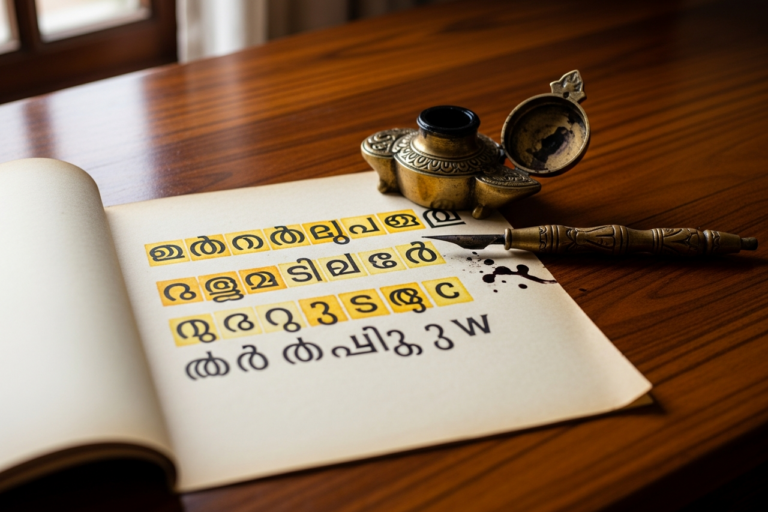
The Malayalam script has beautiful, rounded shapes in its letters. When you look at the Malayalam consonants for the first time, some of them can seem the same. With more practice, you will start to see the little things that make them different. This visual guide will help you get used to their forms.
You can think about learning the shapes like drawing. Watch where you start each letter and which way your lines move. For instance, the letters ‘പ’ (pa), ‘വ’ (va), and ‘ദ’ (da) all have curves that look the same. But their endings and extra lines help you know which one is which. A clear chart with the Malayalam script can show you these details.
To get good with the shapes, write them out by hand. You can first trace each letter. After that, try to write them without tracing. If you connect the look and sound of every consonant while using Malayalam, you will remember them better. This will make reading the Malayalam script simpler and feel more natural.
Special Consonants and Chillu Letters
Besides the basic consonants, the Malayalam script has some special letters. These are called “chillu” letters, or chillaksharam. These are not new consonants. They are a fun way to write consonants in Malayalam.
These chillu letters help show the right sounds, mainly at the end of words. They are important in Malayalam for accurate writing. Now, let’s take a look at chillu letters and see how they are like or different from consonants in other Indian scripts.
What Are Chillu Letters and How Are They Used?
Chillu letters are a unique part of the Malayalam script. They are special ways to write some Malayalam consonants. These letters show a pure consonant sound, without the built-in ‘a’ vowel. This means a word can end with a true consonant sound, like the ‘n’ in “avan” (which means “he”).
People use chillu letters in certain places. You will find them at the end of syllables or at the end of words. For example, there is a chillu form for the consonant ‘ന’ (na), which is written as ‘ൻ’ (n). When you see ‘ൻ’ at the end, you only say the ‘n’ sound. There are chillu versions for a few common Malayalam consonants like n, l, r, and k.
Learning about these chillu letters is important for reading and getting the correct pronunciation in Malayalam. The chillu letters are a smart way in the Malayalam script to show the end of a word with a consonant, and they do this without using a special mark to take away the vowel sound. This helps keep the script looking smooth and flowing.
Comparison With Other Indian Scripts
The malayalam script comes from the same family as other Indian scripts. It shares roots with Brahmi, Grantha, and Vatteluttu. Because of this, you can see many things in common with the consonants in tamil and some sounds taken from sanskrit. But, malayalam has its own things that make it special.
There are sounds in malayalam that you do not see in other nearby languages. For example:
-
The sound ‘ഴ’ (ḻa) is often seen in malayalam and tamil. It is not used in most other big Indian languages.
-
Malayalam keeps more consonants from sanskrit. Tamil, on the other hand, uses fewer consonants and has a simpler list now.
By mixing Dravidian and Sanskrit parts, malayalam consonants have a broad and one-of-a-kind set of sounds. It has the same roots as scripts like Devanagari, but the malayalam script has grown to fit the language the best.
Conclusion
To sum up, learning about Malayalam consonants is important if you want to get better at the language. You will see how each consonant has its own look and sound. This helps with both pronunciation and writing in Malayalam. When you learn the difference between voiced and voiceless consonants, plus special chillu letters, you will get more skilled and also start to enjoy the language more. Remember, you have to keep practicing! If you want to learn more or need extra help, you can contact us for a free consultation. Try out the beauty of Malayalam and get started today!
Frequently Asked Questions
How can I improve my pronunciation of Malayalam consonants?
To get better at saying Malayalam consonants, listen to native speakers and try to copy how they talk. Use online tools that have sound to practice each letter in the Malayalam alphabet. Pay attention to where in your mouth you make each sound. This will help you be more correct when you say them.
What tips help remember Malayalam consonant letters quickly?
To remember Malayalam consonant letters fast, try flashcards. Each card should show the letter, its sound, and a picture. Practice writing the letters every day. Try to match the letters to basic Malayalam words too. Put letters that look alike together, and pay attention to how they are different. This will help you remember them better.
Are there any tricks for writing Malayalam consonants easily?
A good way to write Malayalam consonants is to learn some basic strokes and curves in the Malayalam script. The script is full of rounded shapes, so it helps to practice making circles and smooth lines. You can start by tracing Malayalam letters, which can help you build muscle memory. After that, try writing them on your own, without tracing.