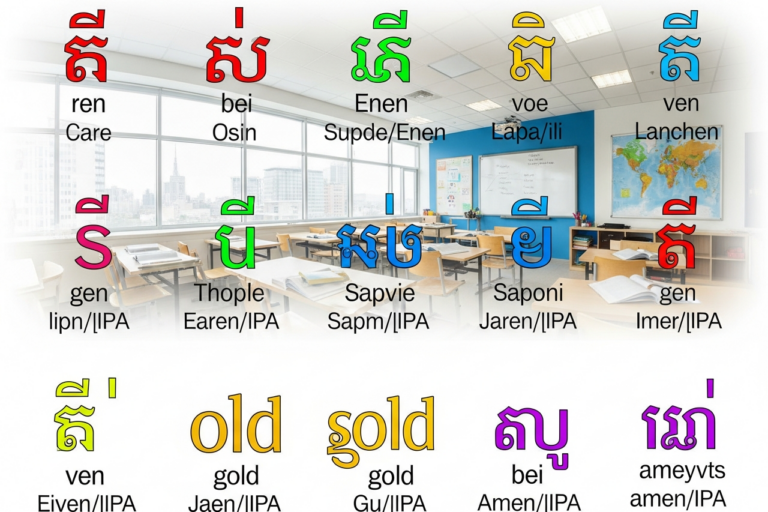
Key Highlights
-
The Khmer script is a type of writing called an abugida. In this system, each consonant already comes with its own vowel sound.
-
Khmer vowels are put into two main groups. There are dependent vowels and there are independent vowels.
-
The way that dependent vowels are said will change. This depends on which consonant series they are attached to.
-
The consonants in the Khmer alphabet are split into two types. These are called the a-series and the o-series.
-
If you want to say words in the right way, it is important to know how the consonant series and the vowel signs work together.
-
Independent vowels in the Khmer script are letters that can make a sound without needing a consonant in front.
Introduction
Welcome to the world of the Khmer language. If you have ever wanted to know more about the beautiful Khmer script you see in Cambodia, you are in the right spot. The Khmer script is at the heart of the Khmer language. It is more than just a set of letters. The script can also open the door to the rich and old culture of Cambodia. In this guide, we will show what is special about this way of writing. You will learn about its different consonant sounds and the vowel signs. This can help you get started with Khmer words.
The Importance of Learning Khmer Vowels
Learning Khmer vowels is an important step in understanding the Khmer language. The vowels show how words sound. Even a small change in vowel sound can make a word mean something else. If you know them well, you can talk clearly.
When you learn about the vowels, you get closer to Cambodian culture. You can read, write, and speak better. This helps you feel more sure when you talk to native speakers. It also makes your talk with them richer. Next, we will see why vowels matter so much in the Khmer language and how they guide how words sound.
Why Vowels Matter in the Khmer Language
The vowels in the Khmer language are a big part of how the language works. The Khmer language is the official language of Cambodia. It is different from many other languages because Khmer does not just use consonants to build words. It uses the vowel system to make many sounds, so learning these vowels is very important for anyone who wants to speak the language.
The vowels in Khmer are split into two main categories. These categories and their sounds connect with consonants in a special way. This setup is at the center of how people who speak the Khmer language write and talk. If you do not understand these vowels, you will find it very hard to use the words the right way.
So, if you want to learn the Khmer language, you need to start with its vowels. The vowels are more than just single sounds—they help make the rhythms and music you hear when Khmer people speak. If you get to know these vowels, you can open the door to speaking well and feeling the heart of Cambodian culture.
Role of Vowel Sounds in Building Words
In Khmer writing, the vowel sound plays a big part in making words. People add vowel symbols, called diacritics, to the initial consonant to build each piece of a word. You can not make most Khmer words if you do not put a consonant together with one of these vowel signs. This is the most basic part of the writing system.
Even simple words need this pairing. The vowel symbol shows what sound is after the first consonant. It is what brings a word to life. If you use the wrong vowel, the khmer word may not make sense or it might mean something else. This shows how key the vowel symbols are in Khmer writing.
When you start to build your list of khmer words, you will see how using other vowel symbols can give you new words from the same starting consonant. This lets you know that you need to understand vowel sounds and vowel signs well in order to read and write. This way, you can make and spot many words in the Khmer language.
Understanding Vowel Influence on Pronunciation
The effect of vowels on how words sound in the Khmer script is very strong. One vowel sign can have two sounds. The sound you say depends on the consonant it is with. This double-sound system really shapes how the language works. It is also a big problem for people learning to read and speak Khmer.
Dependent vowels are the type you see most often. They do not make any sound by themselves. What sound you make comes from the consonant series they are used with. On the other hand, independent vowels are single letters. They always have their own vowel sound. These are used when there is no consonant before the vowel, like at the start of a syllable.
If you want to speak well, you need to know all the vowel signs and how they work with the group of consonants. Your vowel sound depends on which series the consonant belongs to. To say words the right way in Khmer, you need to be able to see this and use the correct sound for the khmer script. This is the main way to get the right sound in the language. It will help you with speaking, reading, and understanding both independent vowels and dependent vowels.
Overview of the Khmer Alphabet System
The Khmer alphabet, also called អក្សរខ្មែរ (âksâr khmêr), is the way people write the Khmer language. This is a type of writing called an abugida. In the Khmer script, every consonant has a vowel sound built in. The Khmer alphabet has deep historical roots that go all the way back to old Indian writing systems, like the Brahmi script and the Pallava script.
This alphabet has its own way of being set up, and that is what makes it different from all the other writing systems. If you want to get to know the true style and strength of Khmer writing, you first need to learn how it works. Next, we will talk about what is special about the Khmer script, how the consonant series work, and the main things you need to know about the Khmer alphabet.
How the Khmer Script Differs From Other Alphabets
The Khmer script is very different from writing systems like the Latin alphabet used for English. In English, letters show a consonant or a vowel. But the Khmer script is a unique writing system, called an abugida, and it works in a special way. Each consonant in khmer writing has a vowel sound built in. You can change this vowel sound by adding vowel signs to the main letter.
Another thing that sets the khmer script apart is the absence of spaces between words. In English and many other languages, you use spaces to show word boundaries. Khmer does not do this. The space is used to show that a clause or sentence is ending, not that there is a new word. This can be hard for people starting to learn the script, as they may not know when one word finishes and another starts.
The way consonants and vowel signs work together in khmer script is also different from many other writing systems found in Southeast Asia. You will need to know how the inherent vowel in each consonant and the extra vowel signs come together. This means, instead of learning letters one by one, you get to know how consonants and vowel signs make syllables. This is what makes the khmer script so special.
Introduction to Consonant Series and Their Impact on Vowels
The Khmer script puts its consonants into two groups. These groups are called consonant series. Learning about these series is one of the first things that you should know when you start with this language. The series of the initial consonant in a word tells you how the vowel will sound.
The first series is called the a-series. The next group is called the o-series. The main consonant in a word shows if the vowel nearby will make an “a” sound or be read as an “o” sound. So, a single vowel sign can sound in two ways. It all depends on which consonant series the vowel goes with.
For example, when a vowel sign connects to an a-series consonant, it sounds one way. When that same sign comes after one of the second series consonants, it sounds different. To read and speak this well, you need to know how the main consonant and the vowel work together in the Khmer script and why the series of the initial consonant matters.
Key Components of Khmer Writing
Khmer writing uses two main things: khmer consonants and vowel signs. The modern khmer script has 33 consonants. These are the base of every word. In english, a letter stands alone, but here, these consonants are split into two groups. This split changes how they sound.
Vowel signs are added marks that sit with the consonants. These vowel signs change how a consonant should be said. You can see vowel signs placed over, below, before, or after a consonant. There are more than 20 vowel signs in khmer writing. Each one changes the sound of the consonant next to it.
There is a third thing you need to know: the subscript form. When you see two khmer consonants together without a vowel in the middle, the second consonant is written underneath as a smaller sign. This is called the subscript form of the second consonant. If you want to read and write khmer script well, you have to get used to these three things: khmer consonants, vowel signs, and the subscript form.
The Two Main Types of Khmer Vowels
When you learn the Khmer language, you will find out that there are two main kinds of vowels. There are dependent vowels and independent vowels. Most of the vowels you see are dependent vowels. These need to go with a consonant before you can hear their sound.
Independent vowels are different. They are full letters, so they can stand alone at the start of a word. The next parts will talk more about what independent vowels and dependent vowels are, how you use them in the Khmer language, and show you ways to know which is which.
Dependent Vowels: Definition and Usage
Dependent vowels are the most used kind of vowel in the Khmer script. They are not full letters. They look like small marks and help change how a consonant sounds. There are over 20 vowel signs. These vowel signs cannot be used by themselves in a word.
The name “dependent” is used because how they sound is based on the series of the initial consonant they are linked with. When you use the same vowel sign with an a-series consonant or an o-series consonant, you get a different sound. This is a basic rule in Khmer script.
You will see these vowel signs before, after, above, or below a consonant. This makes a whole syllable. If you are starting to learn Khmer, you will need to get good at hearing and using the two ways each dependent vowel is said. Knowing this will help you read and speak Khmer well.
Independent Vowels: Definition and Usage
In the Khmer script, independent vowels are full letters. They have their own set sound. These vowels do not need to go with a consonant to make a syllable. You can find them starting a word or a syllable by themselves.
There are fewer independent vowels in the Khmer alphabet, and people do not use them as much as dependent vowels. The main job of these vowels is to show the vowel sound at the start of a word. You see this happen a lot in words from Pali or Sanskrit.
For people learning, you can think of independent vowels like the vowels in the English alphabet. They stand on their own as letters. You will not see these vowels as much, but knowing them helps a lot. It is a key part of reading and understanding the whole Khmer script.
Comparing Dependent and Independent Vowel Sounds
The main difference between independent vowels and dependent vowels in the Khmer script is how they look and what they do. Dependent vowels are small marks that change a consonant’s vowel sound. Independent vowels are full letters in the script. They have their own vowel sound that does not need another letter.
Their sound is also set in different ways. The way you say a dependent vowel can change, depending on which consonant this vowel comes with. But the sound for an independent vowel does not change. It always stays the same, no matter where it is in a word.
Here is a clear comparison:
-
Form: Dependent vowels are small marks. Independent vowels are full Khmer script letters.
-
Function: Dependent vowels must be used with a consonant. Independent vowels in the Khmer language can be used alone.
-
Pronunciation: Dependent vowel sounds will change with the consonant series. Independent vowels have a set vowel sound.
-
Frequency: People use dependent vowels much more than independent vowels in the Khmer language.
Complete List of Khmer Vowel Symbols
The Khmer alphabet has many vowel symbols. These are very important for both reading and writing in the Khmer script. The number of these vowel signs can change a little, but in most cases, there are more than 20 main vowel signs in modern Khmer script. Each of these vowel symbols stands for a different sound. What it sounds like can change based on the consonant with it.
To really know their sounds, it helps to see a chart of all the Khmer vowels. The chart shows how these vowel signs sound, often with the international phonetic alphabet. Below, you can find a chart for all Khmer vowels, see what they usually sound like, and get a guide on where they go in the word.
Chart of All Khmer Vowels With Pronunciation
Having a chart of Khmer vowels is an invaluable tool for any learner. It allows you to see all the vowel symbols at once and associate them with their respective pronunciations. The table below outlines the dependent vowels and shows how their sound changes when paired with a-series and o-series consonants, using the International Phonetic Alphabet (IPA) for accuracy.
Remember that the pronunciation can vary slightly in different dialects, but this chart provides the standard sounds used in formal Khmer writing. Use this as a reference to practice and memorize the different vowel sounds.
|
Vowel Symbol |
Name |
A-Series Pronunciation (IPA) |
O-Series Pronunciation (IPA) |
|---|---|---|---|
|
៙ (example) |
Srak a |
/a/ |
/ea/ |
|
៙ (example) |
Srak i |
/əj/ |
/i/ |
|
៙ (example) |
Srak ei |
/ej/ |
/ɨj/ |
|
៙ (example) |
Srak o |
/o/ |
/uə/ |
|
៙ (example) |
Srak ou |
/əw/ |
/u/ |
Common Sound Values of Each Vowel
Each Khmer vowel has its own sound. These sounds are very important if you want to say words the right way in the Khmer language. The main rule to remember is that a vowel changes the way it sounds, based on what kind of consonant it follows. There is an a-series and an o-series for consonants. This simple rule is at the heart of Khmer.
For example, a vowel that looks the same may make the “a” sound in “father” when it follows one series. But it can sound like “ea” in “fear” with the other series. To really understand these vowel sounds, listen often to native speakers. They help you notice small differences.
You can use charts to get started, but you will learn and remember the sounds better by hearing them in the real world. Pay close attention to how native speakers say Khmer vowels in different words. This will help you get a better ear for the sounds and fix your accent.
Visual Guide to Vowel Placement
In the Khmer script, vowel signs are not put in a straight line like in English. You be supposed to put them in a special way, and it depends on the consonant they change. The place where you put vowels is an important part of Khmer writing.
To use the khmer script, you need to know both what the vowel signs sound like and where you have to put each one. Each vowel sign out of the more than 20 has one place around the main consonant where it should go. Some can even show up on different sides of the consonant at the same time.
Here are the main ways to put vowel signs in khmer writing:
-
Above the consonant: Some vowel signs are written right on top of the main consonant.
-
Below the consonant: Other vowel signs appear under the main consonant, and a few may look like a subscript form.
-
Before or after the consonant: Certain vowel signs go to the left or right side of the consonant.
-
Surrounding the consonant: The most complex vowel signs wrap around the consonant on more than one side.
How Khmer Vowels Combine With Consonant Series
The way Khmer vowels work with the two consonant series helps shape how the language sounds. When you add a vowel to an initial consonant, its sound will change. This will depend on if that consonant is in the a-series or the o-series, which some people also call the first series or the second series.
This system gives the language a clear and rich structure. It helps people know how to say most khmer words. In the next sections, we will talk about the sound changes for both the a-series and the o-series consonants. We will also give examples to show how they are different.
Sound Changes With A-Series Consonants
When you put Khmer vowels with a-series consonants, they make one of two basic sounds. The a-series consonants come with a built-in /ɑː/ sound. This is a lot like the “a” you hear in the word “father.” This built-in sound helps decide how any attached vowel will sound.
These sound changes happen the same way every time. Every vowel in the khmer script gets a special sound when you use it with an a-series consonant. You need to remember and practice these set pairs.
For example, a vowel might sound like “ee” if you use it with an a-series consonant. But, when you use that same vowel sign with an o-series consonant, it will sound different. This planned change is important when you read the khmer script.
Sound Changes With O-Series Consonants
The o-series consonants are also called the second series consonants. They come with a built-in /ɔː/ sound, like the “o” in “more.” This base sound helps decide the way any Khmer vowels attached to them will sound.
Just like the a-series, the sound changes with o-series consonants are easy to guess. Each vowel sound shifts in its own way when it works with these second series consonants. It will not sound like it does with the a-series.
For example, a vowel sign might make an “oo” sound, but only if it is next to a second series consonant. Learning how these sound changes work is key if you want to say Khmer words the right way. You need to figure out first if the consonant is from the second series. Then, you use the right vowel sound for that series.
Examples of Words Illustrating Sound Differences
Seeing examples is one good way to see how the consonant series changes the vowel sound in the Khmer language. If you look at two Khmer words with the same vowel sign but different consonant series, it becomes much easier to get the idea.
Let’s say there is a vowel sign that we call “V.” When you put it with an a-series consonant like ក (kâ), you get a word that is said as “ka-V.” When you use the same “V” with an o-series consonant like គ (kô), you might end up with a word that sounds like “ko-V,” and the vowel sound is all different.
Here are a few simple examples to help with this:
-
Word 1: A-series consonant + Vowel X = Sound A
-
Word 2: O-series consonant + Vowel X = Sound B
-
The vowel sound will switch from A to B depending on which consonant you use.
You will see this rule with both short and longer words in the khmer language. It can sometimes be hard for people who are new to this to see where one khmer word ends and the next starts, since there can be no clear word boundaries.
Special Features of Khmer Vowels
Khmer vowels have some special things that make the Khmer script look interesting and different. There are basic types called dependent and independent vowels. But the script also uses extra marks, changes in shapes, and sometimes joins letters together to make new syllables.
These features include the way vowel signs are put around other letters, and how more marks can change the sound even more. We will now talk about where to put vowel signs, what diacritics do, and a few special cases you may see in the Khmer script.
Vowel Signs Above, Below, Before, and After Consonants
The Khmer script stands out because the vowel signs are not placed in a straight line. English vowels go next to consonants in one row. In Khmer writing, vowel signs are put in different places around the consonant. This makes the letters look close together and layered.
Each vowel sign in khmer writing has a set place. To use the khmer script well, you must know where to put each vowel sign. You cannot just put the vowel sign next to the consonant. It needs to be in its own spot so people can see the syllable.
This way of putting vowels shows up in a few ways:
-
Vowel signs can be put above the consonant.
-
Some are put below the consonant.
-
Others are written to the left side of the consonant (before it).
-
Some go on the right side (after it).
The system is what makes khmer writing look so special and unique.
Use of Diacritics and Altered Vowel Forms
The Khmer script uses a lot of marks called diacritics to show vowels. All the dependent vowels in Khmer script are, in fact, diacritics. They are small marks added to a main letter, and they are very important for the whole writing system.
Along with the usual vowel signs, Khmer script also uses changed forms of vowels. Some diacritics can go together with a vowel sign to change how it sounds. This adds more detail to the script, kind of like how some languages use accents, but in Khmer, it is a bigger part of how their system works.
Because Khmer script depends so much on diacritics, it is different from other writing systems you might know. To read and write in Khmer, you need to be able to spot the little marks above, under, and next to the main letter. These small details in khmer script and their dependent vowels carry a lot of meaning and different sounds.
Ligature Formation and Special Cases
In the Khmer script, some letters or combos stick together to make one new shape. This happens when some consonants and vowels come together, and you have to remember these by heart.
These new shapes are not just a style thing. They are needed in normal Khmer writing. For example, sometimes a consonant plus a certain vowel will look different when put together than when you see them alone.
Here are some things to know about these special cases:
-
Certain Khmer vowels and consonants go together to form one new character.
-
You have to learn these new forms one by one because they don’t always follow normal rules.
-
It’s important to spot these special cases for smooth reading, because you will find them in the words people use a lot.
These rules are a big part of the khmer script and are used in everyday khmer writing.
Common Challenges in Learning Khmer Vowels
Learning Khmer vowels can be hard for some people, especially if you do not know the khmer script yet. The reason is that the way each vowel sounds changes with the consonant series. This may be the biggest thing to get used to, as you have to think in a new way about how the letters work together. There are also many different vowels in the khmer alphabet, and that can feel like a lot when you start.
Many people also find it tough to hear small changes in sounds or to know if a vowel should be long or short. Next, we will talk more about these common problems and share some good tips to help you move past them.
Differences in Pronunciation for English Speakers
For people who speak English, saying the Khmer vowels can be tough. The Khmer language has a lot of vowel sounds that are not in English. So, you have to learn new ways to move your mouth and hear new sounds.
In Khmer, the sound of a vowel changes based on which consonant comes before it. English does not work like this at all. You need to stop thinking of each letter having just one sound. You have to get used to how sounds go together in this new way.
There are some clear things that make saying Khmer hard:
-
A lot of Khmer vowels sound different from anything you get in English.
-
It is not easy to hear and say the short vowel and long vowel sounds.
-
The system with two ways to say dependent vowels is hard to get at first.
-
If you forget which group, or series, of consonants you are using, you can say words wrong a lot.
Learning the Khmer language means spending time paying close attention to dependent vowels and making sure you know the consonant series. This will help you get the right sound when you talk.
Troubles With Vowel Length and Nuances
Another big problem when you learn Khmer vowels is getting the vowel length right. In Khmer, the way you say a vowel—if you say it quick or hold it longer—can change what a word means. This change can be small and hard to notice, especially if you are new to the language.
Many people get stuck here because a lot of languages, like English, do not care about vowel length in the same way. If you get the length wrong, it can cause people to not understand you. That is why working on this part helps you say things the right way.
You will need time to get used to these differences in vowel sound. It helps to listen to native speakers. You can also practice with word pairs where only the vowel’s length changes. Doing this can help you hear and say these vowel changes better in Khmer.
Tips to Overcome Vowel Memorization Hurdles
Memorizing the many Khmer vowels and how they sound in two different ways can seem like a big job. But, with the best way and right tools, you can do it. The first thing is to make the work smaller. Just focus on a few vowels at one time, not all together.
One good idea is to use memory tricks. Try to link the look or sound of the vowel to a thing you know. Use active recall. For example, write the vowels by memory instead of just looking at them. This is more helpful than only reading. The best way is to try out tools and ways that work for you.
Here are some tips to help you remember:
-
Use flashcards every day. Focus on one group of vowels at a time.
-
Write the vowels out by hand to help your hand and brain remember.
-
Make memory tricks or image links for each vowel sign.
-
Listen to how the vowels sound and say them out loud often. This will help your ear and how you say them.
Helpful Resources and Methods to Master Khmer Vowels
To get good with Khmer vowels, you should use different tools and ways to study. Try to use charts you can see and apps on your phone to help you learn. These things help you stay interested and can make it easier to understand. Doing practice exercises is important too. These let you use what you know.
There are the many tools you can use, no matter what your level is. In the next parts, we will show you special charts, apps, and flashcards you can try. We will talk about good ways to remember what you study. You will also find ideas for real-world practice exercises.
Recommended Charts, Flashcards, and Mobile Apps
Using the right tools can make it much faster to get good with Khmer vowels. Having visual aids helps you remember the script. You can hang Khmer alphabet charts on your wall. This way, you see the letterforms all the time and get to know them well.
Flashcards are another good way to learn. These can be physical cards or digital ones on your phone or computer. Flashcards help you remember by making you practice over and over. You can make your own flashcards or use ones that are already made. There are also mobile apps that let you practice anytime you want. Many of these apps help you with writing and saying each vowel, sometimes with audio.
Here are some resources to help you get started:
-
Charts: Look online for Khmer alphabet charts you can print out, or buy posters on sites like Amazon.
-
Flashcards: You can use apps like Anki to make digital cards, or you can make your own paper flashcards.
-
Mobile Apps: Apps like “Write Me” or “Ling” give you step-by-step lessons and small quizzes to help with the Khmer script.
-
Online Keyboards: The site Lexilogos gives you a virtual keyboard so you can practice typing in Khmer.
Using the right tools like these is a good way to get used to the Khmer script and reach your goals faster.
Effective Study Techniques for Retaining Vowel Sounds
When you use the right tools, you also need good study methods to really remember Khmer vowel sounds. It helps to use spaced repetition. This means you study something, then come back and review it after more and more time passes. Many flashcard apps use this idea. It helps people remember things for a long time.
Another way that works well is active listening. Do not just listen without thinking. You need to really pay attention to how native speakers say each vowel. Try to copy what you hear. Record your voice and compare it to the native speakers.
Here are some good study techniques:
-
Spaced Repetition: Keep going over vowel sounds using something like Anki. This helps move what you learn into your long-term memory.
-
Auditory Practice: Listen to Khmer audio files and pick out the vowel sounds. Copy how native speakers say them to help your mouth get used to the right shapes.
-
Contextual Learning: Practice vowels as part of whole words, not by themselves. This shows you how vowels sound in real situations.
Practice Exercises for Real-World Application
Now that you know the basics of Khmer vowels, it’s a good time to use what you have learned. You should try exercises that help you use the Khmer script in real life. This will make your skills stronger. Begin by taking easy Khmer words that are written with roman letters and write them in the Khmer script.
Reading simple things can help too. Look for children’s books or easy talks written in Khmer. Try reading these out loud. This will help you spot vowels as you read and say them the right way. Do not stress if you do not know every word. Your job is to read the words written in the script as well as possible.
Here are some things you can try:
-
Transcription: Listen to or look at Khmer words that use roman letters, then write them in the Khmer script.
-
Reading Aloud: Read easy stories or short texts in Khmer. This lets you see and say the vowels and helps you get better at saying the words out loud.
-
Labeling: Put labels on things in your home using the names in Khmer. This will bring the Khmer script into your everyday life.
These steps will help you learn and use khmer script and khmer words much better.
Conclusion
To sum up, learning Khmer vowels is important if you want to understand the Khmer language better. Knowing about both independent vowels and dependent vowels helps with how you say words. It also lets you talk with people more clearly. When you get to know the vowel symbols, their sounds, and how they work with consonants, you will boost your skills fast. Just remember that you have to practice often. This will help you enjoy and get the most out of your learning. If you want to try the next step, you can get a free trial of our Khmer language course right now!
Frequently Asked Questions
How many vowels are there in the Khmer script, and what do they sound like?
The Khmer script has more than 20 dependent vowels and a smaller group of independent vowels. The vowel sound for each dependent vowel can change, depending on which consonant it is with. Because there are so many different sounds, people often use the International Phonetic Alphabet to show them in a clear way.
What is the difference between dependent and independent Khmer vowels?
Dependent vowels in the khmer script are small marks written with a consonant. They change their sound, based on the consonant you use. In the khmer language, independent vowels are full vowel symbols. These work as full letters and have just one sound. People often use independent vowels to start a word when speaking or writing in khmer.
Are there any strategies for memorizing Khmer vowels quickly?
The best way to remember something is to do it each day with the right tools. You can use flashcards and simple tricks to help you link shapes to sounds. Try to use active study steps, like writing the Khmer vowels by hand. Also, listen to native speakers often. These things will help you get better at it fast.