Key Highlights
-
The way you say words in English depends on how you learn each vowel sound. This is more than just knowing the five vowel letters.
-
We will look at the difference between short vowels, long vowels, and the more complex sounds called diphthongs.
-
The International Phonetic Alphabet (IPA) is an important tool. It helps you say every speech sound the right way.
-
You will see some interesting changes in vowel sounds when you compare American English to British English.
-
This guide explains it all—from simple vowel sounds to harder topics—so you can have clear English pronunciation.
Introduction
Welcome to the world of English vowels! Learning the vowel system is the key to having clearer pronunciation and helping you speak with more confidence. The English language has only five vowel letters. But, it has many different vowel sounds. In this guide, you will go through each speech sound. We will start with the simple ones and move to the harder ones. Are you ready to work on your pronunciation and sound more natural when you speak English? Let’s start.
What Are English Vowels?
So, what is a vowel? In English, a vowel is a speech sound that you make when air moves through your vocal tract without much blocking. For example, when you say “ah” or “oh,” your mouth stays open, and the sound comes out easily.
These sounds are the main part of syllables. They are important for the correct pronunciation of every English word. Knowing more about vowels helps you become clear and smooth when you speak English. We will now talk more about what vowels are and how they are not the same as other speech sounds.
Definition and Purpose of Vowels in English
Vowels are sounds that you make by letting air flow out through your mouth without anything like your tongue, lips, or teeth blocking it. The way that your tongue and lips move makes different vowel sounds. These vowel sounds are very important for how we say words.
In the English language, vowels are at the center of most syllables. Every time you say a word in English, you almost always need a vowel sound. This is what gives English its beat and helps words be clear. Without vowel sounds, words can run into each other, and it would be very hard for anyone to understand what people say.
If you want to speak English well, you need to know how to make each vowel sound the right way. Each vowel can make a word mean something different. For example, “bat” and “bet” or “sit” and “seat” sound close, but the vowel in the middle makes them mean something else. Even a small change in a vowel sound can change the meaning of a word. So, getting your vowel sounds right is key for good pronunciation.
The Five Vowel Letters vs. Vowel Sounds
Many people think the five vowel letters—A, E, I, O, and U—are only linked to five vowel sounds. But this is not true. In the english language, there is a bigger number of vowels based on sound, and that can make pronunciation hard. The same vowel letter can have more than one sound, to go with each word and its spelling.
In american english, there are about 14 to 16 different vowel sounds. The way words sound changes, depending on the dialect. That is why the number of vowels as letters does not always match with the number of vowel sounds you hear. This is also one big reason why english spelling can be so hard to follow. Take the letter ‘a,’ for example. It sounds different in:
-
cat
-
father
-
cake
This is why you should learn vowel sounds, not just the vowel letters, when you study english. By knowing the sounds, you get better pronunciation every time, no matter how a word is spelled. It helps learners improve, and the process becomes easier.
How Vowels Differ from Consonants
The main way that vowels and consonants are different is in how you make them, or their articulation. Vowels use an open vocal tract, so air moves easily when you speak. But, when you say consonants, there is something in the way. Your lips, tongue, or teeth block the airflow at some point.
Think about the sounds ‘p’, ‘t’, or ‘s’. For all three, you use your mouth to stop or shape the air. This makes them different from vowel sounds. Here is a simple look at how vowels and consonants are not the same:
-
Vowels: The air moves out openly and they are the main part of a syllable.
-
Consonants: The air is partly blocked and you will see them at the beginning or the end of a syllable most of the time.
Knowing this difference is a big part of understanding english phonology. The way vowels and consonants come together is what gives english its sound and rhythm. When you think about how you move your mouth for each, it helps you use better pronunciation.
The Vowel Letters in the English Alphabet
The English alphabet has five main vowel letters. These are A, E, I, O, and U. There is also the letter ‘Y’. Sometimes, it gets counted as a vowel too. These vowel letters form the base for English spelling and writing. Still, there is not a simple match between each vowel and a sound. One letter can show many different sounds.
This mixing up of spelling and how we say words is common in the english language. In the next parts, we will talk more about vowel letters, the sounds they make in english, and the times when ‘Y’ acts as a vowel.
Overview of A, E, I, O, U and Sometimes Y
The vowel letters A, E, I, O, and U are the main signs we use to write vowel sounds in English. But each of the letters can make more than one vowel sound, and this often causes people to get confused with the English language. So, if you just look at the spelling, you might not know the right way to say a word.
Take the letter ‘O’ as an example. It has a different vowel sound in each word: “hot,” “go,” and “women.” The letter ‘E’ does the same thing. It sounds different in “bed,” “see,” and “pretty.” That is why it is good for learners to really pay attention to the vowel sound itself, not just the letter you see.
There is also the letter ‘Y,’ and it makes things even harder to get. It sometimes acts as a consonant, like in “yes.” But in words like “gym” or “fly,” it becomes a vowel. The job of ‘Y’ depends on the spot it holds in the word, and the vowel letters or sounds near it. Here’s what you need to know:
-
Vowel letters are signs we use in writing.
-
Vowel sounds are how we really say the vowels.
-
One vowel letter can have more than one sound.
-
The letter ‘Y’ can be used like a vowel or like a consonant.
Understanding the difference between a vowel sound and vowel letters can really
When Y Behaves as a Vowel
So, when does ‘Y’ act as a vowel? The letter ‘Y’ is a vowel when a word does not have any other vowel letters. It can also be a vowel when it comes in the middle or at the end of a word. In these spots, its pronunciation usually sounds like the letter ‘I’ or ‘E’. Because of this, ‘Y’ is one of the most flexible letters in the english alphabet.
For example, the letter ‘Y’ gives the vowel sound in short words like “gym,” “myth,” or “fly.” It often has the short /ɪ/ sound or the long /aɪ/ sound in these words. If ‘Y’ was not there, these words would not have a vowel sound. They would not have a syllable nucleus and would be hard to say.
You can also see ‘Y’ as a vowel at the end of longer words like “happy” or “candy.” In these words, it usually has an /i/ sound. Knowing when ‘Y’ is a vowel can help you with pronunciation, spelling, and understanding vowel sound roles in english words. This can make it easier to say and write even the hardest words.
Common Misconceptions About Vowel Letters
Many people think there are only five vowels in English: A, E, I, O, and U. But in American English, these five vowel letters stand for many sounds. In fact, there are over a dozen. This is why so many of us make mistakes with pronunciation.
A lot of people also believe that each vowel letter has just one “correct” sound. This is not true at all. The way you say a vowel can change based on the other letters near it. Where it is in the word also matters. Thinking that one vowel should always sound the same can slow down your learning.
Here are a few myths about vowel letters and vowel sounds:
-
Myth: Five vowel letters mean five vowel sounds.
-
Reality: There are a lot more sounds than there are vowel letters in English.
-
Myth: Spelling tells you exactly how to say a word every time.
-
Reality: English spelling is not always the same as how a word is said.
It will be much better to pay attention to the sounds themselves. Using tools like the IPA can help you learn American English pronunciation in a good way, even when spelling is not always helpful for most learners.
Types of English Vowel Sounds
English vowel sounds can be put into different groups depending on how they sound and where they are made in the mouth. Short vowels, like /ɪ/ in “bit,” and long vowels, like /iː/ in “beet,” are very important for English pronunciation. There are front vowels, back vowels, and central vowels. They sound the way they do because of the position of the tongue and the shape of the vocal tract.
English vowels also include diphthongs and triphthongs. Diphthongs mix two vowel sounds, and triphthongs bring three together. Knowing about these groups makes it easier for learners to understand English vowel sounds. This helps people get better at their speaking skills and improve how they say words.
Short Vowels: What They Are and How They Sound
Short vowels are quick, clear sounds. They are very important in english pronunciation. You will usually find short vowels in a syllable that ends with a consonant. These basic vowels are often the first vowel sounds that new learners get to know.
When you make short vowel sounds, your tongue and jaw will be relaxed. Short vowels are monophthongs, which means the sound does not move or change. For example, listen to “cat” and “Kate.” The vowel sound in “cat” is short. “Kate” has a long vowel sound that changes. Some of the main short vowel sounds in english are:
-
/æ/ as in ‘cat’
-
/ɛ/ as in ‘bed’
-
/ɪ/ as in ‘sit’
-
/ɒ/ or /ɑ/ as in ‘hot’ (this depends on dialect)
-
/ʌ/ as in ‘cup’
Knowing these short vowels will help you tell words apart and improve your english pronunciation. Mastering these basic vowels gives you a strong start for your english. These short vowel sounds are also in many words you use every day.
Long Vowels: Pronunciation and Patterns
Long vowels are vowel sounds that you say for a longer time than short vowels. In many words, a long vowel sound is the same as the letter’s name. For example, in the word “cake,” the ‘A’ has a long vowel sound. In “feet,” the ‘E’ is also long. These sounds are an important part of english pronunciation.
Long vowels usually show up in open syllables. That means the syllable ends in a vowel sound, not a consonant. Long vowels can also come from special vowel combinations or spelling rules. A good example is the “silent e” rule, like in “hike.” There, the “e” at the end tells you to say the first vowel as a long sound. But in “hick,” the vowel is short. Some words use vowel teams, like ‘ea’ in “team” or ‘ai’ in “rain,” to show a long vowel.
It is important to notice these vowel patterns for good pronunciation. Even though english spelling rules can have exceptions, knowing the usual vowel combinations like ‘ee,’ ‘oa,’ and ‘ie’ helps a lot. They give you clues to say the right long vowel sound. This will make your reading better and help you understand words faster.
Diphthongs and Triphthongs Explained
In English, there are more than just short vowels and long vowels. The language also has vowel sounds that are called diphthongs and triphthongs. A diphthong is one vowel sound, but your mouth moves from one spot to another inside one syllable. You can hear this in words like “boy” or “cow.” Your mouth changes shape while you make the sound.
A triphthong is even more than that. It is when your mouth moves through three vowel qualities in one syllable. These vowel sounds do not show up as much in English, but you hear them in words like “fire” or “hour,” mostly in some dialects of English. The triphthongs give the language a rich sound.
If you want to get a more clear and natural English pronunciation, it helps to learn how to say these gliding vowels. Here are a few common diphthongs with their vowel sound:
-
/aɪ/ as in ‘price’
-
/ɔɪ/ as in ‘choice’
-
/aʊ/ as in ‘mouth’
-
/eɪ/ as in ‘face’
Working on your vowel sound, especially these diphthongs and triphthongs, can really make your English spoken words better. When you know and use these vowel qualities, you sound more like a native speaker.
The International Phonetic Alphabet (IPA) for English Vowels
The International Phonetic Alphabet, or IPA, is a group of signs used to show every speech sound in any language. When it comes to English vowels, the IPA is a great way to tell each vowel sound apart. It uses one symbol for each English vowel sound. This helps you get around the confusion you find in English spelling. The IPA system was made clearer by people like Daniel Jones.
If you learn the IPA symbols for English vowel sounds, you can know them and say them with much better accuracy. You go beyond looking at letters and learn the real pronunciation. Now we will see what these IPA symbols for English vowels are and how to use them.
Introduction to IPA Symbols for Vowel Sounds
The IPA provides a consistent, one-to-one relationship between a symbol and a sound. This set of symbols is used by linguists, phoneticians, and language learners worldwide to accurately document pronunciation. For English, where one letter can have many sounds, the IPA brings much-needed clarity.
Each IPA symbol corresponds to a specific articulation—a particular position of the tongue and lips. For example, the symbol /i/ always represents the long “ee” sound in “fleece,” regardless of how it’s spelled (e.g., ‘ee’ in “feet,” ‘ea’ in “seat,” ‘ie’ in “piece”). This precision helps you learn the exact sound.
Understanding these symbols allows you to use dictionaries more effectively and practice your pronunciation with a clear target sound in mind. It’s like having a map for the phonology of English.
|
IPA Symbol |
Example Word |
|---|---|
|
/i/ |
fleece, see |
|
/ɪ/ |
kit, sit |
|
/ɛ/ |
dress, bed |
|
/æ/ |
trap, cat |
|
/ɑ/ |
start, father |
|
/u/ |
goose, two |
|
/ʌ/ |
strut, cup |
American English Vowel Chart
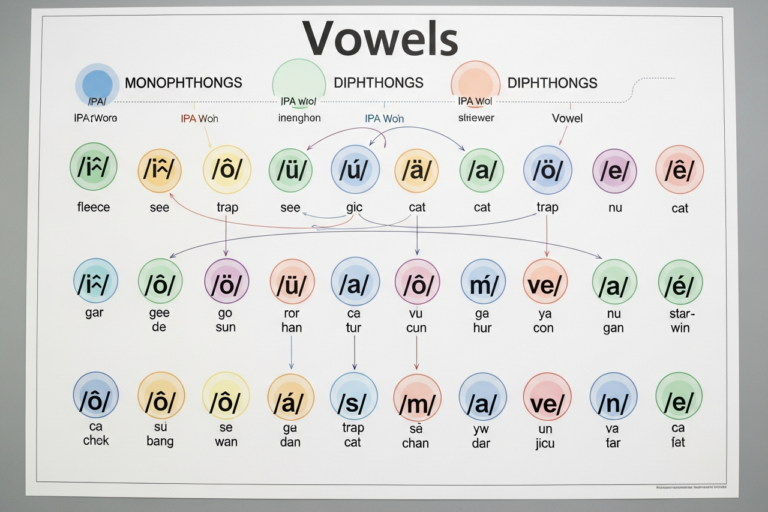
English comes in many forms, but in the United States, American English has a usual set of vowel sounds. People often put these vowel sounds on a chart. This chart shows each vowel sound based on where the tongue is in the mouth. It tells you if the tongue is high or low, and how far forward or back it goes. This kind of chart is a simple way to see the vowel system in the United States.
For example, the vowel sound /i/ (like in “fleece”) is a high, front vowel. This means the tongue is up high and at the front of the mouth. But the vowel /ɑ/ (like in “start”) is a low, back vowel. So, the tongue is down low and toward the back. People use the IPA to show these spots and vowel sounds in English the right way.
Most types of American English have about 14 to 16 main vowel sounds such as monophthongs and diphthongs. Knowing where each vowel goes on the chart helps you learn the tongue’s position and how to say each vowel. This can help you get better at American pronunciation.
How to Use the IPA for Accurate Pronunciation
Using the IPA is a good way to get better at your pronunciation. When you look up a word in a trusted dictionary, you will see the IPA letters right next to it. With these marks, you do not need to guess what the word sounds like by reading its spelling. You can see the symbols and know right away how to say it.
The first thing you should do is get to know the signs for each vowel sound. Start with the ones people use the most. Over time, build up your list. Say the sound for each sign and make sure you notice how your mouth moves and where your tongue is. Doing this again and again helps your mouth and tongue remember what to do.
Here are some ways you can use the IPA in your daily work:
-
Look for the IPA letters when you find new vocabulary words.
-
Listen to audio samples online to match the sign to how the sound is made.
-
Record your voice and check if your pronunciation is like the sound you want.
This way of learning will help you sound much clearer and improve your speaking skills fast.
Key Differences Between American and British English Vowels
One of the biggest ways British English and American English are not the same is in how people say their vowel sounds. Even though people who speak each kind of English can talk to each other with no big problem, the way they pronounce some vowels is not the same. These differences in pronunciation make the english language more interesting.
The sound of the ‘a’ in “dance” and the sound of “o” in “hot” are good examples. They help give each dialect its own feel. In the next parts, we will show some of these vowel differences. We will use examples so you can hear and understand how each sounds in british english and American english.
Unique Vowel Sounds in American English
American English stands out because of how it uses vowels. One big point is rhoticity. This means people say the ‘r’ sound after a vowel in words like “car” and “bird.” But in British English, people often drop the ‘r’ sound. This feature changes the vowel sound in a lot of words.
Another thing you notice is the vowel sound in words like “trap” or “cat.” American English uses the /æ/ vowel sound here. This sound is different from what you hear if someone speaks British English today. Also, American English does not have some diphthong changes that are common in British English. It keeps many high back vowels steady in certain words.
Here are some more traits of American English vowels:
-
Rhoticity: People pronounce the ‘r’ in words like ‘car’ and ‘hard.’
-
TRAP vowel: There is a clear /æ/ sound in words like ‘cat’ and ‘rag.’
-
LOT vowel: You hear an unrounded /ɑ/ sound in words like ‘lot’ and ‘stop,’ and this often sounds like the vowel in ‘father.’
You will notice these vowel sounds are a big part of what sets American English apart from British English. The way back vowels and high back vowels sound in American English makes every word easy to know.
Vowel Variations in British English
British English, especially what people call Standard British English or the modern RP (Received Pronunciation), has its own vowel qualities. A key point is that it is non-rhotic. This means the “r” at the end of a syllable is not spoken unless there is a vowel sound after it. For example, the word “car” sounds like “cah.”
The vowel system in modern Standard Southern British English also has changed. For example, the vowel sound in “trap” is now lower and pushed back in the mouth for a lot of people. It does not sound the same as the American English /æ/. Also, the vowels in words like “lot” and “thought” are now said higher, which can be tricky for learners who know American English best.
British English also uses more types of diphthongs, and some long vowels like the ones in FLEECE and GOOSE have changed and now sound more like diphthongs. Old RP did not have these shifts in the same way. These vowel changes give British English its unique and flowing pronunciation.
Pronunciation Differences with Examples
Hearing the differences between British English and American English vowel sounds is the best way to get what makes them different. The pronunciation of words can change a lot in these two kinds of English. Here are a few examples to show you how.
Take the word “dance.” In American English, people say it with the /æ/ vowel sound, like the sound in “trap.” But in many Southern British English accents, “dance” will use the /ɑː/ vowel, which you also hear in “start.” This one vowel could make the word seem new. With the word “hot,” American English will use an unrounded /ɑ/ sound. At the same time, many people in Britain go for the rounded /ɒ/ sound.
Let’s look at some more words that show the difference in american english and british english pronunciation of words:
-
Water: American English often has a quick ‘t’ and a clear ‘r’ (/ˈwɑːtər/). British English keeps the ‘t’ sharp and drops the final ‘r’ (/ˈwɔːtə/).
-
Path: People in American English use /æ/ (/pæθ/). In British English, they use /ɑː/ (/pɑːθ/).
-
New: In American English, it’s often /nuː/. In British English, it can be /njuː/.
-
**Schedule
The Role of Vowels in English Pronunciation and Spelling
Vowels are a big part of english pronunciation. They can be hard to learn because how you say them does not always match how you spell them. To speak well in english, you have to know how to make clear vowel sounds. Even a small mistake with a vowel can make a new word, like changing “ship” to “sheep.”
In english, the vowel system does not match sound to spelling in a simple way. This is why many learners find it hard. In the next few parts, you will see why it is so important to learn these sounds the right way. You will also get to know some spelling patterns that help with pronunciation.
English pronunciation gets easier when you know the vowel patterns. This can help make your speech better as you keep learning.
Why Mastering Vowels Improves Clarity
Getting good at making clear vowel sounds is one of the most important things you can do to make your pronunciation clear. Vowels are the main part of each syllable, and they carry much of the sound that makes up speech. If your vowels are not clear or not right, the words you say can sound mixed up. People may have a hard time knowing what you want to say.
For example, there is a small change in vowel sound between “sit” and “seat.” This little change makes two totally different words. Saying these vowel sounds the right way is key to good communication. When your vowel sounds are clear, every word can stand out and what you want to say will come through the way you want.
Having strong vowel sounds also makes it easier for people to listen to you. Listeners do not have to work hard to figure out what you mean. When you use better vowels, your speaking skills improve and you feel more sure of yourself in any talk.
Keywords: speaking skills, vowel, vowels, pronunciation, syllable
Common Spelling Patterns of Vowel Sounds
English spelling might look messy, but there are some common things that can help you with vowel sound pronunciation. If you spot these patterns, it can give you a good idea about how new words might sound.
To hear a long vowel sound, watch for certain vowel combinations or the “magic e” rule. When you see a silent “e” at the end of a short word, it will usually make the main vowel long. Think about “cap” and “cape.” Vowel teams are when two vowels sit together in a word. These often make a long vowel sound too, but the exact sound can change.
Here are some patterns to look out for:
-
‘ai’ or ‘ay’ is used to make the long ‘A’ sound /eɪ/ (like in ‘rain’ or ‘play’).
-
‘ee’ or ‘ea’ is how you get the long ‘E’ sound /i/ (like ‘feet’ or ‘meat’).
-
‘ie’ or ‘igh’ will often make the long ‘I’ sound /aɪ/ (think ‘pie’ or ‘high’).
-
‘oa’ or ‘ow’ is there for the long ‘O’ sound /oʊ/ (like in ‘boat’ or ‘show’).
There will always be some words that do not follow these rules, but learning these common patterns in English vowel spelling is a good way to
Silent Vowels and Unstressed Vowel Sounds
Not every vowel sound in a word is said the same way. Some are not heard at all, and many are not strong. For example, silent vowels are written but you do not say them, like the ‘e’ in “name” or the ‘a’ in “bread.” A silent vowel often helps change the speech sound of another vowel in the same part of the word. Knowing about these silent letters is important for good spelling and clear pronunciation in English.
Even more, there are unstressed vowels. In English, the parts of a word do not all get the same push or stress. Most of the time, vowels in these soft, unstressed spots turn into a quiet, relaxed speech sound. This is called the schwa (/ə/), the most used vowel sound in English. It sounds like a quick “uh,” as you hear in the ‘a’ of “about” and the ‘e’ of “taken.”
If you want your speech to sound good and natural, you need to notice and use the schwa right. Many learners say every vowel carefully and that can make speech sound flat and slow. If you get good with silent and weak vowels, your English pronunciation will sound much better and more like a fluent speaker.
Conclusion
To sum up, learning how to use English vowels is very important if you want to get better at pronunciation and be clear when you speak or write. It’s good to know the small differences between vowel letters and vowel sounds. You should also know a bit about the IPA, which can really help you improve your english skills. It will help you when you need to choose between american and british english. This is also helpful if you want to avoid mistakes with vowels. When you understand vowels well, you can share your thoughts in a better way.
If you want to know more, or become stronger with your vowels, you should check out other resources or do practice work. The best time to get better with vowels in english is today!
Frequently Asked Questions
How Many Vowel Sounds Are There in American English?
American English usually has between 14 and 16 different vowel sounds, depending on the dialect. These vowel sounds include single vowels, which people call monophthongs, and also moving vowels, called diphthongs. There are only five vowel letters in English, so this bigger number of vowels can make pronunciation hard for many learners.
What Are Effective Ways to Practice English Vowels at Home?
To work on vowel sounds at home, you can use dictionaries that show IPA and have audio. It helps to record your own voice and then play it back to compare with native speakers. You can try minimal pair drills too, like saying “ship” and “sheep.” Look at your mouth in a mirror and focus on how you make each sound. This is a good way to boost your speaking skills and have more control over your vowel articulation.
Can You List All the Main English Vowel Sounds with Examples?
The most common english vowel sounds are /i/ like in ‘fleece’, /ɪ/ like in ‘kit’, /ɛ/ like in ‘dress’, /æ/ like in ‘trap’, /ɑ/ like in ‘start’, /ɔ/ like in ‘thought’, /ʊ/ like in ‘foot’, and /u/ like in ‘goose’. The ipa helps you learn the right pronunciation for all english vowel sounds.