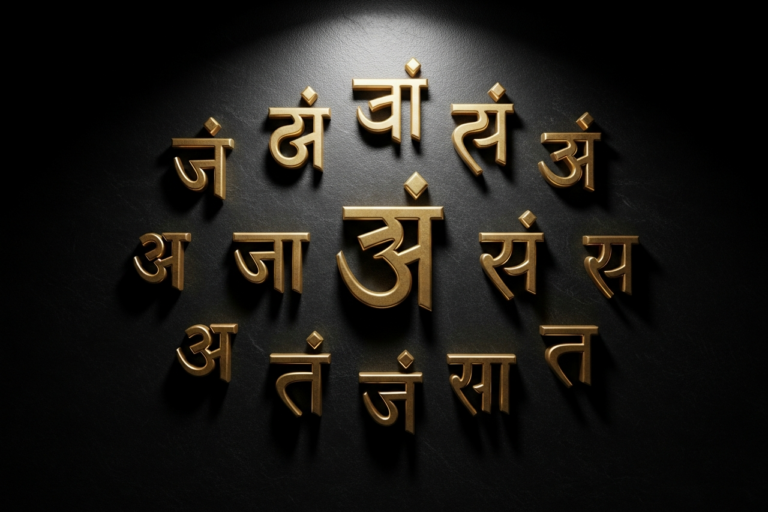
Key Highlights
Ready to learn about Hindi vowels? Here’s what you will get to know about the Devanagari script.
-
The Devanagari script has 13 main vowels. Each one makes a special vowel sound.
-
Every vowel comes in two forms. One is called the independent form, and the other is the dependent form (matra).
-
Devanagari is not like English. In Devanagari, there are different letters for short vowel sounds and long vowel sounds. This helps make pronunciation easy.
-
Each consonant in Devanagari has a default vowel sound. The default is ‘a’ (schwa). You can change this sound as needed.
-
Vowels are important in each syllable. They join with consonants to make words.
Introduction
Welcome to your easy guide to Devanagari vowels! If you want to learn the Hindi language, it is good to first know the alphabet. The Devanagari script can look difficult in the beginning. But you will see that it can be simple and makes sense. This guide will help you learn how each vowel letter in Devanagari works. You will find out the sounds each vowel letter makes and how to get the pronunciation right. When you finish reading this, you will have a good start to read and say words in Hindi, and use the Devanagari script with more confidence.
Understanding the Devanagari Script
The Devanagari script is a writing system used for Hindi and some other South Asian languages. At first, the Devanagari alphabet can look hard because it has 47 characters. But it is very neat and has a clear order. The letters all hang from a horizontal line, which is what makes the writing stand out.
This writing system is an abugida. That means every consonant already comes with an inherent vowel sound. When you read and write, the way you mix the consonant sounds and vowels is very important. This is how people learn to read and write in the script. Now, let’s look at the history, the structure, and some special things that make the Devanagari script interesting to us.
Structure of the Alphabet and Its Syllabic Nature
The Devanagari alphabet is made in a way that makes sense. It puts letters together by how you say them. It is not like the English alphabet, which can seem out of order to people. Devanagari puts vowels first. After that, you see the consonants. The order of the consonants is based on what part of your mouth you use to make the sound.
People sometimes call this the “script of the city.” The script is based on syllables. Each consonant letter in Devanagari always has a short ‘a’ sound with it. This short sound is called the schwa. If you want a different vowel sound with your consonant, you use a mark with it. The syllable is the key unit in the script, not just one letter at a time.
So what is the real difference between vowels and consonants in the Devanagari alphabet? Vowels can be their own sound, or they can change the sound that comes with a consonant letter. Consonants need a vowel to help make a whole syllable in this script. In a way, vowels are like the tune, while the consonants give the beat.
Historical Origins and Development
The roots of the Devanagari script are in ancient India. It came from the Brahmi script, one of the earliest writing forms in this part of the world. The look we know as Devanagari started to show up around the 7th century. By the 10th century, it was fully formed.
The name Devanagari means “script of the divine city.” This shows how people used it for special writing, like Vedic Sanskrit. The devanagari script is very exact and helps keep the right pronunciation for old hymns and holy books like the Vedas. Because of this, the words and meaning stayed true as they were passed down from one generation to the next.
Vowels in Devanagari were needed for this reason too. Where the devanagari vowels came from links back to the need to capture all the sounds in Sanskrit just right. In these old texts, even the change from a short vowel to a long one could change the meaning or the flow. This clear way of showing letters and sounds is still a big part of the script today.
Features That Distinguish Devanagari from Other Scripts
One thing that stands out in Devanagari is the strong horizontal line at the top. People often call it a “clothesline.” You will see that the letters hang from this line. This shirorekha links all the letters in a word together and gives the writing a smooth look. This is not how the Latin script works for English. In Latin script, the letters sit on a baseline, not hang from a line.
Devanagari is also an abugida. This means every consonant already carries an inherent vowel with it. The Latin script, used for English, is a real alphabet. In this system, vowels and consonants are separate. Both have their own spot in the alphabet and work as their own letters. This main difference changes the way people build and read words. The system of Devanagari is used in many other scripts that you find in South and Southeast Asia.
Here are some other unique things about Devanagari:
-
No Capital Letters: In Latin script, you get both uppercase and lowercase letters. But in Devanagari, you will find there are no capital forms.
-
Punctuation: At the end of a sentence, writers use a vertical line (|) known as a danda. Now, many people also use marks from Western punctuation.
-
Syllabic Structure: Words in Devanagari grow from syllables. Each part mixes a consonant with a vowel and
Importance of Vowels in Devanagari
In the Devanagari script, vowels are very important. They are the main part of the language and help make the sounds. Every consonant has a default vowel, which is the ‘a’ sound, also called schwa.
If there were no vowels, the Devanagari script would only show consonants that have no sound. Vowels are needed to make real words and help us tell words apart. Sometimes, a vowel stands alone. Other times, it is added to the first consonant of a syllable as a small mark. The vowel is what makes the script clear and full of meaning. Let’s look closer to see how vowels work in Devanagari.
Role of Vowels in Sound Formation
Vowels are very important to how sounds are made in Hindi. Every vowel sound is made when the vocal tract is open, so air flows freely from the lungs. The place of articulation, which is the shape of the mouth and where the tongue is, makes each vowel sound different. For example, some vowel sounds are made at the front of the mouth. Others happen at the back.
The Devanagari script shows these small changes in vowel sound very well. With consonants, you block or shape the airflow, which is called the manner of articulation. But for vowels, air just flows out with no block in the way. That is the main difference: consonants are about stopping the air or making it change direction, but vowels let the sound ring out without anything in the way.
The system for Hindi vowels uses Devanagari to show all these possible sounds just right. When you pick up how Hindi vowels look in Devanagari, you are not just remembering what they look like. You are really learning a full map of sounds that you can make with your mouth. This is why once you get the rules, pronunciation in Hindi is easy to get right every time.
Why Vowels Are Considered the Foundation of the Script
Vowels are the key part of the Devanagari script. No syllable can be there without a vowel. Every single word in Devanagari is built with vowel sounds. You can think of consonants as the bricks and the vowels as the glue that holds everything together and makes words mean something.
The whole script is made in a way where consonants need vowels so you can say them. You see this in two main ways:
-
Every consonant in the script comes with an inherent vowel. This vowel is ‘a’, and it stays there unless a vowel mark changes it, or unless the vowel is silenced on purpose.
-
When there are many consonants together in a conjunct, only the last consonant keeps its vowel. The first member of a conjunct does not keep its inherent vowel, so it is known as a “half” consonant.
This shows how the vowel system is at the heart of the Devanagari script. Consonants give the structure, but vowels give the voice and life to words. Without a clear vowel system, the script would not make sense, and it would be impossible to speak the language. The vowels are what makes everything work in Devanagari.
Comparison of Vowels and Consonants in Devanagari
In the Devanagari script, vowels and consonants have distinct but complementary roles. Vowels are the core of the syllable, representing open-mouthed, resonant sounds. They can appear independently at the start of a word or as marks that modify a consonant’s sound.
Consonants, on the other hand, represent sounds made by obstructing the flow of air in the mouth. Each consonant character has a default vowel (‘a’) built-in, which is a unique feature of this abugida system. When consonants group together in a consonant cluster, special rules apply to remove the inherent vowel from all but the last one.
This table summarizes the main differences:
|
Feature |
Vowels |
Consonants |
|---|---|---|
|
Function |
Core of the syllable; represent resonant sounds. |
Form the structure; represent obstructed sounds. |
|
Independence |
Can stand alone (independent form). |
Cannot stand alone without a vowel sound. |
|
Inherent Sound |
Represent a single, pure sound. |
Have a default vowel (‘a’) sound included. |
|
Form |
Have independent forms and dependent marks (matras). |
Have a single primary form. |
The Complete List of Devanagari Vowels
Let’s talk about the most important part: the vowels. The Devanagari script, which is used for modern Hindi, has 13 vowels. Each of these vowels stands for a different vowel sound. If you want to read and say words in Hindi the right way, you need to learn these vowels.
You will see that each independent form of a vowel has a special character. This character is used when the vowel comes at the start of a word or right after another vowel. Some vowels, like the ‘a’ sound, are very simple. Others, like diphthongs, are more complex. If you can master all the Hindi vowels, you will be able to make all the sounds in the language. We are going to learn about each one, how it looks in Devanagari, and the special sound it makes.
Independent Vowel Characters and Their Pronunciations
Each vowel in Devanagari has an independent form, which is a full-fledged vowel letter. This form is used when a vowel sound appears at the beginning of a word or directly after another vowel, where there’s no consonant for it to attach to. For instance, in the Hindi word “aam” (mango), the “aa” sound at the start is written using its independent form.
Understanding the pronunciation of each independent vowel is your first step toward reading words correctly. The sounds are generally consistent, which is a huge advantage for learners. Unlike English, where ‘a’ can have multiple sounds, the Devanagari characters are much more predictable.
Here is a list of the primary vowels in their independent form, along with their English pronunciation equivalent to get you started:
|
Vowel |
Pronunciation (like the vowel in…) |
|---|---|
|
अ |
about |
|
आ |
father |
|
इ |
sin |
|
ई |
seen |
|
उ |
book |
|
ऊ |
food |
|
ऋ |
rhythm |
|
ए |
mate |
|
ऐ |
sad |
|
ओ |
soda |
|
औ |
saw |
|
अं |
lung (nasalized) |
|
अः |
a-ha! (aspirated) |
Short, Long, and Diphthong Vowel Sounds
One great thing about Devanagari is how it helps you tell different sounds apart. It shows if a vowel is short or if it is a long vowel. In English, the same letter, like ‘a’, can have many sounds—as in ‘mat’ and ‘mate’. In Hindi, you see a different character for each sound, so you don’t have to guess which one it is.
The vowels are put into three main groups by their sound. This makes it much easier to know how to say a word and to get the right rhythm when you speak. When you start to hear and see every different sound, you reach an important step as you learn the language.
Here is a clear list to help you understand:
-
Short Vowel: These sounds are quick and short. The main short vowels are अ (a), इ (i), and उ (u).
-
Long Vowel: These sounds last longer than a short vowel. They include आ (aa), ई (ee), and ऊ (oo).
-
Diphthong: This is when you put two vowel sounds together into one syllable. Examples are ए (e), ऐ (ai), ओ (o), and औ (au).
-
Special Vowels: This group has ऋ (ri), अं (am/an), and अः (ah). Each has its own sound.
Learning about different sounds, short vowels, and long vowel is an important part of Hindi
Importance of the 13 (or 18) Vowels in Hindi and Sanskrit
When you use a primer of modern standard Hindi, you will see 13 Hindi vowels taught for everyday use. But the devanagari script has more vowels, mainly for Sanskrit words and sounds. In “real Sanskrit,” there are more vowels to show small sound changes that most people no longer use when they talk in modern Hindi.
The confusion about if there are 13 or 18 vowels comes from history and language changes. Sanskrit has longer forms of some vowels, like a long ॠ (ṝ) and also vowels like vocalic ऌ (ḷ). These are not found much in Hindi now. The extra vowels were there so people could write all the sounds of old Vedic Sanskrit words in devanagari script.
Most people who want to learn modern Hindi only need to know the main 13 hindi vowels. It is good to know the devanagari script system has more vowels, which you might see if you want to study Sanskrit or something close. For Hindi, the short, long vowels, and the diphthongs are important—the base for reading and writing both in Hindi and in languages like Sanskrit.
Writing Devanagari Vowels: Forms and Features
Now that you know the vowels, let’s learn how to write them in Devanagari. Devanagari letters use a clear and smart way to join vowels with consonant symbols. Each vowel has two types. One is the independent form, and the other is a mark called a matra.
The matra is a quick symbol. The matra sticks to a consonant. This changes the basic ‘a’ sound to another vowel. The marks can be above, below, before, or after a consonant. Their place does not change. This two-type style makes the script simple and spot-on. We will look at both forms next.
Independent Vowel Symbols
The independent form of a vowel is its whole character. You use this form when the vowel is not joined with a consonant. It is like the vowel’s “default” look. You use it when a word starts with a vowel or if one vowel comes right after another. For example, in Hindi, the word for “now” is अब (ab). It starts with the independent vowel letter अ (a).
Learning to write these symbols means you have to know their shapes. Some shapes seem hard, but many of them share some parts, so you can remember them as a group. Each character is part of the Unicode standard. This makes sure they show up right on all devices and fonts.
Here are the key things to know about independent vowel symbols:
-
They are full letters, not just marks.
-
You use them at the start of words or syllables.
-
Each one stands for a certain vowel sound that doesn’t change.
Dependent Vowel Marks (Matras)
Dependent vowel marks, also called matras, are very important in the devanagari script. They help people say the words in the right way by adding a vowel sound to the consonants. These matras have their own special marks, and they go before or after a consonant in the devanagari script. This makes the sound flow well when you speak.
For example, a short vowel can look like a small horizontal line or a straight up-and-down stroke. In the hindi language, each matra gives a certain vowel sound that can turn one simple consonant into a whole syllable. Knowing how to use these marks can make it easy to read or write in hindi. It also helps people understand the language better and enjoy learning it.
Formation and Placement of Matras with Consonants
Dependent vowel marks, which many call matras, are very important in the Devanagari script. They change how consonants are spoken in Hindi. The marks add or shift the basic vowel sound of a letter. This change can affect the tone and the meaning of a word in hindi. For example, if you use a short vowel matra like ‘अ’ with a dental consonant, it will make a different sound. If you use a long vowel like ‘आ’, the sound becomes longer and stronger.
Where you put the matra also matters. The marks can be written above, below, to the left, or to the right of consonant symbols. By adding a matra to a consonant, you form new syllables. This way, pronunciation in Devanagari creates a nice flow. All this makes the Hindi language rich and full of variety.
Pronouncing Each Devanagari Vowel
Knowing the theory is good, but language is really about sound. Let’s look at how to say each Devanagari vowel. The right pronunciation matters so you can be understood. Hindi vowels are easy to say. In Hindi, you say them as they are written. This is not like English, where vowels can be tough.
Every vowel has its own sound, and that sound always stays the same. If you learn these sounds and use them with consonants to make a syllable, you can speak Hindi more clearly. We will check out the main vowel sounds, a few tricky ones, and give tips to help you get your pronunciation right.
The Sound Value of ‘अ’ and Its Usage
The vowel ‘अ’ (a) is the easiest and most basic of all Hindi vowels. The sound is called a “schwa.” It is a relaxed vowel sound like the ‘a’ in the English word “about” or the ‘u’ in “sofa.” This sound is short, not stressed, and shows up a lot in Hindi.
This vowel is important because it is the default vowel for every consonant. If you see a Hindi consonant like क, it’s not just the letter ‘k.’ You say it as a whole syllable, “ka.” Because it is the default vowel sound in Hindi, there is no matra for ‘अ.’ When you see a Hindi consonant and there is no matra, you add this vowel sound.
Here are some main points about how it is used:
-
As an independent letter: The letter ‘अ’ is used when a word starts with the schwa sound, for example, in अब (ab), which means “now.”
-
Implied in consonants: Any consonant without a matra includes the ‘अ’ (schwa) sound. Sometimes at the end of a word, this sound is dropped when people speak modern Hindi.
Keywords used: vowel sound, hindi vowels, default vowel, inherent vowel, end of a word, vowels, consonants, hindi, english, default, syllable, schwa, matra
How to Pronounce and Identify Complex Vowel Sounds
Beyond simple short and long vowels, Devanagari has some vowel sounds that are more tricky. These are called diphthongs. Diphthongs slide from one vowel sound to another in a single syllable. Some examples are ऐ (ai) and औ (au). You need to switch between the sounds slowly to say them right.
To spot and say these vowel sounds, pay attention to the place of articulation. For instance, ऐ (ai), like in ‘sad’, is made in the front of the mouth. औ (au), like in ‘saw’, happens at the back. You can listen to people who use Devanagari to hear the small changes. That is how you understand the differences.
Here are some ways to get better at these sounds:
-
Isolate the sound: Try saying the diphthongs all by themselves before adding them to words.
-
Listen for the glide: Notice how the sound goes from one shape to another. For example, ओ (o) does not move, but औ (au) slides from ‘a’ to ‘u’.
-
Don’t confuse them with English: The sound of ऐ (ai) is not the same as the English ‘eye’. It’s more like the vowel in ‘cat’ or ‘sad’.
The key is to practice, listen close, and remember the way the sounds move in Devanagari compared to English. It helps you know how each vowel sound fits in a syllable
Tips for Accurate Vowel Pronunciation
Getting the right pronunciation of Devanagari vowels can look hard at first, but there are some easy ways to make it better. The key is to listen to the sounds and try to say what you hear. In Hindi, pronunciation is steady. If you learn a rule, you can use it almost every time. That is not like how you speak in English, where the rules can change.
A lot of people use English speaking habits by mistake. One problem is that many have trouble knowing the difference between dental and retroflex consonants, which you hear with these vowel sounds. Try to feel where your tongue is when you speak. If it is a dental sound, your tongue touches the back of the teeth.
Here are some simple tips to help you:
-
Record yourself: Play back your voice and check your pronunciation. Try to match how a native speaker says the same sound.
-
Use mnemonics: Match each vowel sound with an English word that sounds close. For example, think of ‘आ’ (aa) as the “a” in “father.”
-
Practice mouth positions: Use a mirror. Watch the shape of your mouth for sounds, such as ऊ (oo) versus ओ (o).
-
Focus on tongue placement: For vowel sounds like ऋ (ri), think about where the back of the tongue is. Try to make it just like you hear.
With time and daily practice, you will get better at saying Devan
Special Characteristics of Devanagari Vowels
Devanagari vowels have extra steps that give more detail to how words sound. One of the key things is nasalization. This feature makes a vowel sound like it is coming from the nose. The script shows this nasalization with marks above the vowel or its matra.
There are signs like the bindu, which is just a dot, and the chandrabindu, which is a dot inside a moon shape. These are not marks to show stress. Instead, they are needed to get the right pronunciation and meaning in Devanagari. The use of nasalization can change the meaning of a word in the script. This is what makes Devanagari, its vowels, and its marks, such a rich and clear way to say and write words.
Lack of Standalone Forms: Myths and Facts
Many new learners think that Devanagari vowels do not have their own letters. This idea is not true. The reason for this is that most of the time, vowels in the writing system show up as matras. These marks are added to consonants. Since you see matras so often, you can miss the independent form of vowels.
But, every vowel in Devanagari has two forms. There is an independent form. This is a full letter, and people use it at the start of words. There is also a dependent form, which is the matra. This mark is put with consonants. So, it is not right to say vowels do not stand alone. These independent forms of vowels are a key part of the system that is used for writing.
Here’s the breakdown:
-
Myth: Devanagari vowels only exist as marks (matras) attached to consonants.
-
Fact: Every vowel has both an independent form (a full letter) and a dependent form (a matra). The independent form is used whenever a vowel is not attached to a preceding consonant.
Nasalization and Accent Marks in Vowels
Nasalization is a big part of Devanagari. It changes a vowel sound by adding a nasal quality. This means you use both your nose and mouth to say the vowel. In writing, this is shown with special marks called the bindu and the chandrabindu.
The bindu ( ं ) is just a dot above the horizontal line. The chandrabindu ( ँ ) is a dot inside a crescent shape, and it sits above the line too. The usage may change, but often the chandrabindu gives a stronger nasalization. For example, the word for “I,” मैं (main), has a bindu to make the vowel sound nasal. The word for “am,” हूँ (hoon), uses a chandrabindu.
These marks are not accents like in English to show stress. They are tweaks to the vowel sound. Here is what they do:
-
They add an ‘n’ or ‘m’ touch to the vowel sound.
-
They may change what a word means.
-
Their use matters a lot for how you spell and say the word.
The nasalization, chandrabindu, bindu, vowel sound, vowels, horizontal line, english, and pronunciation all play a key role in Devanagari.
Regional Variations in Writing and Sound
While the Devanagari script is used in the languages of South Asia, there are differences in the way people write and say words. The sound of a vowel may change from one area to another, even if the letter looks the same.
For instance, the way the inherent vowel ‘अ’ (a) is spoken in Maharashtra is not the same as the standard Hindi pronunciation. Some languages, such as Marathi, also add extra characters to the Devanagari script. They may use different methods to show their sounds in writing.
These local differences show how flexible the script can be. The basic system stays the same. But over time it has changed to fit how people speak in many languages and places. If you are learning a language like Marathi or Nepali, you should know about these changes. This helps you understand the script and how people use it.
Devanagari Vowels in Major South Asian Languages
The Devanagari script is used a lot in South Asia. It is the official writing system for many big languages. The main language that uses Devanagari script is Hindi. It is also used for Sanskrit, Marathi, Nepali, and other languages. Each language uses the vowels in the script in a way that fits its sound system.
Most of the main vowels stay the same. But each language has its own way of using and saying those vowels. When you look at how Devanagari works for Hindi, Sanskrit, Marathi, and Nepali, you can see how strong and flexible this writing system is. It shows the devanagari script can be used in many ways for different languages in South Asia.
Usage in Hindi
In Hindi, people use the Devanagari script the most. This is the script you will see and use today if you read Hindi. In modern Hindi, there are 13 vowels you need to know. These vowel letters help make all the main sounds of the language. Each vowel has the same sound every time, so Hindi is easy to read out loud. Once you learn the Hindi alphabet, you will see how clear its pronunciation can be.
The vowel system in Devanagari is simple and works well. The script uses matras to let people make words in a shorter way. It is easy to tell short vowels from long vowels. This is important in Hindi for meaning and flow when you speak.
Here are some important things to know about vowels in Hindi:
-
People learn and use a standard set of 11 to 13 vowels when they write or study every day.
-
The inherent vowel ‘अ’ (a) that comes at the end of a word is often not said in modern Hindi. This is called schwa deletion. It is one time where the pronunciation is different from the written word.
Comparison with Sanskrit and Marathi
While Hindi, Sanskrit, and Marathi all use the Devanagari script, each one is different when it comes to how they use vowels. Sanskrit, which is a classical language and has had the script made just for it, comes with more vowels. It even has long vowel sounds such as ॠ (ṝ) that Hindi does not have.
Marathi is the main language in Maharashtra. It stands out because it keeps some sounds and has its own rules for writing words. For example, in Marathi, the chandrabindu is used in a special way, and sometimes the vowel ‘अ’ will sound more like ‘o’.
Here’s a quick comparison:
-
Sanskrit: Has more vowels in the Devanagari script so you can tell all the different sounds apart. The last schwa sound in words always gets said out loud.
-
Hindi: Uses a smaller set of 13 vowels in Devanagari and people often do not say the final schwa when they speak.
-
Marathi: Makes some vowels sound different and there are a few letters like ‘L’ with a dot (ळ) that you will not find in Hindi.
These differences show how the devanagari script, vowels, and pronunciation set Sanskrit, Hindi, and Marathi apart. The way the schwa sound is used in each one is also something to notice, and Marathi even gives a special place to chandrabindu in the language of Maharashtra.
Application in Nepali and Other Languages
Beyond India, the Devanagari script is the official way to write Nepali in Nepal. It is used there to write the Nepali language. The way people use Devanagari in Nepali is a lot like how it is used in Hindi. The same vowels and consonants are in both, so if you can read Hindi, you can also read Nepali, even if you do not understand what the words mean.
But, there are some small changes in how people say words. The pronunciation of some vowels and consonants is different. This is because Nepali and Hindi have grown to be their own languages over time. For example, some different sounds that used to be in older Nepali have now come together into the same sound. That gives the current Nepali language a bit different sound.
The Devanagari script is very useful because you can use it to write many languages across South Asia, like Konkani, Maithili, and Newari. Each language uses the basic vowels and consonants of Devanagari but may sometimes change things a little for different sounds. This shows that the devanagari script is good for different sounds and can work well across a lot of languages in South Asia.
Conclusion
To sum it up, Devanagari vowels are very important if you want to know how to read and write the devanagari script. They help with pronunciation and the meaning of words in many South Asian languages. The vowels have a long history and some special traits. When you learn them well, you get better with language and you start to understand and enjoy the languages they are used in. No matter if you want to learn or if you just like how language works, learning about Devanagari vowels lets you see things in a new way. If you want to know more, you can get a free meeting and find out about the devanagari script and its vowels.
Frequently Asked Questions
How many vowels are there in Devanagari and what sounds do they represent?
Modern Hindi has 13 vowels in the Devanagari script, but Sanskrit has more. Each vowel matches a vowel sound, like ‘अ’ (a as in about) and ‘आ’ (aa as in father). The pronunciation does not change much, so once you learn these vowels in Devanagari, it is easy to know the sounds in Hindi.
How do vowel marks (matras) change the sound of a consonant?
In the Devanagari script, there is a mark called a matra. It connects with a consonant and changes its default ‘a’ sound. For example, the letter क, which sounds like “ka”, will be written as कि, which sounds like “ki”, when the ‘i’ matra is used. This way, you can use the consonants and different matras to make lots of other sounds. It helps people form many kinds of syllables in a simple way in Devanagari.
Are there differences in vowel usage across Hindi, Sanskrit, and Marathi?
Yes, there are some differences. Sanskrit has more vowels than modern Hindi. Marathi also uses its own way to say some Hindi vowels, like ‘अ’. It uses some letters you will not find in Hindi. These changes show how the Devanagari script fits each language’s sounds. This makes Sanskrit, Marathi, and modern Hindi have their own style and pronunciation for vowels in the Devanagari script.