Key Highlights
Ready to learn about the bengali alphabet? This guide will show you the vowels at the base of the bangla alphabet. Be able to know these first. It will help you understand the bengali script. Here’s what you need to know:
-
There are 11 main vowels in the bengali alphabet. Each one has its own sound.
-
bengali vowels each have two forms. They can be a letter on their own, or a vowel sign (called matra) that goes with a consonant.
-
One vowel, অ (ɔ), is called the “inherent vowel.” The writing system reads it by default if there is no other vowel.
-
The writing system for vowels puts letters before, after, below, or around consonants.
-
Some vowels, like ই and ঈ, used to sound different. In modern bengali, people say them the same way.
Use this to get started with the bangla alphabet. Then, step into the world of bengali script.
Introduction
Welcome to your first step into the Bengali language. If you want to read and write in Bengali, you should start with the Bengali alphabet. The Bangla alphabet may seem hard when you see it for the first time. But it is not as tough as you may think. The Bengali script is phonetic. That means once you know the letters, you can say most words just by looking at them. In this guide, we will show you each vowel found in the Bengali script. We will make the sounds and shapes clearer to you.
Understanding Bengali Vowels
Before we start looking at the letters, let’s talk about what makes the vowels in the Bengali alphabet different. They are the main sounds that help form words in the bangla alphabet. When you make a vowel sound, your mouth is open and the air flows out without stopping. But this is not the case for consonants.
In the bengali alphabet, vowels can be letters by themselves. They can also turn into marks that change the sound of consonants. This is a big part of why the alphabet works the way it does. We will find out how many vowel sounds there are and why they matter so much for bangla.
How Many Vowels Are in the Bengali Alphabet?
So, how many vowels are there in the bengali alphabet? The bangla alphabet has 11 vowels. These vowels are key parts of the bengali language. This language is the official language of bangladesh. It is also one of the official languages in india. There are 32 consonants too, and these consonant and vowel letters are needed to write in bangla.
You may find it interesting that out of the 11 standard vowels, there are some which now sound the same in modern bengali. For example, the short ই (i) and long ঈ (i) both sound the same. The short উ (u) and long ঊ (u) are also spoken in the same way. This makes it easier for people to learn the bengali alphabet.
There is one vowel, ঋ (ri), in the bangla alphabet that is special. It is called a vowel in bengali, but when you say it in english, it sounds like a vowel and a consonant put together. This comes from the language called sanskrit, and it shows that bengali has a long history.
The Importance of Vowels in the Bengali Script
Vowels are at the heart of the Bengali script. They are needed to make syllables and give the language its smooth sound. If there are no vowels, the bangla alphabet is just a mix of consonants, and you would not be able to say any word right. Everything you say or write in Bengali depends on the right vowel sound.
One thing that makes the bengali script special is the idea of the “inherent vowel.” This means that when you see a consonant, the vowel অ (aw) is usually there unless you see a vowel sign with it. So, when reading, you need to know that this vowel is often there even if you do not see it. For example, in the word for ‘pen’, কলম (Kolom), you read it with an অ sound after the consonants.
Because of this, vowels are very important in Bengali. A vowel can come at the beginning of a word by itself or they can go with a consonant to change how it sounds. This is a key part of how you use the bangla alphabet and learn to read and write in the bengali script.
Names and Sounds of Bengali Vowels
Now, let’s move on to the fun part. Here, you will learn the real names and sounds of the vowels in the bangla alphabet. If you speak the english language, there is good news for you. Most vowel sound in bengali has something close to it in english. This means learning them at first will be much easier.
It is important to know each vowel sound to say words the right way in the bengali language. First, we will list the normal names for each vowel in the bangla alphabet. Then we will talk about how you can say them the right way.
Standard Bengali Vowel Names
Getting to know the names of the vowels is the first thing you need to do to learn the Bangla alphabet. Some of these vowels have easy names and some are called “hrasho” (short) or “deergo” (long). Even though you might say them the same way now, these names are still used.
These names are part of how people have always learned the Bengali alphabet. Learning these helps you talk about the letters as you go. For example, you may find that “hrasho-i” and “deergo-i” sound the same. But when you spell words in bengali, it is important to know the difference.
Here are the 11 vowels in the bengali alphabet:
-
অ (o)
-
আ (a)
-
ই (i) – known as hrasho-i (short i)
-
ঈ (i) – known as deergo-i (long i)
-
উ (u) – known as hrasho-u (short u)
-
ঊ (u) – known as deergo-u (long u)
-
ঋ (ri)
-
এ (e/æ)
-
ঐ (oi)
-
ও (o)
-
ঔ (ou)
Correct Pronunciation for Each Vowel
Getting the right pronunciation matters when you want to learn a new language. The good thing is that many Bengali vowel sounds are ones you may know if you use the English language a lot. You need to match each Bengali letter with the sound it makes.
The best way to get better is to practice often. Try to listen to how native people say the words. After you hear them, try to make the same sound. If you do not sound perfect in the first few tries, that is okay. It takes some time to get it right. Your main goal should be to build a good base that will help you talk clear when you use the Bengali language.
Here is a guide to help you learn the pronunciation of each vowel:
-
অ (o/aw): Sounds like the ‘o’ you say in “on” or the ‘aw’ you use in “hot” with a British accent.
-
আ (a): Like the ‘a’ in “art.” It is an open ‘ah’ sound.
-
ই/ঈ (i): The sound is like the ‘ee’ you hear in “cheese” or the short ‘i’ you use in “kiss.”
-
উ/ঊ (u): The sound is like the ‘oo’ in “hoop” or the ‘u’ in “put.”
-
ঋ (ri): It uses ‘r’ and ‘ee’ together
Visual Guide to Bengali Vowel Letters
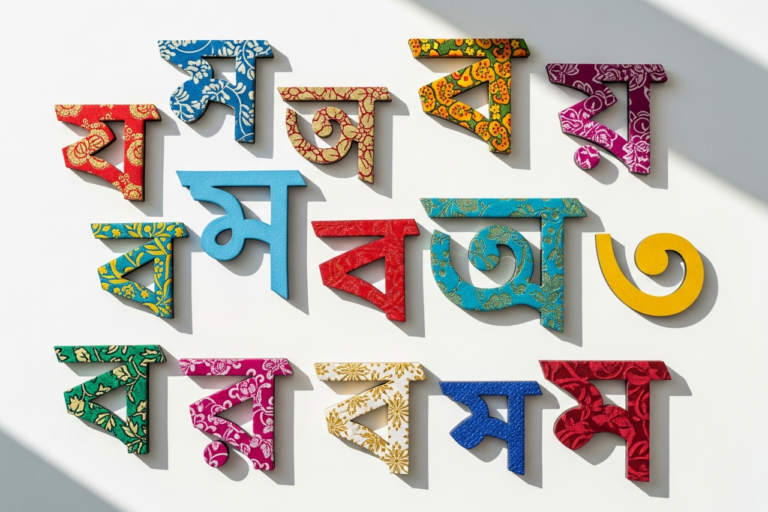
When you see something for yourself, it makes things clear. This happens often with a new writing system. The way letters look matters a lot. The Bengali script is easy to spot because of its smooth and beautiful letters. Each letter in the bangla alphabet has its own way it looks and is written with a certain stroke order. That is what helps each letter stand out.
Here, we will show you more about the vowels. You will see every vowel shape and will notice how each one is written on the page. We also give you the English transliterations with the letters. This can help you make a link between the way the letter looks and the sound in bangla that you just learned.
Shape and Stroke Order for Each Vowel
The Bengali script, like many other writing systems, has its own look. The letters seem to hang from a line at the top. This line is called a ‘matra’. You need to know the shape and the order in which you should write each vowel to write them the right way.
It can take time and some practice to get the stroke order just right. If you start by getting a basic idea, it will help you see how to form each letter. Many letters in the bangla alphabet look smooth and seem to flow. This is different from some other alphabets, which can be more square.
Below are some ways vowels are made in the Bengali script:
-
অ (o/aw): You use this vowel as the base for the next vowel, আ (a).
-
আ (a): To make this vowel, just add a straight stick to অ.
-
ও (o): This vowel looks nice and stands out in the bangla alphabet.
-
ঐ (oi) and ঔ (ou): People call these “combo” vowels. Each has a special look.
It is good to start with these basics when you learn the bangla alphabet, especially when thinking about the horizontal line that the letters hang from and how the vowels shape the bengali script. This will help you know more about how the writing system works.
Bengali Vowels with Their English Transliterations
To bridge the gap between the Bengali alphabet and what you already know, English transliterations are incredibly helpful. These English equivalents give you a phonetic guide to pronunciation, making it easier to remember the sound of each vowel.
Keep in mind that transliteration is not always a perfect science. Some Bengali sounds don’t have exact English equivalents, but these approximations are a great starting point for any learner of the Bengali language. They provide a quick reference as you become more familiar with the script.
Below is a table listing the 11 Bengali vowels along with their common English transliterations and a guide to their sound.
|
Bengali Vowel |
English Transliteration |
Pronunciation Guide |
|---|---|---|
|
অ |
o / ɔ |
Like ‘o’ in “on” |
|
আ |
a |
Like ‘a’ in “art” |
|
ই |
i |
Like ‘ee’ in “cheese” |
|
ঈ |
i |
Like ‘ee’ in “cheese” |
|
উ |
u |
Like ‘oo’ in “hoop” |
|
ঊ |
u |
Like ‘oo’ in “hoop” |
|
ঋ |
ri |
Pronounced as a soft ‘ree’ |
|
এ |
e / æ |
Like ‘e’ in “egg” or ‘a’ in “ape” |
|
ঐ |
oi |
Like ‘oy’ in “oyster” |
|
ও |
o |
Like ‘o’ in “oval” |
|
ঔ |
ou |
A blend of ‘oh’ and ‘oo’ |
Writing Bengali Vowels in the Bangla Script
Understanding how to write Bengali vowels is an important step. The writing system in Bengali has an interesting part. These vowels are written in two ways. The way you write the vowel depends on where it comes in a word.
When a vowel is at the beginning of a word, you use the full form. But if the vowel comes after a consonant, it changes to a vowel sign. You will also hear this called a “matra.” It is important to learn both ways to make sure you know how to read and write the Bengali script in the right way.
Standalone Vowel Forms
When a word in the Bangla alphabet starts with a vowel sound, you use the full form of the vowel. Think of this as the big version of the vowel. These are the main 11 vowel characters. They show up at the start of a word and hang from the main horizontal line that joins the letters.
The word for “one” in Bengali is এক (Ek). Here, the vowel এ (E) is used in its standalone shape because it is the first sound. The word for “medicine,” ওষুধ (Oshoodh), also starts with the independent vowel ও (O).
This is the easiest way to write vowels in the Bangla alphabet. You see these full forms each time a syllable starts with a vowel and is not tied to a preceding consonant letter. It is cool to notice that the old vowel ঌ uses the same sign as the Bengali number nine (৯), but no one uses it in writing today.
Vowel Signs (Matra) Used with Consonants
When you see a vowel sound after a consonant, it turns into a shorter form. This short form is called a ‘matra’ or vowel sign. Every vowel except the inherent vowel অ has a vowel sign that connects to the letter just before it, which is the preceding consonant. This idea is basic to many Brahmic scripts.
These vowel signs are not always written right behind the consonant. You can find them before, after, below, or even around the consonant they change. For example, the sign for ই (i) goes before the consonant, but you still say it after the consonant. It might be hard at first, but you will feel ok about it with some practice.
Below are some examples to help you see how these matras work:
-
The vowel আ (a) changes to the sign া (ka-kar). You can see it in কা (ka).
-
The vowel ই (i) turns into ি (i-kar), and this is written in front of the consonant, as in কি (ki).
-
The vowel উ (u) changes to ু (u-kar). You see it below the consonant, like in কু (ku).
-
The vowel ও (o) changes into ো (o-kar). This one shows up around the consonant, as you see in কো (ko).
Bengali Vowels vs. Consonants
Now that you know the vowels in the Bengali alphabet, let’s talk a bit about how they are not the same as consonants. In every language, vowels and consonants both have their own roles. They work together but are not the same. Consonants in the Bengali alphabet, like those in English, block the airflow in your mouth a little.
Vowels are different. You make vowels with your mouth wide open, and there is nothing blocking the air. This big difference is important for how people make bengali words. Let’s look at what makes vowels and consonants different and what special things vowels do in bengali words.
Key Differences in Structure and Usage
The main thing that sets vowels and consonants apart in the Bengali alphabet is how they work and look. Vowels can be at the center of a syllable and stand alone. Consonants usually need a vowel to say them.
Vowels in Bengali have two forms. One is a full letter, used at the beginning of words. The other is the vowel sign, called matra, which goes with consonants. Consonants mostly keep their basic shape, but they can join together to make consonant clusters. You will see a consonant at the beginning of a word, the end of a word, or in the middle.
One more difference is the inherent vowel. Each consonant in the bengali alphabet comes with the ‘অ’ (o/aw) sound by default. If there is another vowel sign, or if the sound is turned off with a special mark (hasanta), it changes. Vowels don’t work this way. Vowels in bengali always show their own clear sound.
Role of Vowels in Bengali Words
In Bengali words, vowels help the consonants be spoken. They give the main sound that makes up every syllable. If you use only consonants, the sound would not make sense and it would be hard to say.
When a vowel is at the beginning of a word, it starts the sound, like আম (aam), which means “mango.” If you add a vowel to a consonant as a matra, it changes how the consonant sounds. For example, the consonant ক (k) becomes কা (ka), কি (ki), or কু (ku) after the vowel sound is used.
Vowels also play a big role in the flow and tune of Bengali. The way different vowel sounds come together in a word gives it a special sound. You can think of consonants as the base, while the vowels add life and sound to Bengali words. Vowels are really needed in the language.
Special Features of Bengali Vowel Pronunciation
As you get used to the basics, you will see that there are some special things about how people say vowels in Bengali. There are many vowel sounds in Bengali that have english equivalents, but there are some small things in Bangla that make them sound different.
For example, the way you say a vowel can change if there are other vowels close to it in the word. In Bengali, there are not any vowels you say with a puff of air, but there are some consonants you say with a puff of air. Now, let’s look at some common vowel sounds in Bengali and also talk about ways to get better at the hard ones.
Common Bengali Vowel Sounds Explained
Let’s go over some of the most common vowel sounds that you will find in Bangla and get better with how to say them. It can help to look for english equivalents to these vowels, but in the end, the aim is to speak them the way people do in bengali.
The vowel অ (ɔ) shows up a lot in bengali words. The way you say it can change. At times, it sounds a bit like the ‘o’ in “on.” Sometimes it opens up more and sounds like ‘aw.’ If the next part of the word has an ‘i’ or ‘u’ sound, the অ may also change to sound close to the ‘o’ in “go.” This small change happens a lot in bengali and it is good to know about it.
Let’s look at a few common bengali vowel sounds and see how they work:
-
অ (o/ɔ): In the word অনেক (onek, “many”), this sound is like the ‘o’ you find in “on.” In another word, কঠিন (kothin, “difficult”), the sound changes. It is more of an ‘o.’
-
এ (e/æ): This vowel gives a closed ‘e’ sound, such as in কেন (keno, “why”). In the word এক (ek, “one”), it turns into an open ‘ae’ sound.
-
**ঐ (oi) and ঔ (ou
Tips for Pronouncing Difficult Vowels
Some Bengali vowels can be hard for people who grew up speaking the English language. To get better at saying these sounds, you need to listen a lot, try to copy what you hear, and get feedback from others. Do not feel shy to practice out loud!
Modern tools make this much easier. You can use things on the internet like Google Translate to listen to the right way to say words. Many apps with AI will tell you right away how your speaking is going. Still, talking to and listening to native speakers is the best thing you can do if you get the chance.
Here are some good ways to work on the tough bengali vowel sounds in the english language:
-
Listen over and over: Watch videos or listen to audio with native speakers. Pay attention to the way they use their mouth to make the sounds.
-
Record yourself: Record how you say things on your phone. Then compare your voice to a native speaker. This helps you find and fix small problems.
-
Work on diphthong vowels: With vowels like ঐ (oi) and ঔ (ou), first say the two sounds slow. Then keep practicing until you can mix them together fast in one word.
-
Look at your mouth: Watch what your mouth, lips, and tongue do. For the ‘ri’ sound in ঋ, you want to roll your ‘r’ just a little—it’s kind of between the english ‘r’ and ‘l’.
Keep using these tips
Bengali Vowels in Unicode and Digital Writing
In today’s digital world, it is important to be able to type in Bengali. Unicode helps with this by giving a standard way to show all letters and marks from the Bengali alphabet. Every vowel, vowel mark, and symbol in the Bengali alphabet has its own Unicode code. This helps make sure Bengali text looks right on any device or platform. You see it in documents, websites, and PDF files.
When you type in Bengali, your keyboard uses Unicode codes to show the characters. If you type a consonant with a vowel, they join together to make the correct sound. For example, the right matra appears with the consonant. Now, we will look at the Unicode codes for Bengali vowels. These vowels help make digital writing in Bengali work well.
Unicode Codes for Bengali Vowel Characters
Every character in the Bengali alphabet has a specific hexadecimal code point assigned by the Unicode consortium. This includes the standalone vowels, vowel signs (matras), and even characters like the Bengali numerals. Knowing these codes isn’t necessary for everyday typing, but it’s interesting for those curious about how digital text works.
These codes are the universal language that computers use to understand and display the Bengali script. When you select a Bengali keyboard, you are essentially telling your computer to interpret your keystrokes and map them to these specific Unicode values.
The table below lists each Bengali vowel and its corresponding Unicode code point. This illustrates the standardized system that allows for seamless digital communication in the Bengali language.
|
Bengali Vowel |
Unicode Code Point |
|---|---|
|
অ |
U+0985 |
|
আ |
U+0986 |
|
ই |
U+0987 |
|
ঈ |
U+0988 |
|
উ |
U+0989 |
|
ঊ |
U+098A |
|
ঋ |
U+098B |
|
এ |
U+098F |
|
ঐ |
U+0990 |
|
ও |
U+0993 |
|
ঔ |
U+0994 |
Conclusion
To sum up, it is important to know Bengali vowels if you want to learn the language well. When you get familiar with their names, the way they sound, and how to say them right, you start to build a good base for clear talk. The way the guides show you how to write and say these vowels can help you learn in a better way. This makes learning fun and useful. Knowing how vowels work in Bengali words is more than just language. It helps you connect with a deep culture. If you want to use what you have learned, look for more tools and keep working to get better at it. Happy learning!
Frequently Asked Questions
Are There Any Tips for Beginners to Learn Bengali Vowels Easily?
Yes! Start by linking each vowel sound in the Bangla alphabet to a word you know from the English language. When you use flashcards, try to connect the way each letter looks to how it is pronounced. Listen to people who speak the language and try to say the sounds yourself every day. It is better to have many short practice sessions than one long one. This helps you learn the Bangla alphabet and the sounds much faster.
Can You List All Bengali Vowels With Their English Transliteration?
The Bengali alphabet has vowels like: অ (o), আ (a), ই (i), ঈ (i), উ (u), ঊ (u), ঋ (ri), এ (e/æ), ঐ (oi), ও (o), and ঔ (ou). It helps a lot to use a chart or PDF with these letters and their sounds. This way, you can learn the Bengali alphabet better.
What Resources Can Help Me Practice Bengali Vowel Pronunciation?
There are many things that can help you with saying words right. YouTube has a lot of videos about the bengali alphabet. You can also use google translate to hear how words sound by playing the audio. Some language apps that use AI can tell you if you say things the right way. You might also want to listen to bengali music or podcasts. This is a fun way to get used to the sounds of the alphabet and the language.