Key Highlights
-
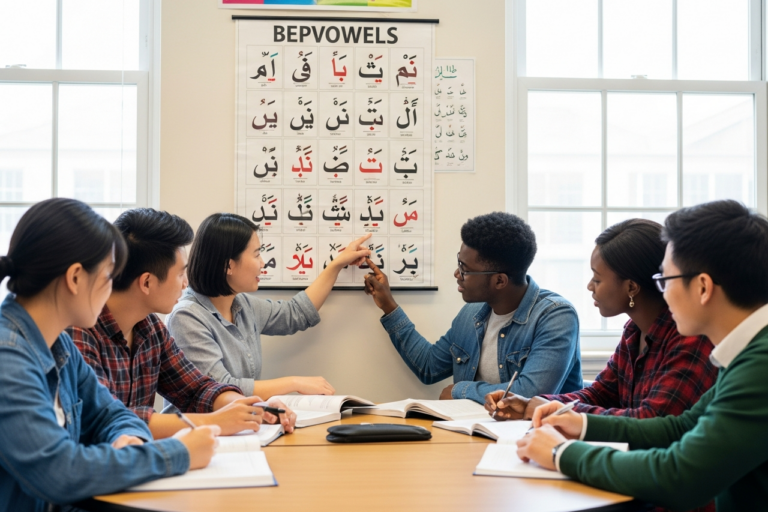
The Arabic language has six main vowels. There are three short vowels and three long vowels.
-
Short vowels are called harakat. In Arabic, these are shown by little marks called diacritical marks. They are placed over or under consonants.
-
To make a long vowel, you need to use a short vowel diacritic along with one of three letters. These three letters are Alif, Waw, and Yaa.
-
The letters Alif, Waw, and Yaa have double functionality. This means they can be used as long vowels or as consonants, based on where they are in the word.
-
There are also semivowels in Arabic. Semivowels help blend the vowel sounds. They make pronunciation smoother.
-
It is very important to learn how to use vowels in the Arabic language. Knowing how to use short vowels and long vowels will help you say words the right way. It can change the meaning of words and help you understand Arabic more clearly.
Introduction
Welcome to the world of Arabic vowels! If you are starting to learn the Arabic language, knowing how vowels work is a key step. The way vowels work in Arabic is not the same as in English. In English, you find vowels as letters in the alphabet. In Arabic, vowels are usually marks put above or below the letters. This guide will help you learn everything you need. You will learn about short vowels and other types too. By the end, you can use this to speak Arabic with more clarity and to get better at pronunciation.
Understanding Arabic Vowels
Arabic vowels are a key part of how you say words in the arabic alphabet. These are not standard letters. Instead, they help guide the vowel sounds that you use with the alphabet’s consonants. If you leave them out, the meaning of words can get unclear. Just changing a vowel sound can make a word mean something else.
There are three main types of vowels in arabic. These are short vowels, long vowels, and semivowels. Each of these helps shape how you say a word and also how you understand what it means. Knowing these types of vowels will make your language skills better. Let’s look at what these different types of vowels do in arabic.
Types of Arabic Vowels: Short, Long, and Semivowels
The Arabic language classifies vowels into three primary categories: short vowels, long vowels, and semivowels. Short vowels are diacritical marks, while long vowels are represented by actual Arabic letters. Semivowels are unique as they bridge the gap between vowel and consonant sounds.
The main difference between short and long vowels lies in their duration and how they are written. Short vowels are quick sounds indicated by small marks, while long vowels are held for a longer duration and are formed using specific letters of the alphabet. This distinction is crucial for both pronunciation and meaning.
Some Arabic letters, specifically Alif (ا), Yaa (ي), and Waw (و), exhibit a fascinating double functionality. They can function as long vowels or as consonants, depending on their position and the diacritics around them.
|
Vowel Type |
Description |
|---|---|
|
Short Vowels |
Diacritical marks (harakat) for “a,” “i,” and “u” sounds. |
|
Long Vowels |
Created by combining short vowels with the letters Alif, Yaa, or Waw. |
|
Semivowels |
The letters Yaa and Waw acting as consonants (“y” and “w”) or as part of diphthongs. |
Role of Vowels in Arabic Pronunciation and Meaning
Vowels are at the center of arabic pronunciation. They help you speak words the right way, and they also change the meaning of words that may look the same. The vowel sounds you use can switch the meaning of a word, so it is important for proper pronunciation in standard arabic.
You can think of vowels as the melody in the language. When you change a vowel sound, you can go from one word to another. For example, the consonant group “ktb” can be “he wrote” (kataba), or “books” (kutub), based only on what vowel sounds you use. This shows how vowels shape the meaning of words and are truly key.
So, to get correct arabic pronunciation, you need to understand both short and long vowel sounds well. As you work with standard arabic, you will notice how these small vowel sounds help set the flow and meaning for all that you say and read.
Arabic Short Vowels Explained
Arabic short vowels are called harakat. These are small diacritical marks that you see above or below a consonant. They show you a special sound for that letter. These marks are not letters, but they help you get the right pronunciation. They also help with the grammar in a word. Each one of these short vowels has its own sound.
These marks are important when you are a beginner or when you read the Quran. But people often leave them out in everyday writing. Native speakers have familiarity with the language. So, they use context to know what vowel sounds to add. Now, let’s talk about each of these short vowels and see what they do.
Fatha (ـَ): The “a” Sound
The Fatha is one of the three main short vowels in Arabic. Sometimes, people call it Fathah. This mark stands for a short “a” sound, just like the “a” in “cat” in English. You write the Fatha as a small dash that goes above an Arabic letter. It makes you say a short “a” right after the consonant.
When you see the Fatha in Arabic words, you need to say that quick “a” right after the consonant. For example, when the Fatha is on the letter ب (b), you say بَ (ba). Learning to use the Fatha helps you read the harakat and say Arabic words the right way.
Here are a few things about the Fatha:
-
Symbol: ـَ
-
Placement: On top of the consonant.
-
Sound: A short “a” sound.
Kasra (ـِ): The “i” Sound
Next, we will talk about the Kasra (or Kasrah). This is one of the main short vowels in Arabic. You use the Kasra to make a short “i” sound. It is the same sound as the “i” in hit or sit. The Kasra looks like a small diagonal line. It sits right under the consonant letter. When you see it, you know to use a short “i” sound.
It is important to spot and use the Kasra the right way. Doing this helps you get good Arabic pronunciation. For example, in the Arabic word for “girl,” which is bint (بِنْت), you see the Kasra under the first letter. This gives you the “bi” sound. If you leave out the Kasra, the sound and the meaning of many Arabic words can change a lot.
Here is a quick way to remember the Kasra:
-
Symbol: ـِ
-
Placement: Below the consonant.
-
Sound: A short “i” sound.
The Kasra is a big part of understanding short vowels, Arabic vowels, and working with each consonant. Using it helps with better Arabic pronunciation.
Damma (ـُ): The “u” Sound
The last short vowel is called the Damma, and you may also see it spelled as Dammah. This mark shows a short “u” sound, like the “u” in “put” or the “oo” in “look.” The Damma looks like a small loop or a tiny letter Waw. You will find it above the consonant. The Damma adds the short “u” sound to the consonant it is on.
For example, take the word for “dream,” Hulm (حُلْم). You will see the Damma over the first letter, making the sound “Hu.” If you are just starting out, it helps to practice with these harakat by reading things like children’s books or other easy texts that include them. Listening to people who speak the language will also make it easier to link the Damma to the right pronunciation.
Here’s a quick look at the Damma:
-
Symbol: ـُ
-
Placement: Above the consonant.
-
Sound: A short “u” sound.
Arabic Long Vowels and Their Uses
Now let’s talk about Arabic long vowels. Short vowels in Arabic are shown by small marks, but long vowels use real letters from the alphabet. You get a longer version of the short vowel sound when using these. Knowing how to use long vowels is a big step if you want to get better at Modern Standard Arabic. These long vowels show up in a lot of Arabic words.
There are three letters that work as long vowels in Arabic: Alif (ا), Waw (و), and Yaa (ي). When you see each of these letters together with a short vowel mark, it makes the vowel sound longer. Let’s look at how the letters Alif, Waw, and Yaa help make long vowels in Standard Arabic words.
Alif (ا): Long “aa” Sound
The letter Alif (ا) helps you make the long “aa” sound. You get this sound when there is a consonant with a Fatha (ـَ) on it, and then an Alif comes after that. This makes the short “a” sound last longer, just like the “a” in the English word “father.” This pair of sounds is one of the most distinct sounds you hear in the language.
For instance, look at the word for “day,” nahaar (نَهَار). Here, the letter ه (h) has a Fatha first, then an Alif comes next, and this makes a long “haa” sound. In everyday writing, people may not write the short vowel mark (Fatha), but you can still spot the long “aa” sound because there is an Alif right after a consonant.
Key facts about the long “aa” sound:
-
Letter: Alif (ا)
-
Combination: A consonant with a Fatha (ـَ) followed by Alif (ا).
-
Sound: A long “aa” sound.
Waw (و): Long “uu” Sound
The letter Waw (و) in Arabic helps make the long “uu” sound. This happens when there is a consonant with a Damma (ـُ) on it, right before a Waw. When you put these together, a short “u” turns into the long “uu” sound, like “oo” in the English word “food.”
You can see this with the word for “sitting” in Arabic, which is juluus (جُلُوس). The letter ل (l) has a Damma over it and comes right before a Waw. This gives the long “luu” sound. In everyday writing, writers often leave out the short vowel mark. So, you get to know the long vowel by seeing a Waw after the consonant.
Here is a quick guide about the long “uu” sound:
-
Letter: Waw (و)
-
Combination: A consonant with a Damma (ـُ), then a Waw (و).
-
Sound: A long “uu” sound.
This rule for long vowels in Arabic helps you read and write words the right way. It is a key part of learning Arabic vowels and how sound works with a consonant.
Yaa (ي): Long “ii” Sound
The letter Yaa (ي) makes the long “ii” sound in Arabic. You get this sound when a consonant with a Kasra (ـِ) comes before the letter Yaa. This mix turns the short “i” sound into a longer “ii” sound, like the “ee” you hear in the English word “see.” This is important in Standard Arabic.
For example, in the word for “beautiful,” jamiil (جَمِيل), the letter م (m) has a Kasra and then comes Yaa. This gives you the long “mii” sound. Getting this sound right is a big part of Arabic pronunciation. You need to know Yaa shows a long vowel when you learn the Arabic language.
Here is a quick look at the long “ii” sound:
-
Letter: Yaa (ي)
-
Combination: A consonant with a Kasra (ـِ) followed by Yaa (ي).
-
Sound: A long “ii” sound.
Arabic Semivowels: The Bridge Between Sounds
The Arabic alphabet uses more than just short and long vowels. It also has semivowels, called hurouf al leen. These sounds are special because they are like both vowels and consonants. They act as a link between the two types of sounds. The letters Waw (و) and Yaa (ي) are examples we have already learned about as long vowels. They also work as semivowels.
This double functionality makes Arabic pronunciation stand out. At times, Waw and Yaa do not work as long vowels. Instead, Waw is read as the sound “w” and Yaa is read as “y” like in “yes”. It is important to know when these letters are used as vowels or as consonants. This is a big part of reading and speaking in Arabic in a good way. In the next part, you will see tips on how to find and use these useful sounds in the alphabet.
Recognition and Usage of Semivowels
Knowing when Waw (و) and Yaa (ي) are working as semivowels or as long vowels has to do with the vowel sounds that come before or after them. Semivowels like Waw and Yaa are not the same as long vowels. This is because they still sound like a consonant. Waw is spoken as a “w” sound, and Yaa is said as a “y” sound when they do not come after their matching short vowel.
For example, if a Waw or Yaa is in the three-letter root of a word, they are often used as a consonant. You will see them show up in diphthongs as well. Here, when they are with a Fatha, they make “aw” and “ay” sounds. This is much more than just making long vowel sounds like “uu” and “ii.”
Here is how you can tell the difference between them:
-
As a Semivowel/Consonant: Waw (و) will have a “w” sound, and Yaa (ي) will be a “y” sound.
-
In Diphthongs: If a Fatha comes before, you get “aw” (ـَوْ) and “ay” (ـَيْ) sounds.
-
As a Long Vowel: If a matching short vowel comes before (Damma before Waw, Kasra before Yaa), it will stretch the
Common Examples in Everyday Words
You can see semivowels in many Arabic words people use every day in the Arab world. These words in everyday writing show how the letters Waw (و) and Yaa (ي) work as consonants. This is important for the right way to say the words.
One good example for Waw is the word for “face,” wajh (وَجْه). The Waw comes at the start and you say it as “w.” For Yaa, look at the word yad (يَد), which means “hand.” Here, Yaa is said as “y.” These examples make it clear that both letters work as consonants, not as long vowels, in these words.
Here are a few easy examples to look at:
-
Wajh (وَجْه – face): Waw is said as “w.”
-
Yawm (يَوْم – day): Yaa and Waw make the “aw” sound here.
-
Bayt (بَيْت – house): Yaa helps make the “ay” sound.
These words from Arabic show how the letters Yaa and Waw can be consonants instead of vowels in many words used across the Arab world. This helps people get the right pronunciation in everyday writing.
Conclusion
To sum up, knowing the vowels in the Arabic language is important if you want to get better at how you speak. You should get to know the types of vowels in arabic, like short, long, and semivowels. This will help you a lot with your pronunciation. Vowels do a big job in the arabic language as they add meaning and help you say words right. No matter if you are just beginning or want to get better, spending time to practice vowels and learn their sounds will help you the most in your arabic learning. If you want to take your arabic even further, you can sign up for a free trial or ask for a meeting to improve your skills.
Frequently Asked Questions
Are Arabic vowels always spelled out in texts?
No, in everyday writing in Arabic, the vowels are often left out. You will not see these vowels in most books or newspapers. The small marks above or below the letters, called diacritics or harakat, are usually there only in the Quran, books for kids, or learning materials. People who read well in Arabic use what is around the word to know which vowels and what pronunciation to use. This helps them read with no problem, even with the omission of vowels.
How can beginners practice recognizing Arabic vowel marks?
For beginners, the best way is to read texts where the harakat are always shown. This can be found in children’s stories and beginner textbooks. Listening to audio and reading the text at the same time helps you learn arabic pronunciation faster. It lets you link the marks to the correct sound in arabic. This makes learning go quicker.
What tips help learners master Arabic vowel pronunciation?
To get good at vowel pronunciation, you need to listen to native speakers and try to sound like them. You can record your own voice and compare it to how a native speaker says it. This will help you find out what you need to work on. Practicing with Arabic words often, and paying close attention to the difference between short and long vowels, is the way to gain proper pronunciation. Keep doing this, and your Arabic pronunciation will get better.