The South African rand (ZAR) is the official currency of South Africa, issued by the South African Reserve Bank (SARB). It is divided into 100 cents and comes in coins and banknotes. Travelers can use cards widely while keeping rand cash available for smaller purchases and other cash-based situations.
ZAR and R mean the same currency: ZAR is the international ISO currency code, while R is the symbol commonly used on South African prices.
This Remitly guide is designed for U.S. travelers and people sending money to South Africa. It covers rand denominations, banknotes, payment methods, and regional acceptance, with no exchange-rate discussion.
Quick Answers
- The South African rand (ZAR) is South Africa’s official currency and is issued by SARB.
- Current currency includes coins from 10c to R5 and banknotes from R10 to R200.
- Cards are useful for many everyday purchases, but carrying some smaller rand notes provides flexibility.
- The rand also circulates within the Common Monetary Area, although its legal status and acceptance vary in Lesotho, Namibia, and Eswatini.

South African rand (ZAR) basics: name, code, symbol, and who issues it
The South African rand is the official currency of South Africa, with the international code ZAR, and the domestic symbol R. The South African Reserve Bank (SARB) issues South African banknotes and coins.
South African rand at a glance
| Official name | South African rand |
| ISO currency code | ZAR |
| Symbol | R |
| Subdivision | 1 rand = 100 cents (c) |
| Issuing authority | South African Reserve Bank (SARB) |
Why is it called the rand?
The name rand comes from the Witwatersrand, the gold-rich ridge near Johannesburg. The rand replaced the South African pound in 1961, when South Africa became a republic.
ZAR vs R: what’s the difference?
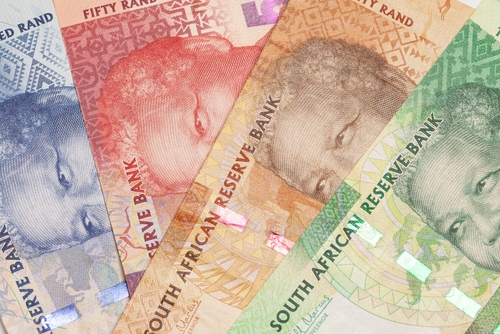
ZAR and R both refer to the South African rand, but they’re used in different contexts. ZAR is the standardized code used by banks, money-transfer services, and other cross-border platforms. R is the domestic symbol you’ll commonly see on South African prices. For example, R100 means 100 rand.
The abbreviation ZAR derives from the Afrikaans Suid-Afrikaanse rand, not the Dutch Zuid-Afrikaanse Rand, as some sources incorrectly state.
Is the South African rand a closed currency?
For U.S. travelers, it’s important not to treat the rand as a strictly closed currency obtained only after arrival. It’s traded internationally through authorized institutions abroad, and once in South Africa, SARB-issued cash is legal tender, with SARB alone authorized to issue it.
South African rand banknotes and coins (denominations and what they look like)
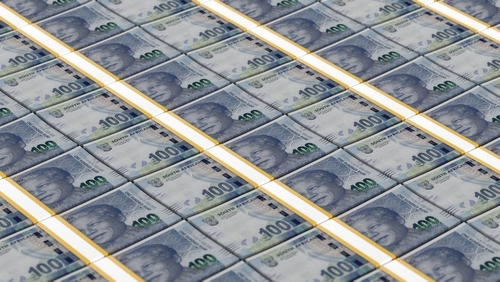
South African currency comes in five banknote denominations and six currently minted coin denominations. SARB introduced upgraded Mandela banknotes and its fourth decimal coin series in 2023, which circulate alongside earlier valid issues. Banknotes are not polymer: SARB confirms that all current banknotes are printed on a cotton substrate.
| Type | Denomination | Common use | Current design theme |
| Coin | 10c | Small amounts and making change | Fourth decimal series: South African fauna and flora |
| Coin | 20c | Small amounts and making change | Fourth decimal series: South African fauna and flora |
| Coin | 50c | Small purchases and change | Fourth decimal series: South African fauna and flora |
| Coin | R1 | Everyday small purchases | Fourth decimal series: South African fauna and flora |
| Coin | R2 | Everyday small purchases | Fourth decimal series: South African fauna and flora |
| Coin | R5 | Everyday purchases | Fourth decimal series; current R5 features the southern right whale |
| Banknote | R10 | Smaller everyday purchases | Nelson Mandela on front; rhinoceros family on reverse |
| Banknote | R20 | Everyday purchases | Nelson Mandela; elephant family |
| Banknote | R50 | Everyday and mid-sized purchases | Nelson Mandela; lion family |
| Banknote | R100 | Larger purchases | Nelson Mandela; Cape buffalo family |
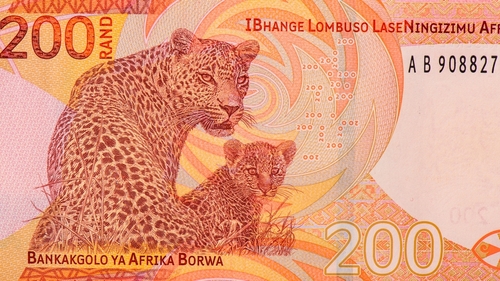
| Banknote | R200 | Larger cash purchases | Nelson Mandela; leopard family |
SARB’s coin series follows a “deep ecology” theme. Minting of 1c, 2c and 5c coins has been discontinued, though SARB doesn’t demonetize its currency, so earlier coins retain their face value.
What do South African banknotes look like?
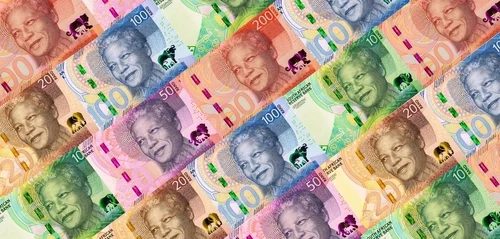
Upgraded 2023 notes retain Nelson Mandela’s portrait on the front, while the reverse depicts families of the Big Five: rhinoceros, elephant, lion, Cape buffalo, and leopard.
Travelers may see more than one design, since upgraded notes co-circulate with earlier Mandela-series banknotes that remain legal tender regardless of issue date.
How to spot a genuine South African banknote
SARB recommends its “look, feel and tilt” method rather than relying on just one security feature:
- Look: Check the denomination and detailed security imagery.
- Feel: Genuine notes use cotton-based paper with raised printing you can feel.
- Tilt: Tilt the note and look for security elements that shift or appear.
An unfamiliar-looking note isn’t necessarily counterfeit, since older valid series still circulate alongside upgraded designs. If you’d like a closer look at spotting fake currency in general, our guide on how to spot fake money covers the security features to check for.
Where the South African rand is used and accepted
The South African rand (ZAR) is legal tender in South Africa and also circulates through the Common Monetary Area (CMA). The CMA includes South Africa, Eswatini, Lesotho, and Namibia, allowing close monetary cooperation, per SARB’s 2026 guidance.
| Country | Local currency | Is South African rand accepted? |
| South Africa | South African rand (ZAR) | Yes. The rand is South Africa’s legal tender. |
| Lesotho | Loti (LSL); plural maloti | Yes. The Central Bank of Lesotho confirms both the loti and rand are legal tender there. (Central Bank of Lesotho) |
| Namibia | Namibian dollar (NAD) | Yes. The Bank of Namibia confirms both currencies are legal tender there. (Bon) |
| Eswatini | Lilangeni (SZL); plural emalangeni | CMA-linked. Eswatini’s currency is tied to the rand through the CMA, but confirm acceptance with the merchant rather than assuming. (Central Bank of Eswatini) |

What this means for U.S. travelers
Don’t confuse the rand’s regional role with international acceptance. ZAR isn’t a currency you’d normally use to make purchases in the U.S. Its broader acceptance is specific to southern Africa and the CMA framework.
The CMA doesn’t make all four countries’ currencies interchangeable everywhere, so don’t assume Lesotho maloti, Namibian dollars, or Eswatini emalangeni will be accepted for everyday purchases in South Africa. Check local currency requirements when crossing borders.
Practical tips for using South African currency (cards, cash, ATMs, and everyday situations)
For U.S. travelers, using a combination of cards and South African rand (ZAR) cash provides flexibility for everyday spending, since electronic payments are widely supported but cash is still useful when they aren’t available. (South African Reserve Bank)
Cash vs. card in South Africa
| Payment method | Best for | What to know |
| Credit/debit card | Hotels, restaurants, supermarkets, larger retailers | Chip-and-PIN and contactless are both common; keep your PIN ready in case tapping isn’t available. |
| Mobile/contactless payment | Businesses with contactless terminals | Look for the contactless symbol and follow the terminal prompts. |
| Cash (ZAR) | Small vendors, tips, markets and cash-only situations | Carry smaller rand notes rather than relying on R100 or R200 bills. |
| ATM withdrawal | Obtaining rand after arrival | Choose ATMs at established banks or well-trafficked locations; your bank or the ATM operator may charge fees. |

7 payment tips for U.S. travelers
- Bring a card with a PIN. Be ready to insert it and enter the PIN if required.
- Tap when the terminal supports it. Contactless can be convenient, but not every terminal will support it. Keep your physical card accessible as a backup.
- Understand dynamic currency conversion (DCC). A merchant or ATM may offer to bill you in U.S. dollars instead of South African rand. This is DCC, and you should be able to accept or decline it yourself.
- Choose ATMs carefully. Use ATMs at established banks, shopping centers, or airports rather than secluded or poorly lit machines, and shield your PIN from strangers.
- Check what ATM fees apply. An ATM transaction can involve fees from both the ATM operator and your U.S. card issuer or bank. Review on-screen fees before confirming, and check your bank’s policy beforehand.
- Keep some cash for everyday situations. Rand is useful for tips, markets, and situations without card terminals. Keep smaller notes handy for easier change.
- Carry a backup payment method. Keep a second card separate from your wallet, plus some cash, and never share your PIN. If an ATM keeps your card, contact your bank directly.
Sending money to or from South Africa
If you’re sending money to someone in South Africa, you generally don’t need to handle physical rand yourself; providers may offer delivery options such as bank deposit or other supported payout methods, so confirm which one your recipient can use before starting the transfer. If you’re sending to a South African bank account, it also helps to know how South African branch codes work.
If you’re sending money home to the U.S. from South Africa, cross-border transfers follow South African exchange-control rules; use an authorized provider and be ready to show ID. For current rules, consult the South African Reserve Bank’s Currency and Exchanges guidance rather than relying on travel advice, since requirements can change.

FAQs about South African currency (rand/ZAR)
What is the currency of South Africa?
The official currency of South Africa is the South African rand, divided into 100 cents. Its international ISO currency code is ZAR, while the symbol R is used domestically. The South African Reserve Bank (SARB) is responsible for issuing the country’s banknotes and coins.
Is ZAR the same as the South African rand?
Yes. ZAR and South African rand refer to the same currency. ZAR is the three-letter ISO code used by banks and payment systems. The name “rand” comes from Witwatersrand, the gold-rich area near Johannesburg central to South Africa’s economic history.
What South African rand denominations are currently in circulation?
South Africa’s current banknotes are R10, R20, R50, R100, and R200. The current coin series consists of 10c, 20c, 50c, R1, R2, and R5. SARB has discontinued minting 1c, 2c, and 5c coins, though earlier currency remains valid.
Can you use U.S. dollars in South Africa?
Travelers should plan to use South African rand rather than U.S. dollars for everyday purchases. Businesses price in rand, though some tourist-oriented merchants may have their own policies. Carry rand or an accepted card rather than assuming a merchant will take USD.
Are old South African rand banknotes still valid?
Yes. Older genuine South African banknotes can remain legal tender even when their designs differ from newer notes. SARB doesn’t demonetise its currency, so banknotes and coins issued since 1961 retain their face value, and travelers may see different valid designs in circulation.
Is the South African rand accepted outside South Africa?
Yes, the rand also circulates within the Common Monetary Area (CMA), which includes South Africa, Lesotho, Namibia, and Eswatini. Its legal status and acceptance vary by CMA member, so check each country’s central-bank guidance rather than assume identical payment practices.
What’s the difference between ZAR and the R symbol?
ZAR and R identify the same South African currency but serve different purposes. ZAR is the standardized code for banks and cross-border payments. R is the symbol typically used with prices inside South Africa. For example, R200 and ZAR 200 both mean 200 South African rand.

Key takeaways
- The South African rand is the official currency of South Africa, and the South African Reserve Bank (SARB) issues the country’s banknotes and coins.
- Current denominations include 10c, 20c, 50c, R1, R2, and R5 coins, plus R10, R20, R50, R100, and R200 banknotes.
- ZAR and R refer to the same currency: ZAR is the international ISO currency code, while R is the symbol commonly used on prices within South Africa.
- The rand also circulates within the Common Monetary Area (CMA), including Lesotho, Namibia, and Eswatini, although its legal status and everyday acceptance vary by country.
- U.S. travelers should plan to use a combination of cards and rand cash, keeping smaller notes for tips and situations where cards aren’t accepted.
Using South African rand (ZAR) with confidence
The South African rand (ZAR) is South Africa’s official currency, issued by SARB in coins from 10c to R5 and notes from R10 to R200. The rand also circulates within the Common Monetary Area (CMA), although its legal status and acceptance vary across Lesotho, Namibia, and Eswatini. Because multiple banknote series can remain valid, use SARB guidance to verify unfamiliar notes rather than relying on design alone.
Before you go or before you send:
- Confirm whether prices and payments are shown in ZAR/R and check which payment methods are accepted.
- Carry a combination of cards and smaller rand denominations for everyday situations.
- Check SARB or the relevant central bank for current currency, banknote-validity, and cross-border guidance.Need to send money back to friends or family? Remitly provides a secure way to send money to South Africa, with delivery options that may include bank deposit or cash pickup, depending on availability.
Last reviewed: August 2026