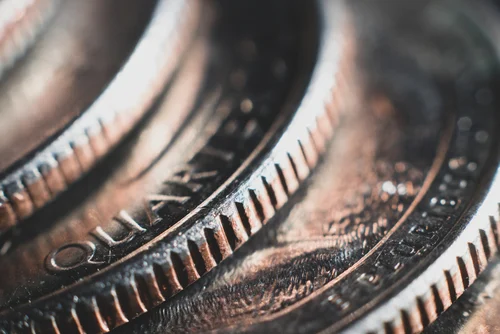
Quick answer: The ridges around some coins, known as reeding, were originally designed to discourage people from shaving valuable metal off gold and silver coins. Removing metal disrupted the patterned edge, making tampering easier to spot. Many modern coins, like U.S. dimes and quarters, keep reeded edges today even though their circulating versions no longer contain precious metals.
Run your finger around the edge of a dime or a quarter, and you’ll feel a series of small, evenly spaced ridges. Try the same thing with a penny or a nickel, and you’ll notice something different: a smooth, unbroken edge. That contrast isn’t an accident of design. It’s a leftover clue from a centuries-old problem involving stolen precious metal.
Those tiny grooves, known as reeding, were originally added to protect the value of coins made from gold and silver. Understanding why they exist means understanding a practice called coin clipping, and the clever, low-tech solution that helped put a stop to it.

What Are the Ridges on Coins Called?
The repeated ridges running around a coin’s outer edge are called reeding. A coin with this pattern is described as having a reeded edge. Not every coin uses this design. Depending on the denomination and country, a coin’s edge can be plain, reeded, lettered, or decorated with another pattern entirely.
What Is the Difference Between a Coin’s Edge and Its Rim?
It’s easy to mix up a coin’s edge with its rim, but they refer to two different parts of the coin.
| Coin part | What it means |
| Edge | The outer surface running around the coin’s circumference |
| Rim | The raised border around the design on either face |
The raised rim serves its own purpose: it helps protect the coin’s design from wear as it passes through countless hands and pockets. That’s a separate function from reeding, which historically served an anti-tampering role.

How Did Ridges Help Prevent Coin Clipping?
What Was Coin Clipping?
Many historical coins were struck from gold or silver, metals valuable enough that even small shavings were worth collecting. Coin clipping described the practice of shaving thin slivers of metal from a coin’s edge and pocketing the shavings. The clipped coin, now lighter but still roughly the same size and shape, would then be passed along and spent as though nothing had changed.
Picture someone shaving a little silver from several coins, setting the shavings aside, and spending the altered coins at their original face value. Repeated across many coins and many hands, this practice gradually drained precious metal out of circulation, undermining the value of the currency itself.
Why Did a Patterned Edge Help?
A reeded edge made clipping much harder to pull off unnoticed. Removing metal from a patterned edge disrupted the regular, repeating ridges, leaving a telltale gap or irregularity. On a plain edge, by contrast, a thin shaving was far less obvious.
Reeding worked as a deterrent and a detection method rather than an absolute safeguard. It didn’t make coin clipping impossible or eliminate fraud outright, but it made tampering significantly easier to spot at a glance.

Why Do Modern Coins Still Have Ridges?
Coin designs often outlive the original problem they were built to solve, and reeding is a good example. Today’s circulating U.S. dimes and quarters are copper-nickel clad coins, meaning they contain no gold or silver. Yet both still carry reeded edges.
That lingering design choice now serves a different, more practical purpose. A ridged edge offers an additional tactile clue that helps people distinguish coins by feel, alongside cues like size and shape, which is especially useful for anyone identifying currency without looking at it directly.
It’s worth being clear about one thing: a reeded edge is not proof that a coin contains silver or gold. The historical reason reeding was introduced and the reason it remains on modern coins are two different things, and U.S. Mint policy doesn’t treat reeding as a precious-metal indicator today.
Why Do Some Coins Have Smooth Edges?
Reeding is a design option, not a universal rule. In the United States, pennies and nickels have plain, smooth edges, while dimes, quarters, and half dollars carry reeded edges. Some U.S. dollar coins take a third approach entirely, using edge lettering instead of ridges.
Other countries follow their own combinations of edge treatments, and there’s no fixed pattern linking a coin’s value to whether it has ridges. A low-denomination coin in one country might be reeded, while a higher-value coin elsewhere could be smooth. Edge design depends on each mint’s own history and standards, not a universal rule.
How Are Ridges Put on Coins?
Reeding isn’t carved into coins individually after the fact. It’s formed as part of the striking process itself, through a few coordinated steps:
- A prepared metal disc, known as a planchet, is positioned in a coining press.
- A surrounding collar holds the planchet in place and controls its shape as it’s struck.
- For a reeded coin, grooves machined into the inside of that collar press the ridges into the coin’s edge at the same moment the faces are struck.
In other words, the ridges appear the instant the coin is struck, formed by the collar rather than added as a separate finishing step.

How Many Ridges Do Coins Have?
The exact ridge count varies by denomination, and the U.S. Mint’s specifications give two concrete examples:
| U.S. coin | Number of reeds |
| Dime | 118 |
| Quarter | 119 |
These figures apply specifically to current U.S. dimes and quarters. They’re not part of a universal pattern that applies to every reeded coin worldwide, and the specific counts don’t carry any deeper symbolic or mathematical meaning. They simply reflect each denomination’s individual minting specifications.
Frequently Asked Questions About Coin Ridges
Why do quarters have ridges?
Quarters historically contained silver, and their reeded edges made it easier to notice if someone had shaved metal from the coin. Modern circulating quarters keep the reeded edge as a design holdover, even though they’re now struck from copper-nickel rather than silver.
Why do dimes have ridges but nickels do not?
The difference traces back to the metals each coin historically used. Dimes were historically struck in silver, making them a target for clipping, while nickels were made from a copper-nickel alloy with no precious metal to protect. That history shaped each coin’s edge design, which has carried forward even as dimes shifted to copper-nickel composition.
Do ridges mean a coin is made of silver?
No. Modern circulating U.S. dimes and quarters have reeded edges despite being made of copper-nickel, not silver. A ridged edge reflects a coin’s design history, not its current metal content.
Are coin ridges the same as the raised rim?
No. The edge is the outer surface running around a coin’s circumference, where reeding appears, while the rim is the raised border around the design on each face. They’re separate features that serve different purposes.
Do all countries put ridges on their coins?
No. Edge design varies by country and denomination. Some mints use reeding, others use plain edges, lettered edges, or decorative patterns, depending on each country’s own history and standards.
The Small Detail in Your Pocket
Next time you’re handed change, take a second to feel the edge of the coins. Those tiny ridges on a dime or quarter are a small, physical reminder of a problem people faced centuries ago: how do you protect a coin’s value when the metal itself is valuable? Reeding was a simple, effective answer, and even though the silver and gold are long gone from everyday currency, the ridges remain, a quiet piece of monetary history sitting in your pocket.