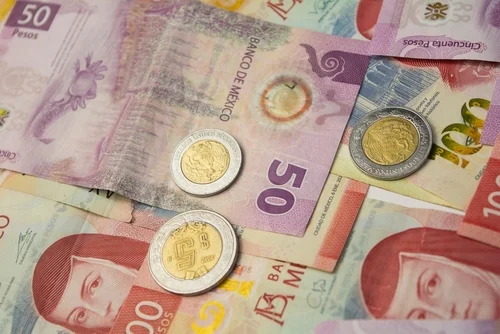
Mexican currency is the Mexican peso (MXN). Prices are usually shown with ‘$,’ and 1 peso equals 100 centavos. Banco de México issues coins and banknotes in multiple denominations with modern security features to reduce counterfeiting.
Quick Answers
- Mexico’s official currency is the Mexican peso (MXN), and 1 peso equals 100 centavos.
- The $ symbol in Mexico usually refers to pesos, not US dollars, unless USD is clearly stated.
- Current Mexican banknotes range from 20 to 1,000 pesos, while coins include centavos and pesos denominations up to 20 pesos.
- Use Banco de México’s look-feel-tilt checks to verify unfamiliar banknotes.
- Carry a mix of smaller denominations for tips, markets, and small everyday purchases.

What is Mexican Currency?
Mexican currency is the Mexican peso (MXN). The Mexican currency symbol is $, the same symbol used for US dollars, and one peso equals 100 centavos.
MXN is the international currency code for the Mexican peso, while MX$ may be used when a clearer distinction from US dollars is needed. You may also encounter M.N., short for moneda nacional (“national currency”).
This Remitly guide focuses on the practical side of Mexican currency: how to recognize Mexican coins and bills, understand denominations, identify security features, and use pesos confidently while traveling or handling Mexican money. If you are sending funds to family in Mexico, our guide to sending money to Mexico covers delivery options once you have got the currency basics down.
Tip: If you see $250 on a menu in Mexico, it will usually mean 250 Mexican pesos, unless the price is specifically marked as dollars.

Mexican peso basics
Banco de México is responsible for providing Mexico with its national currency and publishes information on the banknotes and coins currently in circulation. The $ is used for pesos in Mexico, and you may also see MXN, M.N., and USD when a price is specifically quoted in US dollars.
- MXN: The three-letter code used to identify the Mexican peso.
- Peso: The main unit of Mexican money.
- Centavo: one-hundredth of a peso; 100 centavos equal 1 peso.
- M.N.: Short for moneda nacional, or “national currency,” meaning the amount is stated in Mexican pesos.

Avoid confusion
- Treat $ as Mexican pesos when prices are displayed locally in Mexico.
- Look for MXN or M.N. when you want confirmation that an amount is in pesos.
- If a price says USD, it refers to US dollars rather than pesos.
- When currency is unclear, ask before paying instead of relying on the $ symbol alone.
Tip: At a restaurant, a bill showing $850 M.N. means 850 Mexican pesos. In a taxi, a quoted fare of $300 will ordinarily refer to pesos unless the driver specifically says the amount is in US dollars. At a souvenir shop in a tourist area, you might see both MXN and USD prices, so check which currency applies before agreeing to the purchase.

Mexican coins and banknotes in circulation (2026)
Mexico uses both coins and Banco de México banknotes, with denominations ranging from 5 centavos to 1,000 pesos. Banco de México’s current design listings include 5, 10, 20, and 50-centavo coins; 1, 2, 5, 10, and 20-peso coins; and 20, 50, 100, 200, 500, and 1,000-peso banknotes.
| Denomination | Currency type | Color and shape cues | Commonness |
| 5, 10, 20, 50 centavos | Coin | Small, silver-colored coins. The denomination is followed by the ¢ symbol. | Valid legal tender, but the smaller denominations like 5, 10, and 20-centavo coins are rarely used in everyday cash transactions |
| 1 peso | Coin | Round, with a gold-colored center and silver-colored outer ring | Very common small-change denomination. |
| 2 pesos | Coin | Similar two-tone design to the 1-peso coin, but slightly larger | Common for change and small cash payments |
| 5 pesos | Coin | Larger two-tone coin with $5 on the reverse | Common for change, transit, tips, and small purchases |
| 10 pesos | Coin | Large round, two-tone coin with a silver-colored center and gold-colored outer ring | Common and useful for everyday cash spending |
| 20 pesos | Coin | Modern versions are 12-sided and two-tone; designs vary because many are commemorative | Less common than 1–10-peso coins, but valid for payment |
| 20 pesos | Banknote | Green and red polymer note; current Family G design commemorates Mexican independence | Valid legal tender working alongside 20-peso coins |
| 50 pesos | Banknote | Predominantly purple polymer note; features the axolotl and Xochimilco scene on the reverse | Common everyday note |
| 100 pesos | Banknote | Predominantly red polymer note featuring Sor Juana Inés de la Cruz | Common everyday note |
| 200 pesos | Banknote | Predominantly green cotton-paper note featuring Miguel Hidalgo and José María Morelos | Common for routine purchases |
| 500 pesos | Banknote | Predominantly blue cotton-paper note featuring Benito Juárez | Extremely common; useful for larger everyday purchases |
| 1,000 pesos | Banknote | Predominantly gray cotton-paper note featuring Francisco I. Madero, Hermila Galindo, and Carmen Serdan | Valid and circulating, but considerably less common than lower-value notes |
Tip: Keep some smaller peso coins and lower-denomination bills with you instead of only carrying 500- or 1,000-peso notes. They can be more convenient for tips, public transit, markets, street food, and small vendors.

How to spot genuine Mexican pesos (and avoid common counterfeit mistakes)
Mexican banknotes include several security features that can be checked quickly without special equipment. Banco de México recommends checking more than one feature using a touch-look-tilt approach rather than relying on a bill’s color and appearance alone.
Feel the bill
Genuine Banco de México banknotes are made from either polymer or cotton paper and have a different texture from ordinary printer paper. You should be able to feel raised printing in certain areas, although this relief can become less noticeable as a bill wears down.
Look at the security features
Hold the bill up to a light when possible. Current 200-, 500-, and 1,000-peso Family G notes contain watermarks, while the polymer 20-, 50-, and 100-peso notes instead feature transparent windows built into the material. The window contains denomination-specific details and is part polymer itself, rather than something printed onto the surface.
Security threads are also present on some Mexican banknotes. Current 200-, 500-, and 1,000-peso notes contain a dynamic thread whose numbers and bars appear to move when the bill is moved. For a closer inspection, Banco de México also uses very fine microprinting and line patterns. Some microtext is small enough that a magnifying glass may be needed to read it clearly.
Tilt the bill
Tilt the note forward and backward and watch the denomination. Current Family G banknotes have a multicolor denomination that changes color as the bill moves. For example, the 50- and 100-peso numerals shift from gold to green, while the 200- and 500-peso numerals shift from green to blue.

What if a peso bill looks suspicious?
If you’re paying in a taxi, market, or restaurant where lighting is poor, start by feeling for raised printing and checking the bill’s material, then tilt it to look for movement or color changes. For polymer notes, check the transparent window when there’s enough light. Don’t rely on color alone, especially with worn bills.
Avoid using a counterfeit-detection marker as your only test. Banco de México specifically warns that the “marker” test is unreliable and can unnecessarily damage banknotes.
Tip: If someone gives you a bill that doesn’t look or feel right during a transaction, ask for another note or use a different payment method rather than accepting it and trying to resolve the issue later.

Using Mexican currency day-to-day
For most travelers, the easiest approach is to carry both Mexican pesos and a card. Credit and debit cards are widely accepted in Mexican cities and tourist areas, while cash remains useful for smaller businesses, local markets, tips, street food, and vendors that may not accept cards.
Cash is especially useful for:
- Street food stands and market stalls
- Small independent shops
- Tips and other small payments
- Vendors that do not accept cards
- When you want to pay an exact amount without relying on a large bill being changed
Cards are generally more convenient for:
- Hotels and many restaurants
- Larger stores and retailers
- Larger purchases which would require carrying a significant amount of cash
Tip: Even if you mostly pay by card, keep a mix of smaller Mexican coins and bills with you. A few peso coins and lower-value notes can make everyday transactions easier.

Choose MXN when a card terminal or ATM asks
US travelers may encounter dynamic currency conversion (DCC) when paying by card or withdrawing money. This happens when a merchant or ATM offers to convert the purchase into US dollars instead of processing it in Mexican pesos.
When given the choice, select MXN rather than USD. This avoids the merchant or ATM applying its own currency conversion, which may include an added markup or less favorable rate. For more information, see our guide to exchanging currency.

What should you do with a damaged peso bill?
A torn, heavily worn, or otherwise damaged Mexican banknote does not automatically lose its value. Banco de México has specific rules for determining whether damaged bills remain valid. Rather than trying to spend a questionable note, take it to a commercial bank branch that provides Banco de México’s free banknote and coin exchange service. The bank can evaluate it and, if it retains its value under Banco de México’s rules, exchange it for a bill in good condition.

Frequently Asked Questions (FAQs)
What is Mexican currency called?
Mexico’s official currency is the Mexican peso (MXN), and one peso is divided into 100 centavos. MXN is the currency code you’ll commonly see when Mexican pesos need to be distinguished from other currencies.
Why does Mexico use the $ symbol?
Mexico uses the $ symbol for the peso, so the sign does not automatically mean US dollars. Mexican monetary rules specify $ for pesos, which is why a price such as $500 in Mexico will generally mean 500 pesos.
What Mexican coins and bills are currently in circulation?
Banco de México lists current coins of 5, 10, 20, and 50 centavos and 1, 2, 5, 10, and 20 pesos. Current Family G banknotes come in 20, 50, 100, 200, 500, and 1,000 pesos. Older valid designs may also remain in circulation.
Are centavos still used in Mexico?
Yes. A Mexican peso is divided into 100 centavos, and Banco de México still lists 5-, 10-, 20-, and 50-centavo coins among Mexico’s current coin designs. You may therefore encounter centavos in prices or change.
Can you still use old Mexican peso bills?
It depends on the bill. Older banknotes that are in the process of being withdrawn retain their face value and can still be used. However, demonetized notes from Mexico’s pre-1993 monetary unit have a current value equal to their denomination divided by 1,000.
What is the largest Mexican peso banknote?
The 1,000-peso note is the largest denomination among Banco de México’s current Family G banknotes. The current design is a cotton-paper note featuring Francisco I. Madero, Hermila Galindo, and Carmen Serdan.
How can you check if a Mexican peso bill is genuine?
- Touch: Feel the banknote’s texture and raised printing.
- Look: Check features such as transparent windows, watermarks, or security threads, depending on the note.
- Tilt: Look for moving or color-changing security elements.
Key takeaways
- In Mexico, the $ symbol usually refers to Mexican pesos (MXN), not US dollars, unless USD is clearly specified.
- 1 Mexican peso equals 100 centavos.
- Check Banco de México for the latest information on current coin and banknote denominations.
- Use the look-feel-tilt method to check multiple security features if a banknote seems suspicious.
- Keep smaller coins and bills handy for tips, markets, and small everyday purchases.
Getting comfortable with Mexican currency comes down to recognizing common denominations, checking unfamiliar bills when needed, and carrying smaller coins and notes for everyday spending. Before accepting cash, look for security features described by Banco de México, and avoid accepting a bill if you are unsure about its authenticity. For more practical guidance, explore Remitly’s resources on sending money to Mexico, currency, and travel before your next trip or transaction.
This article is based on current guidance from Banco de México and other official sources on Mexican banknotes, coins, and currency use.
Last reviewed: August 2026
Sources:
- https://www.banxico.org.mx/banknotes-and-coins/currently-banknotes-and-coins.html
- https://www.banxico.org.mx/services/presumably-counterfeit-bankno.html
- https://www.banxico.org.mx/banknotes-and-coins/in-the-process-of-being-withd.html
- https://www.banxico.org.mx/services/banknotes-and-coins-exchange-.html
- https://www.banxico.org.mx/banknotes-and-coins/banknote-authenticity-verific.html
- https://www.mexperience.com/introduction-to-mexicos-peso-its-coins-banknotes/