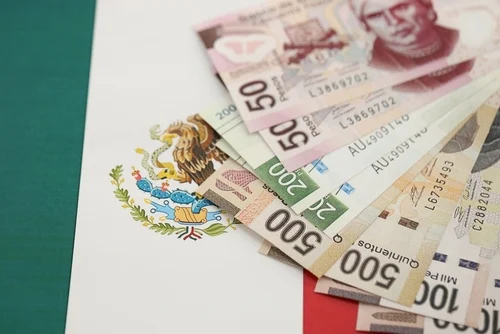
The official Mexican currency is the Mexican peso (MXN), issued by the Bank of Mexico. Pesos are divided into 100 centavos and come in banknotes ranging from 20 to 1,000 pesos, while coins run from 5 centavos up to 20 pesos. MXN is the third most-traded currency in the Americas after the US dollar and Canadian dollar, according to the Bank for International Settlements, and is frequently used in international transactions.
Whether you’re planning a trip to Cancún or Los Cabos, sending money to family in Mexico, or simply curious about the bills and coins you might come across, this Remitly guide walks you through what the peso is, what it looks like, and where it comes from, including a few little-known facts about its history.

Quick Answers
- The official Mexican currency is the Mexican peso (MXN), which is divided into 100 centavos and is issued by the Bank of Mexico.
- Coin denominations for the peso range from 5 centavos to 20 pesos, while banknotes range from 20 pesos to 1,000 pesos (but most smaller vendors don’t accept the 1,000-peso note).
- The Mexican peso is older than the US dollar and actually gave the dollar its infamous “$” sign.
What is Mexican Currency?
Mexican currency is the Mexican peso, issued by the Bank of Mexico and identified internationally by the ISO code MXN. Mexican pesos are divided into 100 centavos. Amounts are usually written with a $ or Mex$ sign, similar to other currency symbols used around the world, with ¢ for centavo values.
According to the Bank for International Settlements’ Triennial Central Bank Survey, the peso is the third most-traded currency in the Americas, behind only the US dollar and the Canadian dollar — worth knowing if you’re comparing it with CAD before a trip or a transfer.

Mexican Peso Denominations: Coins and Banknotes
The Mexican peso comes in banknotes ranging from 20 to 1,000 pesos, while coins range from 5 centavos up to 10 pesos. The Bank of Mexico issues and prints peso banknotes, while Casa de Moneda de México, the oldest mint in the Americas, mints coins under the administrative control of the Bank of Mexico.
If you’re used to Canada’s coin lineup, including the loonie and toonie, Mexico’s system will feel fairly familiar: a small set of coins for everyday change, plus banknotes for anything larger. These are the denominations of coins and banknotes currently in circulation:
MXN coins:
- 5¢
- 10¢
- 20¢
- 50¢
- Mex$1
- Mex$2
- Mex$5
- Mex$10
- Mex$20
MXN banknotes:
- Mex$20
- Mex$50
- Mex$100
- Mex$200
- Mex$500
- Mex$1,000
As of 2026, the Bank of Mexico has fully implemented polymer versions of the 20-, 50-peso, 100-peso notes. This new material is more durable and harder to counterfeit. The higher-value 200-, 500-, and 1,000-peso notes remain on traditional cotton-fibre paper and are not set to change. It is worth noting, though, that the 20-peso polymer note is gradually being phased out in favor of coinage.
Cash remains common for small purchases across Mexico but debit and credit cards are widely accepted in cities and tourist areas. It’s worth checking with your bank about foreign transaction fees before deciding between using a card in Mexico or carrying pesos in cash. Keep in mind that while the 1,000-peso note is the largest bill in circulation, it is rarely accepted by smaller shops, market stalls, and taxis. If you have a larger note, it’s better to break it at a bank or a larger store if you can.

Who and What Appears on Mexican Banknotes
Mexican peso banknotes each feature an image of a historical figure or something else significant to Mexican culture. Here’s a list of the featured figures on the front of each MXN banknote:
- $1,000: Francisco I. Madero, Hermila Galindo, and Carmen Serdán, key figures from the Mexican Revolution
- $500: Benito Juárez, Mexico’s first president of Indigenous heritage
- $200: Miguel Hidalgo and José María Morelos, leaders of Mexico’s independence movement
- $100: Sor Juana Inés de la Cruz, a celebrated 17th-century poet and scholar
- $50: Imagery honouring pre-Hispanic Mexico, including the founding of the ancient city of Tenochtitlan
- $20: artwork marking the bicentennial of Mexican independence, or Benito Juárez — but these notes are being phased out in favor of coinage
Many of the designs on the reverse sides of the notes highlight Mexico’s natural and cultural heritage, from historic archaeological sites like the Teotihuacán pyramids on the 100-peso note to native wildlife such as monarch butterflies and axolotls. These details are worth a second look the next time you’re handling pesos.

A Brief History of the Mexican Peso
The peso originated from the Spanish dollar, a silver coin worth eight Spanish reales and known as “a piece of eight.” In the late 1700s, the widely used “$” sign actually originated with the peso as a written shorthand for “Spanish peso”. After Mexico gained independence in 1821, the nation continued using the Spanish monetary system until 1823, when the first Mexican banknotes appeared.
That same Spanish silver coin is also the ancestor of the US dollar; in fact, the USD was modelled after the peso. The Coinage Act of 1792 defined the new American currency in reference to the Spanish dollar — the same coin that gave both currencies their $ sign — and Mexican pesos remained legal tender in the United States until 1857, making the peso one of the few currencies that predates the US dollar it’s often compared against today.
The Mexican peso remained relatively stable through most of the 20th century until the 1970s oil crisis severely damaged the economy, causing debt defaults and significant peso devaluation. In response, the government introduced the “nuevo” (new) peso in 1993, with one nuevo peso equaling 1,000 old pesos. Once the old currency left circulation in 1996, the “nuevo” designation was dropped.
The peso’s influence wasn’t confined to North America, either. Historical currency records show it served as a model for several other currencies that adopted a similar silver-coin standard, including the Hong Kong dollar, the Japanese yen, and the Chinese yuan — whose name literally means “round,” a reference to the shape of the silver peso coins that once circulated widely across Asia. That shared history is one more reason the peso can feel oddly familiar to Canadians moving to Mexico from Canada or visiting for the first time.

5 Facts about Mexican Currency Most People Don’t Know
There’s a lot about Mexican currency that Canadians may not know, but perhaps some of the most interesting facts are the following five.
1. “Peso” means “weight”
The word “peso” comes from the Spanish word for “weight,” tracing back to the Latin “pensum,” meaning “something weighed”. The name made sense when pesos were coins made of precious metal, often called “peso oro” (gold weight) or “peso plata” (silver weight).
2. The dollar sign comes from the peso
The familiar “$” symbol is thought to come from “PS,” an old abbreviation for Spanish pesos that gradually merged into a single symbol. Because Mexico held Spain’s largest silver supply, the original peso was a silver coin, and its symbol travelled with it into the US dollar and other currencies that still use it today.
3. Early peso banknotes were printed in New York
According to Museum of the Bank of Mexico, The American Bank Note Company of New York (ABNC) printed Mexican peso banknotes from 1925 to 1934.
4. The peso is one of the world’s most-traded currencies
According to the Bank for International Settlements’ Triennial Central Bank Survey, the Mexican peso ranks as the 14th most-traded currency in the world and the most-traded currency from Latin America. This reflects Mexico’s close trade ties with the US and Canada, and its role as a major oil exporter. MXN is also the third-most-traded emerging market currency in the world, behind only the Chinese renminbi and the Indian rupee.
In addition, 82% of all transactions involving MXN take place outside of Mexico. That kind of trading volume is one reason sending money to family in Mexico from Canada tends to be relatively straightforward compared with less commonly traded currencies.
5. Mexico’s newest banknote family finished rolling out in 2021
Rather than a single commemorative bill, Mexico’s biggest recent currency event was a full redesign: the Bank of Mexico rolled out its current “Series G” family of banknotes between 2018 and 2021, replacing the design of every denomination and introducing the country’s first polymer notes.

Frequently asked questions about Mexican currency
What is the official currency of Mexico?
The official currency of Mexico is the Mexican peso, issued by the Bank of Mexico and used for everyday transactions, from market stalls to major retailers. It’s identified internationally by the currency code MXN and is the only currency accepted for cash payments throughout the country.
What does MXN mean?
MXN is the international currency code, or ISO code, for the Mexican peso. Codes like MXN help banks, exchange services, and money transfer providers identify currencies clearly, since several countries use a peso and the code avoids confusion with, for example, the Argentine peso (ARS) or Colombian peso (COP).
What are the denominations of Mexican currency?
Mexican coins come in denominations of 5, 10, 20, and 50 centavos, as well as 1, 2, 5, 10, and 20 pesos. Banknotes range from 20 to 1,000 pesos, although the 20-peso note is being phased out in favor of the coin. The 1,000-peso note is the largest in circulation, though smaller vendors don’t always have enough change to accept it.
What symbols and abbreviations are used for the Mexican peso?
The Mexican peso is commonly written with a $ sign or as “Mex$” to distinguish it from other dollar and peso currencies. Centavo amounts use the ¢ symbol. In international finance and money transfers, you’ll most often see it abbreviated as MXN.
How does the Mexican peso compare to the US dollar?
The Mexican peso and the US dollar share a common ancestor in the Spanish silver dollar, and Mexican pesos were even legal tender in the US until 1857. Today, the two currencies float independently, and their exchange rate changes daily based on market conditions.
Who appears on Mexican banknotes?
Current Mexican banknotes feature a mix of historical figures and cultural imagery, including independence leaders Miguel Hidalgo and José María Morelos, former president Benito Juárez, poet and scholar Sor Juana Inés de la Cruz, and Mexican Revolution figures Francisco I. Madero, Hermila Galindo, and Carmen Serdán.
What are common nicknames for the peso?
Like many currencies, the peso has its own slang. In Mexico, you might hear pesos called “lucas,” “lana,” “marimba,” “morlacos,” “papiros,” or “varos” in everyday conversation. These are informal terms worth recognizing if you’re travelling or chatting with family and friends in Mexico.
Key takeaways
- The official Mexican currency is the peso (MXN), divided into 100 centavos, with coins ranging from 5 centavos to 20 pesos and banknotes ranging from 20 to 1,000 pesos — though smaller vendors don’t always accept the 1,000-peso note.
- The peso predates the US dollar, which was defined in reference to the same Spanish silver coin as the peso in 1792, and it even shaped the dollar’s own “$” symbol.
- As one of the world’s most-traded currencies, the peso is relatively straightforward to exchange, spend, or send compared with less commonly traded currencies, whether you’re at a bank counter in Canada or an exchange window in Mexico.
- Whether you’re travelling, moving to Mexico, or sending money to family there, Remitly can help you send CAD to Mexico with transparent fees and exchange rates you can check before you send. If you’re planning a trip, it also helps to check how long you can stay in Mexico as a Canadian visitor and what Mexico’s weather looks like before you go.
Last reviewed: September 2026