Key Highlights
-
A traditional Thai wedding is full of meaning and is an important part of Thai culture.
-
The wedding day usually starts by picking an auspicious date and giving merit to Buddhist monks.
-
Thai wedding traditions that stand out are the happy Khan Maak procession and the door games that everyone enjoys.
-
The white thread ceremony, called Sai Monkhon, and the water blessing ceremony, known as Rod Nam Sang, are at the heart of the wedding ceremony.
-
Family and friends all take part, which helps bring everyone closer together.
-
All these rituals help bring the married couple together and wish them good fortune as they start their new life.
Introduction
Have you ever thought about what a wedding looks like far away, on the other side of the world? In Thailand, weddings are full of bright colour, happy faces, and strong tradition. Every wedding ceremony draws from thai culture, making each part special. From daytime rituals to moments when family members offer blessings, there is deep meaning in everything. If you are from Canada, learning about these traditions can give you a great look into a wedding that is about more than love—it is also about the people around, the spirit of the day, and coming together as one.
A Canadian’s Closer Look at Wedding Traditions in Thailand
From a Canadian view, the colorful and deep thai wedding traditions show a new side of life in thai culture. A traditional thai wedding is more than just one event. It is made up of many parts that come together to make the wedding day full of joy and meaning. Every ritual in this day has something special. The goal is to bring the couple good luck, money, and being happy.
When you look at these customs, you see how the thai culture cares a lot about family, honor for older people, and getting blessed in spirit. We will talk about some of the most special things in a traditional thai wedding, like the happy parades and the gentle water blessings.
1. Choosing Auspicious Dates and Times for the Ceremony
In Thai customs, the timing of the wedding ceremony is very important. People do not just pick any weekend that works for everyone. Couples often talk with their families, Buddhist monks, and even an astrologer. They all help pick the most auspicious date and time to get married.
This first step matters a lot. It sets up the whole wedding later on. Many believe that if you get married on a day with good signs, your marriage will be blessed from the start. This shows how closely spirituality and daily life are linked in Thailand.
Choosing this auspicious date is one of the first things to do for the religious ceremony. It helps to make sure the couple begins their married life with the best luck possible.
2. The Khan Maak Procession: A Joyful Start
The wedding day often starts with the Khan Maak procession. This is a bright and happy parade. The groom leads the way with his family members and friends. They walk together to the bride’s home. In the parade, they carry symbolic gifts for the bride’s family. It is a sign of respect and marks the start of the event.
This parade is full of colour, sound, and fun. Musicians who play drums walk with the group. Dancers dress in bright outfits and dance along. The groom and his group dance as they go up to the bride’s house. It is a lovely and warm start to the wedding day.
In the past, the Khan Maak procession was a formal agreement between families. Now, it is mostly a fun and symbolic part of the day. Many people use the Khan Maak procession to bring two families or cultures together, such as in Western-Thai weddings. It adds joy and excitement to the wedding day.
3. Door Games: Playful Challenges for the Groom
When the groom’s group gets to the wedding, he can’t see his bride right away. At first, he needs to join the ‘Sanuk’ or door games. These are a set of fun acts made by the bride’s friends and her female family. They stand as gatekeepers in in a traditional thai wedding.
As the groom walks closer, the bride’s friends block his way with “gates.” These can be a ribbon or chain. To go through each gate, he may be told to sing, answer questions about the bride, or pay a small amount of money. The door games are made to be fun, and bring some laughter to the wedding day.
Door games are a big moment for all wedding guests at a traditional thai wedding. It is a sweet way for the groom to show his love and want to be with his bride. It helps all people to feel happy and join in the joy in a thai wedding.
4. Traditional Thai Engagement (Phiti Mongkhon)
After the groom goes through the door games, he is invited in for the official engagement ceremony. This part of the traditional Thai wedding is more personal and often has just the parents and older relatives. It is called Phiti Mongkhon. Here, the groom asks for the bride’s hand by offering gifts to her family.
At this event, the couple exchanges engagement rings. The dowry, or ‘sin sod,’ is also given now. These gifts stand for good luck and show that the groom can take care of the bride. The ceremony is important, and it brings the two families together for real.
This engagement ceremony is a big step before all the main wedding rituals start. It brings both families closer to each other and helps start the married couple’s new life. The tradition also brings them lots of support and good wishes from their family and friends.
Keywords: thai wedding, traditional thai, traditional thai wedding, married couple, engagement ceremony, symbols of prosperity, door games
5. Buddhist Blessings and Monastic Rituals
A big part of a Thai wedding is making merit. This happens through Buddhist blessings. On the morning of the wedding day, the couple invites some Buddhist monks to their home. This is to do an important religious ceremony. The number of monks is always odd, with nine being the most common. Nine is a lucky number in Thai culture. People believe this number will give the best blessing.
The couple gives food to the monks. After that, the monks say prayers in Sanskritic, and they bless the couple. They hope the couple will have a happy, healthy life. They also hope the marriage will bring good fortune. The senior monk then uses holy water to bless the couple. This is a very special moment during the morning of the wedding day.
People respect this ritual a lot. Many say it is needed to bring good fortune to the wedding. When the monks are done with their blessings, they go back to the temple. Then, the rest of the wedding day can start. Now, the marriage is spiritually ready.
6. Sai Monkhon: The Sacred Head String Ceremony
After the engagement, people take part in the Sai Monkhon ceremony. In this moment, there is a white thread ritual that links the bride and groom. An elder or someone who is respected will put a special headpiece made with one loop of white thread on both the bride and groom. This joins them together as one.
The white thread, called ‘sai monkhon,’ stands for their union and the coming together of their lives. They sit next to each other, and with the white thread connecting their heads, they start a new journey as one. They also hold their hands together like in a prayer.
This simple white thread ritual is a strong way to show their unity and that they will face life together. It is a wish for them to get good fortune, health, and happiness, as the ritual ties the couple in spirit for the next step of the ceremony.
7. Rod Nam Sang: The Water Pouring Blessing
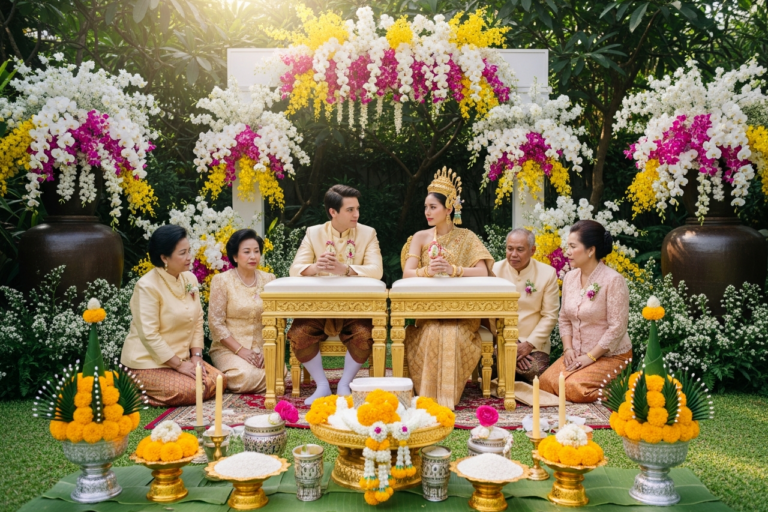
The Rod Nam Sang, also called the water pouring ceremony, is often the biggest part of a thai wedding. It might be the most important event in the whole day. At this moment, the couple stay connected by the Sai Monkhon thread. They sit side-by-side and keep their hands together over some nice floral arrangements.
Guests line up and get ready to give the water blessing. Each guest holds a conch shell. It is filled with blessed water. They gently pour the water over the couple’s hands. While they pour, they share their good wishes and advice. They hope the couple will have a good life together. For family and friends, this is a special way to join in and show the couple their love and care.
Water has a big meaning in thai culture. It stands for blessing and for making things pure. The water pouring part is not just about show. It means a lot. It is how the whole group tells the couple they support them. It is a way for everyone to wish them smooth days and a good start for their new future.
8. Gifting and Dowry Customs (Sin Sod)
The idea of ‘sin sod,’ which is often called the dowry, plays a big part in Thai weddings. In this custom, the groom gives monetary gifts and sometimes other valuable things to the bride’s family. This is not a payment for the bride. It’s more of a gesture to say thank you and to show respect for what the bride’s parents did to bring her up.
Sin sod shows the groom has enough money and that he is able to look after his new wife. Both families usually talk about and agree on the dowry before the wedding. This is a way to honour the bride’s family and to show that the groom is ready for what comes in marriage.
In many modern Thai weddings, the bride’s parents often give the monetary gifts back to the couple. This helps them as they begin their new life. Now, this tradition is more about honouring the past and helping the couple start out together.
9. Involving Family and Community in Thai Weddings
Unlike some Western weddings that focus mostly on the couple, Thai weddings bring everyone together. Family members and people from the community take an active role. The wedding guests be part of the celebration, not just watch. This is an important part of traditional weddings and Thai culture.
Right from the start, families take part in big decisions. You can see the involvement of all wedding guests through the whole day. This makes it clear that a marriage in Thai culture is more than just two people coming together. It is the joining of two families and their communities. This be different than what you see in other cultures.
Here are a few ways family and community are involved:
-
Elders lead key ceremonies like the Sai Monkhon.
-
The bride’s friends give and run the fun door games.
-
All guests take part in the Rod Nam Sang water blessing.
-
There is a ritual where people give gifts to elders as a sign of respect.
Conclusion
To sum up, looking at wedding traditions in Thailand shows that there are many unique customs. These customs, like the water pouring blessing and the head string ceremony, are full of meaning. They are done at special times and show what people in Thailand believe about life and love. Learning about all of this can help a Canadian see love and weddings in a new way. It can also help bring people closer by showing how different groups celebrate big moments in life. If you want to learn more about the water pouring tradition or other Thai customs, you can get in touch for a one-on-one meeting to find out more about Thai weddings.
Frequently Asked Questions
What are the most important rituals in a traditional Thai wedding?
In a traditional Thai wedding, there are a few key rituals. The first is making merit with Buddhist monks. Then, there is the Sai Monkhon ceremony. In this, a white thread joins the couple. After that comes the Rod Nam Sang, which is the water pouring blessing. These parts are the heart of the wedding ceremony. They show unity and bring good fortune to the couple.
The wedding ceremony in a traditional Thai way brings everyone together to wish the new couple a good start. Thai wedding customs, like using the white thread and the water pouring, make the day special.
How do modern Thai weddings differ from traditional ones?
Modern Thai weddings mix old customs and Western ideas. Many couples still have the important rituals, but they may put the whole thai wedding into a single day. A modern thai wedding can end with a Western-style party for the wedding guests, with a wedding cake and some dancing after the Thai ceremonies are done.
What symbolic meanings are behind key Thai wedding traditions?
Many key traditions carry a lot of meaning. The white thread is a sign of unity between people. The water blessing stands for both good wishes and making things pure, usually given by loved ones. The dowry, called sin sod, is a way to say thank you and to show the groom can take care of his family. All of these parts are there to help bring good fortune.