Key Highlights
-
A Korean wedding is a mix of the old and the new. People join modern ways with old traditions, which makes the wedding ceremony special.
-
Family members have a big part in the event. They help match the couple and take part in key moments like the pyebaek ceremony.
-
The hanbok, which is the traditional outfit, has a lot of symbolism. Its colours have meaning and can show the wearer’s role and the good wishes people have for the couple.
-
One big Korean wedding tradition is when the two families swap gifts that have meaning.
-
Many modern Korean weddings happen at fancy wedding halls, and there is a big buffet for every guest.
-
The pyebaek ceremony comes after the wedding. It is time for the couple to show their respect to the groom’s family.
Introduction
Are you wondering how people celebrate love in other parts of the world? In South Korea, weddings blend old ways with new ideas. The wedding ceremony is full of colour, and it comes from both history and korean culture. At a korean wedding, you will see beautiful clothes and special steps that hold meaning for the couple and families. Each part of the ceremony shows a piece of the country’s story. This guide will show you the traditions and special moments that make a korean wedding standout in korea. You will get to see how people join to honour love, family, and where they come from.
An Overview of Korean Wedding Traditions
A Korean wedding is a wonderful event. It brings together old traditions and a bit of new style. At the wedding, you may see a bride in a white dress. But you will also see the couple follow special customs from Korean culture. These customs show how much the couple and their families value their history.
Today’s modern ceremonies use both Western ideas and important Korean wedding traditions. Families meet each other in a formal way during the wedding. The couple often gives each other certain gifts. After the main event, there is sometimes a ritual called pyebaek. All these parts of the day help the couple honour their background in Korean culture.
Influences of History and Culture on Modern Weddings
A traditional Korean wedding used to be a big event for the whole community. The way the family was seen, or their social status, was easy to spot during these times. These weddings took a long time and used many special Korean traditions. Each part had its own meaning. It was not only about the couple but also about the joining of the two families.
Now, these traditions and Korean weddings have changed over the years. While important ideas like respect and the coming together of people in families still matter, modern Korean weddings fit today’s fast-paced life. Western ways, like the white wedding dress and a quicker wedding, are also common now.
Even with these new ways, people still hold on to the feeling of the old days. Many couples pick some old traditions to use in their weddings. A popular choice is to wear hanbok for part of the day or include the pyebaek ceremony. This lets them bring together both old and new parts of a korean wedding.
Comparing Western and South Korean Wedding Customs
When you go to a Korean wedding, you will see the wedding ceremony is not like a Western one. One thing people notice is the place and how long the main ceremony lasts. Most modern Korean weddings are held in big wedding halls. These wedding halls are made just for weddings like this.
Western weddings can run all day and even into the night, but in Korea, the main ceremony is short. It usually takes only 20-30 minutes. After that, the couple and all the guests move to a buffet hall. The buffet hall part is more relaxed and easy-going.
Here are some big differences in a modern Korean wedding:
-
Ceremony Length: The wedding ceremony is fast. Most finish in less than thirty minutes. Everyone then takes group photos.
-
Attire Changes: The bride often starts the main ceremony in a white wedding gown. After that, she may change into a hanbok for the meal or pyebaek.
-
Venue: You will not find many weddings at churches or outside. Wedding halls are normal in Korea. These halls can hold a few weddings on the same day.
Pre-Wedding Traditions and Preparations in South Korea
Before the wedding day, there are many things to get ready for. These pre-wedding activities are a big part of Korean culture. The purpose is to make sure the wedding is not only about two people coming together for love, but also about both families joining in a good way.
People take care with each step. From formal matchmaking to choosing the best day for the wedding, every choice is made with care. All these plans help to build a strong and happy marriage. Each part respects both old ideas and new ways of thinking. Now, let’s look at some main steps that happen before a wedding in korean culture.
Matchmaking, Proposals, and Family Involvement
Family is very important in a Korean wedding. In fact, the families get involved even before the proposal happens. Today, most people marry for love, but the tradition called sang-gyeon-rye is still a big part of a korean wedding. This is when both families meet for the first time. At this meeting, both the groom’s family and the bride’s family talk about the marriage.
This gathering is not just a simple meal together. It is a formal time, as it is about the families saying yes to the relationship. Both sides discuss the future. From here, the wedding preparations start. In the korean wedding tradition, families must agree before things can really move ahead.
After this meeting, family members, and especially mothers, are a big part of every planning step. They help set the budget and pick the place for the wedding. For a korean wedding, it is a team job because people see marriage as families coming together, not just two people.
Exchanging Betrothal Gifts (Yedan)
A big part of Korean traditions before a wedding is when the families exchange betrothal gifts called yedan. In the past, the groom’s family sent fabric so the bride could make new clothes for her in-laws. Now, the groom’s family gives money to the bride’s family for them to get gifts.
The bride’s family uses this money to buy gifts for the groom’s family. These gifts often mean respect and thankfulness between the two families. The bride’s family may also send some money back to the groom’s family to show modesty.
Common yedan gifts include:
-
Sets of silver cutlery and bowls for the parents-in-law.
-
High-quality bedding, which means comfort and a good life.
-
Cash, because it is useful and many people like it.
These steps are important in korean traditions and are part of what the groom’s family needs to do.
Selecting Auspicious Wedding Dates and Locations
Choosing the right wedding date in Korea is more than just a matter of convenience; it is a process steeped in tradition. Many couples consult with a fortune teller or a monk who uses the couple’s birth dates and times to determine the most auspicious date for their wedding ceremony. This is believed to ensure a long and happy marriage.
Once the date is set, the search for a location begins. The most popular choice for modern Korean weddings is a dedicated wedding hall. These venues are an all-in-one solution, offering a decorated ceremony space, a private room for the bride (sinbu daegisil), and a large buffet hall for the reception.
The efficiency of these wedding halls is a major draw, as they allow for a structured and timely celebration. Wedding halls often offer packages that simplify the planning process.
|
Feature |
Description |
|---|---|
|
Ceremony Hall |
A lavishly decorated space, often with a runway-style aisle. |
|
Bride’s Room |
A private, beautifully decorated room for the bride to greet guests before the ceremony. |
|
Buffet Hall |
A large dining area, often shared with other weddings, offering a vast array of Korean and international food. |
|
Pyebaek Room |
A separate room decorated for the traditional pyebaek ceremony. |
Traditional Korean Wedding Attire and Symbolism
The traditional Korean wedding attire is more than lovely clothes. It is full of symbols and deeper meaning. The main piece is the hanbok, which is the usual dress for Korea. Every part of it, like the colours and the stitched patterns, sends a message. These messages are for good fortune, long life, and happiness for the bride and groom.
This korean wedding outfit is not just for the bride or groom. Family members wear it too, and the style of their outfits shows their place in the ceremony. Now, let’s get a closer look at these korean wedding clothes. There is a lot of skill in them and each small part has a meaning. These beautiful traditional korean wedding outfits show both history and hope for a good future.
The Hanbok: Colours, Styles, and Hidden Meanings
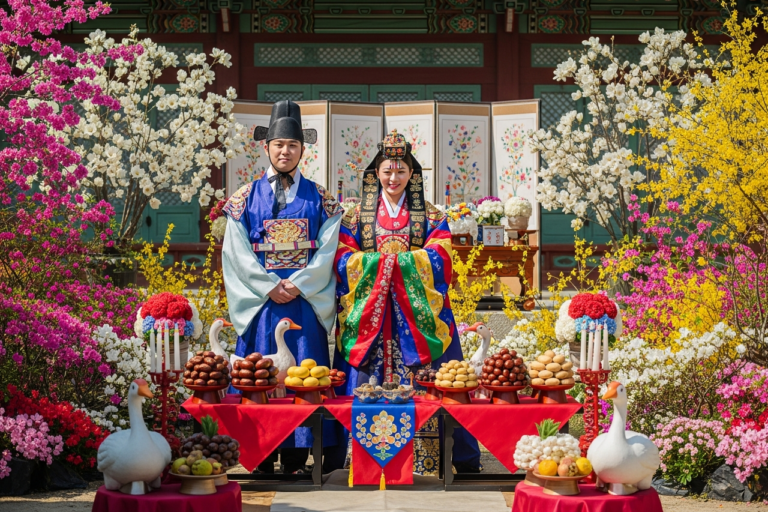
The wedding hanbok is bright and full of meaning. The bride often wears a red or pink skirt, called a chima, with a green or yellow top jacket, known as a jeogori. The red stands for passion and good fortune. Green is about new starts and hopes for a good future. Bright colors play a big part in this look. They show the joy that comes with such a big day.
The groom’s outfit is special, too. He will often go for a blue hanbok. Blue stands for honesty and being steady. The full set includes a hat, called a samo, and boots, which make the groom look proud and proper. The symbolism in these colors shows what the couple will be in their new life together. It also shows what the people around them wish for the pair.
The patterns and stitch work on hanbok hold their own messages. Peonies are often there to wish for wealth and honor in the couple’s life. Lotus flowers say the couple should be pure and have good hearts. Every stitch and color in hanbok, whether on the bride or groom, is linked to hope that they will have a happy life that is full and bright.
Accessories in Korean Wedding Dress
Accessories play an important part in finishing the traditional Korean wedding attire. They add meaning and beauty to the look for both the bride and the groom. On the wedding day, the bride has her hair put up in a nice style. The hair is decorated with a special hairpin called a binyeo and a headdress known as a jokduri or hwagwan. The bride also has red dots, called yeonji gonji, put on her face to help keep away evil spirits.
The groom does not wear as many accessories, but what he wears matters a lot for the traditional Korean wedding. He puts on a black hat and a belt. These show that he is respected and has a high place in society. Together, the bride and the groom both wear carefully chosen pieces of Korean wedding attire that mean a lot on this special day.
For both, some key accessories and the things they stand for are:
-
Jokduri: This is a small headdress that looks a bit like a crown. The bride wears it on the wedding day to show how important she is.
-
Norigae: This is a pretty pendant that gets tied onto the bride’s hanbok. It is often kept in the family and shared through many years. It stands for good luck.
-
Gourd: The bride and groom both use two halves of a gourd to drink wine together. This part of the Korean wedding ceremony stands for the
Significance of Wedding Attire for Family Members
At a Korean wedding, the mother of the bride and the mother of the groom have a dress code that is just for them. The mother of the bride usually wears a hanbok in a warm colour like pink or purple. The mother of the groom wears a hanbok in a cool colour, such as blue or green. This choice of colour is important. It shows the balance of yin and yang. It is a way to show that both families can live in harmony.
This rule of korean wedding attire is not always said out loud, but it helps people know who is who. The mothers’ hanbok are often elegant and made just for them. It shows they are important in this korean wedding. As they stand at the front of the ceremony, the mothers welcome family members and guests. This simple act shows the value of family.
Many close family members also wear hanbok. Their clothes make the day feel even more festive and special. When everyone joins in wearing korean wedding attire, it shows how much the ceremony values family. It reminds people of strong family bonds and how everyone has a part in making the day special.
The Traditional Korean Wedding Ceremony
The traditional Korean wedding ceremony is beautiful and quiet. It is full of history and meaning. Unlike the fast and busy wedding hall events today, this ceremony takes more time. It feels more close and personal. The focus is on old wedding rituals that show the couple’s promise to stay together for life.
In the main ceremony, every action, like bowing and sharing wine, has a special meaning. These wedding rituals are a way to honour the parents and ancestors of the couple. They also celebrate the start of their life together. Let’s see what the important moments are in this traditional Korean wedding ceremony with deep symbolism.
Procession, Bowing Rituals, and Family Introductions
The main ceremony in a traditional Korean wedding starts with a procession. At this point, the groom is usually the first to enter. He may even come in carried in a palanquin, and he stands and waits for his bride at the wedding table. After him, the bride comes in. Most times, she keeps her face hidden with her long sleeves. Attendants help her as she walks in.
A big part of the traditional korean wedding ceremony is the bowing ritual. Here, the bride and groom bow to each other. This shows the promise of respect and commitment they give as a couple. They also do deep bows to both sets of parents. This is to show thanks and honour the familial relationship that brought them to this day.
The main ceremony of korean wedding ceremonies includes:
-
The Procession: This is a formal entry that sets up a serious mood for the wedding.
-
Gyobaerye: In this step, the bride and groom bow as they greet each other as a couple for the first time.
-
Family Introductions: The wedding ceremony also joins two families. Both families do formal bows and introductions which play a big part in this union.
The Symbolism of Wild Geese in Jeonan-rye
One of the most special parts of a Korean wedding tradition is called Jeonan-rye. This is when the groom gives a wild goose to his future mother-in-law. In the past, he would bring her a real, live goose. Wild geese are picked for this moment because people believe that they stay together for life. So, the goose stands for the groom’s promise to love and be true to his bride forever.
This act was his way to show strong commitment and loyalty. It meant that he would always take care of her daughter, like a wild goose that never leaves its mate. The wild goose also means that there will be peace in the new couple’s life, and it shows hopes for a lucky future.
These days, bringing a live goose isn’t possible. Now, couples present a wooden goose instead. The wooden goose is called kireogi. It still stands for the same ideas as the live goose. The couple keeps this wooden goose from their korean wedding to remind them about what they promised each other—to stay faithful and keep their marriage strong always.
Koreans’ Unique Wedding Wine and Hap-geun-rye Moment
A very important part of a Korean wedding is the Hap-geun-rye, where the bride and groom share wedding wine. In this ritual, they drink a special wine called jeongjong. They use two halves of a gourd for this. The gourd started as one piece but was split into two. This shows that the bride and the groom were once still separate people.
When the bride and groom drink from each half and then join them together, it shows they are now one. The act means they will not be apart again. It’s full of symbolism about the groom and bride starting to share their life, their future, and everything else. You see how two separate lives start coming together.
This ritual, though simple, is meant to bring good fortune for the couple. It speaks of the hope for a happy and smooth future. The shared drink is also a way for the bride and groom to promise they will be there for each other. It marks the true start of their life together at the korean wedding.
Reception Traditions and Post-Ceremony Customs
After the main ceremony of a Korean wedding ends, the party is not done yet. At the reception, guests eat and say congrats to the couple. But this is also a time for some important customs after the wedding. These new rituals are just as important as the wedding itself.
One of the biggest parts of this is the pyebaek ceremony. This old tradition is only for close family. This part of the day and the big meal at the reception brings happy times and a lot of respect for family and the ways of the old days. Now, we will look at these bright and busy post-wedding events.
The Pyebaek Ritual with Parents-in-law
The pyebaek is a special post-wedding event where the newlyweds show respect to the groom’s parents and other family members. The couple wears bright and fancy hanboks for this. They bow deeply to the parents-in-law, who sit behind a low table that has many foods with special meaning.
In the pyebaek, the parents-in-law talk to the couple and offer advice and good wishes for their new life. There is also a fun part where the parents toss dates and chestnuts into a big cloth that the newlyweds hold together. The number of chestnuts and dates the couple gets stands for the number of children they may have. Dates stand for sons, and chestnuts stand for daughters.
This close gathering is a warm tradition where the bride is officially welcomed into the groom’s family. It helps show that family members and good family bonds are important. It is a meaningful way to finish the wedding day.
Korean Wedding Feasts: Food, Drinks, and Specialties
Food is very important at a Korean wedding. It stands for good luck and shows a warm welcome to all guests. At many modern Korean weddings, people have a big buffet in a buffet hall. These buffets are well known for having lots of food that is way more than you would see at most weddings.
You will see many kinds of dishes at these Korean wedding buffet halls. There is fresh seafood, sushi, and different types of kimchi. People also get grilled meats and many Korean snacks. There is so much food, and this is how the hosts show they want everyone to eat well and be happy.
At most buffets for a korean wedding, you will see some well-loved dishes. Some of the favourites are:
-
Galbi-jjim: These are short ribs that are cooked soft in a tasty sauce.
-
Japchae: Glass noodles cooked with lots of veggies in a stir-fry.
-
Noodle Soup (Janchi Guksu): A noodle soup that feels simple and nice. The long noodles are a wish for the couple to have a long and happy life.
Every guest at the buffet hall gets to enjoy good food and many snacks. It’s a happy time with lots to eat for all.
Music, Dance, and Modern Festivities
Modern Korean weddings mix old customs with new fun in a simple way. The main ceremony is often short and a bit formal, but the reception is warm and lively. The main ceremony lasts about 20 to 30 minutes. During this time, it is common for friends to sing a song for the couple, and sometimes the groom will even sing for his new wife.
In a korean wedding, you will not see much dancing, like at Western weddings. There is no dance floor that keeps going through the night. Instead, the welcome is all about eating good food and talking with other people. It is more like a big dinner for everyone than a dance party.
Still, some couples add Western ideas to their wedding day now. People may have a cocktail hour or invite close friends to a small after-party. As more modern ceremonies happen, couples use these chances to make their special day both modern and true to their Korean roots. This way, their wedding is one that is both meaningful and just right for them.
Etiquette and Expectations for Wedding Guests
Going to a Korean wedding as a guest is a great time, but you should know the local manners. In Korea, people do not usually get gifts from a list. The main thing to give is cash. People also follow a few rules for what to wear at the wedding.
If you want to be a good guest at a korean wedding, it is good to learn about these simple things. That way, you will feel at ease and it will show the couple and their families that you care. When you know these customs, you can have a better time at the party and not make mistakes. Here are a few important things you need to keep in mind.
Appropriate Dress and Gift-Giving Customs
When you go to a korean wedding, you should dress well, but not too formal. Men often wear suits. Women usually wear nice dresses or even a top with a skirt or pants. There is one big rule: don’t wear white. Only the bride gets to wear white. You should also not wear clothes that look too casual.
Gift-giving is simple because of the korean wedding tradition: give cash. This cash gift, called chug-ui-geum, goes in a clean, white envelope that has your name on it. When you get there, you give the envelope at a table near the entrance and sign a book. The amount of money you give can go up if you are closer to the couple.
Here a few tips for giving a gift:
-
Use a proper envelope: You can buy special wedding envelopes at a stationery shop, but a clean white one will be fine.
-
Give crisp, new bills: It is a way to show respect if the money is new and clean.
-
Amount: The amount often ends in numbers like three, five, or seven. Many people feel these are lucky numbers. For a friend or someone from work, fifty thousand KRW is a good place to start.
Participation in Ceremony and Celebrations
Taking part in Korean wedding ceremonies is easy. Be sure to arrive on time and sit on the side for the person who asked you—either the bride’s side or the groom’s side. When the main ceremony starts, stay quiet and pay attention.
After the main ceremony, there will be group photos. First, the couple will stand with their parents for pictures. Next, the larger family joins in. At the end, all the friends of the bride and groom will be called up for one big photo. The group picture is an important part of your time at the korean wedding, so be ready!
When the photos are done, everyone goes to the buffet hall. You can eat, talk, and enjoy yourself at your own speed. The newlyweds might change clothes and walk around the buffet hall, meeting guests and saying hello. This is a nice moment for you to give your good wishes to them. Once you finish your meal, you can head out—there is no need to stay longer, and no set rules for when to leave.
Conclusion
In short, South Korean weddings bring together a lot of history, family, and culture. This is what makes each korean wedding special. There are bright colors and many detailed patterns in the hanbok people wear. Meaningful steps like the pyebaek show deep family roots and strong ties between people. If you learn more about these korean wedding traditions, you will get a better idea of what they mean. You will also show respect to the people and the culture. It does not matter if you are planning your own day or going to a korean wedding as a guest. Take your time to see and enjoy all these customs for what they are. If you need help or want to know more, you can reach out for a free talk!
Frequently Asked Questions
What makes South Korean wedding rituals unique compared to other cultures?
South Korean wedding rituals stand out because they mix old traditions with new ones. At a Korean wedding, you often see a quick, modern wedding ceremony held in a wedding hall. Then, there is the traditional pyebaek ceremony. Korean traditions have deep symbolism, and one example is using wild geese in the wedding rituals. These geese show fidelity. This is one thing that makes Korean weddings different from others.
How important is family involvement in a Korean wedding?
In a Korean wedding, family members play a big role. The first meeting between families, called sang-gyeon-rye, is very important. At the pyebaek ceremony, the couple shows respect to the groom’s family. These traditions are all about bringing the two families together. Mothers and the rest of the family are often the main people who make decisions during the wedding.
What gifts are expected when attending a Korean wedding?
The usual gift at a Korean wedding is cash. For wedding etiquette, people give cash gifts to the couple in a white envelope. The exact amount you give depends on how close you are to them. This is a wedding tradition in Korea that helps the newlyweds and shows your support.