Key Highlights
-
Japanese weddings mix old Shinto customs and new Western wedding ideas.
-
A traditional Japanese wedding, or Shinto wedding, has steps like cleaning rituals and sharing sake.
-
Family members take part in many ways. They may join the ceremony and make formal greetings.
-
Japanese couples often wear more than one outfit on the big day. They start with kimonos and later switch to Western gowns and suits.
-
The san-san-kudo ceremony, where sake is shared, is a main event that joins the couple and their families together.
-
It is important at Japanese weddings to give money gifts in fancy envelopes. This is a common and special part of the day.
Introduction
Have you ever thought about what a wedding in Japan would be like? If you are from Canada, seeing how another country handles wedding traditions can be very interesting. Japanese culture has a lot of history and meaning, and you can see this in their wedding ceremonies. Japanese weddings bring together old rituals and new styles. These moments give us a look into what is important in Japanese society. Let’s take some time to get to know the special and detailed world of these celebrations.
Historical Evolution of Japanese Wedding Traditions
The story of Japanese wedding traditions has changed a lot over time. In the beginning, these weddings were just simple family gatherings. There was not much religious ceremony then. As years went by, and during times like the Edo period and the Meiji era, these wedding traditions started to change.
Shinto practices became a bigger part of weddings, first among rich people, and later among more people in Japan. Family members have always played an important role in weddings. The way weddings are done and the rituals they follow have changed with time. Let’s look at how these wedding traditions came to be.
Early Customs and Influence of Shinto Beliefs
Japanese weddings started as simple family events. Most of the time, they took place at home. The religious part was not always a big thing in these early days. But then Shinto beliefs, which focus on purity and the respect for spirits (kami), started to enter these wedding ceremonies. The first written record of a wedding in a Shinto guide showed up in the late 1800s. This was a big change for japanese weddings.
At first, these religious wedding ceremonies were held for the families of a shinto priest. The steps in these wedding ceremonies were meant to clean the couple and ask the kami to bless their life together. These parts of the wedding would happen at shinto shrines. It was a new spiritual part that was not there when people got married at home.
With time, these kinds of wedding ceremonies opened up to more families. The idea spread that a wedding should not just join families but should also be a spiritual event. Now, this is the ground for many of the japanese weddings we see, with many people knowing these wedding ceremonies today.
Transformation During the Edo and Meiji Periods
During the Edo period, the rokuyo calendar system became well-liked by Japanese people. People used it to pick good days for events, like weddings. This shows how much cultural beliefs mattered in wedding planning back then. Even in those times, family bonds were very important. Marriage was about joining two families together.
The Meiji Restoration brought a lot of change to law and social life. The Civil Code, made during this time, gave a legal meaning to marriage. It also said that people needed to hand in a marriage certificate. Later, in this period, there was the first modern Shinto wedding. This happened when Prince Yoshihito got married in 1900.
This royal wedding started something new. After that, many of the elite began to have Shinto wedding ceremonies. This change showed a different way of looking at marriage—as more of a partnership. It mixed old values with a new and public way to show commitment.
Post-War Trends and Modern Changes
After World War II, Japanese weddings changed a lot. People moved into cities and started living in smaller places. Because of this, it was hard to have big family parties at home. Many couples then began to get married at public spots like hotels and special wedding halls. A wedding planner would often help with these events.
In recent years, modern Japanese weddings often take place in chapels. Many people now like this Western style, sometimes more than a traditional Shinto ceremony. Many couples choose to mix things up. They might have a Shinto ceremony for close family and a big Western-style party for friends.
This way, couples can keep their family customs while also enjoying new ideas from around the world. They can choose what fits them best and make their Japanese weddings feel special and just right for who they are.
Types of Japanese Wedding Ceremonies
Japanese couples have a lot of choices when it comes to wedding ceremonies. Many people think that the Shinto wedding is the most well-known. But, it is not the only way to get married. There are now many Japanese couples who want their weddings to match their own style and beliefs.
Wedding traditions can take place in many places. Some have sacred rituals at old shrines. Others have their services in new chapels. These different wedding ceremonies help us see how Japanese couples celebrate their special day in ways that mean a lot to them. Each couple can make it their own and do what feels right for them.
Shinto Weddings: Rituals at Shrines
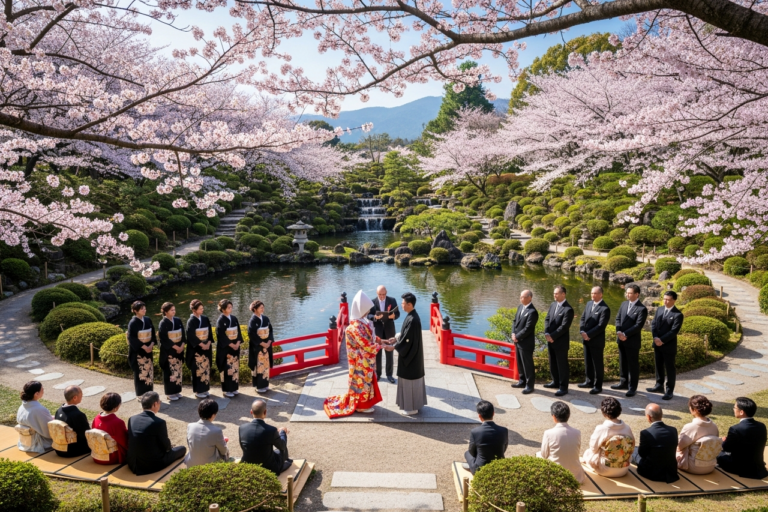
The Shinto wedding, also called “Shinzen kekkon,” is a ceremony held at Shinto shrines. This shinto ceremony is full of tradition. The shinto priest leads a ritual purification that is meant to bless the couple. Usually, this event is small, with just close family there. The shinto priest starts the ceremony by cleaning the shrine in a special way and asking the kami, which are kind spirits, to give their blessing.
One of the most important parts of a shinto wedding is the “san-san-kudo”. The bride and groom each take turns drinking sake from three cups of different sizes. They do this to show they will be together, share good times, and help each other when times get hard. After drinking the sake, the couple goes to the altar to exchange vows and rings.
The shinto wedding ends with the priest placing special evergreen branches on the altar. The couple does the same after him. Then, the family representatives take their turn. This simple but beautiful moment is a way to thank the kami for being with the couple as they start their life together.
Christian-Style Chapel Ceremonies
Christian-style wedding ceremonies are now a very popular option in Japan. It does not matter what the couple’s faith is. These wedding ceremonies mostly happen in pretty chapels. Many of these chapels are built inside hotels or are made just for weddings. Couples pick this style when they want the romance and look of western weddings.
The ceremony has some things people in North America know well. The bride walks down the aisle, also called the “virgin road.” The couple will say their vows, put rings on, and sometimes there are bible readings, too. But the person leading the ceremony is not always a minister. Usually, it is a person hired for this job.
This shows how much people like western weddings and western culture. It is very different from the quiet way of a Shinto service. For a lot of people, a western-style wedding is about making a day that feels both modern and romantic. They want a beautiful moment that everyone will remember.
Civil and Non-Religious Ceremonies
A civil wedding is an important step for marriage in Japan. It is the legal foundation, not just a religious ceremony. The legal process starts when a couple hands in their marriage registration form, which is called “konin todoke,” at a local government office. The couple can do this before or after the main wedding event. This is the step that makes the marriage official in the eyes of the law.
In recent years, there has been a creative change in the way couples go through this. Along with the regular forms, couples can now pick from many beautifully designed marriage registration form certificates. The market now has options that are pleasing to look at. Some couples choose regional marriage certificates. These show local patterns or symbols, and can make people think of where the couple comes from. This can be a way for the two people to show off their hometown, style, and personal preferences.
Making the marriage process personal is now a big part of people’s wedding story. Even when filling out paperwork, people in Japan enjoy having a marriage registration form that gives them a chance to share something about who they are and where they come from. Using regional marriage certificates or picking a special design lets their story become part of the wedding experience.
Essential Rituals and Symbolic Practices
The Japanese wedding ceremony is known for its beautiful customs. There are many traditions in this event. These rituals are not just regular actions. They show the couple’s love, unity, and hope for a happy future. The sharing of sake and the exchange of vows are some examples. Each step in the ceremony means a lot.
These wedding customs are a good way to see what is important in Japanese culture. Looking at these rituals can help us understand the deeper meaning of each part of the celebration. Let’s explore some of the most important of these symbolic acts in a japanese wedding ceremony.
San-san-kudo: The Sake Sharing Ceremony
In a traditional Shinto wedding, one key moment is the san-san-kudo. This means “three, three, nine times.” In this part of the ceremony, the bride and groom share cups of sake. There are three cups, each one a bit bigger than the last. The couple takes three sips from each cup.
This ritual has deep meaning. The first set of three sips is for the bride and groom. The next set is for their families. The last set stands for their new life together and for the blessings that come from the kami. When they drink the cups of sake, it shows that they are now joined and will go through life’s highs and lows together. It also shows their eternal love.
This portion of the ceremony is a wish for good fortune and a strong, happy marriage. It is one of the most special moments in a Shinto wedding. It shows deep respect for tradition and family.
Exchanging Vows and Sacred Offerings
After the sake ceremony, the couple goes on to share their vows. The groom often says his vows out loud, showing everyone his promise to his new wife. She stands and listens. This part of the ceremony means they are making a real promise of eternal love. It also marks the start of their new life together. Sometimes, to honour old ways, they add a thank you for the matchmaker, or “nakodo,” if one was part of things.
Next comes the exchange of rings. This is a big part now, though it first came from Western traditions. You will find it in most Japanese ceremonies, even Shinto ones. The ring’s circle shows that their love and promise have no end.
The ceremony often finishes with the couple placing gifts at the altar. They both offer a small branch of a special green tree called tamagushi, giving it to the kami. They do this to say thank you and to show respect, hoping for the kami to bring good things for their marriage as they move into this new life.
Gifts and Monetary Customs for Couples
Gift-giving at Japanese weddings follows its own rules. Instead of using a gift registry, people at these events usually give money. This is called a “goshugi” monetary gift. The cash should be in a nice decorative envelope, which is known as a “shugi-bukuro.” How much you give depends on if you are close to the couple. Family members and close friends will give more money.
The way you give the money is important, too. It is best to use crisp, new bills. Try to give amounts that are odd numbers. Even numbers can be split, and people think that can be unlucky. Giving a monetary gift like this means you wish the couple good fortune as they start their new life together.
A few important things to remember about goshugi:
-
Place the money inside a special decorative envelope.
-
The amount you give should show your relationship with the couple.
-
Usually give an odd number, such as ¥30,000 or ¥50,000.
-
Use new bills to show you thought about your gift and want to show respect.
The Role of Family in Japanese Weddings
In Japanese wedding traditions, the family members do more than just attend. They play a big part in the whole event. The ceremony is not just about japanese couples. It is about the joining of their families, too. You can see strong family bonds in every step of the process, from the start of planning to the big day itself.
Family members take on many roles, showing how much these ties mean. In many wedding traditions, families help each other and share happy moments. Japanese wedding traditions give a clear sense of unity and joy. Now, let’s look at how families get involved.
Parental Participation in Ceremonies
Parents take on an important and respected role in a Japanese wedding ceremony. In western weddings, people sometimes put all the focus on the couple getting married. But in Japan, family members, especially close family members, are at the centre of the day. For example, at a Shinto ceremony, the parents sit right behind the bride and groom. They do this to show their support and their place with the couple.
One touching moment has to do with the mother of the bride. She may help her daughter get ready one last time, or the two might get a little time alone before things begin. In a few traditions, the parents of both the bride and the groom take part in the sake-sharing. This is done to show that both families are now connected.
With this level of involvement, the wedding is made into a larger community event. The families are honoured for being there as the couple grew up. It also marks a promise that they will give help and support as the new marriage starts.
Arranged Marriages and Formal Introductions
While love marriages are very common for most Japanese people now, the old ways of arranged marriages, called “omiai,” still shape some things today. In the past, getting married was a big part of life and would be done with help from families. Back then, families would bring possible partners together by having someone not related—a matchmaker—help make the plans.
Even today, there is still the idea that having a formal introduction matters. Before two people decide to get married, it is usual for them to have a special dinner with both sets of parents. This meal, called the “yuino,” is a kind of engagement party. Families will share gifts, and there is a clear show that both families support the couple.
This is just one way japanese culture puts a strong value on what parents think. Most japanese people now do not do arranged marriages as much, but the need to have families on good terms and show respect for their approval is still a big part of this social institution in Japan. The link between families is a special step on the way to getting married.
Family Involvement During the Reception
The reception party, called “hiroen,” is the time when family members are seen and take part in a big way. There is often a master of ceremonies who helps keep things on track. The fathers of the bride and groom will usually say a few words at the start and end. They welcome people, thank them for coming, and speak for the family.
You will hear speeches from family members, bosses, and friends. These talks are warm and formal. People look back at the couple’s life and give their hopes for a good future. The reception party is more than just having fun. The day is set up to show respect for both the couple and their families in front of all the guests.
Near the end, the couple often gives gifts to their parents. It can be flowers or even a letter. This is a public way of saying thank you for all the love and help the family has given. This sweet time shows again how family members are at the heart of the whole celebration.
Attire and Fashion at Japanese Weddings
Fashion at a Japanese wedding is a big event. It brings together old tradition and new style. The clothes worn by the couple and their guests have deep meaning and they look amazing. Japanese brides often wear more than one outfit on this day. Each one has a special reason behind it.
At a shinto ceremony, the bride usually wears a pure white kimono. Later, at the reception, she may put on a colorful gown. What you wear on this day, for both the bride and the groom, is an important part of the story. The groom’s clothes also mix old ways and new looks well. These beautiful outfits help make any Japanese wedding a day to remember.
Bridal Outfits: Shiromuku and Iro-Uchikake
For a traditional ceremony, Japanese brides wear an elaborate and beautiful formal kimono. The most traditional of these bridal outfits is the “shiromuku.” This is a pure white ensemble, from the kimono itself to the accessories. The white colour symbolizes purity, innocence, and the bride’s willingness to be “dyed the colour” of her new family. The shiromuku is often paired with a white hood called a “wataboshi” or a headdress called a “tsunokakushi.”
Another stunning option is the “iro-uchikake.” This is a colourful and heavily embroidered outer kimono, often in auspicious colours like red, gold, and black. Worn over another kimono, the iro-uchikake is a lavish and joyful garment, often worn during the reception or for a part of the ceremony.
Both are incredibly intricate and represent the height of Japanese textile art.
|
Garment |
Colour |
Symbolism |
|---|---|---|
|
Shiromuku |
All white |
Purity, innocence, and a new beginning |
|
Iro-Uchikake |
Red, gold, black, etc. |
Good luck, fortune, and celebration |
Groom’s Attire: Montsuki Hakama and Western Suits
The groom’s outfit for a traditional Japanese wedding is called the “montsuki hakama.” It is made up of a black silk kimono called “montsuki.” This kimono has the family crest on it. The groom wears it over wide pleated pants called “hakama.” He then puts on a white “haori” jacket to complete the look. This outfit shows respect for his heritage. It also fits the importance of the wedding ceremony.
But there are more choices now for wedding ceremonies. Grooms, like brides, can pick different looks. At many weddings today, especially those that mix traditional Japanese wedding customs and Western styles, you may see the groom in a suit or tuxedo. This modern look is often used during the reception party or if the couple has a Christian-style chapel ceremony.
Some grooms decide to wear both styles. They wear the montsuki hakama during the Shinto ceremony. Then, for the reception party, they change into a western suit. This way, the groom can keep old customs and enjoy a new, modern style too.
Costume Changes and Blending Cultural Styles
One thing that stands out in modern Japanese weddings is the use of “oironaoshi.” This means changing outfits during the wedding. Many brides wear two, three, or even more different outfits on their big day. This gives the bride a way to show off her style and keep special traditions.
Most times, the bride starts with a white shiromuku for the Shinto ceremony. Then, she might switch to a colourful iro-uchikake for her walk into the wedding party. Later, she often puts on a Western-style white dress for the rest of the party, which can include cutting the cake. These changes are a big part of the excitement for everyone there.
This mix of styles shows how japanese weddings bring together old and new. By wearing both traditional Japanese clothes and western elements, couples make their own style of wedding. This lets them share their roots while also giving a nod to the world outside Japan.
Conclusion
In the end, learning about the many wedding traditions in Japan lets you see how the country mixes old customs with new ideas. Japanese weddings have special Shinto rituals and clothes that show respect for their history. Each part of these weddings shows how important family and community are. While some things change over time, the ceremonies still celebrate love and keep up with new trends, which makes every wedding different. If you are thinking of planning a wedding or want to know about other ways people get married, learning about these customs can help you understand and enjoy love in new ways. For more help or to get tips about japanese weddings or wedding traditions, you can ask for a free consultation!
Frequently Asked Questions
How is a Shinto wedding ceremony typically performed in Japan?
A Shinto priest leads a Shinto wedding. The wedding starts with ritual purification. The main part is called san-san-kudo. In this, the couple drinks from cups of sake to show they are coming together. After this, they say their vows and have an exchange of rings. At the end, they make offerings to the gods and ask for their blessing.
What makes Japanese weddings different from Western weddings?
In Japanese weddings, there are a few main differences. One is that you may have a traditional Japanese wedding at a Shinto shrine. There is often a special sake-sharing ceremony, and the couple might change outfits more than once. In western weddings, things are a bit different. People might read from the Bible, and the bride most often wears just one dress. Japanese weddings put more focus on family and mix both Japanese and western traditions together.
Do Japanese weddings blend traditional rituals with modern practices today?
Most modern Japanese weddings nicely mix old and new. The couple might take part in a ceremony with Shinto practices. After that, there will often be a reception that has things from the West, like a wedding cake and the first dance. A wedding planner is usually there to help put everything together and make the day special. This is how japanese weddings can use both their own culture and western elements to make a day that really fits the couple.