Key Highlights
Here are the key takeaways from our guide on religion in Vietnam:
-
Vietnam has many different religions. People in Vietnam mix their old local beliefs with other faiths from around the world.
-
The government lets 16 religions and 43 religious groups work in the country. There are more than 26.5 million people in Vietnam who follow a religion.
-
Buddhism is the largest religion that is organized, but most people do folk beliefs. Ancestor worship is very common.
-
The law in Vietnam says people have the freedom of belief and freedom of religion. The government still keeps watch over religious activities.
-
There are new religions in Vietnam like Caodaism and Hoa Hao Buddhism. Many people follow these groups now.
-
Vietnamese people who live in Canada still keep their religious ways. They set up community groups and use places of worship all across Canada.
Introduction
Are you getting ready for a trip to Viet Nam, or are you just interested in what makes up viet nam and its culture? Knowing about religion is important if you want to understand the heart of vietnamese culture. The country brings together many kinds of beliefs. You will find old ways of worship as well as the world’s major faiths here. For people in Canada, learning about how religion works in Viet Nam will help you connect better with others and see the world through their eyes. This simple guide takes you into the many sides of religion in Viet Nam and will help you see the country in a new way.
Understanding Religion in Vietnam: An Overview
Vietnam is known as one of the most religiously diverse countries in Southeast Asia. The country is home to many different religious groups. They not only live side by side but sometimes mix their ways of life. You can see old beliefs like animism at work. You will also find larger groups such as Catholicism and Buddhism. This big mix happened over many years because people shared ideas and created new ways to show faith.
The Committee for Religious Affairs run by the government now counts 16 main religions and 43 separate religious groups. Some of these faiths started in other countries. Some began right in Vietnam. Now, let’s see how history shaped this open and special place for religion and how these groups grew and changed with time.
The Historical Roots of Vietnamese Religious Beliefs
The roots of Vietnamese religion go back a long way and are affected by many things inside and outside the country. Before world religions came, people in Vietnam followed indigenous religions. These early faiths were about believing in spirits, gods, and the power of nature. People cared a lot about things like fertility, the earth, and special people in their groups. This formed the start of what the Vietnamese people believe today.
A key part of how Vietnamese religion grew was because of the strong Chinese influence. Ideas like Confucianism and Taoism came in and mixed with local habits, not pushing them out. So, the vietnamese religion became a mix where many beliefs could live together. For example, some Taoist ideas fit in well with local folk ways.
As time went by, religious leaders in Vietnam changed both the outside and indigenous religions to make them suit local people. Buddhism made its way to Vietnam from India and China. But the vietnamese people and leaders shaped it in their own style. It became their own, and after some time, it turned into a state religion when local kings were in power.
The Evolution of Religious Diversity Over Time
The mix of religions in Viet Nam has changed a lot over time. At first, different ethnic groups each had their own folk beliefs. Then, in the second century, Buddhism came and was the first big religion from another place. Not long after, both Taoism and Confucianism got to Viet Nam from China.
Things changed again in the 17th century when Catholic missionaries came. They brought Christianity to the people. Much later, at the start of the 20th century, Protestantism showed up and started to grow too. Around this time, some new religions started in Viet Nam itself, like Caodaism and Hoa Hao Buddhism. These religions, including hoa hao, made the area’s beliefs even more mixed, mostly in the south.
Now, things are still changing. The government in Viet Nam lets many religious groups be official. Because of this, people do many types of religious activities all over the country. This mix of old and new beliefs helps Viet Nam stay rich in culture, giving the people many ways to follow faith that connect to ethnic groups, their history, and today’s new ideas.
Recognized Faiths and Legal Protections for Religion
The Vietnamese government gives legal protection for religion, mostly through the Constitution of Vietnam. The constitution says that everyone in the country has the right to follow any religion or not follow one at all. It also makes sure all religions are seen as the same under the law. This rule is there to keep the freedom of belief safe for all people.
In 2022, there are 16 faiths and 43 religious groups that are officially recognized by the government. These groups include big religions such as Buddhism, Catholicism, Protestantism, and Islam. Some indigenous religions like Caodaism and Hoa Hao Buddhism are also on the list. For religious groups to do their work in Vietnam, they must be registered with the government.
The law says there is religious freedom, but there are rules to follow. The 2016 Law on Belief and Religion talks about how religious groups need to register and explains how the government manages religious affairs. These rules help give a clear way for religious practice. But, some people from other countries say the oversight from the government sometimes puts limits on what can be done, especially when it comes to unregistered religious activities or groups.
Major Religions Practiced in Vietnam
Viet Nam has many different religious groups. Each group has its own places of worship, where many of their religious followers gather. Folk traditions are seen all over the country. But, organized religions still play a big role in the lives of millions of people.
There are more than 29,000 places of worship in Viet Nam. These places serve over 26.5 million believers. You can find these religious groups in every part of the country, but some areas have more believers than others. The government also works to manage religious affairs. This helps make sure all religious groups can live together in peace.
Now, let us look at the main religions in Viet Nam. We will start with Buddhism, since it has the most followers. Then, we will talk about Christianity, Confucianism, and some other religions too.
Buddhism: Practices and Influence
Buddhism is the largest organized religion in Vietnam. There are about ten million people who follow it. It came to the country early, around the second century. Because of its long history, Vietnamese Buddhism once became the state religion. You can see its influence in a lot of places. There are thousands of pagodas across the land. In daily life, many lay people follow Buddhist ways, too.
There are two main branches of Buddhism in Vietnam. The first is Mahayana Buddhism, the most common kind. It came from China. The second type is Theravada Buddhism. This one made its way into Vietnam from nearby countries like Thailand and Cambodia. The Khmer ethnic group in the south follows Theravada Buddhism the most. Both schools have their own way of doing things, but they are both a big part of vietnamese buddhism.
Buddhist ways are mixed into the everyday culture of Vietnam.
-
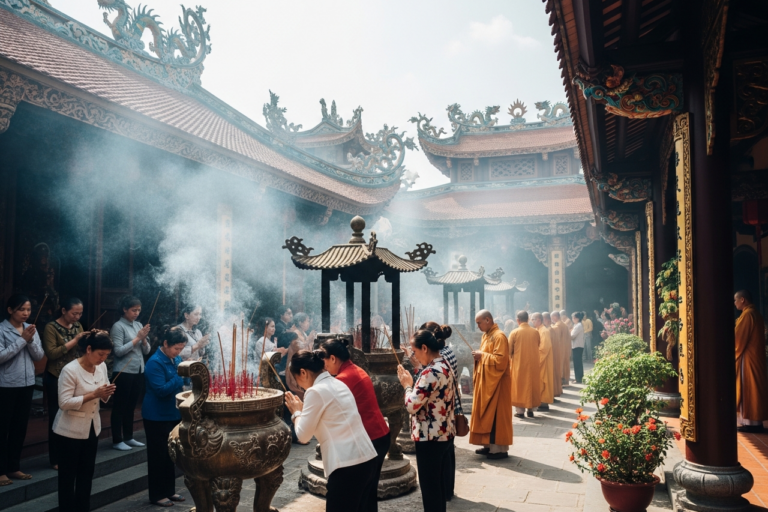
Many people go to pagodas for prayers and offerings, even if they are not Buddhist.
-
Buddhist beliefs like kindness and mindfulness help shape how people act with others.
-
Monks and nuns are important. They lead events and help give spiritual advice to their communities.
Christianity: Catholicism and Protestantism
Christianity plays a big part in Vietnam’s religious life. The Catholic Church is the second-biggest organized religion in the country, coming after Buddhism. Foreign missionaries from Spain, Portugal, and France brought the Catholic Church to Vietnam in the 17th century. Now, the Catholic Church has about six million followers in Vietnam and there are over 6,000 churches spread across the country.
The Protestant faith came later, in 1911, but started to grow more after 1920. There are fewer people in the Protestant Church of Vietnam than in the Catholic Church, but it is still a strong religious organization. Both the Catholic Church and the Protestant church focus on the teachings of Jesus Christ. Both have made solid community networks for people to rely on.
There were hard times too, especially during the colonial period and the Vietnam War, but now Christians are a steady part of Vietnamese society. They take part in religious activities, help with social welfare, and live together with people of other faiths. The government in Vietnam has also recognized some Christian groups officially, so they can operate and worship in the open.
Confucianism: Philosophy and Rituals
Confucianism is often known more as a way of thinking than a religion, but it has shaped Vietnamese society in deep ways. The ideas from Confucianism first came into Vietnam because of Chinese influence. In the 15th century, during the Le dynasty, it became the main way people thought about government and life. The teachings shaped how Vietnam was ruled, how people were taught, and how they lived together for a long time.
Confucian beliefs focus on being good, keeping the peace, and doing what is right. The teachings say to show respect for elders, put family first, and be loyal. These values are a big part of Vietnamese culture and society now. Even though Confucianism does not have big religious buildings or set up like a church, you can see its ideas in many customs and daily habits.
Even today, Confucianism is still part of daily life in Vietnam. There is a big stress on education, how the family works, and on showing respect to older people and leaders. These all started with Confucian ideas. The teachings have mixed with other beliefs over time, which gives Vietnamese culture its special, blended way of looking at what is good and right.
[chinese influence] and [vietnamese culture] are still shaped by these old teachings, and vietnamese society carries many of these ideas up to now.
Taoism: Ancient Traditions
Taoism is another important tradition from China. It came into Vietnam near the end of the second century. Compared to Confucianism, which has strict rules for society, Taoism is more personal and mysterious. People liked its way of thinking, that you should let things happen on their own. Some even used this idea to quietly push back against those from outside who wanted control.
Taoism’s ideas mix well with folk beliefs in Vietnam. It talks about the need for things to be in balance, the harmony with nature, and things that feel magical. These match the old ways people used to believe in the country. You can see how they go together during religious activities or in how traditional medicine is used. Many healers use Taoist thoughts about energy and working with nature in their work.
Today, Taoism is not found much as a strict religion in Vietnam. But the feeling of Taoism is still alive. The way people live and think still shows its mark all the time in Vietnamese culture and spirituality. For example, Taoist gods are sometimes shown respect even in Buddhist places. Ideas from Taoism help shape how people view health, nature, and what will be.
Islam and Hinduism: Minority Communities
Islam and Hinduism are both found in Vietnam, but only among a small group of people. These faiths are mostly followed by the Cham people. The Cham live in Central Vietnam and in the Mekong Delta. Their history goes back a long way with these two big world religions.
Hinduism was the state religion a long time ago in the old Champa kingdom. You can still see amazing temple ruins from that time at My Son Sanctuary. Some Cham people who live in Binh Thuan still follow this old form of Hinduism today.
Islam came to the Cham people many years ago. Over time, it became the main religion for many of them. The Cham Muslims, also called Cham Bani, now mostly live in the south of Vietnam. There are not a lot of Cham Muslims or Hindus when you look at the whole country, but the two faiths are known and accepted by the country. This helps keep the special culture of the Cham ethnic minority alive.
Folk Religions and Indigenous Practices
Beyond the well-known religions, the real heart of Vietnamese spirituality can be found in the many folk beliefs and native practices. Most people, even if they follow a formal religion, also take part in these time-honoured beliefs. For them, the practices are not kept apart. You may find a Catholic or a Buddhist who also keeps an altar at home for ancestor worship.
These folk beliefs are very wide-ranging. They can include the worship of village gods and ideas that have to do with a person’s life. Ancestor worship is the most important, and it brings people together from different backgrounds. This key practice is found all over the country. Now, let’s look at how ancestor worship holds a strong place in Vietnamese culture, and talk about other special native beliefs.
Ancestor Worship: Its Central Role
Ancestor worship is one of the most important parts of Vietnamese culture. People see it as more than just something religious. For many, it is a way to live that puts family, duty, and heritage at the centre. You will find an altar for ancestors in almost every home, no matter what the family’s main religion might be.
Many believe that the souls of those who have passed away still have an effect on those who are alive. Because of this, families do certain rituals to show respect and say thank you. They hope to get blessings and advice from their ancestors this way. Ancestor worship can also mean showing respect for not just family, but also for people who started their family lines, and for national heroes who many see as common ancestors for all people in Vietnam.
The rituals linked to ancestor worship are close to daily life and special days.
-
Offerings such as food, incense, and paper money are given on the day when a relative passed away, and also during big holidays like Tet (Lunar New Year).
-
It is thought to be at the heart of what keeps families together and helps young people show respect for parents and elders.
-
There is a day when the whole nation comes together to worship the Hung Kings, who are the legendary founders of Vietnam.
Đạo Mẫu: Mother Goddess Worship
Đạo Mẫu is a part of Vietnam’s culture, and it stands out as one of the country’s most lively indigenous religions. People in this belief system honour a group of goddesses. They think these goddesses rule over many parts of the universe, such as the sky, the woods, the water, and the earth. This practice shows the strength and colour of Vietnamese folk beliefs, and it has been around for many years.
There are many bright and joyful rituals in Đạo Mẫu, and one key event is the “hầu đồng” spirit ceremony. In this, people who act as mediums invite the spirits of different gods and goddesses to come into them. The spirits are believed to guide and bless those who attend. These events are big celebrations, with music, dance, and fancy dress. All this makes the ceremonies feel very meaningful and rich to the people who take part.
Đạo Mẫu has been named by UNESCO as an Intangible Cultural Heritage of Humanity. This shows how important it is to Vietnamese spirituality. It mixes parts of Taoism, Buddhism, and old folk beliefs. People honour female deities, and believe these goddesses watch over and care for people. This faith is still strong today, and you can find temples that celebrate the Mother Goddesses all over the country.
Other Indigenous Faiths: Diverse Local Beliefs
Vietnam is home to many types of faiths besides the well-known folk religions. These are often found in its 54 ethnic groups. People in these groups usually follow local beliefs that are made up of nature and spirit worship. They pray to deities that are linked to mountains, rivers, and forests around them. This adds a lot to the religious diversity of the country.
In the Central Highlands, many ethnic groups have their own special religious activities. Most of the time, the village elders or shamans lead these events. The community gathers for rituals to ask for good of health, to pray for good crops, and to bring in luck. Their beliefs are very tied to the land and to how the farms and fields grow at different times of the year.
Indigenous religions are a big part of what makes Vietnam’s culture rich and different from other places. While some groups have taken some ideas from bigger faiths such as Buddhism or Christianity, many have kept their old ways. These religions help people feel close to a past that is very old. They show how much variety and life there is in how people in Vietnam look at faith and worship.
Caodaism and Hoa Hao Buddhism
In the early 1900s, Vietnam started to see new religious movements that grew inside the country itself. Two of the most important are Caodaism (Cao Dai) and Hoa Hao Buddhism (Hoa Hao). Both came from Southern Vietnam and found many followers in the Mekong Delta. Today, millions of people in that area belong to these groups.
Hoa Hao and Cao Dai mix pieces of Eastern and Western thinking, which makes for a new style of Vietnamese religion. They show us how some spiritual beliefs can change over time in Vietnam. Let’s take a closer look at how these faiths began, what they teach, and what makes their practices and temples so special. These things help to set cao dai and hoa hao apart in the world of vietnamese religion.
Origins and Core Teachings of Caodaism
Caodaism, or Cao Dai, is one of the most visually striking new religious movements in the world. It was formally established in 1926 in Tay Ninh province, which remains its headquarters. The religion’s founder and early religious leaders received what they believed to be divine messages through séances, instructing them to create a new faith that would unify all of humanity’s religions.
The core teaching of Cao Dai is that all religions are ultimately one and the same, stemming from a single divine source. It seeks to synthesize the teachings of major world religions into a single, harmonious doctrine. Its pantheon includes figures from various faiths, demonstrating its universalist approach.
Cao Dai’s goal is to bring about a new era of peace and unity. It has a complex organizational structure modelled after the Catholic Church, with a pope, cardinals, and priests. The faith venerates a host of “saints” from different cultures and eras.
|
Saint Category |
Examples of Venerated Figures |
|---|---|
|
Religious |
Buddha, Jesus Christ, Muhammad, Confucius |
|
Philosophical |
Lao Tzu, Socrates |
|
Literary/Political |
Victor Hugo, Sun Yat-sen |
Hoa Hao Buddhism: Reform Movement
Hoa Hao Buddhism is one of the main religions that started in Southern Vietnam. This faith began in 1939, and Huynh Phu So was the founder. He wanted to make changes to what people did in Buddhism, to help more people take part. His goal was to show a simpler way and make it easy for all. Many of these people were farmers living in the Mekong Delta.
The key point in Hoa Hao Buddhism is in how you do things at home and as a person. You do not have to do a lot of complex rituals or go to temple often. What matters are good deeds, praying, and doing your best as part of your community. The faith is built on something called “Four Debts of Gratitude”. These debts are to your parents and ancestors, your country, the Buddha’s teachings (Buddha, Dharma, Sangha), and to all people. Because Hoa Hao is direct and simple, it brought in a lot of new religious followers.
This religion took some ideas from a group called Tứ Ân Hiếu Nghĩa. It says to worship in a plain way. Many choose to pray or burn incense at home instead of heading for a big pagoda. People try to be good, helpful, and honest. Today, Hoa Hao has many who follow it in the Mekong Delta, where hoa hao Buddhism is still strong.
Practices and Temples of New Religious Movements
The new religious movements in Vietnam have made their own special ways to worship and have their own places of worship. The Cao Dai Holy See in Tay Ninh is the best known. This temple stands out because it mixes styles from both the East and the West. The building is full of bright symbols, like the Divine Eye, which you can see there.
On the other hand, Hoa Hao Buddhism is about keeping things simple. People who follow Hoa Hao mainly pray at home instead of going to fancy temples. They have a plain altar with a piece of brown cloth to pray at. This shows that in Hoa Hao, the inner faith matters more than the outsides or the ceremony. Other small movements, like Minh Ly Dao, also have their own ways to worship and their own different temples.
These new faiths have brought many of their own ways to show their beliefs in Vietnam.
-
Cao Dai followers go to bright and colorful ceremonies four times each day. They wear robes in special colours that show their group in their faith.
-
Hoa Hao followers spend time on simple prayers, doing farm work, and giving help to the poor as main things in their religion.
-
The people in these movements often have strong ties to each other and take part in helping out in their community and doing good work for others.
Religion and Daily Life in Vietnam
Religion in Vietnam is not just something you find in temples or on special days. It is part of everyday life for people. The food people have, and the way they talk with their families or meet their friends, is often shaped by spiritual beliefs. These religious activities are always there. They help guide what people do and bring meaning to each day.
All over the country, you will see many spiritual places. These places act as centres where people in the community come together. Through the year, there are many lively religious festivals. People join these events to celebrate and feel close to others.
Let’s look at how these beliefs show up in festivals and ceremonies, how they help shape what is right and wrong in vietnamese society, and how they change the look of towns through temples and churches.
Festivals, Ceremonies, and Community Gatherings
Religious festivals and ceremonies are a big part of life for people all across Vietnam. These events are colourful and full of life. They help people come together to celebrate their faith and culture. Some events are big, like Tet (Lunar New Year), which has many spiritual rituals. Others are small local village festivals. All of these help people in the area bond with each other.
Different groups have their own special calendars for these activities. Buddhists hold big events like Vesak, where they think about Buddha’s birth, when he reached enlightenment, and when he died. Christians gather for Christmas and Easter. The Cham people have their own Kate Festival. A lot of these religious activities are not just for one group—you can often join in and learn more about other ways of life.
These festivals do more than honour the different faiths. They are social times too, letting everyone in the group grow closer together.
-
The Hung Kings’ Temple Festival is a national holiday. People in the country come together for ancestor worship.
-
The Perfume Pagoda Festival brings millions of Buddhist pilgrims on a spiritual journey.
-
The Mid-Autumn Festival, which is great fun for kids, is also tied to old farming and spiritual customs.
How Religion Shapes Ethics and Social Norms
Religion has a big impact on the way people in Vietnamese society think about right and wrong. The “three teachings”—Confucianism, Taoism, and Buddhism—have given people guidance for many years. Confucianism especially talks about how important it is to respect your elders, listen to people in charge, and live in peace with others.
Buddhism works together with these ideas. It adds lessons about being kind, thinking about your actions, and not hurting others. When you put the three teachings together, you get a way of living that puts the group ahead of just one person. People in Vietnamese society learn to be humble, wait their turn, and show respect. These old ways of thinking still guide how people treat each other every day, in families and in the community.
Religious leaders guide the people and help keep these rules strong. They often give advice on how to live a good life. Vietnamese society is changing fast, but the teachings from these old beliefs are still very strong. They shape not just family life, but how people do business and get along.
Spiritual Sites: Temples, Pagodas, and Churches
The spiritual side of Vietnam can be seen in all the places of worship around the country. There are temples, pagodas, and churches everywhere you go. These are not only buildings. They are the heart of the community and show how people have believed in different things over time. In big busy places like Ho Chi Minh City and the coastal town of Da Nang, you will see these important sites standing out.
Buddhist pagodas are some of the most common sights. You can often find them in quiet spots and spot their roofs, which are shaped with a gentle curve. There are also Catholic cathedrals. These buildings have tall, pointed towers and old stonework that remind people of the French colonial time. Some places, like the Cao Dai Holy See in Tay Ninh or the old Cham temples near Da Nang, are extra special.
The people visit these sites all year long. It is not just for major events or holidays. Some come for a calm moment to think, some to offer small gifts, and others to ask for help or direction. These are places where people feel closer to the divine and can meet each other. Whether you go in the city or the countryside, these places of worship take up an important spot in people’s lives.
Government Regulations and Religious Freedom
The Vietnamese government tries to balance religious freedom with keeping control over religious affairs. The law in Vietnam gives people the right to have their own beliefs. But the government still checks and manages all religious activities. The country has a Government Committee for Religious Affairs, and they are in charge of everything to do with religion.
If you want to start a religious group in Vietnam, you need to register with the government. This is the system the government uses so groups can work within the law. Some people and groups from other countries say this makes it hard for some people to practice their religion the way they want. They say it can limit religious freedom.
Here, we will look at how the Vietnamese government handles these policies. We will see what you need to do to register, and go over the rights and limits that shape religious practice in Vietnam.
State Policy on Religion in Vietnam
The official state policy on religion in Vietnam is clear. It says that the country respects and protects the freedom of belief. At the same time, religious activities must follow the law. There is no state religion in Vietnam. The constitution treats all religions as equals. The main goal of the government is to make sure that religion can help with national unity and development.
The Government Committee for Religious Affairs is in charge of these policies. It takes care of registering religious groups. It keeps an eye on their activities. It also connects the state with religious organizations. The government believes that state management of religious affairs is needed to help keep social stability.
In recent years, the laws on religion have changed and improved. The largest change was the 2016 Law on Belief and Religion. This law sets the rights about religion that are in the constitution into the country’s laws. It gives clear steps for religious groups to follow. The government wants to make things easy and fair for religious followers and state authorities with this policy.
Registration and Recognition of Faith Groups
For religious groups in Vietnam to run in a legal way, they have to go through a set process of signing up and getting a yes from the government. The Law on Belief and Religion, made by the National Assembly, explains how this is done. It says these groups need to share details about who they are, who leads them, and what things they do.
To get full approval, a religious organization must also show they have had some time of steady work. By 2022, the government had said yes to 16 religions and 43 organizations. That list covers big faiths like Buddhism and Catholicism, plus local groups like Cao Dai and Hoa Hao.
Still, this step-by-step process for signing up can take a lot of time and be hard. This is tough, especially for smaller or newer religious groups. Because of this state control, groups who do not get registered live in a space where the law is not clear. Their religious activities can also be stopped or limited. When a group gets recognized, it has the legal right to act as a faith group and do many things in an open way.
Restrictions and Rights Regarding Religious Practice
The Constitution of Vietnam says that people have freedom of religion. But, this freedom is not without limits. The state has control and makes the final call on what is allowed. There is a legal framework that lets people practice religion, but it also sets rules that people have to follow. Any religious activities that are seen as harmful to national security, social order, or national unity are not allowed.
Because of these rules, there are some restrictions on religious freedom in Vietnam. For example, religious groups need to be registered to publish books or other materials. They also have to register if they want to train clergy or build new places of worship. The government watches over religious activities and only lets groups that are officially recognized gather and practice. Groups not approved may find it hard to meet or express their beliefs in the open.
Some international groups, including the United States Commission on International Religious Freedom (USCIRF), have named Vietnam as a “country of particular concern.” They think that the rules and registration laws the government uses stop people from having true religious freedom. However, the Vietnamese government says these policies are needed to keep order and match with local laws.
Religion’s Impact on Vietnamese Canadians
For many Vietnamese Canadians, religion stays as a strong way to connect with their roots. After moving to a new place, people in this community work hard to make new places of worship. They also start groups where everyone can come together and keep doing their religious activities. These places and events are a home for their faith and bring people closer.
Community groups also help keep old ways alive. They teach the young about these ways, so their beliefs and stories do not fade, even if they now live far away from Vietnam. Let’s look at how Vietnamese Canadians keep their many religious ways going and how important their community centres and places of worship are in their daily lives.
Maintaining Traditions in Canada
Vietnamese Canadians work hard to keep their religious traditions strong in Canada. For many people, faith is at the heart of their life. It helps them stay close to their culture and remember where they come from. They have set up the groups and communities they need to follow their beliefs. The groups include Buddhism, Catholicism, and ancestor worship.
These religious groups help new immigrants be part of the community. They are there to give support and help people feel like they belong. In new places of worship, people hold services, ceremonies, and take part in festivals to keep their spiritual lives close. Vietnamese Canadians celebrate days like Tet and Vesak and honor life events such as weddings and funerals in their own way.
It is important to share all these traditions with younger people. There are language and scripture classes to help the next generation feel close to their faith and culture. When Vietnamese Canadians use their places of worship and ways of ancestor worship, they keep more than beliefs alive—they help keep their culture growing in their new home.
Community Organizations and Places of Worship
Across Canada, you will find many community organizations and places of worship. These can be seen a lot in urban areas where there are big Vietnamese communities. They are the backbone for Vietnamese Canadian religious life. You get everything from large Buddhist temples in Toronto and Vancouver, to Catholic churches with mass in Vietnamese. These places are important hubs for the people.
They are more than just places to pray. Each one is also used as a community centre. They put on cultural events. People can go there for language classes. There is support for seniors and youth, plus they help organize things for charity. Each group helps to keep the community strong, no matter if it is a big Catholic parish or a smaller Caodaist group.
The fact that these places of worship are here shows how much the community wants to stick together and help each other.
-
Buddhist temples often have traditional Vietnamese architecture. This helps followers feel at home.
-
Catholic and Protestant churches offer spiritual help and help bring people together.
-
Followers of smaller faiths also have their own centres, where they can keep practising what they believe.
[https://your-link-if-there-was-one.com]
Conclusion
To sum up, it is important for Canadians to know about religion in Vietnam if they want to connect with people there or with Vietnamese folks in Canada. The many beliefs, like Buddhism and folk religions, touch not just each person’s life, but also shape bigger things like festivals, behavior, and daily habits. If you take time to see how different these beliefs are, you can build more respect and stronger bonds with Vietnamese people. If you want to know more about how religion shapes the lives of Vietnamese Canadians, feel free to ask for a free talk. We can go over old ways and new traditions that are still alive today.
Frequently Asked Questions
What is the most widely practiced religion in Vietnam?
Buddhism is the biggest organized religion in Viet Nam and it has the most religious followers. But, folk religion is the practice that most people do in their day-to-day lives. In fact, many people, even those who say they are Buddhist, still take part in ancestor worship and follow other old ways and beliefs. So, ancestor worship and these native beliefs are the most common spiritual tradition in Viet Nam.
How does the Vietnamese government handle religious freedom?
The Vietnamese government says that people in the country have religious freedom in the constitution. But the government also controls religious affairs through a special government committee. All religious groups need to sign up to be able to work by the law. The government checks what they do to make sure they follow the country’s laws and keep social order.
What are common religious festivals in Vietnam?
Common religious festivals in the year include Tet (Lunar New Year), where people hold ceremonies for ancestor worship. Vesak is important too, as it is Buddha’s birthday. The Hung Kings’ Temple Festival is a national day for ancestor worship. There is also the Kate Festival, special for the Cham people. These events bring people together at different places of worship.