Key Highlights
-
Qatar has Islam as the state religion, and most local people are Sunni Muslims.
-
The country uses Islamic law, and this shapes how people live and how the government works.
-
Qatar gives some religious freedom. Expatriate Christians and people of other faiths can worship, but they must do this in special areas.
-
There are many people from other countries living in the country. They bring different faiths with them, like Christianity, Hinduism, and Buddhism.
-
The Ministry of Islamic Affairs in Qatar handles all issues about religion. They take care of mosques and how religion is shown in public.
-
People who are not Muslim can practice their religion in the country. However, telling others to change their religion is limited to keep public order.
Introduction
Welcome to your guide on faith and culture in Qatar. If you are from Canada, you may want to know more about the religious life in this country in the Middle East. Qatar is officially an Islamic state. Islamic law is the main source of its rules, and it shapes many things in daily life. This guide will help you see how religion is a big part of life in Qatar. It will show how Islam is the dominant faith and how people from other places still practice their own religions here. Qatar is home to many these different communities.
Overview of Religion in Qatar
Islam is the state religion in Qatar. It is at the heart of the country’s identity and is part of the daily life there. Most of the people in Qatar are Sunni Muslims. Their faith is easy to see in places like the mosques. You can hear the call to prayer each day. The country also has national holidays for big Islamic events. In the Middle East, people know that faith and society go hand in hand in Qatar.
Islam shapes the laws in the country. It also guides social rules. Qatar has a big total population because many people come from other places, and the country must find ways to mix its Islamic roots with the lives of a world community. This was a big topic during the World Cup. If you want to know the country well, you need to see how faith touches its culture. In the sections below, you will read more about the religious groups living there, how faith impacts daily routines, and the values that are important in Qatari society.
Religious Landscape and Demographics
Qatar’s mix of faiths has two main parts: the citizens and the big group of foreign workers. Most citizens are Muslim. Almost all are Sunni, and a small group are Shi’a Muslims. Out of the total population of more than 1.5 million, only about 225,000 are Qatari citizens. This shows the country has a lot of foreign workers.
The large group of migrant workers in the country comes from South Asia, Southeast Asia, and Arab nations. These people bring many different beliefs. Because of this, there are many religious groups in Qatar. Christians make up a strong share of the non-citizen population. Community groups say there are about 80,000 Roman Catholics, and another 10,000 who are Anglicans or Orthodox Christians.
As well as Christians, there are other faiths leading life in the country. Many Hindus from South Asia, mostly India, and many Buddhists from South, Southeast, and East Asia live there. There is also a small group of around 500 Baha’is. The mix of different beliefs comes from the way Qatar counts on its global migrant workers for much of its total population.
Influence of Religion on Daily Life
In Qatar, Islam touches almost every part of life. It is the state religion. The ideas of Islam are built into how the country works and its laws. Each day, people plan their work around the five daily prayers. Across cities and towns, you can hear the call to prayer from many mosques. This regular call helps remind everyone of how important faith is in the country.
Sharia, known as Islamic law, is the main source of rules in Qatar. It shapes family matters, property handed down to others, and some crimes. For instance, Islamic law strictly guides who can get what from an inheritance. The constitution points this out clearly. Because of this foundation, both citizens and people living in Qatar have to follow these rules and customs set by Islamic law.
The Ministry of Islamic Affairs watches over all religious places and supports Islamic instruction, too. This way, values and teachings of Islam stay strong and are taught to each new group of people. When you live in the country or just visit, knowing how much Islamic law guides daily life helps you understand what to do and what to expect.
Key Religious Values in Qatari Society
Qatari society is made up of core Islamic values. These values focus on family, community, and being a good host. They are not just about beliefs. They shape the way people act every day and how they treat others. People in Qatar are taught to respect elders, show kindness to guests, and feel responsible for the whole group. All these things come from Islamic teachings.
The government tries to hold on to these values and also keep public order. The law gives people some religious freedom and lets them follow their own religious rites. But, these rites must not go against public order or general morals. This way, different groups can live together well, as long as they respect Islamic rules the most.
Key values you see every day and at events:
-
Family: Family is seen as the base of the society. Its main points are religion and morals.
-
Generosity: Hosting guests is very important, both by culture and religion.
-
Modesty: People show this in how they dress and act, both men and women.
-
Community: There is a strong need for people to help and support each other.
Islam in Qatar
Islam is the state religion in Qatar. This is written in the country’s constitution. Because of this, Islamic law is the main source for laws in the country. The Prime Minister and other leaders of the country take an oath to respect Islamic law. This shows how important Islamic law is in how the country is run. The Ministry of Islamic Affairs is the main group in charge of religious matters in Qatar.
Islam is a big part of daily life in the country. It affects things like public holidays and how people should act in social settings. For Canadians living in Qatar, it is good to know the customs and traditions that come from Islam. The next parts will talk about the different sects of Islam found in Qatar. They will also cover the part that mosques play and the main Islamic holidays that are important in the country’s calendar.
Sunni Islam – The Majority Sect
Most people in the country are Sunni Muslims. The state’s main version of Islam is a strict form, known as Wahhabi, and this is also followed a lot in Saudi Arabia. This Sunni sect of Islam plays a big part in the laws, the way of life, and how people follow their faith in Qatar.
Sunni Islam stands out all over the place. You can see this in the country’s many mosques, and the state mosque, which is called Imam Muhammad ibn Abd al-Wahhab Mosque, is one of the biggest and well-known. These mosques are big parts of community life. People go there to pray, learn more about the faith, and meet each other. The government puts a lot of money and help into Sunni mosques and schools that teach about Islam.
For Sunni Muslims who live in the country, their faith leads daily life. They follow prayer times, eat halal food, and their beliefs help shape what they do with family and others in the community. Their connection to the Sunni way is an important part of what makes them Qatari.
Shia Islam – Minority Representation
Sunni Islam is the main religion in Qatar. At the same time, a small group of Shia Muslims also lives in the country. This group makes up less than 5 percent of the citizen population. Some members of the expatriate workforce come from places with many Shia people, and they also follow this branch of Islam.
Shia Muslims are one of the recognized religious groups in the country. They can follow their faith in private. However, their public events and religious gatherings have more rules than those of the Sunni majority. The government keeps an eye on Shia religious activities. They also do not give as much money or support to Shia groups as they do to Sunni Islam.
Although the Shia are a small group, they keep their way of worship and celebrate their own holidays and rituals. Their presence adds something special to the religious groups in the country, but they still have to follow rules that give the most importance to the state’s main Sunni teachings.
Role of Mosques and Islamic Institutions
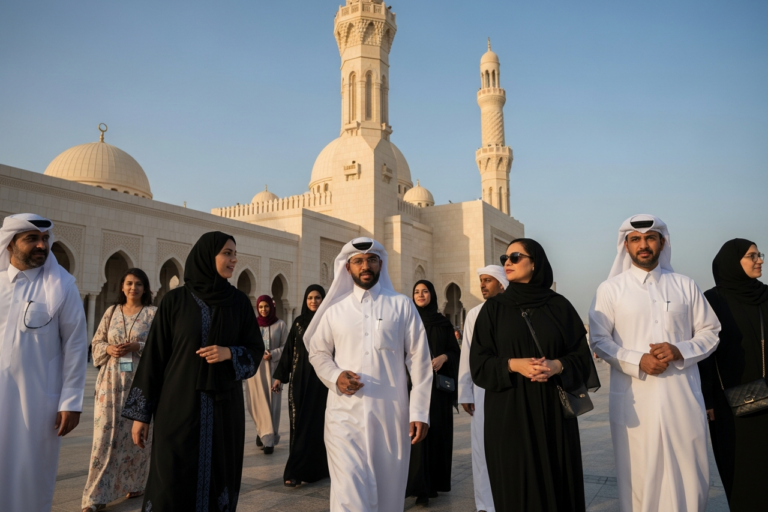
Mosques play a big role in the lives of people in Qatar. You can find one in almost every area of the country. They are centres where people meet for prayers, to learn, or to help others. Many mosques show a nice mix of old and new design styles. They are not only used for the five daily prayers but are also a place for the community to come together for meetings, learning, and support.
The Ministry of Islamic Affairs looks after these mosques. It helps build, fix, and run them. This ministry also chooses who will lead the prayers, called imams, and watches them to make sure what they say in their talks and lessons follows the state’s way of Islam.
Along with mosques, there are other places that help share Islamic culture in the country. One such place is the Abdulla Bin Zaid Al Mahmoud Islamic Cultural Center, which used to be called Fanar. This centre teaches people about Islam, especially those from other countries who are living in Qatar. They have classes about Islam, teach Arabic, and offer help for anyone who wants to know about the country’s culture and faith.
Islamic Holidays and Cultural Observances
Islamic holidays are big public events in Qatar. They are an important part of the country’s cultural life. These days are known for prayer, family visits, and community get-togethers. The holidays shape the way people live and work, and everyone in the country notices the change—no matter what their faith is.
The holy month of Ramadan is the most important religious time of the year for Muslims. During this month, people fast from sunrise to sunset. Working hours get shorter, and it’s not allowed to eat or drink in public during the fasting hours. This shows respect for those who are fasting. In the evening, there are special prayers, and families and friends enjoy iftar meals together. Soon after Ramadan, the country celebrates Eid al-Fitr. This is a big festival that marks the end of fasting and is full of joy.
Eid al-Adha is another main holiday. People in the country call it the “Festival of Sacrifice.” It takes place during the time of Hajj—the big pilgrimage to Mecca that many people take part in every year. These religious rites mean the whole country shuts down for public holidays. There are parties and special events everywhere.
The main religious holidays in the country are:
-
Ramadan: This is a month when Muslims fast, pray, and think about their lives.
-
Eid al-Fitr: A happy festival that comes after Ramadan ends.
-
Eid al-Adha: The festival of sacrifice.
*
Legal Framework for Religion
The rules for religion in the country are based on both Islamic law and secular law. In Qatar, Sharia law is the main source of the law. This mix of rules guides how the country handles religion. It also affects what people can do when practising their faith. The constitution says Islam is the state religion. This gives Islam a special place in both the law and the community.
This setup offers people some rights. But it also has some strong limits. The constitution lets people have freedom of worship. Still, this right depends on following rules that keep public order and good morals. Next, you will see more about which rights the constitution gives. The sections will also show what rules there are for religious talk and what the state says about religious practices.
Constitutional Rights and Limitations
Qatar’s constitution speaks clearly about religious freedom. Article 50 says that everyone has the “freedom to worship.” This part is important for the country because there are many different people living in Qatar. It gives the legal right to non-Muslims so they can follow their own faith. This is one of the main rights that all who live in the country get from the constitution.
But this religious freedom is not without limits. The same article says the freedom of religion has to follow the law and protect public order and morals. With these words, the Qatari government can control what religious groups do. For example, people can pray or meet in private, but they cannot show their non-Islamic faith in public places.
The Qatari government wants to help both its big group of foreign workers and keep the country’s Islamic identity strong. What counts as something that harms public order can be taken in many ways. Because of this, the qatri government lets people worship their way but keeps a close watch on where and how public worship happens.
Laws Governing Religious Expression
The laws in Qatar set some clear rules on religious expression, especially for people who are part of non-Muslim faiths. The country’s constitution does give some religious freedom. But, there are separate laws that say how this freedom can be used. The main goal of these laws is to keep public order and stop anyone from trying to change the religion of others.
People in the country can’t show their non-Islamic faith in public places. You won’t find religious marches, public missionary work, or open use of non-Islamic symbols outside special areas set aside for this. These laws try to make sure that the country’s public life follows Islamic rules. If someone does anything that looks like it goes against Islam, there can be legal action—these actions come from laws based on Sharia law.
For non-Muslim groups that are officially registered in the country, they can only practice their religion inside the Religious Complex. In these places, they can hold their services, celebrate special days, and do things together as a group. But, these events can’t be advertised to the public or made to attract people from the Muslim community.
State Policy on Religious Practices
The state in Qatar allows some freedom for religious practices, but it does this with careful control. If you are not Muslim, you can follow your religion, but you must do it by following many rules. Several groups in the government are part of this, and the Ministry of Islamic Affairs is the main group watching and checking these actions.
In the country, people who follow Islam get strong support from the state for the way they practise their religion. The government takes care of building mosques, fixing them, paying imams, and helping Islamic schools and teaching. The policy here is to keep the country closely linked to what the ministry of islamic affairs says about Sunni Islam.
If you are a person who is not Muslim, things are different. You have to tell the government and get approved before you can gather for your religion. Most of the time, non-Muslims must practise in private, or in places set for them inside compounds. The aim of the country is to give foreign people a space for their faith, but not let these religious things to be seen in public. This is because the government does not want anything to look like it changes or questions what the ministry of islamic affairs says about Islam.
Christianity in Qatar
Christianity is present in Qatar, and it keeps growing, mostly because of the people who come from other countries to work or live there. The christian community in Qatar is very mixed, with so many groups of christians from all over the world. There are many expatriate christians, and they have all kinds of jobs and come from many places, which makes their faith community feel busy and full of life.
The qatari government helps support their worship by giving land to christian churches. The government also talks often with representatives of christian churches, so the community can stay connected and heard. This support lets the christian community come together for their services. They can meet and practice their faith, but it is still under some rules.
In the next parts, you will learn about the christian community and its demographics, where they go to worship, and the ways they celebrate their holidays in Qatar.
Christian Population and Expatriates
The Christian community in the country is made up almost fully of people who come from other places. Most of these expatriate Christians and their families work in Qatar as migrant workers or hold jobs as professionals. They come from South Asia, the Philippines, Africa, Europe, and North America. They make the country’s workforce stronger and also help bring more religious diversity.
There are tens of thousands of Christians living in the country now. The Roman Catholic group is the biggest, with around 80,000 people. There are also other large groups, like Anglicans, Greek Orthodox, Eastern Orthodox, and many Protestant churches. This mix of people means you can find church services in many languages. Some of these are English, French, Tagalog, and Malayalam.
Most expatriate Christians live and work in different parts of the country. But when they come together for religious reasons, they meet at the special religious complex in Mesaimeer. This lets them follow their Christian faith and, at the same time, show respect for the country’s laws and customs.
Churches and Places of Worship
Yes, there are designated places of worship for Christians in Qatar. The government has allocated a large plot of land on the outskirts of Doha, commonly known as the Religious Complex or “Church City,” for the construction of Christian churches. This complex is a unique solution to accommodate the spiritual needs of the large Christian expatriate population while maintaining the country’s public Islamic character.
Within this complex, various denominations have built their own church buildings. These are the only officially sanctioned places for public Christian worship in the country. The churches are not allowed to display religious symbols like crosses on their exteriors, but inside, they function as active faith communities with regular services and activities.
Several major Christian denominations have a presence in the complex. Here are some of the key churches and communities:
|
Church/Denomination |
Community Served |
|---|---|
|
Our Lady of the Rosary Church |
Roman Catholic community |
|
Anglican Centre |
Anglican and various Protestant congregations |
|
St. Isaac and St. George Church |
Greek Orthodox and other Eastern Orthodox communities |
|
Syro-Malabar Church |
Indian Catholic community |
|
Coptic Orthodox Church |
Egyptian and other Coptic Christian communities |
Christian Celebrations in the Qatari Context
Expatriate Christians in Qatar mark big holidays like Christmas and Easter. The way they celebrate is adjusted to fit life in Qatar. These holidays are not public holidays like they are in Canada, so most celebrations happen at home or in church areas made for this. You will not see public decorations or big, commercial parties the way you might in Western countries.
Inside the Religious Complex, many churches put on special religious services for Christmas and Easter. These events are well-attended. Churches from the Roman Catholic, Eastern Orthodox, and Protestant branches hold masses, prayer services, and other church activities. These gatherings help the Christian community come together and share in their most important days.
Many families celebrate at home. Expatriate Christians often have private get-togethers where they share a meal and give each other gifts. Some hotels and restaurants might have Christmas dinners, but these are small and quiet. Key parts of these celebrations include:
-
Attending special religious services in the church compound.
-
Private family meals and get-togethers.
-
Community events and bazaars held within the church grounds.
-
Carol services that take place inside the churches, not in public.
These events let the christian community honour their faith and feel close, even when living far from home.
Minority Religions in Qatar
Beyond Islam and Christianity, there are more religious groups in Qatar. Most of these come with the migrant workers who move here from South Asia and East Asia. These workers bring different faiths with them when they get to Qatar. Their religions do not get as much attention as Christianity. They also do not have the same formal status. However, the groups are still big, and there are many people in their communities.
Hindus, Buddhists, and Baha’is are some of the groups that meet and practise their faith here. They do this in a quiet way. The government lets them worship in private. Still, there are no known public temples or places for worship for these groups. The next parts will show you more about their communities and how they keep their beliefs and ways in Qatar.
Hinduism Among the Communities
Hinduism is one of the biggest minority religions in Qatar. About 19.12% of the people there are Hindu. Many in this community are migrant workers who come from India and Nepal in South Asia. There are a lot of Indian expatriates in Qatar, so there is a strong Hindu presence. But, you will not see it much in public.
Hindus, unlike Christians, do not have a government-approved place of worship or temple. Because of this, they do their religion privately. Families and friends sometimes meet in their homes or villas. They do pujas (worship rituals), celebrate festivals like Diwali and Holi, and keep their religious ways strong.
This private way of practicing Hinduism is seen in other Gulf countries as well. Even though there are no public temples, the community stays strong. They keep their faith alive using small groups and private meetings. This helps them meet their spiritual needs and still respect the rules in Qatar.
Buddhism in the Expat Workforce
Buddhism is another important minority religion in Qatar. It is followed by some people who come from other countries to work in Qatar. Most Buddhist workers are from east asia and southeast asia, like Thailand, Sri Lanka, Nepal, and the Philippines. They make up about 1.90% of the people in Qatar, so they are a visible religious group.
Like Hindus, Buddhists in Qatar do not have official public temples or monasteries. They do their religious activities in private. They meet in homes or rented places. There, they meditate, chant, and mark key Buddhist holidays such as Vesak. These small group meetings help people keep their sense of community and faith strong.
In Qatar, Buddhism is practiced quietly and together with other people. Since they do not have their own official places, people in the group organize events by themselves. This peaceful and private way of practicing lets them follow their beliefs while respecting the country’s rules for public worship.
Baháʼí Faith and Other Small Groups
In Qatar, along with the bigger faiths, there are also smaller religious groups. One of these is the Baháʼí Faith. There are about 500 Baháʼís in Qatar based on some estimates. Many of them are from Iran. They make up a small group, and only a few Baháʼí citizens live in Qatar.
The Baháʼí Faith started in the middle east. In some countries in the region, people who follow this faith face many rules that make life hard. In Qatar, Baháʼís can follow their faith, but only in private. They are not allowed to have public temples or hold group events openly. The government watches what they do, so, like other small and unknown religious groups, Baháʼís live carefully.
People who belong to other small religious groups like Sikhs and Jains are in Qatar too. Most of them come from India and live as workers. These groups usually follow their faith in private, too. They gather at home and try to hold onto their culture and ways. The laws in Qatar mean they cannot have large or public places to be together, so they keep things quiet.
Religious Freedom and Restrictions
The subject of religious freedom in Qatar can be hard to explain. The constitution says people are free to worship. But in real life, there are many rules on how this is done, especially for people who are not Muslim. The government makes a lot of rules on this. In fact, the department of state and other human rights groups have noticed this.
These limits show up clearly. For example, there are rules for places of worship and bans on talking to others to change their religion. Also, islamic law is more important when it comes to personal things, like marriage, getting a divorce, or cases of child custody. This can be tough for people who are not Muslim and for mixed-faith families. In the next parts, you will read more about these rules and how they shape religious life in Qatar.
Government Regulation of Religion
The Qatari government has strong rules for anything to do with religion in the country. Islam is the state religion. The Ministry of Islamic Affairs helps the government manage all Islamic affairs. The ministry uses money to fund mosques. It also chooses the imams and makes sure the sermons follow the state’s views.
Other religious groups have to follow more rules to be active. They must register with the government before they can meet. This can take a long time, and some groups do not get approval. If religious groups try to gather without being on the list, they can get into legal trouble.
This way of regulation shows a set order in the country. The state religion, Islam, gets a lot of help and support. Other groups can be in the country, but the limits are very clear. The Qatari government wants to keep society calm, stop fights over religion, and keep the Islamic character of the country. Because of this, there is some religious freedom, but it is strongly managed.
Social Attitudes Towards Religious Diversity
People in Qatar are usually accepting of other religions. This is especially true when you see how people act with each other each day in this diverse place. Many Qataris are used to meeting and working with people from many backgrounds and beliefs. There is peace and respect in how most people live together. This is true if you have your own religion but are quiet about it.
Still, there are some rules because this is a more traditional country. You can practice your own religion in your home or with your religious groups in private. But if you are open about it in public, you might upset some people. The country wants to keep public order and hold onto Muslim values. This means that other religious groups must not be too loud or clear with what they do.
If you wear religious clothes from another faith, have public parties, or try to talk people into joining your religion, people might not like it. Such things might be seen as upsetting how people get along. So, you can see that people in Qatar are open to many groups, but they want the country’s main rules to stay the same, with Islam at the centre of public life.
Restrictions on Religious Proselytizing
Qatar’s law is very clear that non-Muslims are not allowed to try to convert others. If anyone tries to get a Muslim to change their faith, it is a serious crime. The legal consequences can be harsh. Someone could end up in jail or even be sent out of the country. This is seen as one of the biggest limits on religious freedom in the country. The law is strongly tied to the country’s main rules, which are made to protect the state religion and keep public order.
For the government, telling others to join another religion, or proselytizing, can cause problems in society. Both public and private acts like preaching, handing out materials, or just having talks with conversion in mind are included in this law, and all of these are not allowed. The state sets these rules as part of its religious policy. Their purpose is to protect the Islamic identity and help keep public order steady in the country.
Because of that, people who belong to religious groups from other places focus mainly on their own communities. Church leaders and those who help run the groups make sure their events are only for their own members. They try hard not to let their gatherings look like they are trying to attract people from outside their group, especially Muslims.
Recent Developments in Religious Policy
In the last few years, Qatar has tried to take part in talks between faiths. The country wants to show the world that it cares about religious freedom and being open. The Qatari government has even worked with the ministry of foreign affairs to put on meetings and events about living together in harmony. These steps are part of a bigger plan for Qatar to look new, modern, and good to other people and countries.
But there is still a big gap between these efforts and the real situation. Groups like Human Rights Watch say Qatar needs to do more. One big move was starting the religious complex, but after that, there has not been much done for people of other beliefs. It still takes a lot of time to set up new churches. The Qatari government has also moved slowly for Hindus, Buddhists, and other small groups. The rules on speaking about faith in public or asking people to join your faith stay strong and the religious policy has not changed.
Groups like the United Nations and other parts of the world are still reminding Qatar about human rights topics. Religious freedom and the needs of many people are always talked about. While there is no word of any new laws, talks go on with the government, foreign embassies, and others. Many want their citizens living in Qatar to be free to practise what they believe. For now, there is some hope, but not much change yet.
Places of Worship for Non-Muslims
Yes, the country has places where non-Muslims can go to worship. There are special areas set aside for Christian denominations. The government has given land for a large religious complex called Church City, found in Mesaimeer in Doha. Church City is the main place for Christian life in the country. Different Christian groups can use it to hold their services and plan events with the community. The space is recognized by the government.
This step is part of how Qatar deals with different religions. It lets people have a place for non-Muslim worship inside a set area, so the government meets the spiritual needs of many people who live there from other countries, while also keeping other faiths less out in the public. Up next, the sections will talk more about rules at this religious complex, and also about places of worship for people with other faiths.
Church Compounds and Regulations
The church areas inside the Religious Complex have to follow some rules that are set out for them. The government, working through groups like the Ministry of Islamic Affairs, keeps watch over what goes on in “Church City.” People are free to worship inside, but they need to stick to these rules.
One of the main rules is that there can be no religious signs on the outside of the church buildings. There will not be any crosses, bells, or steeples showing on the outside. This is done so the buildings do not look openly religious from the outside. It goes with the rules about keeping non-Islamic faiths from being too public.
The security at the religious complex is strong. Entry is watched and controlled to keep things safe and help with traffic. The churches look after their own running and raise their own money, but for any big changes or a new project, they have to get the government’s okay first. These rules make sure that Christians can worship here in their own space, but it is managed and watched over by the ministry of islamic affairs.
Temples and Multi-faith Centres
The Christian community in the country has the Religious Complex, but there are no official public temples yet for other religious groups like Hinduism, Buddhism, or Sikhism. This shows a big difference in how non-Muslim religious groups are treated. The government has not given land to build a Hindu temple or a Sikh temple, even though there are a lot of people from these faiths in the country.
There has been talk about having a multi-faith centre where smaller religious groups could share a worship space. This idea has come up in different meetings, but the government has not come up with any real plans for it. Right now, the country does not allow new public places of worship for religious groups that are not Christian or Muslim.
So, people from these religions have to meet in private. They use their homes or rent villas to worship, and these meetings are kept away from public view. Not having official places and support is still a big challenge for them in the country.
Access for Visitors and Residents
Access to the religious complex is open to people who live in Qatar and to visitors who want to go to a church service. If you are a Christian living in Qatar or just visiting, you can go to the right church to worship. The churches there support their own groups, and they often share the times for services through community groups or on social media, or sometimes on private sites.
But, there are some rules for who can get in. The religious complex is not in central Doha, so you will need a car or a taxi to get there. On big holidays like Christmas and Easter, a lot of people go, so traffic can get busy and security may tell people where to go. It is not a normal tourist spot—it is a place of worship for people from other countries who live in Qatar.
If you want to go for a service, it is a good idea to check with the church first to find out what time things happen and if there are any rules. The churches are kind and want people to come, but everyone needs to remember this is a place with its own local ways and rules.
Religion’s Role in Qatari Government
Religion is a key part of the Qatari government. The constitution says that Islam is the state religion. It also says Sharia law is the main source for laws in the country. This idea shapes the way the whole government works, from the head of state down to the courts. The Qatari government tries to support and hold up Islamic values in all its decisions and public services.
The Ministry of Islamic Affairs is a very important group in the country that looks after a lot of religious matters. But the effect of religion is not only in this ministry. You will see Islamic ideas in the court system, in how schools teach, and even in the promises top leaders have to make when they take office. In the next parts, you will see how Islam is part of running the country, how the main source for rules comes from Sharia law, and how the government tries to balance religious and non-religious policies.
Islam in State Governance
Islam is an important part of the way the country of Qatar is run by the government. The Emir, the Prime Minister, and all top leaders must be Muslim. They need to take an oath to respect Islamic law before starting their work. This rule in the law makes sure the country’s leaders support its Islamic identity.
The Ministry of Islamic Affairs is the main office that deals with religion in the country. It looks after all of the country’s mosques and manages Islamic education. The Ministry of Islamic Affairs also runs Islamic events. The country pays for Islamic studies in schools and colleges. This helps share one view of the state religion with its people.
Because of these steps, leaders check if government policies follow Islamic law. Even though Qatar uses new ways to run things, Islam shapes the main rules and values. This connection helps guide decisions in all parts of the government and shows how faith and state work closely together.
Sharia Law and its Application
Sharia law is the main source for laws in Qatar. It plays a big part in the legal system. It is used a lot in family law. Family law covers things like marriage, divorce, inheritance, and cases of child custody. These laws are for all Muslims in Qatar, no matter what country they are from.
For non-Muslims, things with Sharia law can be more complex. Usually, non-Muslims follow civil and business laws. But, for family law issues, Sharia law can sometimes apply, especially if there is a mixed marriage with a Muslim. This can lead to outcomes that are very different from what someone from Canada might expect.
Sharia, which is Islamic law, also plays a role in criminal law. Alcohol consumption by Muslims is not allowed. Non-Muslims can get alcohol but only in licensed places. The rules for selling and drinking alcohol are strict. This shows that Islamic law is very important in the legal system, and it guides many areas of life in Qatar.
Balancing Secular and Religious Policies
The Qatari government works hard to keep its religious identity in line with what the world asks for today. Islamic law is very important in the country, but Qatar also uses a set of secular law rules. These rules cover business, money, and company work. By using both, the country can be part of the world’s business scene.
You can see this balanced way as well in Qatar’s religious policy. The state asks people to follow Islam and makes it clear it is the main religion. Still, the Qatari government lets people from other countries practice their faiths in private. Many people in the country are not from Qatar, so this rule helps keep things smooth. It also shows the country knows about the real mix of its people. There are times, though, when this brings up conflict with international human rights ideas about religious freedom.
The Qatari government faces this struggle all the time. It wants the world to see it as modern and open. But the country also does not want to let go of its old Islamic ways. This sometimes leads the country to have rules and ideas that can seem at odds. For example, the country can invite big events from all over the world but still keep social rules very strict.
Cultural Events and Religion
In Qatar, culture and religion go hand in hand. This close link is clear at most public and cultural events in the country. The biggest national holidays are Ramadan and Eid. These events shape both the country’s calendar and social life. The Ministry of Culture often works with groups that look after islamic affairs. They make sure that all events respect religious values and fit the country’s culture.
Most events in the country, even those that are not religious, still use islamic traditions. Many are also planned so they do not clash with big religious events. The strong mix of culture and faith is common in Qatari society. The next parts will look at how this plays out, especially during Ramadan and National Day. These sections will also talk about efforts to build interfaith dialogue.
Ramadan and Eid Celebrations
Ramadan is the most important time for culture and faith in Qatar. During this holy month, the whole country changes a lot. People slow down, and there are fewer working hours. Life out in public feels much more calm and quiet. If you are not Muslim, you should be respectful. You should not eat, drink, or smoke in public when others are fasting.
Ramadan evenings are full of joy and people coming together. Families and friends get to share iftar, which is the meal to break the fast. There are big, fancy tents put up by hotels and groups with nice buffets for everyone. Many mosques and streets have beautiful lights at this time, which makes the nights even more special. People also help those in need, since giving and being kind are very important in Islam.
When Ramadan ends, there is Eid al-Fitr. It is a happy festival that goes on for a few days. This long holiday is filled with time with family, eating good food, and wearing new clothes. These times also show some key parts of Qatari life:
-
Garangao: This is a fun custom for kids during the middle of Ramadan. Kids go out, much like trick-or-treating.
-
Iftar Cannons: A cannon shot lets everyone know it is time to end the day’s fast.
-
Eid Prayers: Big groups of people come together to pray on the Eid morning.
-
**Family Gather
National Day and Religious References
Qatar National Day happens on December 18th. It is a big day where the people in the country show love for Qatar and remember when the country came together as one. The event is mainly about being proud of the nation and is not based on any one religion. You will see things like military parades, bright fireworks, and different shows that tell about Qatari history and culture. Still, even at this special event, you can feel some parts of faith.
When you hear ideas and talks from the Qatari government on this day, they bring up Islam and talk about how it helps tie the people together. They often say things about how being proud, standing with the country, and working as one team all fit with what Islam teaches.
This way of joining together national spirit and the Muslim faith makes sense, since Islam is the state religion in Qatar. Although National Day is not a religious event, the day tells the people in the country that to be Qatari means you also share the Muslim faith. Qatar’s deep bond with its state religion is clear to all during the celebrations, as the nation and its faith are closely connected.
Interfaith Dialogue in Public Events
In the past few years, Qatar has put a lot of effort into supporting interfaith dialogue. It uses this as part of its foreign policy and public diplomacy. The government has set up and run some high-profile conferences and centres. These are for building understanding between people of different faiths. The Doha International Center for Interfaith Dialogue (DICID) plays a big part in this work.
These events often involve the Ministry of Foreign Affairs. They bring together the leaders of different religions, experts, and community members from many countries. These meetings let people talk about living side by side, being open, and showing respect for all. The forums play a big role in how Qatar wishes to show itself to the rest of the world.
These talks are important, but it is another thing to see real changes in local policies or what people think in the country. What is said at these public gatherings is about peace for the whole world. Most of the time, they do not cause the rules for religious groups in Qatar to change. Still, having these talks shows that the country wants to work with and accept people of many faiths.
Expatriate Religious Practices
Expatriates in Qatar have found ways to keep their faith strong, even with the law rules they face. For expatriate Christians, much of their day-to-day life centres on the Religious Complex. Here, they can go to services and join in church activities with others. Other religious groups, who do not have official places to meet, often gather in private homes. This helps them hold on to their spiritual ways.
These communities count a lot on their personal networks and tools like social media and messaging apps. This is how they keep in touch with each other, plan events, and lend help when needed. In the next parts, we will talk about the religious life of Canadians in Qatar, the ways people handle faith at work, and how their communities support many different faiths.
Religious Life for Canadians in Qatar
For the Canadian community in Qatar, religious life can be different for each person depending on their faith. Christian Canadians often find a place at the religious complex, where there are many English-speaking groups. These churches give you a way to worship that you know and a place to meet other expatriate Christians from many parts of the world.
Church activities be a big part of life for some. They offer important ways to be social and grow in faith. Many churches plan more things outside of Sunday services. This can be bible studies, youth groups, and community events (that are allowed there). That is how a lot of people find a “home away from home,” and this is important for many in the Canadian group.
If you are Canadian but from another faith, or if you don’t have one, you might join other community groups, or just follow and respect the local Islamic ways. If you are a Christian Canadian, finding your way in religious life in Qatar often means:
-
Finding an English-speaking church at the religious complex.
-
Using friends in the community to find out about services and church activities.
-
Keeping holidays like Christmas and Easter with your family or others in the church area.
-
Showing respect for local Islamic customs at work and in public.
Navigating Faith in the Workplace
Navigating faith at a workplace in Qatar means you need to know and respect Islamic customs. For example, during Ramadan, non-Muslim workers should not eat or drink where their fasting coworkers can see them. The company will often give a private room where those who are not fasting can go to have their meals.
Most employers are open to giving Muslim staff some time and space for daily prayers. There are not any clear rules for workers from other faiths, but people in global companies often show respect for each other.
If you are an expatriate, you should be careful when talking about religion. Your coworkers might want to know what you believe, but you need to avoid any talk that looks like you are trying to spread your faith. The best way is be open to new things about Islamic practice, and keep your own beliefs more private. This will help keep the workplace peaceful and professional.
Community Support for Diverse Faiths
Community support is very important for people from other countries who want to practice their faith in Qatar. Public expression is limited here. That’s why most religious groups make strong inner networks to help each other. These networks help with many things, like worship events, and they also give social and emotional support.
For Christians, the churches in the Religious Complex are the main place for this support. These churches plan social events and charity work. They also have support groups. These things help people deal with the hard parts of living far from home. For many, the church community feels like a second family.
For other religious groups—like Hindus and Buddhists—who do not have public places to worship, having community support matters even more. They use small get-togethers, culture groups, or even just sharing information to plan their festivals and faith events inside private homes. These simple steps help keep their religions and traditions alive, even when there are no public events or venues.
Education and Religion
Religion is a big part of the education system in Qatar. In public schools run by the government, Islamic instruction is a subject that all Muslim students have to take. This curriculum is there to teach students the values and lessons of the state religion from a young age. The way private and international schools teach this can be different.
There are places like the Qatar Foundation that manages Education City. Here, you will find many international universities. These schools usually have more academic freedom. Still, they also show respect for the local culture. The next parts will talk about the religious curriculum in schools, university policies, and what young Canadians go through in Qatar.
Religious Curriculum in Schools
The religious curriculum you find in Qatar’s public schools is the same across the country. The Ministry of Education looks after it closely. Muslim students need to take Islamic instruction. It is a main subject, and students have to learn it every year while they are in school. Kids learn about the Quran, what Prophet Muhammad taught, Islamic history, and values to help them be good people. Everything is taught using a Sunni viewpoint.
In many private and international schools where you see lots of expatriates, things are not the same. These schools do not have to teach the state’s Islamic curriculum to students who are not Muslim. So, a lot of international schools pick classes like comparative religion or courses on ethics instead.
But all schools in Qatar still need a license from the Ministry of Education. Every school must show respect for the local culture and religion. So, even in international schools, people are careful about culture, and teachers will not use material that could upset Islam.
University Policies and Faith Clubs
At the university level, there are schools from the country and from other places around the world. Qatar University is the national university here. It puts a lot of focus on Islamic studies and has a campus that shows the country’s Islamic identity. The College of Sharia and Islamic Studies is there. This school makes sure that Islamic values are part of what students see every day.
Education City is known for being a joint venture where top global universities work together. The feeling on those campuses is a bit more open. Each branch campus has its own rules, and many are the same rules used at their main schools. Here, students get to start student groups, like faith clubs, so they can follow and practice what they believe.
But, even in Education City, these faith clubs need to keep the country’s rules and culture in mind. For example, events must always show respect for Qatari laws and local ways. Students cannot do public acts or hold events that look like they are going against Islam. This rule helps keep a balance, so even these international areas stay safe and fit with the country’s beliefs.
Young Canadians and Cultural Integration
For young Canadians growing up in Qatar, cultural integration means they deal with both Western and Islamic ways of life. Many of them go to international schools. There, they meet and spend time with people from many other cultures and countries. This mix of cultures shapes their lives while they grow up.
But they also live in a place where Islam is very important. Young Canadians in Qatar learn to respect local ways of doing things. Some examples are dressing the right way and following the rules during Ramadan. Because of this, they become very good at handling new places and people. The Canadian community in Qatar has to find a way to live with both their own culture from home and the local customs every day.
Both schools and family give support for this kind of life. Schools with kids from all around the world run programs to help everyone understand and learn from each other. Families help too. They teach their kids why it matters to respect Qatari ways. They also show that it is just as important to keep their own culture and faith.
Women and Religion in Qatar
The role of women in Qatar comes from many things. There is Islamic tradition, new ideas, and changes in society. Traditional gender roles still shape how women live, but Qatari women now do more in education and public life. Some, like sheikha moza bint nasser, are known around the world. They speak up for education and help others, which helps break old ideas about women in that part of the world.
Religion still guides what is expected of women. It affects family life, work, and the way women dress in public. There are set religious dress codes as well. In the next parts, you will read about women’s roles in religious life, what they wear, and how more women are starting to lead in faith groups.
Gender Roles in Religious Practice
In Qatar, you can see traditional gender roles a lot, especially when it comes to religion and how people follow Islam. In mosques, men and women have their own areas to pray. Men usually need to go to the main group prayers, mainly on Fridays. For women, going to the mosque is more of a personal choice. Many women like to pray at home.
These roles come from old ways people understand Islamic writings and follow the culture. Men are the only ones who lead the prayers as imams. Both men and women can learn about religion, but it usually happens in different groups for each gender.
At home, men are often the main providers and look after the family. Women look after the kids and take care of the house. While these ways of living are still common, things are changing. Many women now go for higher education and jobs outside of their homes.
Religious Dress Codes and Customs
Religious customs in Qatar play a big role in how people dress, especially women. There is no law that says all women must wear a hijab, but many Qatari Muslim women dress modestly as people in the country expect it. A lot of women wear an abaya, which is a long black dress, and a shayla, which is a headscarf, when they go out.
Expat women, like those from Canada, can dress a bit more freely, but they still need to follow some rules. People ask all visitors and those living in the country to dress in a modest way in public places. This includes malls, offices, and markets. For women, this means covering their shoulders and knees. Clothes should not be too tight or show too much skin. Following this is about showing respect for local culture, even if it’s not always a law. Some places may not let you in if your clothing does not meet their standards.
These clothing rules are based on Islamic views about modesty. They show the country is quite traditional. Even if not forced by law for expats, following these dress customs is a good way to be respectful and fit in while living or visiting the country.
Female Leadership in Faith Communities
In Qatar, some old ideas about what women can do still shape religious roles. For example, women usually do not lead prayers or hold top jobs in Islamic communities. But we see Qatari women be strong leaders in many other areas. Sheikha Moza bint Nasser, the chairperson of Qatar Foundation, is a very good example. She is well known both in Qatar and outside of it. Her work in education, science, and helping communities shows the important roles that women can have.
For women in the expatriate Christian groups, what they can do often depends on their church. For example, in some Protestant churches, women might be pastors or leaders in the group. That matches what happens in many Protestant churches back home. But in other groups like the Roman Catholic church or the Orthodox church, all priests are men. Even in these cases, women lead or organize most activities, help with teaching, and run programs to help others.
People see many strong women as leaders in jobs that are not related to religion. This is starting to change how people think about gender roles in all of society. The religious area is still more traditional, but more women at work and in education means things can change over time in Qatar.
FAQs (Frequently Asked Questions)
In Qatar, non-Muslims can gather and practice their faith in certain places, like christian churches that are set aside for this. People must respect the laws and customs of the country while they do so. Many Canadians like to blend in local ways with their own holidays, which may show up in joyful gatherings or church events at these christian churches. Some faith groups started by Canadians help put together events and talks between people of different beliefs. This helps to build a good and open space for everyone.
If you come to the country with an open mind and show respect, you can have a real and rich experience around faith and local life. Anyone wanting to be a part of this can find kind and open groups all over Qatar.
Can non-Muslims practice their faith openly in Qatar?
Yes, people who are not Muslim can still follow their faith in Qatar, but they have to do it quietly. You can have religious activities, but it is better to keep these in private places. People should not show their religion in public because it is usually not allowed. It is important for everyone to respect the local rules and ways, so people in the community can get along well.
How do Canadians celebrate religious holidays while in Qatar?
Canadians in Qatar often mix their, own traditions with ways of the local people during special religious times. They might have small get-togethers at home. Some join in with bigger community happenings. Many find time to meet with friends from back home, too. By doing this, they show care for their own roots but also respect the rules and culture of the place they live in now.
Are there any Canadian-led faith groups or events in Qatar?
Yes, there are groups and events run by Canadians based on faith in Qatar. Most of these are set up by people who live there but come from other places. These groups let you have a place to worship. They help you meet with others and share your culture. It is good for Canadians who want to keep up their faith and also make new friends around them in the local area, which has many kinds of people.
Tips for Canadians Navigating Religion in Qatar
It is important for Canadians in Qatar to know about the local customs and traditions. Show respect in how you act. Always give a warm hello and follow Islamic rules for how to act in public. Spending time with local faith groups can make your stay better. You can go to events put on by expatriate Christian groups or at the Islamic Cultural Center.
Follow the rules about religious practices when you travel, too. Pay attention to when people pray and try to plan your activities around these times. This is very important during Ramadan. When you use these guidelines, you help show respect and you get a better understanding of the culture in this place.
Respectful Behaviour and Etiquette
It is important to understand the local customs and show good manners when you live in this region. Dress in a modest way, especially in public. You should follow what people do when they talk or meet each other. During Ramadan, you must not eat, drink, or smoke in public when the sun is up. When you go to a place of worship, remember to take off your shoes before going inside the mosque. Taking part in talks about religion can help you learn more and connect with people in the large group of expats. When you show respect, it helps everyone get along better.
Connecting with Local Faith Communities
Being part of local faith communities in Qatar can add a lot to your life there. Many people from other countries get close with others by joining different religious groups. You can join English groups for worship. Going to events at the Islamic Cultural Center or visiting Christian churches gives you a place to grow in your faith. You can also make new friends. The Ministry of Islamic Affairs puts together events between different faiths. This makes it easy for people to talk and learn from each other. When you walk around the souq waqif, you might find local meetings or cultural parties that show the many beliefs found in Qatar. Getting involved with these chances helps you know more about the many cultures and beliefs in this lively country.
Guidance for Religious Observance During Travel
Traveling in Qatar can be a great way to see how religion is part of daily life. If you are not Muslim, you can visit christian churches, like greek orthodox or roman catholic groups. They have services and make people feel welcome. Going to them can be a good way to feel at home in the country.
You will notice people follow Islamic customs. Prayer times and fasting during Ramadan are important for most. By watching these ways, you will learn more about the culture. It is also a way to show respect to the people there.
In busy spots like souq waqif, try to be polite. It matters most during prayer hours. The country is known for friendly people, which helps make space for talks between faiths. This lets you enjoy more cultural moments and meet different faith groups.
Conclusion
Getting to know the different religions in Qatar can be a good and meaningful experience. The country has strong Islamic roots, but you will also see signs of many cultures from around the world because so many people come to live and work here. If you live in Qatar, or just visit, you can join in by showing respect for all faiths. Take part in local activities and follow customs—it helps you build a better bond with people around you.
You can explore busy markets or go to community events. This will help you understand the way people in Qatar practice their religion. These simple things can help you meet new people and have better talks with them. If you come with an open mind, Canadians in Qatar can enjoy the spirit of faith and culture together.