Key Highlights
-
Most of the Polish population is Roman Catholic. This makes the Catholic Church a big part of life in Poland.
-
Religion is closely tied to Poland’s history. It helped keep the country’s culture alive during tough times, like the partitions and when Poland was under communist rule.
-
The Polish constitution says there will be religious freedom. The Catholic Church is strong in Poland, but there are also rules that give rights to religious minorities.
-
There are several religious minorities in Poland. These include the Polish Orthodox Church, Protestants, Jews, and Muslims. Each group has its own history in the country.
-
Right now, not as many people are going to church. This is happening even more with young people. Because of this, the religious landscape in Poland may be changing.
Introduction
Are you planning a trip to Poland or do you just want to know more about its culture? If yes, it’s good to know how much religion has shaped the country. The Catholic Church has been very important in Poland for many years. It has helped shape the country’s history, customs, and values. Most people in Poland are Catholic, but the law says everyone has religious freedom. This guide will help you learn about the unique religious life in Poland. It will give you tips if you are a Canadian traveller.
Overview of Religion in Poland
The way people believe in Poland is shaped a lot by the Roman Catholic Church. For most people there, faith is not just something you keep to yourself. It is a big part of who they are and how they see their country. You find the catholic church woven all through the daily life of the people.
But there are more than just roman catholic groups in Poland. You can also find other religious denominations in the country. As you learn more about this, you will get to know the facts about this mix, how strong religion is for the people, and how it is not the same as what you see in Canada’s multicultural religious scene.
Key facts about Poland’s religious landscape
The main religion in Poland is Roman Catholicism. Most people in the Polish population are Roman Catholic. According to the 2021 national census, about 71% of people in the country belong to this faith. This is a drop from 88% ten years earlier. The number shows that there has been a change in religious affiliation in Poland.
In the past, Poland was home to people from different religions, but World War II had a big effect on this. Before the war, the country had many Jewish people and other groups. Today, Poland is a lot more the same when it comes to religion.
Even though Roman Catholicism is still at the top, about 7% of people now say they are not part of any religion. There are other groups in Poland too, but they are small. This is shown by both church statistics and census data.
The significance of religion in Polish society
The catholic church has a very important role in Poland. It is a big part of polish culture and the way people live. For many years, the catholic church helped keep polish identity, language, and culture safe. This happened during hard times when the country was under the control of others or dealing with tough politics, like during the partitions or when there was a communist government.
Many people in Poland see their religious identity as part of who they are as a country. The catholic church gave people a place to come together when they could not trust the government. It helped people work as a group and keep strong values. This is still seen in the way people live and act today.
Even though fewer people go to sunday mass now, there is still so much of catholic life in polish culture. Catholic traditions, special days, and symbols stay in polish family events and big country gatherings. The important role of the catholic church is clear, and you can see and feel it all over Poland.
Comparison between religion in Poland and Canada
When you look at religion in Poland and Canada, you can see some clear differences. Poland is one of the most religious places in Europe. Most of the people there are part of one main faith, which is Roman Catholicism. This is not the case in many other European countries, where more people have stepped away from religion.
Canada, on the other hand, gets known for its mix of cultures and different faiths. It also has a history tied to Christianity, but there is not one religious group—like the Catholic Church in Poland—that stands out as the top group. Still, both countries protect freedom of religion under the law and let many religious minorities live and practice.
Here are a few key points about both countries:
-
Dominance: Poland has one main religious group. Canada has many kinds, with no one group in charge.
-
Secularization: Not as many people go to church now in Poland, but religion still matters more in day-to-day life than it does in much of Canada.
-
Religious Tolerance: Both places have religious tolerance in their laws. This makes sure people in any religious group have their rights.
A Brief History of Religion in Poland
The history of Poland is closely linked with the story of religion in the area. When Poland accepted Christianity in 966, it marked the start of the Polish state. This important step brought Poland into Western Christianity and Roman Catholicism right from the start.
This strong connection has gone through many tests and has become even stronger during tough times in politics. Here, we will see how Christianity came to Poland, how people held on to their faith during the communist years, and the main moments that changed Poland’s modern religious identity.
Christianity’s roots in Polish history
Christianity came to Poland in 966 when Duke Mieszko I was baptized. This was a key moment that helped shape the country and its identity. It brought Poland closer to Western Europe and made it part of the Roman Catholic world. Soon after, the first dioceses started. This helped the catholic church take an important place in the new state.
Over time, Poland had times where people could choose their religion. In the 16th century, there was more religious freedom in Poland than most of Europe. Later, during the Counter-Reformation, many people returned to being roman catholic. The Polish Constitution in 1791 called the roman catholic faith the “dominant national religion,” but also promised peace for people of other beliefs.
When Poland was divided by other countries in the late 18th and 19th centuries, the roman catholic church helped save polish culture, the language, and the people’s sense of who they are. This helped make the roman catholic church an important part of being Polish, and it kept playing this role in the 20th century.
Religion through the communist era
After World War II, the communist government in Poland put a lot of pressure on religious life. The leaders said they were atheist and thought the Catholic Church held too much power. They saw the church, and other religious organizations, as something that could stand against them. Even though they promised religious freedom, they broke that promise and tried to control people’s beliefs.
The government told state security to keep a close eye on priests and anything connected to religion. They also took property away from the Catholic Church and worked to make church members afraid. This time saw people from the church, even priests, die suddenly and in ways that shocked many. Still, the church did not give up. It became a strong force for those who wanted change and a big part of what made Polish people who they are.
In 1978, Karol Wojtyła from Poland was made Pope, now known as Pope John Paul II. This gave people hope. He showed the world and his country that faith in the Catholic Church was still strong and that people wanted more than life under the regime. When John Paul II became Pope, it made many stand up against the communist leaders. Because of his work, and the support he gave, the church helped bring an end to communism in Poland. This time showed that faith was strong, no matter how hard things got.
Major turning points shaping modern religious identity
Many important events have helped shape Poland’s religious identity today. After World War II, the country went through big changes. The war left Poland with fewer different groups of people and made it more focused on one main religion. The loss of the large Jewish community and other groups made the people in Poland look more to Catholicism as the main part of who they are.
When Karol Wojtyła became Pope John Paul II in 1978, the country saw another big change. He came home many times and his visits gave people hope. He also offered support to the Solidarność (Solidarity) movement, which stood up to the leaders in power at that time. The Catholic Church became a safe place for people who wanted things to change. Doing this brought faith and the want for freedom closer together.
After the end of communist rule, the church still played a big part in Polish culture and the way leaders make choices. But things have started to change, especially recently. More people are talking and asking questions about how the church fits into daily life. There are also fewer people, mostly young ones, going to church and joining in. This change is leading to a new look at Poland’s religious identity.
Catholicism in Poland – The Dominant Faith
The Roman Catholic Church is the main faith in Poland. Most people in the country say they are Catholic. This is not just a number. It is a real part of life and helps make Poland what it is today. The roman catholic church has shaped Poland for more than a thousand years.
You can see the church’s mark all over Poland. It shows in the beautiful buildings and the traditions people keep. We will look at how roman catholicism started in Poland. We will also talk about the roman catholic rituals that many still do and what their churches stand for in people’s lives.
Origins and growth of Roman Catholicism
The story of roman catholicism in Poland started in 966. The first known ruler got baptized that year. This choice helped the new nation stand with the roman catholic church, the catholic church, and the Holy See. It made Poland different from countries to the east. From then, the roman catholic church became a big part of the polish state and had a big role in polish culture.
As the years went by, the link between the nation and the church grew. In the 1500s, many people who had started to follow other beliefs went back to the catholic church during a time called the Counter-Reformation. Later on, when the polish state was taken apart by others, the church kept the polish language and many old ways alive. The state was gone, but the church was still there for the people.
Because the church stood up for polish culture for so long, the catholic church is still very important in Poland right now. The roman catholic church gave people good advice and hope when life was hard, like in the fights against Nazism and Communism. That is how the roman catholic church won a big spot in the lives and hearts of many Poles.
Catholic traditions and rituals still observed
Church attendance has gone down, but there are still many Catholic customs and rituals that are a big part of life in Poland. These traditions matter to people who live there. It helps visitors learn more about the local culture, and many people still follow them, even if they are not at places of worship every week.
Poles often go to religious services for big moments in life, like when there is a baptism, wedding, or funeral. A good number of people also still attend sunday mass. While not as many go as in the past, you will see many people at church for big holidays.
Here are some common traditions that a lot of people take part in:
-
Christmas (Boże Narodzenie): Families get together for the Christmas Eve supper, called Wigilia. It starts after the first star is seen in the sky.
-
Easter (Wielkanoc): It is tradition to bless food baskets on Holy Saturday. On Easter Sunday, families come together for a special breakfast.
-
Corpus Christi: People walk together in big processions between different outdoor altars.
These customs play a big role in daily life and show what matters in Polish culture.
Symbolism and influence of Catholic churches
The effect of the Roman Catholic Church in Poland is easy to see. You can find churches, chapels, and shrines across the country. These religious symbols show up a lot in cities and small towns. The look of these buildings tells how faith has lasted for many years. Some are old Gothic cathedrals, while others have new designs.
The churches are not just for worship. They are also where people come together and show strength as a country. For example, when President Lech Kaczyński was buried in the Wawel Cathedral in 2010, it showed how close the state and catholic church are in public life. It was a strong moment, as Wawel is a place for kings.
This clear presence makes the Roman Catholic Church’s place in society even stronger. You see a crucifix in the parliament, the Sejm. This is a sign that shows how the catholic church’s symbols are part of the nation’s main places, like government buildings. It causes some people to talk or disagree, but it also shows how deep the roman catholic faith runs in Poland.
The Role of the Catholic Church in Everyday Life
The Catholic Church has a big impact on life in Poland. It is not just about going to church on Sunday. The church is part of daily life. It helps shape the way people celebrate national holidays, study in schools, and even how the government works. The church also gives help to people who need it, and has a strong voice in what the country thinks is right or wrong.
If you want to understand polish culture today, you need to know about this. Next, we will look at how people in Poland mark religious holidays, how the catholic church shapes schools and helps people in need, and the way the church affects what leaders do and say in public.
Religious holidays and national observances
In Poland, a lot of the main public holidays come from the Catholic Church calendar. This shows the big part that religion has in public life here. These religious holidays are important to Polish culture in many ways. People from all walks of life enjoy and mark these days, no matter how much they follow church traditions in their personal lives.
Big events like Christmas and Easter are seen as major days for the country. Families and friends gather together for many old traditions during these times. By sharing in these celebrations, people in Poland build a strong feeling of togetherness. This strong bond is linked closely to the country’s Catholic roots. You can see how much these traditions matter to many in Poland if you look at public opinion research.
Key religious holidays that are also days off for most people in Poland from work include:
-
Easter Sunday and Monday: These two days are about the story of Christ rising from the dead.
-
Corpus Christi: This is in May or June and often has a big walk or parade outside.
-
Assumption of Mary (August 15th): On this day, people mark a Catholic event and it is also Armed Forces Day in Poland.
-
All Saints’ Day (November 1st): Many in Poland use this day to visit cemeteries and think about loved ones who have passed away.
-
Christmas Day and St. Stephen’s Day (December 25th & 26th): On these days,
Catholic values in education and social services
The Catholic Church plays a big role in Poland’s schools. In public schools, students can take religious classes, mostly focused on Catholic teachings. These classes are not required. Even so, many students have taken part in them over the years. Because of this, religious beliefs and lessons from the catholic church often become a big part of school for young people in Poland.
The catholic church also runs its own schools and universities. These schools try to teach with Catholic values at the core. You can find them as part of a bigger group of services that the church runs. This group includes charities, care centres, and places that help people across the country.
When it comes to education and helping people, the catholic church helps shape Polish society. It teaches its beliefs and also gives direct help to people. Because of this, the catholic church is important not just for faith, but also for public life in Poland.
Influence on politics and public figures
The Catholic Church has a big role in Polish politics and daily life. The leaders from the Catholic Church often talk about right and wrong issues, and what they say can shape what people talk about and the laws that get made. You will see government officials at many church events, and people talk about the tie between the church and the state all the time.
This was easy to see when the Law and Justice (PiS) party was in charge. This national group worked closely with the Catholic Church leaders. The Catholic Church showed its power when it backed the near-total ban on abortion, which had a clear effect on what the law says. But this close link also brought criticism as some people in Poland think the church should not be so much in politics.
The council of ministers and other important government bodies sometimes let the Catholic Church’s views help shape big choices. A crucifix in the parliament room is one way to see how much religion and state are mixed. It shows that what people believe still matters a lot in Polish politics.
Minority Religions and Faith Communities
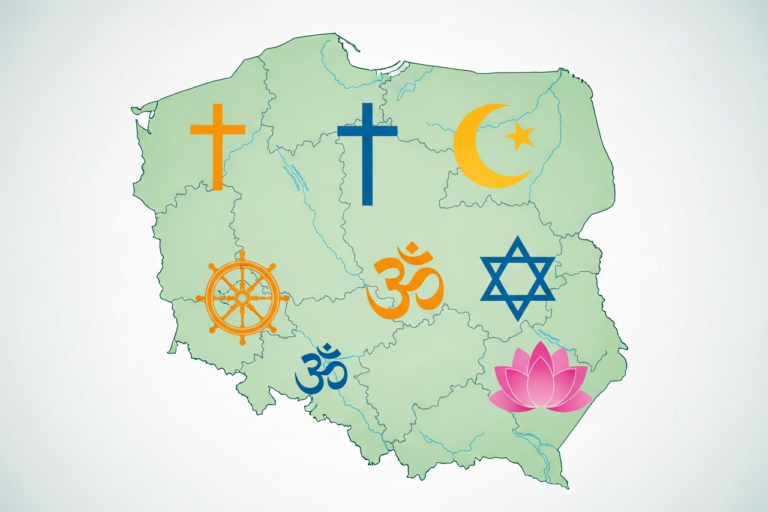
Poland is mostly Catholic, but there are also many religious minorities who live there. These people may be fewer in number, but they all have a long history. They help shape the culture of the country in their own way. Some of the most important groups are the Polish Orthodox Church, Protestant groups, and a small but strong Jewish community.
If you learn about these other religious denominations, you get a better idea of all the things that make up faith in Poland. We will now find out more about the Orthodox Church and Protestant faiths, the history of Jewish people in Poland, the Muslim community now, and other small religious groups.
Orthodox Christianity in Poland
One of the biggest minority religions in Poland is Orthodox Christianity. The faith is mainly brought by the Polish Orthodox Church. This church is part of the eastern orthodox branch and has been in the country for a long time. It is most common in the east of Poland, close to Belarus and Ukraine.
The Polish Orthodox Church leads the group for orthodox church members in Poland. It has its own leaders and runs things by itself, though it is still a part of the bigger Orthodox group around the world. Many people in this faith come from ethnic minorities. Some are Belarusians and some are Ukrainians who live in Poland.
Orthodox places of worship stand out in eastern Poland. Their buildings have onion-shaped domes and feature artwork inside that is special to their faith. These churches are important to the community. They help keep old customs and ways of worship in the country, which is mainly Catholic.
Protestant communities and presence
Protestant groups are also a known religious minority in Poland. The Protestant way goes back in the country to the 1500s. This is when the Reformation happened. During that time, Lutheranism and Calvinism became popular with some people in the cities and among the rich. After the Counter-Reformation, there were not as many Protestants left, but that way of faith did not fully go away.
Now, the biggest Protestant church is the Evangelical Church of the Augsburg Confession. This is a lutheran church. Most of its people live in the Cieszyn Silesia area, which is in the south of Poland. There are also other Protestant groups in the country, like Pentecostals, Baptists, and Adventists.
The government sees these groups as legal. They can teach religion and look after their own matters. Even if their numbers are small next to the Catholics, you can see that they bring something special to Poland’s long story and mix of faiths.
Jewish life and historical legacy
Before World War II, Poland had the largest Jewish community in Europe. Polish Jews were an important part of the nation for hundreds of years. They gave a lot to the country’s culture and economy. But almost all of this rich life was lost in the Holocaust.
Now, the Jewish community in Poland is small, but it is coming back to life. Some synagogues that were not destroyed by the war are being fixed up. Jewish festivals are popular, especially in Kraków and Warsaw. These events bring in people from different walks of life. They also help teach about the deep and long history of Polish Jews.
Today, even though they are few, the Jewish people in Poland work hard to rebuild their religion and their way of life. The story of Polish Jews is still strong for many in the country, and more people want to know about this hard, but important, past. The time before and after world war ii is a big part of this story for both Polish Jews and all of Poland.
Islam and Muslim communities in modern Poland
Islam has a long history in Poland, even if many people do not know about it. The first Muslim groups in the country were the Lipka Tatars. These people came to the Polish-Lithuanian Commonwealth many years ago. They helped out in the Polish military. Their children and families still live in Poland today, mostly in the eastern part of the country. The Lipka Tatars have worked hard to keep their own culture and faith.
In the past few decades, there are more Muslim people in Poland. The group has grown because of people who have moved there, like students, workers, and diplomats from the Middle East and other areas with many Muslims. This is why you can now find new places of worship and mosques in some large cities, like Warsaw.
Muslims are one of the religious minorities in Poland. They work and live with others in a space that allows for religious tolerance. The Muslim group is not big and deals with things that other minorities face as well. But it is important to remember that they help make Poland a more different and lively place. Their presence helps change and shape the country’s religious mix and adds new parts to its story.
Other smaller religious groups
Besides the larger minority faiths, Poland has some other small religious groups too. These groups might not have many people, but they help make the religious life in Poland more rich and mixed. One group is the Old Catholic Mariavite Church. This is a type of Catholic church that started in Poland in the early 1900s. It broke away from the Roman Catholic church.
There are also other groups like Jehovah’s Witnesses. They are one of the more noticed religious minorities because you might see them talk about their beliefs in public. Buddhists, Hindus, and people who follow many new types of religions are in Poland as well. Many of these groups are officially listed as religious unions. Because of this, they get some rights and safety under Polish law.
These different faiths have both people from ethnic minorities and Polish people who changed what they believe. Even if their numbers are small, their presence shows there is religious freedom in Poland. It also shows the country’s spiritual world is deeper than some may first think.
Religious Freedom and Legal Framework
In the Republic of Poland, freedom of conscience and religious freedom are rights that the law protects. The Polish Constitution makes sure that every person can follow their religion, or choose not to, without the state getting in the way.
This setup is important to know when we look at how a country like Poland, which has one main religion, deals with many kinds of faith. Next, we will look at what the constitution says about these rights, how the state works with different religious groups, and how a new group can get official status.
Constitutional guarantees for religious practice
The base of religious freedom in Poland is found in the Polish Constitution. The 1997 Polish Constitution clearly says that everyone has the right to freedom of religion. This is a key rule in the country. The law makes sure every person can believe in and practice any religion, and this is kept safe by the state. It is your personal choice.
The constitution also says that all churches and religious organizations have the same rights. This rule helps stop the state from showing favour to one group over another, even if the Catholic Church has a long past and a big role in Poland’s culture. The state may limit freedom of religion only if it needs to keep people safe, keep public order, protect public health, or care for the rights of others.
Here are the main rights from the constitution:
-
Freedom of Conscience and Religion: Everyone may pick and practise the faith they want.
-
Equality of Churches: All churches and religious organizations are seen as the same before the law.
-
Right to Religious Education: Churches can teach their faith, even in public schools, if they follow the rules.
The Polish Constitution, the idea of a personal choice, and the balance with keeping public order and the rights of others are all important when we look at religious freedom, the freedom of conscience, and the role of the Catholic Church in Poland.
State policy towards religious institutions
Poland has a way of handling religious groups that stands out. The constitution says that everyone should have equal rights. But, the laws for each religious group are not all the same. The state and the catholic church have their relationship set by a special agreement. This is the Concordat, and it is a treaty that Poland made with the holy see in 1993.
Other faiths do not have the same deal. There are separate laws for each. After 1989, the Polish parliament made laws for 15 other religious organizations. This list includes the polish orthodox church and the evangelical church of the augsburg confession. The council of ministers and other government officials would talk to people from those religious groups to help make the laws.
This set-up lets each religious group be guided by its own law. Some people say that this system does not give all groups the same rights. Since the new constitution in 1997, the state has not made new full laws for minority religions. This makes it hard for these groups to get the same type of official acceptance.
How new religious groups are registered
For a new religious group to gain legal personality in Poland, it must go through a specific registration process. This is governed by the 1989 Guarantees of Freedom of Conscience and Belief Act. By registering, religious organizations can gain important rights, such as the ability to own property, conduct public collections, and employ clergy.
The process involves submitting an application to the Ministry of the Interior and Administration. To be successful, a religious group must meet certain criteria. The most significant requirement is providing a list of at least 100 adult Polish citizens who are members of the group and declare their affiliation. This list is a key part of the application.
Currently, there are about 170 registered churches and religious unions in Poland. The registration process provides a legal framework for the functioning of smaller and newer religious movements.
|
Registration Step |
Description |
|---|---|
|
Application |
The religious group must submit a formal application to the relevant ministry. |
|
Membership List |
A list of at least 100 adult Polish citizens who are members must be provided. |
|
Group Information |
The application must include information about the group’s doctrine, rituals, and organizational structure. |
|
Ministerial Review |
The ministry reviews the application to ensure it complies with Polish law and does not threaten public safety or order. |
|
Entry into Register |
If approved, the group is entered into the official register of churches and other religious organizations, granting it legal status. |
Interfaith Relations and Dialogue
In a country like Poland, where there is one main faith and many smaller ones, talking and working together between different groups is very important. In Poland, people try to help everyone understand each other and show more religious tolerance. This helps keep the country peaceful and open for all.
These efforts bring many types of people together. They help make connections and face problems as a group. In this text, you can see how communities work with each other, what projects help build religious tolerance, and the ways problems of not getting along with other faiths are handled.
Cooperation between religious communities
Poland is known for being one of the more religious countries in Europe. Most people in Poland are Catholic, but there are some good examples of the catholic church and other religious groups working together. The Polish Ecumenical Council is one group where different non-Catholic Christian groups meet. They talk, work together, and try to help with different things in the community.
This kind of cooperation often happens in towns and cities. Leaders from different faiths may meet for special events, join in charity work, or help solve problems in the community. By doing this, they build up religious tolerance. They show that it is important to work together for common goals, even if there are differences in beliefs.
The catholic church is not a member of the Polish Ecumenical Council. Still, it takes part in its own interfaith talks, especially with the Jewish community and other Christian groups. These meetings matter a lot. They help grow mutual respect and understanding. In a place where one faith is so strong and public, opening up and talking to others is important for everyone.
Initiatives promoting interfaith understanding
There are many important efforts in Poland that help people understand different faiths and support religious tolerance. The goal of these programs is to teach the public, fight wrong ideas, and help people from different groups come together. Many of these efforts are run by NGOs, schools, or the religious organizations themselves.
One big example is the Day of Judaism in the catholic church, along with the Day of Catholicism in the Synagogue. These events help two groups, with a long and often hard shared history in Poland, talk to each other and show respect.
Other important efforts are:
-
The Polish Council of Christians and Jews: This group works to help Christians and Jews talk and work together more.
-
Cultural Festivals: These events, like the Jewish Culture Festival in Kraków, honour the culture of religious minorities and let more people know about it.
-
Academic Conferences and Workshops: Universities bring together people who study and lead different faiths to talk about interfaith life.
These steps matter. Public opinion research sometimes shows that people do not know much about minority religions. That is why teaching and open talks are very important tools for peace and respect.
Addressing religious intolerance
Poland has laws that support religious tolerance, but problems with hate and intolerance still happen, like in many other countries. It can be hard for the government and people in the community to fix these issues. There are rules in the Polish legal system that say you cannot try to make others hate someone because of their religion.
The state must protect public order and make sure the rights of others are safe from acts of intolerance. State security and police look into crimes that are caused by hate towards someone’s religion. Still, some minority groups say that the response to these crimes can be slow or not the same each time.
Civil society groups are also important in this fight. They keep track of what happens, help victims, and ask for better protections. Using education and helping different religious groups talk to each other is also seen as a good way to help build a kinder place where the rights of all religious groups are respected.
Changes in Religious Belief and Practice
Religious beliefs and practices in Poland are changing. The country is still very much connected to its Catholic past. But recent public opinion research shows clear shifts. People now attend church less often, and this is seen even more in young people.
This time of change raises many questions about the future of religion in Poland. Is religion slowly losing its place, or is there a chance it will grow again? Let’s look at the newest trends in how people show their faith, what the numbers tell us about these changes, and the big differences between the generations.
Trends in church attendance and faith expression
Yes, the newest numbers show that both religious beliefs and how people practice them are dropping in Poland. We see this in both public opinion research and in the church statistics. These reports say that fewer people are now showing up for Sunday Mass. For example, the 2024 report from the state research agency CBOS found that only 34% of Poles go to Sunday Mass the way they used to. This is the lowest it’s ever been.
The fall in numbers has been more clear in the last few years. Back in the 1990s until about 2019, the numbers went down slowly, but the drop got faster after the pandemic hit. The Catholic Church released their own church statistics and showed the same pattern. In 2022, church attendance was only 29.5%, but it was almost 37% right before the pandemic started.
This all shows that now, there is a bigger space between having religious identity and actually taking part in religious beliefs or activities. A lot of people still say they are Catholic, but the way they handle their faith is now different. Many do not feel they must go to Sunday Mass every week or join old rituals, though their personal religious beliefs may still be strong.
Decline or revitalization – what the data says
The data shows that fewer people in Poland are following old religious practices now. It is not going up. Church statistics show that not as many people are going to church these days as they did twenty years ago. Also, almost 14% of the Polish population now say they do not believe in any religion, and this is the highest number so far in 2024.
The 2021 national census showed the change very clearly. In 2011, 88% of people said they were Roman Catholic, but by 2021, that number went down to 71%. At the same time, more people also said they have no religious affiliation, and this number is now almost three times what it was before.
Some people may say that personal spirituality is rising, but the facts about groups like the church say something else. The main reasons people give for walking away from church are not about trying new religions. Instead, many feel that the church is too involved in politics, they are not interested any more, or they do not agree with what the church says about social issues.
Young people and generational differences
The number of young people going to church in Poland is getting lower, showing a big difference between age groups. Most research says that the younger people do not follow religion like their parents and grandparents did. This drop in faith is a big reason why fewer people are part of the catholic church now.
Studies also say that young people and those who went to school for more years are giving up on religious beliefs faster than others. A lot of young people in Poland do not feel close to the catholic church. They think the church’s views on social issues are old-fashioned. They also do not like that the church is mixed up in politics.
This gap between ages in how they see faith is hard for the Catholic Church in Poland. The older group still sees the church as important to who they are. But many young people are building who they are without being in a church. This shows that the whole culture in Poland might change.
Religion and Education in Poland
The Catholic Church has a big say in both religion and education in Poland. You can see this in many ways, like religion classes taught in public schools. The church is also connected to many faith-based schools. Because of this, religion has a formal job in raising many kids in Poland.
This setup shows how the church has been important in Poland for a long time. But it also makes people talk and sometimes disagree. Here, we will look at how schools teach religion, what Catholic and other faith schools do, and how the topic of religion comes up at university.
Religious instruction in schools
In Poland, religious teaching is a part of the public school system. This shows the big role that the catholic church and religion have in everyday life. An agreement between the state and the catholic church means these classes are in public schools and kindergartens. These classes are not must-do, but they are easy to find across the country.
People in charge say that parents get to choose if their kids will join religion, ethics classes, or not go to either one. The catholic church checks what gets taught in their classes, but all the teaching happens inside public schools. The way the church is part of the normal school day in this way is something special to Poland.
There is often talk about this setup. Some people think it makes the line between church and state unclear. They also say it can put social pressure on students who do not take the class. Others believe that this right is in the constitution and helps parents make sure their kids learn in line with their faith.
The role of Catholic and faith-based schools
In Poland, you will find that the Catholic Church and some other religious organizations run their own schools. These schools start at the primary level and go up to high school. They are a big part of the way people here learn. The lessons at these schools mix religious beliefs with the usual school subjects.
Many people think that Catholic schools give a good education. They also help children learn more about their moral and spiritual life from the church. Most of the time, these schools are private. But, some get public money, too. Families often pick these schools if they want their kids to grow in both faith and school learning.
A few other religious organizations do have schools, but not as many as the Catholic Church. This helps different groups teach their beliefs and ways of life to young people. So, these choices make it possible for parents in Poland to pick what is best for their children’s learning and religious life.
Universities and academic study of religion
The study of religion in Poland is strong and well-respected. Programs are offered by both secular and Catholic universities. These schools give people a place to look at religion, learn about its history, and talk about how it works in society. The freedom in these classes helps students see things from many points of view. This leads to a deeper look into different faiths.
Catholic schools like the John Paul II Catholic University of Lublin are important for those who want to learn more about Catholic ideas and beliefs. State schools that are not connected to any church also have places to study religion, sociology, and history. Here, religion is seen as a part of culture and everyday life. This helps support freedom of expression in school life.
Some main parts of the study of religion are:
-
Theological Faculties: Lots of universities have departments that focus on Catholic theology. Most work closely with the church.
-
Religious Studies Programs: Secular schools offer classes on many world religions from a viewpoint that is not tied to any faith.
-
Research Centres: Some centres focus on things like how people of different faiths get along, how religion fits into society, and the story of religion in Poland. Their work gives useful information to the public.
John Paul II Catholic University of Lublin
Religion in Public Life and Holidays
Religion in Poland is not just something people keep to themselves. It can be seen everywhere and plays a big role in public life. People in the country mark important times of the year with religious holidays. These holidays are big events for everyone. You will often see crosses and other religious items in many places outside the home. The Catholic Church will often speak out about big things that matter in the country, like laws and social topics.
This strong show of faith helps set how people in Poland live, act, and come together as a society. Up next, we will talk about how people celebrate the main holidays, what it means to see religious items in public, and how religion shows up at work and in government rules.
Celebrating Easter, Christmas, and other key holidays
The celebration of major Catholic Church holidays like Easter and Christmas is a big part of Polish life and culture. These days are not just about religion. They are also large national events that are tied into the yearly calendar. Many of these church holidays are also days off for the whole country, so they have a special place for all of us.
At Easter and Christmas, people mix both faith and local customs in what they do. For Easter, the blessing of food baskets on Holy Saturday is common. Families get together for a big Easter Sunday breakfast. At Christmas, most families sit down for Wigilia, the Christmas Eve supper. People share the “opłatek” wafer and always leave an empty seat in case someone drops by who needs a place to eat.
Other days that show how catholic church and everyday life come together are:
-
All Saints’ Day (November 1): On this quiet day, millions go to cemeteries. They light candles for friends and family who have passed away.
-
Corpus Christi: This is marked with bright parades that move through both towns and villages.
-
Assumption of the Virgin Mary (August 15): Many go on journeys to holy places like Częstochowa on this date.
These holidays show how catholic church life is tied to public events and bring people across Poland together.
Religious symbols in public spaces
Religious symbols, mainly from the catholic church, are seen all over Poland in public spaces. You can find crosses in schools, hospitals, and where the government works. They are even in the main room of the Sejm, which is the lower house of parliament. This all shows that the catholic church and Poland have a long history together.
People talk a lot about these symbols being in public buildings. Some people support this and say it shows the values of most of the polish population. They say it is part of their freedom of expression and national history. Others do not like it and think it goes against the idea that the state should be neutral. It can also make people who follow another faith or have no faith feel left out.
You also see crosses and small chapels on roadsides in the countryside. Local people put them up to show their faith. These symbols are everywhere and remind people of how important religion is in daily life and the culture of Poland.
Religion in workplace and government regulations
The idea of religious freedom is present at work in Poland, but how it works can be tricky. The law says that workers will not be treated unfairly because of religion. Still, you can see religious symbols in some government spots. This mix of state work and showing faith is something you will find in Poland.
There are not any main government rules that say all private bosses must make space for religion at work. Still, they should be careful of workers’ rights. Most of the time, these matters are looked at one by one. Also, there are separate laws for different religious organizations that might help members get time off for a special religious day.
When people talk about religion at work, they need to find a balance. They have to think about the right for a person to show their faith and also keep the place open for everyone and respect the rights of others. For government officials, they always have to think about how their job fits with the country’s top faith. This is a big part of their work in politics.
Experiences of Religious Minorities
Life for religious minorities can be different in a country where there is one main faith. In Poland, groups like the Polish Orthodox Church, the Jewish group, and people who practice Islam live in a place that is shaped by the Catholic Church. The way they live shows much about how the country deals with religious diversity.
The law says that everyone should have equal rights. But, what happens from day to day is not always the same. Let’s talk about how easy it is for these groups to get to their places of worship. We will also look at how people treat them, what problems they have, and what kind of help they get as religious minorities in Poland and inside the Orthodox Church.
Accessibility to places of worship
Most of the established religious minorities in Poland have good access to places of worship. This is true, especially for groups that have been in the country for a long time. The Polish Orthodox Church, for example, has many churches. You can find a lot of these churches in the east where their members live. Other groups, like Protestants, also have their own churches, and they are found in different cities.
But for smaller or newer religious groups, things can be harder. Muslims or Buddhists may have only one or two places to pray. Many of these are found only in bigger cities. Because of that, some people who live in other places may find it tough to be part of their religious life.
Building new places of worship for non-Catholic groups, like a new Orthodox Church, is allowed by law. Still, at times, there can be issues. Some people living nearby might not want it, or there may be some paperwork that slows things down. But overall, the right to make and keep these places is important for religious freedom in Poland. This gives each group of people a way to practice what they believe.
Social attitudes towards minority faiths
Social attitudes in Poland towards minority faiths are quite mixed. The laws support religious tolerance. Still, public opinion research shows that how people feel about a group often depends on which one it is. Some faiths, like Orthodox Christianity and Protestantism, have a long history here. People in Poland know about them, and many accept them.
Views about other groups, like Muslims or Jehovah’s Witnesses, are less clear. Some people may hold stereotypes or simply have not met members of these groups. Things people see in the media or hear in public talk can change the way they think. Some ethnic minorities see their faith as a big part of who they are, so they sometimes face bias for both reasons.
Even so, many people in Poland show interest and want to know more about other faiths. Cultural days and festivals for Jewish or Tatar groups often pull in big crowds. In all, there are still things to work on, but Poland does have a base of tolerance. The best way forward is to keep working to help people better understand and accept all minority faiths.
religious tolerance, ethnic minorities, public opinion research
Challenges and support for religious diversity
Religious minorities in Poland deal with many challenges. One big challenge is being a small group in a country where one religion is very powerful. This can make people in these groups feel that they are not seen or known by the larger community. These small groups can also find it hard to get money for events or to keep their buildings up.
Another problem is dealing with unfair treatment and dislike of people who are different. Even though Poland has laws to protect religious freedom and human rights, some groups, like visible minorities, do face hate or unkind actions. The government and local groups are both working to fix this and help people see each other fairly.
But, Poland also helps religious diversity in some ways. The government does give some money for the work of ethnic minorities. Many of these groups are also religious minorities. There are also other groups that are not part of the government. They fight for the rights of religious minorities and help people of different religions talk to each other. These kinds of support are very important. They help religious minorities not only live in Poland, but do well and be part of the country.
Conclusion
To sum up, knowing about the religious traditions in Poland helps Canadians as they travel or meet people in this lively country. Poland has a long history with Catholicism and there are also more people each year who practice other faiths. This gives the country a mix of old customs and new ideas. If you join religious celebrations or just talk with local people, being polite and knowing about their beliefs will make your time there better. Before you go, think about how this information can help you connect and get more out of your trip. Take the chance to see and value the different ways people believe in Poland. If you want help or more advice, reach out to us anytime for a free talk!
Frequently Asked Questions
Is Poland a secular or religious country?
Poland does not have an official religion, so it is a secular country. But a lot of the Polish population follows the Roman Catholic faith. The Catholic Church has a big role in the culture and daily life of many people, and their religious beliefs are a big part of their national identity.
Are religious customs important for visitors to know?
Yes, it is good for people to know about religious customs. You do not need to take part in religious services or join in at places of worship. But, it is nice if you show respect. Knowing how holidays like Easter and Christmas are done will help you get more from the polish culture.
Can Canadians practice their faith openly in Poland?
The Republic of Poland gives people religious freedom and the right to follow their own conscience. These rights are basic for everyone. Canadians of any faith can practice their religion out in the open in Poland. There are places of worship for many religions, mostly in bigger cities. The law in Poland will protect your right to follow your faith.