Key Highlights
-
Italian greetings are a big part of Italian culture. They show respect and let people know how close you are.
-
Time of day matters. People say “Buongiorno” in the morning and “Buonasera” in the evening.
-
It is important to know when to use a formal greeting, like “Salve,” and when to use an informal greeting, like “Ciao.” This depends on the social setting.
-
Body language is also a big deal with Italian greetings. You might see a firm handshake or cheek kisses, which are called “il bacetto.”
-
Always use a formal greeting at first. Only use an informal one when someone asks you to do that.
-
You should answer a greeting the right way, not just start one. This shows you understand Italian culture.
Introduction
Welcome to the bright and friendly world of Italian greetings! If you are from Canada and get ready to travel to Italy, it is good to know the local ways from the start. In Italian culture, people care a lot about being polite and getting to know each other. Greetings are a big part of this. When you learn a few words in the Italian language, you will find it helps you in many social situations. It also shows you respect the people you meet. This guide will show you the most important italian greetings, so your time in Italy will be better and easy to remember.
Understanding Italian Greeting Customs for Canadians
Getting to know Italian culture as someone from Canada can be very nice, especially when it comes to how people say hello. The way people use italian greetings can change a lot based on what is happening. In professional settings, you will use different italian greetings when meeting new acquaintances than when you see your close friends.
If you learn these common greetings, you will make a good first impression. It could be a formal handshake or just saying “ciao” in a friendly way. When you use the right greeting, people see that you value and know their customs. Let’s look at the various ways people say hello, so you know what to do for every day and any meeting.
Why Greetings Matter in Italian Culture
In Italian culture, saying hello is more than just a word. It is an important part of how people meet for the first time and set the mood for a talk. The greeting you use shows the level of formality and tells the other person about your relationship with them. If you do not greet someone, especially in a small shop or quiet street, it can look rude.
Italian greetings show how the country values community, respect, and always noticing others. No matter if you are in a busy market or at a serious business meeting, you should take a moment to greet people. Doing this lets others know you respect them and that they count, and this is at the heart of daily life in Italy.
Italian greetings are not just about words. Body language is also very important. A warm smile, looking people in the eyes, and the right touch all add to how people connect. If you get these things right, you will handle social situations well and make good connections with Italians.
First Impressions: What Canadians Should Know Before Visiting Italy
For Canadians going to Italy for the first time, it is good to know how to greet people. When you meet new acquaintances, it’s best to start with a formal greeting. You can say “Buongiorno” or “Buonasera” with a warm smile. This is a safe and good way to show respect.
In professional settings or when talking to someone older, people expect a formal greeting. You should give a firm handshake, and if a woman is there, let her offer her hand first. This shows that you know about their cultural rules and are polite.
For friends or family, “Ciao” is okay. Italians use a lot of body language, and they can be very friendly. Still, it’s smart to let them use informal words or actions first. This way, you will not make things feel strange or awkward.
Common Italian Greetings and Their Meanings
Learning some Italian greetings is a good step if you want to get ready for your trip. Like in other different languages, Italian uses many common phrases to say hello. Each one has its own use and meaning. These words are basic for polite talk.
If you understand the core greetings, you will feel more sure and relaxed. People in Italy say “Ciao” a lot, and you will also hear the formal “Buongiorno”. Each greeting works in its own special way. Let’s see some of the common phrases and italian greetings you will come across and use in Italy.
Everyday Greetings: Ciao, Salve, Buongiorno, and More
When you are in Italy, you will hear a few key greetings throughout the day. “Buongiorno” is a versatile phrase that means both “good morning” and “good day.” It is a polite and common way to greet people until the afternoon. As the day progresses, around 4 p.m., you will switch to “Buonasera” for “good evening.”
“Ciao” is perhaps the most famous Italian greeting, but it’s informal and used for both “hi” and “bye” among people you know well. For a neutral option when you’re unsure, “Salve” is your best bet. It is a polite “hello” that works well with strangers or new acquaintances without being overly formal.
Here is a quick guide to some common greetings:
|
Italian Greeting |
English Translation |
When to Use It |
|---|---|---|
|
Ciao |
Hi / Bye |
Informally, with friends, family, and peers. |
|
Salve |
Hello |
A neutral greeting, suitable for strangers or when unsure of formality. |
|
Buongiorno |
Good morning / Good day |
Formally and informally, from morning until mid-afternoon. |
|
Buonasera |
Good evening |
Formally and informally, from late afternoon onwards. |
Formal vs. Informal Greetings: When to Use Each
Picking the right level of formality is very important in Italian social rules. In many formal situations, you need to use a formal greeting. For example, when you talk to elders, people at work, or someone you do not know. Saying “Buongiorno” or “Buonasera” is a good way to show respect. In these cases, this is the right level of formality to use.
On the other hand, an informal greeting like “Ciao” is for casual situations. This word is a casual way to say hello to friends, family, or people about your age. Do not use it with a stranger or someone with power because they might think you are too close. Save informal greetings like “Ciao” for people you know well.
You need to watch how people greet you, and then match their style. If they use an informal greeting, you can do the same. If you are not sure, start with a formal greeting. Using the right level of formality shows that you understand Italian customs and that you want to show respect in your conversations.
A Beginner’s Guide: How to Master Italian Greetings
Are you ready to use your knowledge in real life? Learning how to say Italian greetings is easier if you know the situation. The greeting you pick can change by the time of day, who you talk to, and what kind of moment it is. It helps to know when you should say “good morning” or “good evening”.
You could be in professional settings or just hanging out with close acquaintances. Practice will help you get better. This guide gives you easy tips that make you feel good when saying hello. It works when you talk to a shopkeeper, a friend, or someone at work. Let’s go over simple steps and make Italian greetings easier for you.
What You Need to Get Started as a Canadian Traveler
As a Canadian traveler in Italy, learning a few basic Italian greetings can really help you out. It’s not about being perfect. People like it when you try, and it makes the place feel more friendly. When you use these greetings, it feels like a fun language exchange. You get to try out something new.
Start with greetings that work at different times of day. In the morning, say “Buongiorno” for “good day.” Around the middle of the day, use “Buon pomeriggio” for “good afternoon.” When it’s late afternoon or getting dark, switch to “Buonasera.”
To help you get going, focus on these simple phrases:
-
Buongiorno: Say this from morning till about 4 p.m.
-
Buon pomeriggio: Use it early to mid-afternoon. People also say “Buongiorno” then.
-
Buonasera: Pick this one from late afternoon onward.
-
Salve: This means “hello.” You can use it at any time of day if you’re unsure.
These words are easy to use and helpful at any time of day. They make your language exchange better. You’ll find people will welcome you more, and that can make your trip feel good.
Step-by-Step Guide to Greeting Customs in Italy
Greeting someone in Italy for the first time can feel a bit like acting on a stage. There are set lines, cues, and even some special moves. This step-by-step guide will help you understand what to do, so you blend into Italian culture with no trouble and feel sure of yourself.
The first thing to do is to pick the best way to say hello. To do this, think about the time of day and the setting. Be sure to use the right level of formality. Common greetings are an important part of every good meeting.
After you know what to say, add in the gestures. In Italy, people use handshakes and cheek kisses a lot. These little things are big in Italian culture when you meet someone. If you follow these, you will give off a good and polite vibe each time.
Step 1: Choosing the Right Greeting for the Time of Day
The time of day decides what greeting you should use in Italy. Most of the day, you can say “Buongiorno,” which means “good morning” or “good day.” It is okay to use this from when you get up until the middle of the afternoon.
When it gets later, like around 4 or 5 p.m., you should start saying “Buonasera.” This phrase means “good evening,” and you use it for the rest of the night. There is also “Buon pomeriggio” for “good afternoon,” but people do not say it as much as “Buongiorno” or “Buonasera.”
It’s a good thing to know “Buona giornata” as well. This means “Have a good day.” People use this when they are leaving, not when they just walk in. There is “Buona serata,” too. This stands for “Have a good evening,” and it is said to someone when you say goodbye in the evening.
Good morning, good day, good evening, time of day, late afternoon, good afternoon, buona serata, buon pomeriggio, buona giornata.
Step 2: Greeting Individuals vs. Groups
When you walk into a room or join a group, it is good to greet everyone you see. You can say “Buongiorno a tutti” (good morning everyone) or “Salve a tutti” (hello everyone). Both are nice to use in professional settings or in casual situations.
After you greet the group, you might meet new acquaintances. When this happens, take a moment to greet each person. Look them in the eye and give a handshake to show that you are polite and care about others. This makes people feel good and welcome.
If you see your close friends, things can be more easygoing. You might wave and say, “Ciao a tutti!” as you come in. The main thing is to notice everyone when you get there. People in Italian culture like to feel included, so it is important to do these small things.
Step 3: Using Gestures — Handshakes, Hugs, and Kisses
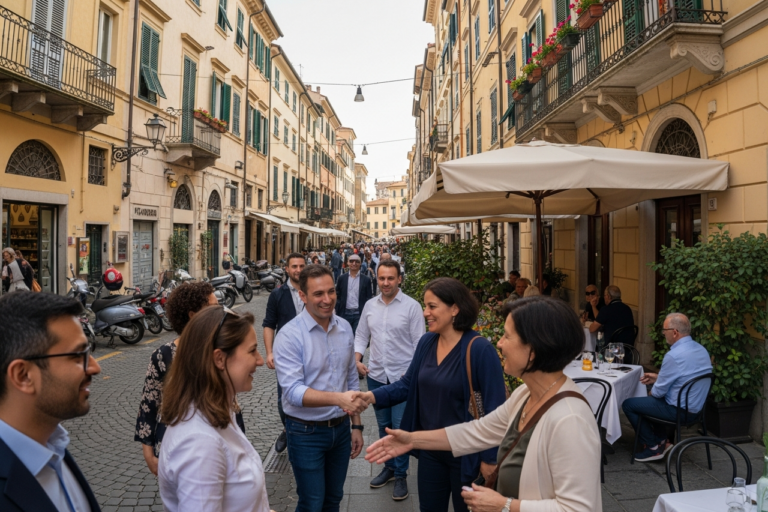
Italian greetings are well-known for how people use their faces and hands when saying hello. It’s not just about what they say. Things like a firm handshake or cheek kisses show how warm and open people can be. It’s important to know these italian hand gestures if you want to blend in.
When you first meet someone or if you are in a formal setting, always use a firm handshake. This shows you have respect for the other person. When meeting a woman, you usually wait for her to offer her hand first. As you get to know someone, greetings can quickly get more personal.
The double cheek kiss, which italians call “il bacetto,” is a common greeting between close friends or family members. People do this to show kindness, and it is a standard part of life there.
-
The Handshake: A firm handshake is best when you meet someone for the first time, or in a job or formal setting.
-
The Kiss (“Il Bacetto”): Close friends or family members give each other two small kisses on the cheeks. You start on the left cheek (your right).
-
The Hug: A hug is given to close friends and family members only.
You will notice that italian greetings show strong body language. Small things like a double cheek kiss or handshake can say a lot about how people feel. If you learn these customs, you will get on much better with other people.
Step 4: Responding to Italian Greetings Politely
Responding to a greeting is just as key as giving one. The most simple way to answer is to say back the same greeting you just got. If someone says “Buongiorno,” you can say “Buongiorno” right back. This is an easy and polite way to keep things friendly.
Many times, once you get a hello, they may ask you something like “Come sta?” for formal or “Come va?” if it’s more casual. A good way to keep it going is to say, “Bene, grazie. E Lei?” if it’s formal. Or you can say, “Bene, grazie. E tu?” for informal chat. This helps make the talk friendly.
If you are meeting a person for the first time, they may tell you “Piacere di conoscerti,” which means nice to meet you. You can answer by saying, “Piacere mio,” meaning the same for me. If you see someone you know, they might say, “Che piacere vederti!” which means what a pleasure to see you. For this, you can show a warm smile and say something just as nice back.
Frequently Asked Questions (FAQ)
Getting to know Italian greetings can feel hard at first. There are a few things that will help make it easy. For different times of day, people often use certain phrases. You can say “buon giorno” in the morning. For early afternoon, “buon pomeriggio” is a good fit. When it gets later, you can use “buona sera”.
For more informal places, phrases like “come va?” or “che piacere vederti!” work well, especially with friends or people you have just met.
Body language is a big part of using Italian greetings. Giving a warm smile or a quick cheek kiss shows you want to connect with other people. Don’t forget to smile when you use these greetings, as that can make all the difference!
How do I politely say goodbye in Italian?
To say goodbye in a more formal way, people use “Arrivederci.” If you want a casual way, you can say “Ciao.” This word works for both hello and goodbye when talking with friends. In the evening, you can use “Buona serata” to wish someone a good evening as you go. Each of these shows respect and helps you end your talk in a kind way.
What is the difference between “ciao” and “salve”?
The main thing that makes italian greetings different is how formal they are. “Ciao” is an informal greeting. People use it with friends and family. “Salve” is a neutral greeting, so it’s a good and polite word when you do not know what kind of social setting you are in. “Salve” is more formal than “ciao,” but not as formal as “buongiorno.”
Are there any greetings that should be avoided in Italy?
Most of the time, using casual greetings is okay in informal contexts. But you should not say things like “Ciao, bella” or “Ciao, bello” to strangers. Some people may see this as too forward. Also, pay attention to your body language. It is good to avoid rude gestures, especially in professional settings. These can be taken the wrong way.
How do Italians greet each other with gestures?
Italians use a lot of body language when they greet each other. You will see people move their hands and show big feelings. In a formal situation, it is common to give a firm handshake. When friends or family meet, they often give each other a double cheek kiss. This is called “il bacetto.” These greetings also have a lot of warm smiles and happy gestures. It is the way people in Italy show their warmth.
Conclusion
To sum up, using Italian greetings is a big part of getting to know and enjoy the culture. People use words like “Ciao” for a simple hello, and more formal greetings too. When you know how to greet others the right way, your trip to Italy can feel much better. Remember, greetings in Italy are not just words. They often come with gestures that show warmth and friendliness. If you follow the easy steps in the guide, you will feel sure of yourself and show respect when you talk to people. So, before you head out on your Italian trip, take some time to practice these greetings. Enjoy your time there and the great people you will meet along the way!