

Last reviewed: August 2026
What Is Pakistan’s Official Currency?
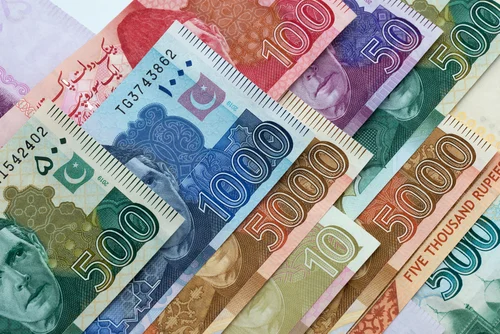
Pakistan’s official currency is the Pakistani rupee (PKR), issued by the State Bank of Pakistan. Coins run from 1 to 50 rupees, and banknotes from 10 to 5,000 rupees. It’s not interchangeable with the Indian rupee.
If you’re sending money to family in Pakistan or planning a trip there from Australia, you’ll be dealing with the Pakistani rupee (PKR), Pakistan’s official currency. It’s also important to note that the Pakistani rupee is not interchangeable with the Indian rupee. Rupees are currently minted by Pakistan’s central bank, the State Bank of Pakistan.
Pakistan also counts large sums using the lakh and crore system rather than millions.

Pakistani Rupee: Quick Reference Facts
- Currency code: PKR
- Abbreviation: Rs
- Issuing authority: State Bank of Pakistan
- Coins: 1, 2, 5, 10, 20, and 50 rupees
- Banknotes: 10, 20, 50, 100, 500, 1,000, and 5,000 rupees
- Numbering system: 1 lakh = 100,000 rupees; 1 crore = 10 million; 1 arab = 1 billion; 1 kharab = 100 billion rupees

A Brief History of Pakistani Currency
The word “rupee” traces to the Sanskrit “rūpyakam” (“coin of silver”). The rupee itself dates to the 1540s, when Afghan ruler Sher Shah Suri introduced it as a silver coin from present-day Delhi, briefly interrupting Mughal rule.
Britain ruled Pakistan from 1857 to 1947. Pakistan gained independence in 1947 without a central banking system, so the Reserve Bank of India temporarily provided its currency while the Government of Pakistan set up its own banking system and printing press.
The State Bank of Pakistan issued the first banknotes on October 1, 1948, in the denominations of 5, 10, and 100 rupee notes. The bank released 1- and 2-rupee notes approximately six months later.
While smaller denominations are no longer in use, Pakistan once subdivided the rupee into the anna and the paisa (paise is the plural form). Four paise equalled one anna, and 64 paise equalled one rupee. In 1961, Pakistan discontinued the anna, and it stopped minting paise in 1994.
Older-design banknotes were phased out between 2016 and 2021 and are no longer in circulation.
The national bank pegged the rupee to the British pound (GBP) to manage inflation. When Pakistan separated from the pound in 1981, inflation increased, the rupee lost value, and Pakistan moved to a managed exchange rate rather than a single peg, leaving it more exposed to trade and investment shocks.

Pakistani Rupee Denominations: Coins and Banknotes
The State Bank of Pakistan has changed the rupee’s design over time. According to the State Bank of Pakistan, the current series was introduced in 2005, and each banknote has a different colour and size, as well as watermarks and security threads to prevent counterfeiting.
Coins run from 1 to 10 rupees in everyday use, Rs 1, 2, 5, and 10, all featuring the crescent-and-star emblem. If you enjoy comparing banknote designs, our roundup of the world’s most beautiful currencies is worth a look.
Banknotes run from 10 to 5,000 rupees: 10 (grey-green), 20 (orange), 50 (purple), 100 (green), 500 (deep blue), 1,000 (brown) and 5,000 (violet-blue), each featuring Muhammad Ali Jinnah on the front and a Pakistani landmark or landscape on the back; for example, the 50-rupee note shows K2.
Ask for smaller notes, i.e., 100 and 500 rupees are the most practical for everyday spending; 1,000 and 5,000 notes can be hard for vendors to break outside major cities. If you’re planning to visit soon, our guide on visas in Pakistan covers relevant information.

Getting Pakistani Rupees From Australia
Plan ahead: Pakistani rupees aren’t as common at Australian currency exchanges as euros or US dollars.
- Order PKR before you travel. Some Australian banks and exchange providers, such as Travelex and Australia Post Travel Money, can order rupees ahead, though availability varies by branch.
- Withdraw from an ATM in Pakistan. ATMs often give a better deal than exchange counters, and Visa and other major networks make it easy to find compatible machines, though fees apply.
A few safety basics: cover the keypad when entering your PIN, prefer ATMs inside a bank branch or hotel lobby over standalone street machines, avoid withdrawing after dark, and check the card slot for anything that looks tampered with before inserting your card. - Use a travel or debit card. A low-fee travel or debit card lets you pay directly in PKR without carrying cash.
Planning travel money for other destinations too? Our guide to the Moroccan dirham covers similar ground.
Pakistan’s customs rules, set by the Federal Board of Revenue, allow up to around AUD 13,900 (USD 10,000) in foreign currency without declaring it on arrival, plus up to around AUD 50 (PKR 10,000) in Pakistani cash when leaving the country.

Pakistani Currency: 5 Facts Worth Knowing
1. The word “rupee” has ancient Sanskrit roots. Today, Pakistanis also call rupees “rupaya” or “rupaye,” and references to “rūpyakam” as a silver coin extend back to roughly the mid-300s BCE.
2. Sher Shah Suri introduced the first coin called “rupee.” The Suri dynasty briefly interrupted Mughal rule in the 1540s; Sher Shah Suri, an Afghan ruler governing from present-day Delhi, struck the rupee as a silver coin weighing around 178 grains.
3. Pakistan’s first currency was Indian money, overprinted. Rather than printing new currency, the Reserve Bank of India initially supplied Pakistan with existing Indian rupee notes overprinted with the words “Government of Pakistan.” The State Bank of Pakistan later took over issuing and printing rupee banknotes.
4. Early banknotes were printed in two languages. Pakistan initially consisted of West and East Pakistan, with two major languages, Urdu and Bengali, so early banknotes were bilingual. Once East Pakistan became Bangladesh in 1971, Pakistan dropped the Bengali text, and surviving bilingual notes are now rare collector’s items.
5. Pakistan issued special “Hajj notes” for pilgrims until 1978. In the 1950s, growing numbers of Pakistani Muslims performed the Hajj pilgrimage to Saudi Arabia. The State Bank of Pakistan issued special “Hajj notes,” which acted as travellers’ cheques, until 1978, and are now popular collector’s items.
Curious about another currency with a rich backstory? Our guide to the Turkish lira covers a similarly long history.

Frequently Asked Questions About Pakistani Currency
What is Pakistan’s currency, and what does PKR stand for?
Pakistan’s official currency is the Pakistani rupee, or PKR, its ISO 4217 currency code, issued by the State Bank of Pakistan. It comes in coins from 1 to 50 rupees and banknotes from 10 to 5,000 rupees, and isn’t interchangeable with the Indian rupee.
Is the Pakistani rupee the same as the Indian rupee?
No. The Pakistani rupee (PKR) and Indian rupee (INR) are separate currencies issued by different central banks, despite sharing a historical root.
What is a lakh?
A lakh is a South Asian numbering unit equal to 100,000. It’s used in Pakistan alongside crore (10 million), arab (1 billion), and kharab (100 billion) for large sums.
How can I get Pakistani rupees from Australia?
You can order PKR through Australian banks or exchange providers such as Travelex or Australia Post Travel Money before you travel, or withdraw cash from an ATM in Pakistan.
How much cash can I bring into Pakistan?
Under Federal Board of Revenue rules, travellers can bring in up to 13,900 AUD (USD 10,000) (or equivalent) and up to 10,000 Pakistani rupees in cash without declaring it.
Key Takeaways
Sending money elsewhere too? Our guide to the South African rand covers another popular corridor.
Here’s what else to remember:
- The Pakistani rupee (PKR) is Pakistan’s official currency, issued by the State Bank of Pakistan, and it’s separate from the Indian rupee.
- The rupee’s roots trace to 1540s Sanskrit-derived coinage under Sher Shah Suri, with the State Bank of Pakistan issuing its first modern banknotes in October 1948.
- For everyday spending, 20, 50, and 100 rupee notes are most practical — larger notes can be hard for vendors to break outside major cities.
- Travellers can bring up to USD 10,000 (or the AUD equivalent) and up to 10,000 Pakistani rupees in cash into Pakistan under Federal Board of Revenue rules.
If you’re ready to send money to loved ones in Pakistan, Remitly can help you compare your options



