Vietnamese currency is the Vietnamese đồng (VND), symbol ₫, issued by the State Bank of Vietnam. Vietnam mainly uses banknotes in large denominations (10,000–500,000 VND), while coins are uncommon. This Remitly guide explains common notes, pricing shorthand, and cash-handling tips to help you use Vietnamese money confidently.
Quick Answers
- Currency name: Vietnamese dong
- Code: VND
- Symbol: ₫
- Where symbol appears: Usually after the number in Vietnamese formatting
- Thousand separator: A period is used, as in 100.000 ₫
- Common shorthand: “k” means thousand
How to read Vietnamese prices
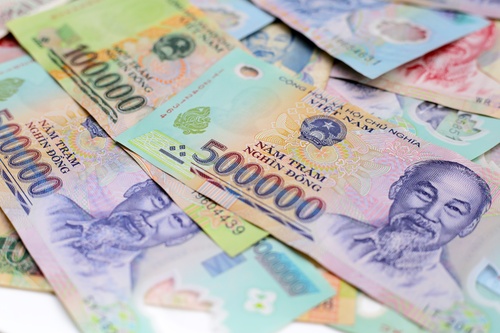
In Vietnamese-language number formatting, the currency symbol typically follows the amount so you may see prices written as 50.000 ₫, while English-language sites may use 50,000 VND. Vietnamese formatting also uses a period to separate thousands, rather than the comma. That means 50.000 ₫ equals 50,000 dong, not 50 dong.
You may also encounter the informal shorthand “k” for thousand, particularly on menus, signs, and casual listings. For example, 50k means 50,000 dong, while 100k means 100,000 dong. This shorthand is informal rather than an official currency symbol, but its use alongside full dong amounts is common in Vietnam.
Vietnam is cash-forward rather than a cash-only destination. According to the Vietnam National Authority of Tourism, cash is commonly used for small purchases and street vendors, while hotels, restaurants, tour operators, grocery stores, and spas generally accept international credit and debit cards.
Tip: If you’re visiting Vietnam and plan on using your card, carry some dong as backup because payment options can vary from one business to another.
Vietnamese banknotes in circulation
The State Bank of Vietnam (SBV) lists Vietnamese banknotes from 100 VND to 500,000 VND. The lower denominations are printed on cotton paper, while notes from 10,000 VND upward are polymer.
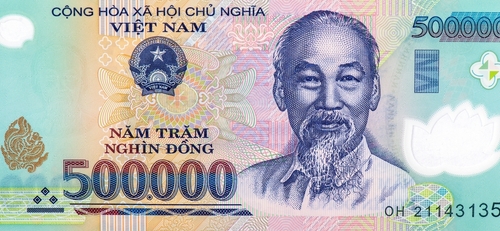
One design feature makes the notes easier to recognize: Ho Chi Minh appears on the front of every denomination from 200 VND to 500,000 VND. The 100 VND note is the exception. The reverse changes with each denomination, showing Vietnamese landmarks, industries, and landscapes such as Ha Long Bay, the Temple of Literature, and the Japanese Covered Bridge in Hoi An.
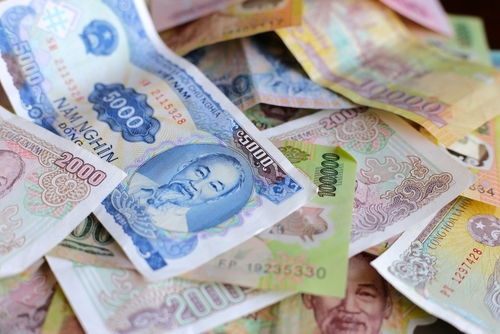
| Denomination | Material | Commonness | Easy identifier | Practical note |
| 100 VND | Cotton paper | Rare | Blackish-brown, Pho Minh Tower on back | Very low value note, also the exception without Ho Chi Minh’s portrait on the front |
| 200 VND | Cotton paper | Rare | Reddish-brown, agricultural scene on back | Unlikely to play a major role in everyday travel spending |
| 500 VND | Cotton paper | Rare | Lotus red, Hai Phong Port on back | May appear as small change |
| 1,000 VND | Cotton paper | Less common | Purple, Yak Don National Park elephants on back | Useful for recognizing smaller amounts and change |
| 2,000 VND | Cotton paper | Less common | Dark brown, Nam Dinh textile factory on back | Another smaller change denomination |
| 5,000 VND | Cotton paper | Less common | Dark blue, Tri An Hydropower Plant on back | Highest cotton-paper denomination listed by the SBV |
| 10,000 VND | Polymer | Common | Dark yellow, Bach Ho oilfield on back | Smallest polymer note |
| 20,000 VND | Polymer | Common | Dark blue, Japanese Covered Bridge in Hoi An | Check the zeros carefully because its blue coloring can resemble the 500,000 VND note |
| 50,000 VND | Polymer | Common | Red and purplish brown, Nha Rong Port on back | Mid-range note you may encounter regularly |
| 100,000 VND | Polymer | Common | Dark green, Temple of Literature on back | Check the denomination before handing it over |
| 200,000 VND | Polymer | Common | Brownish-red, Ha Long Bay on back | A higher-value note, so it helps to confirm the zeros when paying |
| 500,000 VND | Polymer | Common high value note | Blue and bluish-purple, Ho Chi Minh’s house in Kim Lien on back | Vietnam’s largest banknote denomination, take extra care not to confuse it with the 20,000 VND note |
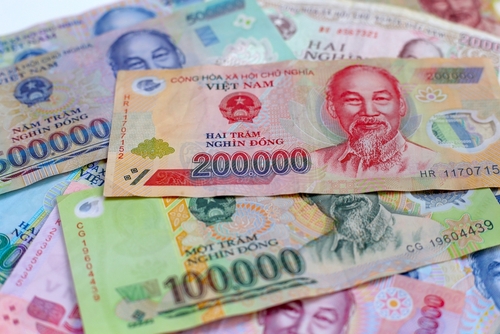
How to avoid mixing up Vietnamese banknotes
- Check the color, but don’t rely on it alone. The 20,000 and 500,000 VND notes are both blue toned.
- Count the zeros. Look at the full denomination rather than identifying a note from its first digits.
- Notice the size and feel. The SBV’s polymer notes increase in size as the denomination rises, from 132 x 60 mm for 10,000 VND to 152 x 65 mm for 500,000 VND.
- Use the reverse image as a second check. For example, 20,000 VND shows Hoi An’s Japanese Covered Bridge, while 500,000 VND shows Ho Chi Minh’s house in Kim Lien.
Coins in Vietnam
Vietnam does have Vietnamese dong coins, but you’re unlikely to encounter them during an ordinary trip. The State Bank of Vietnam lists five coin denominations as legal tender: 200, 500, 1,000, 2,000, and 5,000 VND.
However, coins have largely disappeared from everyday payments in Vietnam, with cash transactions instead relying on banknotes. Their lower denominations also limit their usefulness for everyday purchases.
What to do if you have Vietnamese coins
- Check the denomination before putting them aside. Genuine SBV-issued coins remain legal tender even though they’re rarely used in everyday transactions.
- Try to use them for a small cash payments or ask to swap them for a banknote. Some businesses may be less accustomed to handling coins, so it can be simpler to ask a hotel desk, bank, or cashier whether they can exchange them.
- Keep them as a souvenir if they’re not worth the hassle. Because coins are uncommon in daily circulation, they can make an interesting reminder of your trip without taking up much room.

How to use Vietnamese currency safely
- Carry a mix of Vietnamese banknotes. Smaller notes can make street food, markets, taxis, and other everyday purchases easier, while larger notes are better kept separate until you need them.
- Check the denomination before paying. In particular, look closely at the 20,000 and 500,000 VND notes, which have similar blue coloring.
- Count your change before putting it away. With several zeros on most prices, taking a few seconds to confirm the amount can prevent simple mistakes.
- Keep most of your cash secure. Take normal big-city precautions in Vietnam, particularly in crowded tourist areas where theft, bag grabs, and pickpocketing can occur.
Getting cash from ATMs in Vietnam
International cards such as Visa can be used at thousands of ATMs around Vietnam. Major Vietnamese banks with extensive ATM networks include Vietcombank, BIDV, VietinBank, and Agribank. For smoother withdrawals:
- Check with your US bank before departure. Confirm that your card can be used internationally, review foreign ATM fees, and make sure your phone number and email are current.
- Use an ATM operated by an established bank. A machine at or attached to a Vietcombank, BIDV, VietinBank, or Agribank branch can be easier to identify and gives you somewhere to seek help if something goes wrong.
- Review the screen before confirming. Check the withdrawal amount and any ATM fee shown before completing the transaction. Vietnamese ATMs may charge fees for withdrawals using US-issued cards.

Common money mistakes and scams to avoid
Many problems with using money abroad come from confusion rather than sophisticated scams. You can reduce the risk by keeping a few habits in mind:
- Don’t identify notes by color alone. Always check the printed denomination and zeroes before handing over a bill.
- Confirm prices before paying. If a menu or sign uses shorthand such as “50k,” remember that the “k” means thousand dong.
- Keep control of your card. At restaurants, hotels, or stores, pay attention to where your card goes and check the amount before authorizing the transaction.
- Use official or established financial services. For ATM withdrawals, cash pickup, or international transfers, check the provider and location before handing over money or personal information.
How a family in Vietnam can receive and use remittances
If you’re sending money to Vietnam, it helps to think about how your recipient normally manages their money. Depending on the transfer, Remitly offers several ways to receive funds, such as bank deposit, cash pickup, and mobile wallet, giving your recipient flexibility based on what works best for them. A simple approach is to:
- Ask how they prefer to receive money. Someone with a bank account may prefer a deposit, while another family member may find cash pickup more convenient.
- Check the recipient details carefully. Make sure names, bank information, and phone numbers match the transfer instructions.
- Tell them how the funds will arrive. This helps them know whether to check their bank account, mobile wallet, or visit a pickup location.
- Keep transfer details private. Share reference or collection information only with the intended recipient.
With a Vietnam network including banks such as Vietcombank, BIDV, Agribank, and VietinBank, international money transfer using Remitly is made easier for everyone involved.

Frequently Asked Questions
What is the official currency of Vietnam?
The official currency of Vietnam is the Vietnamese dong, abbreviated VND and represented by the ₫ symbol. The State Bank of Vietnam is the sole issuer of the country’s currency, and its banknotes and coins are legal tender.
What does “k” mean in Vietnamese prices?
In Vietnam, “k” is commonly used as shorthand for thousand dong. For example, 50k means 50,000 VND.
Are coins still used in Vietnam?
Vietnamese coins still exist as legal tender in denominations from 200 to 5,000 VND. However, in practice, coins are rarely used for everyday payments. You should expect paper and polymer Vietnamese banknotes instead.
Who is pictured on Vietnamese banknotes?
Most Vietnamese banknotes feature a portrait of President Ho Chi Minh on the front. His portrait appears on denominations from 200 VND through 500,000 VND. The 100 VND note is the exception, with its front instead showing the national emblem and denomination.
What Vietnamese banknote denominations should travelers know?
Vietnamese banknotes include cotton-paper and polymer notes of 10,000, 20,000, 50,000, 100,000, 200,000, and 500,000 VND. For travel, it’s especially useful to recognize these larger polymer denominations.
How can I avoid overpaying in Vietnam?
To avoid overpaying, confirm the price before paying, count the zeros carefully, and check each banknote’s denomination. Be careful with the 20,000 and 500,000 VND notes since they have similar blue coloring. At markets, asking the price before handing over your Vietnam cash can also prevent confusion.
Can I use US dollars in Vietnam?
It’s best not to rely on US dollars for everyday purchases in Vietnam. The Vietnamese dong is the official currency, and cash is widely used for smaller transactions. Many established businesses, hotels, tours, and restaurants generally accept international cards, so VND or a suitable card is usually more practical than USD cash.

Key takeaways
- Vietnam’s official currency is the Vietnamese dong (VND), represented by the ₫ symbol and issued by the State Bank of Vietnam.
- Travelers mainly use banknotes rather than coins, with polymer notes from 10,000 to 500,000 VND among the denominations you’re most likely to handle.
- Vietnamese prices may use “k” to mean thousand, so 50k means 50,000 VND. Price tags may also use periods as thousand separators, such as 50.000 ₫.
- Carry some cash for street food, markets, and smaller purchases, cards are more commonly accepted at hotels, larger restaurants, and established businesses.
- Before paying, check the denomination and number of zeros carefully, especially because the 20,000 and 500,000 VND notes have similar blue coloring.
Using Vietnamese currency becomes much easier once you recognize the main banknotes and understand how prices are written. Keep a mix of smaller denominations for everyday purchases, double-check the number of zeros before paying, and don’t worry if you rarely see coins. For ATM withdrawals or other financial services, stick with established banks and reputable providers.
Before you travel or send money, it’s worth confirming current currency and payment information with the State Bank of Vietnam or your own bank, card issuer, or financial provider since policies and services can change.
This article is based on current guidance from the State Bank of Vietnam and other official sources on Vietnamese banknotes, coins, and currency use.
Last reviewed: August 2026
Sources: