Romanian currency: the leu (RON) in 2026—what to know fast
If you’re traveling to Romania, resettling as an expat, or sending money from abroad, you’ll utilize Romania’s currency, the Romanian leu (RON), abbreviated as ‘L’ and divided into 100 bani (cents). Though part of the EU, Romania does not use the euro. Lei come in coins (bani) and polymer banknotes, and most everyday prices are listed in lei.
Read on for our guide to Romanian currency and for useful tips on the following topics:
- Romanian leu origins and specifics of coins and banknotes
- Practical information for IRL transactions: currency exchange, ATMs, and what to avoid
- Romania’s transition from Leu to euro
- FAQs

What is the Romanian leu (RON)?
Romania’s national currency is the leu (singular) or lei (plural), abbreviated as RON (Romanian new leu) and often denoted with the symbol L. The leu is subdivided into 100 bani (akin to cents). Prices in shops display the price followed by “lei” or “L”.
Overseen by the Romanian National Bank (RNB) since its founding in 1880, the RNB directed the Romania’s currency transition from the old leu (ROL) to the new leu (RON) in 2005.
| Term | Meaning |
| Leu | A single bank note equivalent to 100 bani |
| Lei | The plural form of leu (one leu, two or more lei) |
| Bani | Equivalent to cents. 100 bani = 1 leu |
| RON | Romania’s currency code since 2005 |
| ROL | Romania’s currency code prior to 2005 |

Romanian Coins and Banknotes: Denominations, Colors, and Figures Featured
- Currency code: RON
- Symbol: L
- Subunit: 1 leu = 100 bani
- Denominations:
| Denominations | ||||
| Bani (coins) | Color / Metal Content | Leu/Lei (banknotes) | Figure | Color |
| 1 ban | Brass-plated steel (yellow brass) | 1 leu | Nicolae Iorga | Green |
| 5 bani | Copper-plated steel (copper) | 5 lei | George Enescu | Violet |
| 10 bani | Nickel-plated steel (silver) | 10 lei | Nicolae Grigorescu | Pink and light red |
| 50 bani | Brass 80% copper 15% zinc 5% nickel (red brass) |
20 lei | Ecaterina Teodoroiu | Olive green |
| 50 lei | Aurel Vlaicu | Yellow | ||
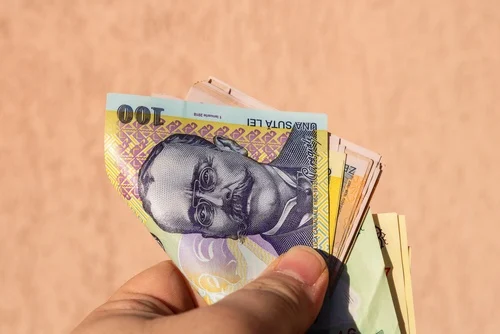
| 100 lei | Ion Luca Caragiale | Blue | ||
| 200 lei | Lucian Blaga | Brown and orange | ||
| 500 lei | Mihai Eminescu | Gray, Blue and violet | ||
- Coins: 5 and 10 bani are the most often used in daily life.
- Banknotes: Stock your wallet with 1, 5, 10, and 50 lei for day-to-day purposes.
- Prices: Receipts and digital POS systems will read RON, while “lei” or “L” may appear on shelf price tags. Prices include bani, utilizing European comma and period conventions, such as 5,99L or 5,99Lei.

Using Romanian currency in real life: cash, cards, ATMs, and common pitfalls
When visiting Romania, it’s practical to carry a range of bills and coins along with a widely accepted credit card for daily purchases. Rather than exchanging currency at the airport as a last-minute step, which tends to come with weaker rates and higher fees, withdraw cash from ATMs at major banks, such as Banca Transilvania, BCR (Banca Comercială Română), ING Bank, Raiffeisen Bank, and BRD, rather than independent or tourist-focused machines, which can carry higher fees. Our guide to exchange rates has more on how currency conversion choices affect what you pay.
Some businesses, particularly in rural areas, might reject large bills like 500 lei. Request smaller denominations when exchanging money, or exchange larger bills at large supermarkets, major banks, gas stations, chain pharmacies, or the postal desk.
For the most streamlined credit card payment, make sure your card is chip-enabled, which is a standard requirement in Romania.
Safe ATM Use Checklist in Romania:
- Reputable ATM: Opt for ATMs within or attached to major banks.
- Credit provider: Ensure your issuing bank’s logo is displayed (Mastercard/Cirrus or Visa/Plus).
- Language Selection: Select English or your preferred language.
- Decline Conversion: Select billing in local currency (RON). Opt out of any offered conversion rates, which may incur high rates or fees.
- Cash Retrieval: Collect your lei, receipt, and card and secure your withdrawal before moving on.
If you have Romanian lei left over after your trip, you can exchange them back at a Romanian bank or currency exchange office before you leave, or keep them for a future visit since lei aren’t easy to exchange once you’re back home. For general tips that apply beyond Romania, see our guide on what to do with leftover currency from international travel.

Will Romania switch to the euro? What to know (without the hype)
Romania has committed to eventually adopting the euro as part of its European Union membership, but as of 2026 it has not yet met all of the convergence criteria the European Central Bank and European Commission require, so no confirmed adoption date has been set. Check the BNR and European Commission’s convergence reports for the current, official status before relying on any specific timeline.
When the transition from the RON to the euro takes place, the Romanian leu (RON) would be replaced by the euro. Romania’s monetary policy control would then be ceded to the European Central Bank, as opposed to the BNR.
What would change with the RON to euro transition:
- This would eliminate exchange rates between the euro and RON.
- Increased abilities for trade and streamlined prices with the rest of the EU.
- What would remain the same with the RON to euro transition:
- Romania’s language, laws, symbols, tax rates, and national budget would remain the same with the transition to the euro.

Frequently Asked Questions (FAQs)
What is the currency of Romania?
Romania’s currency is the Romanian leu (plural lei), abbreviated as RON.
Will Romania adopt the euro?
Yes, Romania plans to adopt the euro in the future, though no specific timeline has been finalized.
What does RON stand for?
RON is the abbreviation for Romania’s currency, meaning Romanian new leu. Currency symbols and abbreviations like this vary widely by country. See our guide to currency symbols for more examples.
What denominations are in circulation?
Coins include 1, 5, 10, and 50 bani, while banknotes range from 1 leu to 500 lei.
What are Romanian banknotes made of?
Romanian banknotes are made from a durable non-paper polymer that is water and tear resistant.
Should I choose USD or RON at an ATM?
Always choose the local currency (RON) when withdrawing cash at an ATM, to avoid steep exchange rates and hidden fees.
What’s the best way to send money to Romania?
Reliable transfer services like Remitly offer fast and affordable ways to send funds directly to Romanian bank accounts or for cash pickup.

Key Takeaways
- When traveling to or sending money to Romania, the currency in use is the Romanian new leu (or lei, plural), abbreviated as L or RON, with the leu divisible into 100 bani (cents). Though a member of the EU, Romania has not adopted the euro as of 2026.
- RON banknotes are made of polymer, using security features including clear windows, watermarks, security threads, color-changing ink, miniscule printed lettering, and UV inks that glow to distinguish BNR issued notes from counterfeits. See our guide on how to spot fake currency if you want a closer look at what to check for.
- Carry cash in a range of smaller bills and coins as well as a chip-enabled credit card to ensure smooth transactions in both small and large cities.
- When you encounter a DCC prompt, which asks for your preference of billing in your home currency or the local national currency, choose the local currency to avoid unexpected fees and high conversion rates.
Understanding Romanian currency makes everyday transactions easier
While most of the EU uses the euro for currency, Romania continues to use the leu. For successful monetary transfers and streamlined traveling, familiarizing yourself with lei or RON puts you two steps ahead. If you have questions regarding the authenticity of RON or a transaction, use the National Bank of Romania as a verification resource. For easy, reliable transfer services within Romania, take advantage of Remitly’s fast and customizable rate-free ways to send funds directly to Romanian bank accounts or for cash pickup.
Last reviewed: August 2026