The Dominican currency is the Dominican peso (DOP), commonly written as RD$ to distinguish it from U.S. dollars. Dominican pesos are used for everyday purchases, although USD may be accepted in some tourist areas. Understanding local denominations, payment practices, and currency labels can make traveling or sending money to the Dominican Republic easier.
At Remitly, we help people across the US send money to loved ones in the Dominican Republic every day, so we know how useful it is to get comfortable with the local currency before you travel or send your first transfer.
Here’s what you’ll learn in this guide:
- The Dominican peso (DOP) is the official currency of the Dominican Republic and is commonly displayed as RD$.
- US dollars may be accepted in tourist areas, but Dominican pesos are generally more practical for everyday local purchases.
- Carry a mix of smaller peso denominations for taxis, tips, markets, and businesses where making change may be difficult.
- Use the Banco Central de la República Dominicana (BCRD) to verify current banknotes, coins, currency features, and official historical information.

What is the Dominican peso (DOP)? Names, symbols, and how prices are written
The official currency of the Dominican Republic is the Dominican peso. Its international currency code is DOP, the three-letter abbreviation used by banks, airlines, financial institutions, and payment providers worldwide.
Within the Dominican Republic, however, you’ll most often see the currency written as RD$. The “RD” stands for República Dominicana, helping distinguish Dominican pesos from other currencies that also use the $ symbol, especially the US dollar (USD). Because both currencies use the dollar sign, the RD$ prefix makes it clear that prices are in Dominican pesos rather than US dollars.
How prices are displayed
You may see the same price written in several ways, all referring to the same amount of Dominican currency:
| Format | Meaning |
| RD$250 | 250 Dominican pesos (most common in the Dominican Republic) |
| 250 pesos | Informal way of writing 250 Dominican pesos |
| DOP 250 | International format commonly used by banks, travel websites, and financial services |
These formats all represent the same currency: the Dominican peso.

How to tell whether a price is in RD$ or US$
In tourist areas, hotels, and some excursion providers, prices may be displayed in either Dominican pesos or US dollars. Before paying, use this quick checklist:
- Look for the RD$ symbol, which indicates Dominican pesos.
- If you see only $, ask whether the amount is in Dominican pesos or US dollars.
- Check menus, receipts, or price lists for a note explaining which currency is used.
- Confirm the currency before paying by cash or card, especially in tourist districts where both currencies may be accepted.
Taking a few seconds to verify the currency can help avoid misunderstandings and ensure you know exactly what you’re being charged.
Dominican peso denominations: coins and bills you’ll actually see
According to the Banco Central de la República Dominicana (BCRD), the Dominican peso is issued in both coins and banknotes, all of which are legal tender throughout the country.
| Type | Denominations in circulation | Best used for |
| Coins | RD$1, RD$5, RD$10, RD$25 | Small everyday purchases, public transportation, parking, convenience stores, and making exact change. |
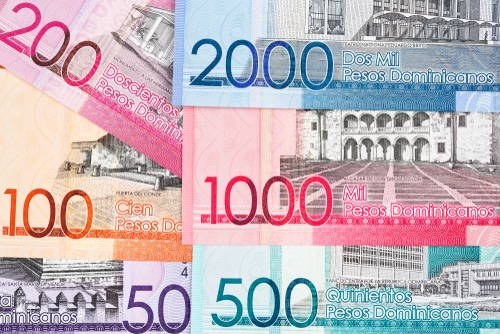
| Banknotes | RD$50, RD$100, RD$200, RD$500, RD$1,000, RD$2,000 | Restaurants, supermarkets, hotels, shopping, and higher-value purchases. |

Practical cash tips
For most travelers, carrying a mix of RD$50, RD$100, RD$200, and RD$500 notes is the most convenient for taxis, cafés, street vendors, local shops, and tipping. Larger RD$1,000 and RD$2,000 notes are useful for hotel bills, larger restaurant checks, or shopping, but some small businesses may not have enough change for high-value notes early in the day.
Banknote designs
Dominican banknotes feature important national figures, historic landmarks, and security features selected by the Banco Central. Designs and security elements are updated periodically as new printings are issued, while older legal-tender series generally remain valid until officially withdrawn. Because commemorative releases and refreshed printings occur from time to time, it’s best not to rely on a single landmark or portrait to identify a denomination.
Refer to the Banco Central’s current banknote guides if you need to verify a specific note or security feature.

Worn bills and making change
It’s normal to receive banknotes that show signs of everyday wear. As long as they remain genuine and are not excessively damaged, they are generally accepted in everyday transactions. The BCRD regularly removes unfit notes from circulation and replaces them with new ones.
When paying with cash, it’s also helpful to keep smaller denominations on hand. Small shops, local markets, and taxis may have limited change available, particularly in the morning or after large purchases, so paying with an appropriate denomination can make transactions quicker and easier.
Paying in the Dominican Republic: cash vs. card, USD acceptance, and common traveler pitfalls
Yes, US dollars (USD) are accepted by many hotels, resorts, airports, and tourist-focused businesses in the Dominican Republic, and you’ll find currency counters at arrival points like the Santo Domingo airport. However, for everyday purchases such as taxis, local restaurants, convenience stores, markets, and public transportation, you’ll usually need to pay in Dominican pesos (DOP), which you have the option of exchanging USD for at the airport. Even when a business accepts US dollars, your change may be given in Dominican pesos, so it’s worth confirming the currency before you pay.

7 common payment pitfalls (and how to avoid them)
The “$” symbol isn’t always US dollars.
Fix: If a price is shown simply as “$250,” ask whether it means RD$250 or US$250. Many businesses use RD$ to identify Dominican pesos, but not all do.
Some tourist businesses quote prices in US dollars.
Fix: Hotels, excursions, and private transportation may advertise prices in USD, while local businesses usually price goods in DOP. Always confirm the currency before agreeing to a price.
Large banknotes can be difficult to break.
Fix: Carry a mix of RD$50, RD$100, RD$200, and RD$500 notes for taxis, cafés, tips, and small purchases. Smaller denominations are often easier for vendors to accept.
Card acceptance varies by business.
Fix: Major hotels, supermarkets, and many restaurants accept credit and debit cards, but smaller shops, markets, and independent vendors may prefer or require cash. It’s a good idea to carry some Dominican pesos for everyday spending.
Taxes may not always be reflected in the first price you see.
Fix: Some restaurants, hotels, and tourism businesses display prices before applicable taxes and service charges. Check your bill carefully and ask whether ITBIS (Impuesto sobre Transferencia de Bienes Industrializados y Servicios) and any service charge are included before paying.
Your change may be returned in Dominican pesos.
Fix: If you pay with US dollars at a business that accepts them, don’t be surprised if the change is given in DOP. Confirm this in advance if you need US currency back.
Street vendors and small businesses may not accept USD.
Fix: Keep some Dominican pesos on hand for local transportation, small restaurants, markets, and neighborhood stores where the local currency is generally expected.
Helpful Spanish phrases for US travelers
- ¿Está el precio en pesos o en dólares?: Is the price in pesos or dollars?
- ¿Aceptan tarjetas de crédito?: Do you accept credit cards?
- ¿Tiene cambio?: Do you have change?
- ¿Puede darme un recibo, por favor?: Can you give me a receipt, please?
- Quisiera pagar en pesos.: I’d like to pay in pesos.
- ¿Cuánto cuesta?: How much does it cost?
Learning these simple phrases and confirming the currency before paying can help avoid misunderstandings and make everyday transactions smoother during your trip.

A mini history of Dominican currency
The Dominican peso has evolved alongside the country’s political and economic history. According to the Banco Central de la República Dominicana (BCRD), here are the key milestones that explain how today’s Dominican peso (DOP) came to be:
| Year | Milestone |
| 1844 | Following the Dominican Republic’s independence, the country began issuing its own national currency, establishing the Dominican peso as part of its early monetary system. |
| 1904–1905 | During the period of US influence in the early 20th century, the US dollar became the country’s principal circulating currency, replacing the earlier peso-based system for everyday use. |
| 1937 | The peso oro (“gold peso”) was introduced as the national currency. Although its name referenced gold, its monetary framework evolved over time as the country’s financial system modernized. |
| 1963 | The Dominican peso transitioned to a fiat currency, meaning its value was no longer linked to a fixed amount of gold or another commodity, a monetary system still used today. |
| Today | The country’s official currency is the Dominican peso (DOP), commonly displayed as RD$ within the Dominican Republic to distinguish it from US dollars (USD). |
Understanding this timeline helps explain why you’ll encounter both DOP and RD$ today, and why US dollars are still accepted by some tourist-oriented businesses. The Dominican Republic’s monetary history reflects periods of both domestic and US currency use, but the Dominican peso remains the country’s sole official currency, making it the standard for everyday pricing and transactions across the country.

Frequently Asked Questions
What is the currency of the Dominican Republic?
The official currency of the Dominican Republic is the Dominican peso, identified internationally by the currency code DOP. Within the country, prices are most commonly displayed as RD$ to distinguish Dominican pesos from US dollars. The Dominican peso is the official currency used for everyday transactions throughout the country.
What does RD$ mean?
RD$ stands for República Dominicana pesos. The “RD” prefix helps distinguish Dominican pesos from other currencies that also use the $ symbol, particularly the US dollar (USD). You’ll commonly see RD$ on menus, receipts, shop signs, and price tags throughout the Dominican Republic.
Can you use US dollars in the Dominican Republic?
Yes, but where they’re accepted depends on the business.
- Hotels and resorts often accept US dollars.
- Many excursion operators and airports also accept USD.
- Local restaurants, taxis, markets, and small shops usually expect Dominican pesos (DOP).
- Always confirm whether a quoted price is in RD$ or US$ before paying.
While you can pay in USD, locals recommend converting your money and using pesos anyway. Prices in USD tend to be inflated, so you’ll usually get a better deal if you pay in pesos.
What denominations of Dominican pesos are in circulation?
The Dominican peso is issued in both coins and banknotes.
| Type | Denominations |
| Coins | RD$1, RD$5, RD$10, RD$25 |
| Banknotes | RD$50, RD$100, RD$200, RD$500, RD$1,000, RD$2,000 |
These denominations are used for everyday transactions across the Dominican Republic.
Who appears on Dominican banknotes?
Dominican banknotes feature important national historical figures, landmarks, and official national symbols selected by the Banco Central de la República Dominicana. Designs are periodically updated with enhanced security features, while older legal-tender series may continue circulating until officially withdrawn.
Should you carry cash or use a card?
For most visitors, using both cash and cards is the most practical approach.
- Carry Dominican pesos for taxis, markets, tips, and small purchases.
- Credit and debit cards are widely accepted at hotels, supermarkets, and many restaurants.
- Some smaller businesses may accept cash only.
- Keeping a mix of smaller banknotes makes everyday transactions easier.
What should you do with leftover Dominican pesos?
Before leaving the Dominican Republic, consider:
- Using remaining pesos for meals, snacks, or souvenirs.
- Paying any outstanding taxi or hotel charges in pesos.
- Checking whether your bank or currency exchange service accepts DOP after you return home.
- Keeping a small amount if you expect to visit the Dominican Republic again.

Dominican currency (DOP) in plain English
Here are the key things to know about Dominican currency before traveling, making payments, or researching the history of the Dominican peso:
- DOP vs. RD$: DOP is the international currency code for the Dominican peso, while RD$ is commonly used locally to distinguish peso prices from US dollars.
- USD acceptance: US dollars are commonly accepted in tourist-oriented businesses, but DOP is the official currency and is generally expected for everyday local purchases.
- Verify denominations: Use the Banco Central de la República Dominicana (BCRD) as the primary source for current coins, banknotes, designs, and security features.
- Carry smaller bills: Keep smaller peso denominations handy for taxis, tips, markets, cafés, and other purchases where vendors may have limited change.
- Source historical claims: Currency-history milestones (including 1844, 1904/1905, 1937, and 1963) are sourced to the BCRD rather than unverified secondary accounts.
Final checklist for using Dominican pesos confidently
Whether you’re traveling to the Dominican Republic or supporting friends and family from abroad, a little preparation can make managing Dominican pesos easier.
- Know the notation: DOP is the international currency code, while RD$ is commonly used for Dominican peso prices.
- Confirm the currency: In tourist areas, check whether a price marked with “$” refers to Dominican pesos or US dollars.
- Carry smaller peso bills: Smaller denominations can be useful for taxis, tips, markets, and businesses that may have limited change.
- Check payment options: Carry some cash even if you plan to use a card, since payment methods can vary by business.
Plan before sending money: Confirm your recipient’s preferred delivery method, such as a bank deposit, cash pickup, or other available option. Our comparison of Remitly vs. Wise for the Dominican Republic can help if you’re weighing providers.
Need to send money back to friends or family in la isla? We’re here to help. Remitly offers secure transfers to the Dominican Republic, with a choice of transfer speeds and delivery options that may include bank deposit, cash pickup, and other methods depending on availability.
Last reviewed: August 2026
Methodology
This guide was reviewed using primary and authoritative sources, with the Banco Central de la República Dominicana (BCRD) used to verify official information about the Dominican peso, including denominations, currency features, and historical milestones. Official government and tourism sources were prioritized for practical information. Details that can change over time, including payment practices and money-transfer delivery options, should be confirmed with the relevant provider or official source before traveling or sending money.
Sources:
- Banco Central de la República Dominicana: Currency & banknote rules
- Banco Central de la República Dominicana: Coins in circulation
- Banco Central de la República Dominicana: Banknotes in circulation
- Banco Central de la República Dominicana: History of Dominican banknotes
- Travelex: What is the currency in the Dominican Republic?
- Visit Dominican Republic: Money & costs in the Dominican Republic