

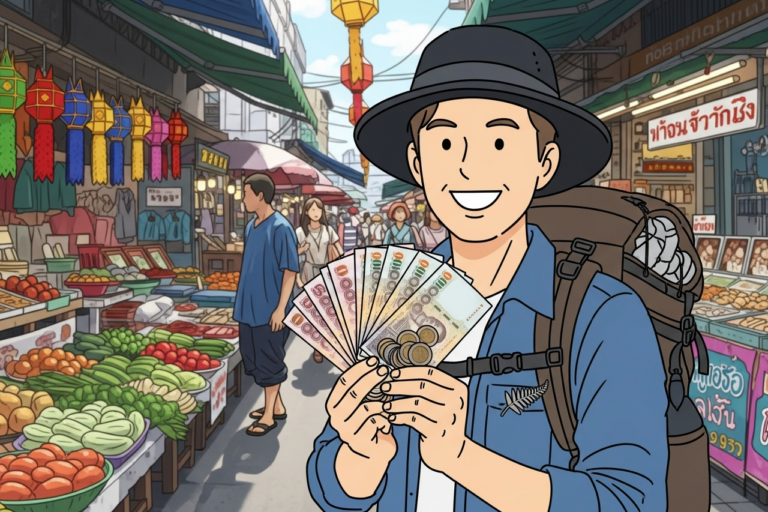
Key Highlights
Thinking about heading to Thailand? Here’s what you should know about travel money:
-
The official currency of Thailand is the Thai baht (THB), which the Bank of Thailand looks after.
-
For buying things and paying for services, always use Thai baht, because shops and people do not often take foreign money.
-
You can swap your New Zealand dollars for baht before you go or after you arrive in Thailand.
-
To get the best exchange rates, check a few different currency exchange places and watch for any extra fees they might charge.
-
It’s easy to use a debit card or travel card at ATMs, but remember there might be fees when you take money out.
This way, you can sort your travel money with less hassle and enjoy your trip more.
Introduction
Are you getting ready to visit the lovely beaches of Thailand? It can be a fun place to go. Before you pack your things, you need to sort out your money matters. One thing you should not forget is knowing about Thailand’s currency. The official currency of Thailand is the Thai baht. It will help a lot if you learn how to get, spend, and keep track of it. This can make your trip much smoother and better. This guide will show you all you need to know to look after your money in the Land of Smiles.
Understanding Thailand’s Official Currency
The main money you will use in Thailand is the Thai baht. The Bank of Thailand is the central bank that looks after and controls this money. You will notice things like food from markets and places to stay are all priced in baht.
If you get to know the Thai currency, it will be easier for you to spend money. It is good to learn its currency symbol and the code (THB), too. These can help when looking at the thai baht exchange rate. Now, let’s look more at the baht and see how you can spot the symbols and codes for the thai baht.
What is the Thai Baht (THB)?
So, what do people use as the official currency in Thailand? It is the Thai baht, which people also call THB. The baht is the only money you can use for everything in Thailand. You need to have some Thai baht for anything you want to buy, from street food like pad thai to small gifts.
The baht is a decimal type of unit of currency. One baht is made up of 100 satang. You might not see satang coins much, especially if you are in popular tourist areas. But satang is still there, like how cents work with the New Zealand dollar.
It is good to know the thb rate if you want to budget well for your trip. The value of the baht can change when you look at it next to other money. So, check the exchange rate both before and during your trip. This way, you can get the most out of your money and enjoy your time.
Recognising Thai Currency Symbols and Codes
When you deal with Thai currency, you will see a special currency symbol and code. Knowing these things will help you read prices and understand exchange rates.
The official currency code for the Thai baht is THB. You will see this code with three letters in the bank, on any currency exchange board, and with online currency converters. The currency symbol that shows on price tags in the shop and on menus is ฿.
Here is a quick summary to help you remember:
-
Currency Code: THB
-
Currency Symbol: ฿
Knowing these words will help you move through your money matters more easily. You can also check exchange rates for New Zealand dollars, US dollars, or other major currencies faster. This makes your time handling thai baht or any other top currency much easier.
Thai Baht Notes and Coins Explained
When you do a currency exchange, you will get a mix of Thai baht notes and coins. The Thai baht has different coins and notes. Each one has its own look and value. The Royal Thai Mint makes the coins and notes.
If you know about the different coin values and note types, you can pay more easily. You can also make sure you get the right change. Now, let’s take a look at the notes and coins you will most likely use in your wallet on your trip.
Common Banknote Denominations in Thailand
Thai baht banknotes are bright and easy to tell apart. They come in a few values, so you can tell which note you have without trouble. The notes often show pictures of Thai royalty. This gives the money a bit of the country’s story.
The old notes have a picture of King Bhumibol Adulyadej (Rama IX), who has passed away. The new notes show his son, King Maha Vajiralongkorn (Rama X). Both these notes are used every day, and you can pay with any of them. It helps to know what each note is worth, as it will make buying things a lot easier.
The thai baht notes you will see most often are:
-
฿20 (green)
-
฿50 (blue)
-
฿100 (red)
-
฿500 (purple)
-
฿1000 (brown)
It’s smart to keep a mix of big and small notes with you for all sorts of uses.
Thai Baht Coin Values and Designs
Along with banknotes, people use Thai baht coins for smaller things they buy. These coins are made by the Royal Thai Mint. They come in different sizes and metals, so you can tell them apart when you get to know them.
The coins show important Thai people and places. Old coins often have King Rama IX on them. The new ones might have a picture of King Maha Vajiralongkorn. You can also find coins with Queen Sirikit or famous Thai temples on them.
Here are the thai baht coins most people use:
-
฿1 (silver-coloured)
-
฿2 (can be gold- or silver-coloured, based on the set)
-
฿5 (silver-coloured with a ring made from copper-alloy)
-
฿10 (bimetallic, silver-coloured in the centre with a copper-alloy ring)
There are smaller coins called satang, worth 25 and 50 satang. They are not often used in tourist areas or in day-to-day trading.
Currency Exchange for New Zealand Travellers
One of the main things you need to do before your trip is work out your currency exchange plan. You want to get the best available deal so you have more money to spend. This means looking for a good THB rate and staying away from poor exchange rates that could lower your spending money. It is a good idea to check the exchange rates you are offered with the market rate. This way, you can know if you are getting a good deal.
You can swap your NZD for THB in a few ways. You might do it before you leave New Zealand, or wait until you are in Thailand. Each way has good parts and bad parts, and we will talk about these to help you pick what works best.
Exchanging NZD to THB Before Your Trip
Exchanging a bit of money before you leave New Zealand can be helpful. This way, you will have some cash ready for things like a taxi or some food as soon as you get there. You won’t need to search for a currency exchange right after you land.
You can swap your money at banks or use a currency exchange service while you are still in New Zealand. The exchange rates here may not be as good as the rates you can get in Thailand. The best way to check is to look up a currency converter online and compare rates.
Think about these choices for changing cash before you leave:
-
Your local bank: It is easy but the exchange rates may not be as good.
-
Currency exchange specialists: These may get you better rates than banks.
-
A multi-currency account like a Wise account: This lets you hold or change your money, often near the market exchange rate. You can pay by using the card that comes with it.
Where to Exchange Money in Thailand
If you decide to wait until you arrive, you’ll find plenty of places to exchange money in Thailand. Generally, you’ll get a better exchange rate within Thailand than you would back in New Zealand, especially if you avoid airport exchange counters for large amounts.
Look for official currency exchange booths or Thai banks. Independent money changers, particularly in popular tourist areas like Bangkok, Phuket, and Chiang Mai, often offer the best available deal, with rates close to the market exchange rate and a low service charge. Always check the offered rate and ask about any fees before handing over your money.
Here’s a comparison of common exchange locations:
|
Location |
Pros |
Cons |
|---|---|---|
|
Airport Exchange Counters |
Convenient upon arrival. |
Often have poor exchange rates and higher fees. |
|
Thai Banks |
Secure and reliable. |
Rates might be less competitive than private changers. |
|
Private Exchange Booths |
Often offer the best rates, especially in cities. |
Rates can vary; requires comparing different booths. |
Making Payments in Thailand
Once you get your Thai baht, you need to think about how you want to pay when in Thailand. Many people still use cash in the country, especially at small shops, markets, and when buying street food. Some big places now take card payments, but cash is still used a lot.
Many people use a debit card or travel card for ATM withdrawals. This is a common way to get cash, but you need to watch out for high transaction fees. If you use your card, and the machine offers you dynamic currency conversion, always say no. This can give you a worse rate for your thai baht. It is good to know both the good and bad sides of using cash or cards before you go.
Using Cash vs. Card – What Travellers Need to Know
Picking between cash or a card in Thailand depends on where you are and what you want to buy. For most things each day, cash is the best way to pay. You will need to use baht for street markets, small shops, and local food places. They do not take foreign currency, like New Zealand or US dollars. The shops will ask for the local currency.
Card payments are okay in big hotels, higher-end places to eat, and at large shopping spots. You may like to use a debit card or travel money card for big costs. But, be ready—some places will charge a bit more for card payments because they have to pay high transaction fees.
Here is a quick guide to help you know what to do:
-
Use cash for: Street food, local markets, small shops, and tuk-tuk rides.
-
Use card for: Major hotels, international chain stores, and high-end restaurants.
-
Always carry some cash: Even if you use a card often, it is good to have an amount of cash for when you need it or if something comes up.
ATM Access and Common Fees for Kiwis
ATMs are easy to find all over Thailand. You can get Thai baht in most places, even small towns. There will be the machines outside banks, inside convenience stores like 7-Eleven, and at the malls. This makes it a good way to get some amount of cash, so you do not have to bring a lot with you when you go.
But the service charge for using an ATM is high. Thai ATMs take a fee from you each time you use a foreign card for atm withdrawals. That fee is around 220 THB each time you use the machine. You may also get hit with extra fees from your own bank in New Zealand. These high transaction fees can pile up quite fast.
To keep your costs down:
-
Withdraw larger amounts: If you get the biggest amount of cash you are allowed to, you will not need as many withdrawals. ATMs often let you take out 20,000–30,000 THB at one time.
-
Check your bank’s fees: Before you go to Thailand, it is a good idea to know what your bank will charge for taking out money.
-
Consider a fee-friendly card: Some travel cards or some bank accounts do not charge the service charge for international atm withdrawals. With these, you could save good money.
Conclusion
To sum up, it is important for people from New Zealand to understand the currency used in Thailand before they visit. The Thai Baht (THB) is the official currency there. You will see different banknotes and coins during your trip. It is good to know how to change your NZD to THB, and if it is better to pay with cash or card. This will help you watch your spending while you are away. Before you go, use the tips shared here to feel sure about using the local currency. If you need more help or have questions, you can get a free consultation to make your travel plans easy!
Frequently Asked Questions
Can I use New Zealand dollars or other foreign currencies in Thailand?
No, you can not use foreign currency to buy things in Thailand. You have to pay in the local currency, which is the Thai baht. To get Thai baht, you can use a currency exchange or take out money from an ATM with your debit card. This is how you pay for your things in Thailand.
How can I find the best exchange rate for Thai baht while travelling from New Zealand?
To get the best available deal, you need to check exchange rates from a few places. First, use a currency converter online so you can see the live market rate. After that, find a service that gives you a thai baht exchange rate close to what you saw, and also has low fees. Some private exchange booths in Thailand often have good rates too.
Are credit cards widely accepted in shops, restaurants, and tourist attractions in Thailand?
Many big places like hotels, department stores, and fancy restaurants in Thailand take credit and debit card payments. But many smaller shops, local markets, and street vendors often ask for cash. It is a good idea to keep some Thai baht with you, because you might need it. Some businesses can add a service charge if you use card payments or your debit card, so having cash helps you avoid extra costs.



