

Key Highlights
-
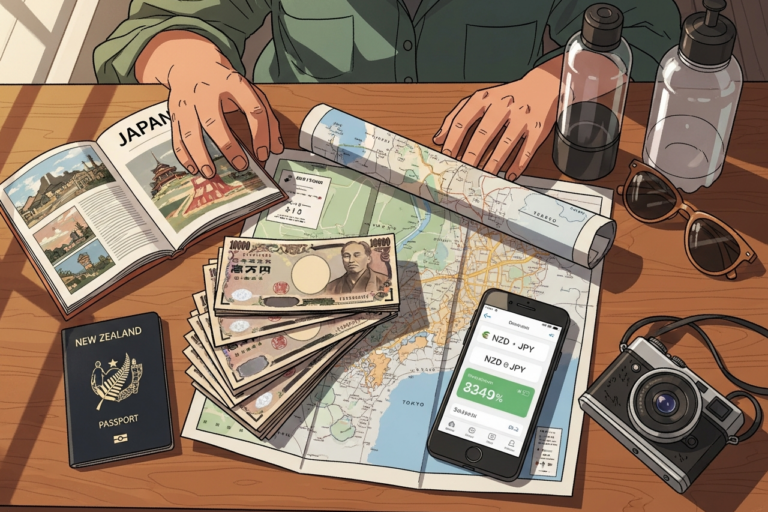
The official currency of Japan is the Japanese yen (JPY). You will need this for your trip.
-
If you know the daily exchange rate between the New Zealand dollar and the yen, you can plan your budget.
-
In Japan, people still use cash a lot. It is good to carry both Japanese coins and banknotes with you.
-
Cash is most used, but in bigger cities, you can also use credit cards and some other payment methods more now.
-
You can do a currency exchange at the airport, at banks, or go to money changers who are allowed to do this.
-
It’s a good idea to get some yen before you get there. Then you have money for your first expenses.
Introduction
Are you getting ready to go on an exciting trip to Japan? This travel destination has many things to offer. You can see busy cities and also enjoy quiet temples. But before you start to pack your bags, you need to know about Japanese currency. When you understand what travel money is used in Japan, your journey will be easier. You will know what to do when you buy tickets for the train or try good local food. This guide will show you what you need to know about travel money in Japan. With this help, you can feel ready and confident to go.
Understanding the Japanese Yen
The official currency of Japan is the Japanese yen. It is one of the most traded currencies in the world. The story of the yen is closely linked to how Japan grew over time. The Bank of Japan gives out and looks after the currency. This is done under a managed currency system.
If you know some things about the japanese yen and the history of money, you will get a better understanding of the culture in Japan. Now, let’s see what makes this currency special.
What is the official currency used in Japan?
The official currency of Japan is the Japanese yen. It is the only legal tender in the country. That means the Japanese yen is the only money people must take when you pay off debts.
In exchange markets, they use the code JPY for the Japanese yen. You will also see its symbol written as ¥.
When you are in Japan, you will notice the kanji character 円, which is said as “en”. People use this character in daily life. You can find it on price tags and menus. This is a big part of how money works in Japan.
If you go to a high-tech shop in Tokyo or walk around a market in a small town, all payments are made with the Japanese yen. It is the backbone of money in the country. So, it will be good for you to have some Japanese yen for your trip.
Pronunciation and symbol of the yen
The official Japanese currency is the Japanese yen. It uses the symbol ¥. This is the same symbol as the Chinese yuan, so people can sometimes get confused. To make it clear, you might see it written as JP¥. When you are overseas, people use the currency code JPY so they know it is the yen and not another currency.
In Japan, people say “en” for yen. This is how locals pronounce the word. So, when you hear someone talking about money, listen for “en”. If you see a yen coin or a banknote, know that the Japanese word is a little different from what you may say at home.
Knowing these little things about the Japanese currency can make your trip to Japan much easier. You will find it simple to shop and read prices if you know the ¥ sign, the currency code JPY, and even a bit about the language. This will help you when you exchange money or pay for things, and make sure you are always clear about how much things cost.
Brief history of the Japanese yen
The history of money in Japan changed a lot when the yen started. The Meiji government brought in the yen in 1871 with the New Currency Act. This ended the old and complex money system from the Tokugawa days. It was an important move for making the country’s economy more modern.
At first, Japan used the gold standard. The value of the yen was tied to a set amount of gold. This made the yen’s value more stable and made international trade easier. Over the years, the system changed, especially as the world economy shifted.
The Bank of Japan was set up in 1882. Since then, it has been the main body for giving out and managing the yen. The story of this currency is tied to Japan’s journey from a feudal society to a strong world economy, and it is an interesting part of the country’s heritage.
Yen Banknotes and Coins
When you are in Japan, you will use Japanese yen banknotes and yen coins. The designs on these yen bills and each yen coin do more than just show value. They also have important parts of Japanese culture and history.
Getting to know the different types of Japanese yen is a good idea. If you can spot what legal tender looks like, your cash transactions will go quicker. This also helps you feel good about handling your cash. Let’s go over the main yen bills and coins and what makes them stand out.
Common yen denominations
The Japanese yen has a straightforward system of denominations, consisting of six coins and four primary banknotes. The coins are used for smaller amounts, while the yen bills cover larger values, making it easy to pay for a wide range of goods and services.
The coins in circulation are the ¥1, ¥5, ¥10, ¥50, ¥100, and ¥500. For banknotes, you’ll commonly use the ¥1,000, ¥5,000, and ¥10,000 bills. There is also a ¥2,000 banknote, but it’s quite rare and not something you’ll see often.
Here is a simple breakdown of the common denominations of coins and banknotes you will encounter:
|
Type |
Denominations |
|---|---|
|
Coins |
¥1, ¥5, ¥10, ¥50, ¥100, ¥500 |
|
Banknotes |
¥1,000, ¥2,000, ¥5,000, ¥10,000 |
Features and designs of Japanese banknotes
Japanese banknotes stand out because of their beautiful and detailed designs, which changed in 2024. The new yen bills now show important people from Japan’s history and well-known cultural images. For example, the ¥5,000 note now has tsuda umeko on it. She was known for her work in women’s education.
The ¥1,000 banknote has a picture of Kitasato Shibasaburō, who studied bacteria. On the back, you can see Hokusai’s artwork “The Great Wave off Kanagawa” with mount fuji behind it. The hard-to-find ¥2,000 bill comes with a scene from the tale of genji and a picture of its writer, murasaki shikibu.
The note worth the most, the ¥10,000 bill, has Eiichi Shibusawa on the front. He is called the “father of Japanese capitalism.” On the back, it shows a picture of the famous tokyo station building in Marunouchi. These yen bills are more than money. They show off Japan’s long history, culture, and science.
Types of Japanese coins
Japanese coins are easy to pick out, just like the banknotes. Each yen coin is made in a way that makes it stand out. The ¥1 coin is made out of lightweight aluminium. It shows a young tree to show the growth of Japan. On the other hand, the bronze ¥10 coin has the Byodo-in Phoenix Hall on one side. On the other side, you can see an evergreen tree.
You will spot two coins that have holes in the middle. The ¥5 coin is gold in colour and the ¥50 coin is silver. Only the ¥5 coin does not show its value in numbers. Both the ¥100 and ¥50 silver coins come with sides that have ridges. The newer ¥100 coin has sakura flowers on it.
The biggest out of all the japanese coins is the ¥500 coin. It is light gold in colour and also has ridged edges. This coin has smart anti-counterfeiting parts. For example, “500円” can be seen if you tilt it. All these shapes, colours, and special details help people tell each yen coin apart, both by looking and by feeling with their hands.
Exchange Rates for New Zealand Travellers
If you are a traveller from New Zealand planning to go to Japan, you need to understand the exchange rate between the New Zealand dollar (NZD) and the Japanese yen (JPY). This is important if you want to budget well for your trip. The JPY exchange rate is set in the global foreign exchange market. It can go up and down each day.
It helps to watch the rate before you leave and while you are in Japan. This way, you can know the best time to do a currency exchange and you will see how much your money is worth. Now, let’s see how to check the exchange rate, the tools you can use, and the things that can cause it to change.
How to check current yen exchange rates
It’s now easy to keep up with the latest exchange rate because of today’s technology. You should know that the rate can go up or down a lot since it depends on supply and demand in the foreign exchange market. So, it’s a good idea to look at the rate often, especially when your trip is coming up soon.
You can find the current NZD to JPY exchange rate from many reliable places. When you know the jpy exchange rate, you can tell if you are getting a good deal or not. Even a small change in the exchange rate can make a big difference, mainly if you are changing a lot of money.
You can check the exchange rate in these simple ways:
-
Online currency converters on financial websites.
-
Your bank’s foreign exchange page.
-
Apps made for currency exchange that update rates in real-time.
Tools and platforms for real-time conversions
There are many digital tools out there to help you keep an eye on the NZD to JPY exchange rate in real time. Many people, when they travel, use phone apps that show up-to-the-minute exchange rates. These can be very good if you want to make a quick price check while you shop.
Some services, such as Wise, give you options to change your money and offer a travel money card. This lets you hold and switch money at rates that are often better than the ones a bank gives you. These sites often let you get alerts when the exchange rate meets a level you want. So, you always know if it’s a good time to swap your money.
You can also use digital wallets like Google Pay and Apple Pay. They help you see the exchange rate as you spend money overseas with your bank account. Before you go to a new place, it’s good to ask your bank what rates they use for international deals with your travel money.
Factors affecting exchange rate fluctuations
Exchange rates change often and depend on many parts of the economy. Some currencies have a fixed exchange rate, for example, the Hong Kong dollar is tied to the US dollar. But the Japanese yen is different, as it moves up and down on the foreign exchange market.
The value of the Japanese yen can go up or down based on how well the economy in Japan is doing. This is linked to things like the rate of inflation, interest rates set by the Bank of Japan, and the way shares perform at the Tokyo Stock Exchange. The country’s politics, and trade deals with other big countries such as the United States, are important too.
Things that happen around the world can push currency values fast, because people often see the yen as a “safe” currency when times are not good. Because of all the changes and connections, the exchange rate you see for the yen today might not be the same tomorrow. That’s why it is good to keep up with what is happening.
Exchanging Money in Japan
When you get to Japan, you will need to have some Japanese money on you. It is quite easy to do a currency exchange and get yen bills for your New Zealand dollars. There are a few ways you can change your cash.
Currency exchange offices and money changers are easy to find in many parts of the country. When you know where to go and what can happen, you will often get a good rate. You can also stay away from extra fees.
Let’s look at the best places for currency exchange in Japan.
Where to exchange New Zealand dollars for yen
When you get to Japan, you will find a few ways for currency exchange. It’s a good idea to do your currency exchange in Japan, not your home country. This way, you may get a better rate and pay less in commission fees.
Try to look for places with an “Authorized Foreign Exchange” sign. You will see these at banks, post offices, and currency exchange offices. Big airports and large department stores in the cities also have these services. But, the rates at these places might not always be the best for you.
If you want good value for your travel money, take some time to compare rates. Checking a few providers can help you get a good deal for your currency exchange. This will give you more yen for your dollars and help you get the most out of your trip budget.
Using airport kiosks, banks, and money exchanges
When you arrive, airport kiosks are the easiest way to get some yen right away. The rates here are usually not as good as what you get in the city. So, it’s a good idea to only change enough money for your first needs, like getting some transport.
You can also use the banks for currency exchange. Banks are open from 9 am to 3 pm on weekdays. Most big banks provide foreign exchange. Though the Bank of Japan takes care of the main country policies, the regular banks help people do their exchanges. They often give better, more competitive exchange rates than the airport.
Money changers, such as Travelex, are in places where lots of tourists go. They sometimes offer better rates than either banks or airports.
-
Airport Kiosks: Good for quick cash but the rates are usually a bit higher.
-
Banks: Trustworthy and may give better rates but they close early at 3 pm.
-
Money Changers: Offer rates that can be just as good, and are easy to find in many areas.
Tips for getting the best rates
Getting good, competitive exchange rates can help you save money on your travel plans. It’s a good idea not to change all your cash at the airport. This spot may be easy, but there are often better deals in the city. Swap just a little at the airport for things you need right away, and get the rest sorted when you get to town.
To get peace of mind, have a look at the rates online first. See what banks and money changers in the area have to offer. Be sure to check for any hidden fees too, as these can take a good chunk out of what you get. If you’re stuck and most shops are closed, using an ATM with a low-fee card can be the only way to get your hands on cash at a good rate.
Here are a few quick tips for peace of mind:
-
Always use an authorised dealer when you exchange money.
-
Carry a mix of cash and cards. This gives you more options.
-
Let your bank know about your travel plans before you go. This helps stop any trouble with your cards.
Accessing Cash in Japan
Even though more people use cards now, it is still important to have cash in Japan. The main way for people to get Japanese yen is to use an ATM. But there are not many ATMs that take foreign bank cards, so you need to know where to find an ATM that works with your card.
When you take out cash, watch out for any withdrawal fees. The ATM operator and your bank might both charge you for this. If you plan how you get your legal tender, you can stay away from surprise fees.
Finding ATMs that dispense Japanese yen
It is now easier to find an ATM that takes international cards. But, you still need to know the right places to look for one. Many banks in Japan do not let you use a foreign card at their ATMs. Yet, there are networks in the country that you can trust for this.
One of the best places to go is a convenience store. 7-Eleven shops have Seven Bank ATMs that you can use any time, day or night. These machines offer help in many languages, like English. Family Mart stores also have E-net ATMs. These often take international cards as well. If you go to a post office, you will likely find a Japan Post ATM. They are easy to use if you are from overseas and there are many of them around.
If you are in a big place like tokyo station or inside a mall, you will see ATMs set up for people from other countries, too. Before you use it, look for Visa, Mastercard, or Cirrus signs on the machine. This will help you know if you can use your card at that ATM.
Card compatibility and withdrawal fees
When you use your New Zealand debit cards at a Japanese ATM, it is important to make sure the ATM is able to work with your card. Most international ATMs in Japan accept cards on the Visa, Mastercard, and JCB networks. It’s a good idea to look at the signs or logos on the ATM before you put in your card.
Be ready to pay withdrawal fees. There will likely be a cost from the Japanese ATM operator and another fee from your bank at home. These fees could be a fixed amount for each withdrawal, and there may also be foreign transaction fees that take a small part of what you take out from your bank account.
To keep costs down, ask your bank about the fees before you go. Some banks have connections with overseas banks, so you might pay less or no fees at all. Withdrawing more money at once, but not as often, is one way to save on any fixed fees your bank charges each time.
Using international debit and credit cards
Using your international debit cards or credit cards in Japan makes it easy to handle your money. In big cities, credit cards work at most hotels, large shops, and many places to eat. The top cards you can use are Visa and Mastercard. JCB and American Express will also work in some places.
With debit cards, you can make purchases where they let you, but most people use them to take cash out from an ATM. Before you go, talk to your bank so they know about your trip. This helps stop your card from being blocked for what looks like odd activity to them. It is best to do this for both debit cards and credit cards.
Also, when you use your card, your bank might charge a fee because you are paying in another country. Some cards for travel do not make you pay these fees. So, check your card to be sure. The best way is to bring both cash and cards with you. This way, you have more options for payment methods while travelling.
Payment Methods Accepted in Japan
Japan is a place where you can find old and new payment methods. Many people might think it is a high-tech place, but cash is still used a lot in daily life. At the same time, people now use debit cards and credit cards more often, especially if you are in the city.
Also, there are now lots of ways to pay money with your phone or e-money. These ways are getting more popular, giving travellers more ways to pay. If you know about the different payment methods and when to use them, your trip will be much easier.
Cash payment traditions and preferences
Even though Japan has lots of new technology, people still like to use cash. Many folks pay with Japanese money in everyday life, especially for small buys. It’s important to have cash on you.
You will need cash at many small restaurants, local shops, and street food stands. You will also need it for entrance fees at shrines and temples. If you go to rural areas, you will see that cash is used even more. Places there might not take cards at all.
There is a custom at shops. You put the money on a little tray at the counter, instead of giving it right to the staff. This is also how you get your change back. It’s a good idea to always have some cash so you do not get caught out.
Card payments: credit, debit, and prepaid options
Cash is still the main way to pay, but credit cards are used in many places. You will find that credit cards like Visa and Mastercard are very common. You can use them at hotels, in big shops, or in larger restaurant chains without any trouble.
Debit cards are taken too, but not as much as credit cards when buying things in person. Most travellers use debit cards to get cash out from ATMs. To be sure your card will work, always look for card logos at the door of a shop or a place to eat.
A prepaid travel money card is also a good idea. You can put Japanese yen on it before you leave. This helps lock in the exchange rate and is a good way to plan your travel money. Using a travel money card is a safe and handy way to carry your legal tender and it does not link right to your bank account.
Mobile payments and e-money for tourists
Mobile payments and e-money are now very common in Japan, and they give tourists more ways to pay. The Apple Pay and Google Pay digital wallets will work at lots of retailers, as long as the store has a contactless terminal.
One of the most popular forms of e-money in Japan is the IC card. The Suica and Pasmo cards are good examples. People use these for train and bus fares, but you can also take these cards and pay at many convenience stores, vending machines, and other shops. You will also see that some smartphones let you set up a digital version of these IC cards. With this, you can pay by holding your phone at the reader.
You will also notice QR code payments in lots of places. Some services, such as PayPay and Rakuten Pay, need a Japanese phone number or even a Japanese bank account to work. If you are visiting Japan, it is often easier to stick with Google Pay or use IC cards to pay for things without any fuss.
Conclusion
To sum up, it’s important for travellers from New Zealand to know about the currency used in Japan. The Japanese yen is what you’ll use for most things, from shopping to paying for food. You will need to get familiar with its banknotes and coins to make your trip go well. Make sure you check the current exchange rates before you go. Find out the best places to get yen to save money and avoid extra fees. It also helps to learn about payment methods in Japan, as cash is still widely used there. Doing these things will help you get the most out of your money. If you want help to plan your trip and handle your money while enjoying Japan, reach out to us for a free consultation.



