

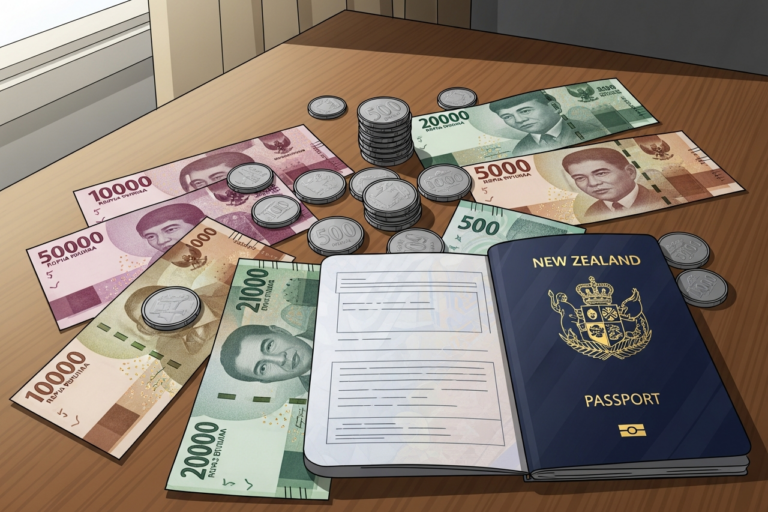
Key Highlights
Heading to Indonesia? Sorting your travel money is easy. Here are some things you need to know about the local currency of Indonesia, so your trip will go well.
-
The official currency of Indonesia is the Indonesian Rupiah (IDR), and it is set by Bank Indonesia.
-
You cannot use New Zealand dollars there. You have to pay in Indonesian Rupiah.
-
The exchange rate means one New Zealand dollar will change to thousands of Rupiah.
-
It is good to have cash for small shops, markets, and places outside big cities.
-
If you change your money before you fly out of New Zealand, you usually get a better rate.
-
Check the live exchange rate often to make sure you get the best value for your travel money.
Introduction
Are you ready for a trip to the beautiful islands of Indonesia? If you want to see Bali’s beaches or take in Java’s temples, you need to know about the local currency. This guide will help you learn all you need to know about the Indonesian rupiah (IDR). You will find out what it is, how to get a good exchange rate for your New Zealand dollars, and some handy tips for using your money while you travel. Let’s sort out your travel spending now so you can look forward to the adventure!
Understanding Indonesia’s Official Currency
The Indonesian Rupiah is the official currency of Indonesia. People often call it IDR for short. You will see the prices for things like a cup of coffee or your hotel room in this currency. The Indonesian Rupiah is the only legal tender you can use in all parts of Indonesia. So, it is good to have some Rupiah with you to make your trip smooth.
Bank Indonesia is the central bank of Indonesia. They look after the currency. The Indonesian Rupiah looks bright and special. It has an interesting story. Next, we will talk about the different notes of the Rupiah, how to tell if money is real, and the history of the currency you will use.
What is the Indonesian Rupiah (IDR)?
The Indonesian Rupiah is the official currency and uses the currency code IDR. It is used everywhere in Indonesia. You need to have this money for all that you buy, from street food to small gifts you may want to take home. The Indonesian Rupiah is the only legal tender there, so you cannot use anything else to pay for things.
One thing you notice right away is the exchange rate. For the New Zealand dollar, you get a lot of these notes. You will see big numbers when you change your money. You might even feel rich for a bit, as your wallet can fill up fast with the IDR exchange rate.
This money comes as both notes and coins. You find notes most often in daily life, from Rp 1,000 to Rp 100,000. There are coins as well, and these are for the small amounts—like Rp 50, Rp 100, Rp 200, Rp 500, and Rp 1,000.
Because the numbers on the notes are big, you get used to having bundles of cash on you when you go shopping. It is good for you to know what each note looks like, as this will help you pay easy and fast.
How to Identify Indonesian Rupiah Banknotes and Coins
Learning about the local currency can help you when you want to buy something. Indonesian Rupiah notes are easy to spot. They have bright colours and show important people from the country’s history. Each one has its own colour and look, so it’s simple to tell them apart.
Bank Indonesia is the group that brings out these notes. They want people to remember the country’s story. You can see pictures of famous people, dances, and well-known places on them. For example, the Rp 100,000 note has pictures of Indonesia’s first president and vice-president. Coins are more basic. They are usually made with aluminium or nickel and display the Garuda Pancasila, which is the country’s mark.
Here are a few things you’ll find on the Indonesian banknotes:
-
Vibrant Colours: Every note has its own colour. The Rp 50,000 note is blue, and the Rp 100,000 note is red.
-
National Heroes: There are faces of important people from history on the front.
-
Cultural Imagery: You’ll see things like Indonesia’s land, plants, or artwork on the back.
The History and Significance of the Rupiah
The indonesian rupiah has the kind of history you get from a long fight to be free. It first started in 1946, put in by indonesian nationalists when they were trying to get out of dutch control. This new money took over from the netherlands indies gulden. The name “rupiah” comes from a sanskrit word for silver, “rupya.” That gives it a link back to something old in the area.
The indonesian rupiah has gone up and down a lot over time. There was a big hit in the asian financial crisis in the 1990s that caused it to lose a lot of value. Even before then, things like the japanese occupation in world war ii made the money less steady.
The reason you see such big numbers on indonesian rupiah notes now is from that history. People have talked about making the money simpler by starting again, but so far that has not happened. The system they have is still here, and it says a lot about how the indonesian economy has learned to get back up after hard times.
Currency Denominations and Features
When you use the indonesian rupiah, you will see many kinds of notes and coins. These all come from bank indonesia. On each note or coin, you can see pictures that show the rich culture and history of this country. If you learn each value, it will be much easier to pay for things.
The banknotes start at Rp 1,000 and go all the way up to Rp 100,000. You may have a few different ones in your wallet. Now, let’s check out these banknotes, what is on them, and also some of the coins you might use while you are here.
Banknote Values and Design Explained
Indonesian banknotes are not only practical but also a beautiful representation of the country’s identity. Each of the currency denominations features a unique colour and design, making them easy to tell apart. Bank Indonesia has carefully chosen national heroes, cultural elements, and iconic landscapes to adorn these notes.
For example, the highest value note, the Rp 100,000, is red and features Indonesia’s first President, Sukarno, and Vice President, Mohammad Hatta, on the front. On the back, you’ll find an image of the Raja Ampat islands. These thoughtful design choices turn every transaction into a small cultural lesson.
Here’s a quick guide to the current series of Indonesian Rupiah banknotes:
|
Banknote Value |
Main Colour |
Front Design (National Hero) |
Reverse Design (Cultural Element) |
|---|---|---|---|
|
Rp 100,000 |
Red |
Sukarno and M. Hatta |
Raja Ampat Islands and a dancer |
|
Rp 50,000 |
Blue |
Djuanda Kartawidjaja |
Komodo National Park and a dancer |
|
Rp 20,000 |
Green |
Sam Ratulangi |
Derawan Islands and a dancer |
|
Rp 10,000 |
Purple |
Frans Kaisiepo |
Wakatobi National Park and a dancer |
|
Rp 5,000 |
Brown |
Idham Chalid |
Mount Bromo and a dancer |
|
Rp 2,000 |
Grey |
Mohammad Hoesni Thamrin |
Ngarai Sianok and a dancer |
|
Rp 1,000 |
Yellow-Green |
Tjut Meutia |
Banda Neira and a dancer |
Common Coin Denominations in Circulation
While you will use the currency of Indonesia in notes for most shopping, coins are still important to have every day. Coins are handy when you pay small amounts or when you get change. The coins you can find are Rp 1,000, Rp 500, Rp 200, Rp 100, and Rp 50. You do not see Rp 50 much these days as it is worth so little.
You will mainly get Rp 1,000 and Rp 500 coins back when buying things. People use them for things like parking, tips, or at small food stalls that people call warungs. The Rp 1,000 coin stands out because it has two different metals. It has a silver ring made of nickel-plated steel and a brass centre. So, you can spot it quickly.
All coins are made and given out by Bank Indonesia. These come from light metals like aluminium. One side of each coin shows the Garuda Pancasila that stands for Indonesia. Their coins may not be bright like the currency of Indonesia’s banknotes, but they are still very useful. Coins help keep things moving when people need change or pay smaller amounts.
Security Features on Rupiah Notes
Bank Indonesia uses many advanced security parts to help protect the Indonesian Rupiah from being copied. These parts help you know the currency of Indonesia is real, so you can feel sure when you use cash. It is a good idea to get to know some of these features.
One main part is the watermark that shows a national hero when you hold the note up to the light. There is also a line called a security thread that goes through the paper. You can see this line when you look at it in the light, and it will change colour if you tilt it.
You can also find these easy-to-see safety features on the Indonesian rupiah:
-
Latent Image: You see this when you tilt the note at a certain angle.
-
Holographic Patch: You will find this part on notes with higher value. The patch can change colour and can show new pictures if you tilt the note.
-
Microtext: This is small writing. You will need a magnifier to read it well.
Exchange Rates and Converting New Zealand Dollars to Indonesian Rupiah
One thing you need to sort out before your trip is the exchange rate between the New Zealand Dollar (NZD) and the Indonesian Rupiah (IDR). If you get a good Indonesian Rupiah exchange rate, you will have more travel money for your time away. The IDR exchange rate can change, so it is smart to keep track of it both before and during your trip.
You have a few ways to do your currency exchange. You can either sort it out before you leave New Zealand, or use services after you arrive in Indonesia. Further down, we talk about how to find the best live rates, the safe places where you can exchange your money, and how to look at different options to help make sure you get the best value.
Finding Live NZD to IDR Exchange Rates
To make the most of your money, it helps to look for the best live exchange rates before you change NZD to Indonesian Rupiah. The exchange rate often goes up and down every day because of the world market, so what you see today can change by tomorrow. An online currency converter is the best way to quickly see the latest IDR exchange rate.
These currency converter tools give you up-to-date info. Usually, you will see the mid-market rate, which sits right between what buyers and sellers agree on. But keep in mind, most places where you swap or buy money will add extra exchange rate markups on top of the IDR exchange rate. They do this to make some profit, so the rate you get will not be as good as the one shown in the tool.
For the best indonesian rupiah rates, check with trusted banks, well-known currency exchange companies, or apps that deal with money. Then, look at all your options. When you compare indonesian rupiah rates, you can find the one that is close to the mid-market rate. This way, you will not lose as much from extra markups, and your travel money will go further.
Where to Exchange Money in New Zealand and Indonesia
You have a few choices for currency exchange in New Zealand before you leave, and in Indonesia after you arrive. Some people like to change a little money at home. This way, they have cash ready to pay for things like taxis or food right when they land. In New Zealand, you can go to banks or an exchange bureau.
When you get to Indonesia, there are money changers at the airport, in tourist spots, and cities. The airport counters are easy, but the rates may not be as good. A better idea is to use authorised money changers in town or to take cash out at an ATM. Watch out for small stalls that look unofficial and offer really high rates. These could be scams.
For a good experience, you can use these options:
-
Dedicated Money Transfer Providers: Companies like Western Union or other travel money services often have competitive rates and safe service.
-
Banks: Your bank in New Zealand can do currency exchange, but their rates might not be the best.
-
Authorised Money Changers: In Indonesia, find official exchange bureaus. Look for clear signs and check there are no hidden fees.
Comparing Rates and Fees for Best Value
To get the most Rupiah when you change your dollars, you need to pay attention to more than just the exchange rate. Some providers might say they have the best exchange rate, but they might have hidden fees or add extra transaction fees. These can cut into your travel money. It’s important to find transparent pricing.
The best provider is the one who gives you a good exchange rate and doesn’t add any hidden fees. Some places make their money by putting markups in the exchange rate, so you get less than the true market rate. Other services may show you a great rate, but they will still have a commission or a flat fee for each trade.
Before you decide, find out the final amount of Rupiah you will get once all costs are added. This simple step will help the process be clear. You can compare offers in an easy way. It does not matter if you swap your money before your trip or when you get there, doing this research will help save you money.
Using Money in Indonesia – Practical Tips for Travellers
Once you have some Indonesian Rupiah, you will want to know the best ways to use it. Using more than one way to pay is often your best bet. Big hotels and places to eat in Bali and other tourist spots take cards. But, you need cash in many other places.
It’s good to have cash, a debit card, and maybe a travel money card with you. This set up helps you pay with the local currency at markets and warungs. Also, you have a safe backup for bigger bills. Here is when to use cash, when to use cards, and some key tips for your travel money.
Cash Versus Card: What’s Widely Accepted?
In Indonesia, whether you use cash or card depends on where you are and what you’re buying. In busy tourist spots like Seminyak or Ubud, it is easy to use debit or credit cards. Most hotels, big shops, and fancy places to eat take cards. But, when you go out of these places, you need cash.
It is important to have enough Indonesian Rupiah to use every day. You will need it for things like local markets, street food, taxi rides, going into temples, or shopping at small family stores. A lot of small shops do not let you use cards, and some want cash so they do not have to pay transaction fees.
When you use a card, remember these things:
-
Dynamic Currency Conversion: If you are asked whether you want to pay in NZD, say no. The exchange rate will not be good. Always pay in Indonesian Rupiah.
-
Card Surcharges: Some shops may add on 2-3% if you pay by card. They do this to cover their own costs.
-
Travel Money Card: A travel money card you can top up before you go might be a good idea. It helps you lock in an exchange rate and keep track of your travel money.
ATMs, Banking & Payment Advice for Visitors
ATMs can be found in most cities and tourist spots in Indonesia. This makes it easy for people to get cash when they need it. Try to use ATMs from well-known banks like Mandiri, BCA, or BNI. They are often more reliable. If you are from New Zealand, tell your bank about your trip. This helps stop your card from being blocked by mistake.
Keep in mind that there are withdrawal limits at these ATMs. You may only be able to take out a small amount at one time. There will also be transaction fees from the local ATM and your own bank. To spend less on these fees, it is better to get more cash in one go, instead of many small withdrawals. Always be careful when you use an ATM. Cover the keypad when you type your PIN and look around before you take out cash.
If you need to pay for big things, like places to stay or tours, money transfers can help. But for most things during your trip, like shopping or eating out, cash and cards are easier to use. Bank Indonesia looks after the banking system, and in the cities, it is modern. But if you go far from the towns, be ready with a backup plan. Things can be less reliable out there.
Conclusion
To sum up, it is important for people from New Zealand to know about Indonesia’s money, called the Indonesian Rupiah (IDR). Get to know the different notes and coins, what they look like, and the money exchange rates. This will help make your trip better. Know where you can swap your cash for a good rate and learn if you should use cash or cards when you travel. If you are ready and know these things, your time in Indonesia will go well. If you still have questions or need some help, you can get a free chat to talk through your travel plans.
Frequently Asked Questions
Can I use New Zealand dollars or other foreign currencies in Indonesia?
No, you can’t use New Zealand dollars or any other foreign currency to pay for things in Indonesia. The Indonesian Rupiah is the official currency of Indonesia and is the only money accepted everywhere. You will need to change your travel money into Rupiah before you can buy goods or use services in the country.
Is it better to exchange currency before arriving or after landing in Indonesia?
It is often good to swap some of your travel money for Indonesian Rupiah in New Zealand before you go. You may get competitive rates like this and not have to pay big fees at airport exchange bureaus. You will have cash ready when you land. After this, you can take more cash out from ATMs when you need it.
How does the rupiah’s value compare to other major currencies?
The Indonesian Rupiah has a low value when you compare it to big currencies like the US Dollar or the New Zealand Dollar. Because of this, the exchange rate lets you get a lot of Rupiah for each dollar you have. This is because, over time, there has been significant inflation. So, there are now large denominations in the Indonesian Rupiah.



