Unusual currencies: limestone discs to faceless banknotes
Unusual currencies include everything from the giant rai stones of Yap Island (limestone discs weighing up to four tonnes) to Germany’s WWI-era notgeld printed on silk and wood. Today, unusual currencies range from Australia’s polymer banknotes to the Cook Islands’ triangular coins. What unites them is that each reflects a unique political, cultural, or technological moment. For UK readers, these serve as a reminder that money has not always been pounds and pence, or even the pre-decimal pounds, shilling and pence system that we used until 1971.
This guide, drawn from central bank and numismatic sources, covers nine striking examples and their stories.
- Yap’s rai stones changed hands by word of mouth, the stone never moving.
- Notgeld and Zaire’s faceless notes both came from political and economic crisis.
- Australia’s 1988 polymer note shaped currencies including the UK’s own.
At Remitly, we help people move money across currencies every day and enjoy a good currency backstory too.
At a glance
- Unusual currencies are forms of money that fall outside traditional notes and coins
- Famous examples include Yap stone money, and animal pelts used as money
- Many unusual currencies emerged because they were scarce, durable, widely accepted, or easy to verify
- The UK once used the complex re-decimal system, and older units such as the guinea
- Studying unusual currencies reveals what has value and why people trust money
What makes a currency ‘unusual’?
A currency becomes unusual for one of three reasons: its form, its history, or its design. Unusual form covers money that doesn’t look or behave like a typical coin or banknote, as with Yap’s stone discs and Central Asia’s tea bricks. Unusual history describes currency shaped by crisis or political change, such as Germany’s inflation-era notgeld or Zaire’s faceless banknotes. Unusual design covers currency that broke new technical or artistic ground, from Australia’s polymer notes to the Cook Islands’ triangular coins, both departures from everyday fiat currencies.
Unusual currencies from history
These currencies no longer circulate, but each reflects a distinct moment in its country’s economic or political story.
Rai stones of Yap Island

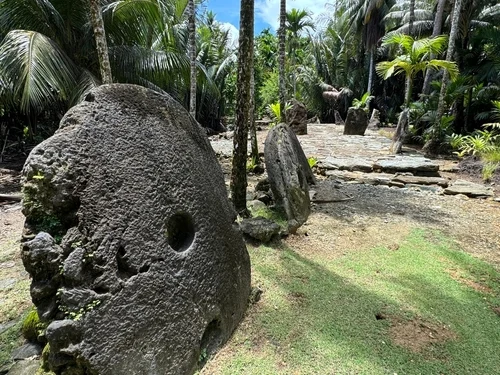
On the island of Yap, now part of the Federated States of Micronesia, communities used enormous limestone discs up to 3.6m in diameter called rai as currency. The Smithsonian’s own specimen measures 1.8 metres across and weighs around 1.8 tonnes, and some documented stones are considerably larger. Quarried in Palau and moved by canoe, rather than moving stones Yapese communities simply remembered who owned it; value rested in the story of its exchanges.
Rai stones are no longer used today as money, but they retain ceremonial and cultural significance on yap today as powerful symbols of status, heritage and community identity.
German notgeld: emergency money after WWI

Between 1921 and 1923, hyperinflation left the German mark almost worthless; by late 1923, the historian Adam Fergusson records its collapse to trillions of marks against the US dollar. Official printing couldn’t keep pace, so local authorities issued their own notgeld, made from leather, silk, wood, and even porcelain. Using these materials, meant money could be produced quickly and cheaply, while shortages of paper and printing capacity worsened.
Genuine notgeld notes are still collected today, part of the wider story of currency across Europe.
Tea bricks: currency you could drink

From the 9th century until the early 20th, compressed tea bricks served as currency across Central Asia and China, traded along the Tea Horse Road, with higher-quality bricks worth more than lower grades. The Museum of Archaeology and Anthropology at the University of Cambridge notes the use of tea bricks as money in Central Asia, and museum collections in Britain and North America have preserved examples from China, Tibet, and Siberia.
People actually preferred receiving payment with tea bricks because they could then consume the tea when confidence in the currency disappeared.
Faceless banknotes of Zaire

President Mobutu Sese Seko, who led the country from 1965, was deposed in 1997, when it was renamed the Democratic Republic of Congo, the new government needed banknotes without his portrait. Rather than wait for a full redesign, officials simply punched Mobutu’s face out of the existing notes.
These faceless notes are now sought after by collectors on eBay and specialist auction houses. Values vary depending on denomination, but their appeal is tied to the extraordinary story behind them rather than economic value.
For those that know their Cold War history, Mobutu was one of Africa’s longest-serving rulers and a prominent Western ally during much of the Cold War.
These extraordinary notes as just one part of the wider story of currency across Africa.
The Cook Islands dollar: triangular coins and shark riders

For UK readers, The Cook Islands dollar is easiest to understand as a close relative to the New Zealand dollar. From 1972 until the New Zealand dollar became more commonly used in everyday transactions, the Cook Islands dollar was a unique triangular coin. There was also an unusual twelve-sided $5 coin. Alongside triangular coins, one banknote featured a woman riding a shark, a nod to Ina, a Polynesian myth figure.
Cook Islands notes and coins are now collectors’ items.
Today, the shark rider $3 note is one of the most recognisable modern banknotes in the world and a staple of numismatic collections. Uncirculated notes and presentation issues typically command higher premiums among collectors.
Unusual currencies still in use today
These currencies remain legal tender, even though each has an unusual story of its own.
Australian dollar: the world’s first polymer banknote

In 1988, Australia became the first country to issue a polymer banknote, developed by the Reserve Bank of Australia and the CSIRO to make notes harder to counterfeit and more durable than paper. The technology proved influential: the UK introduced its own polymer five and ten pound notes in 2016 and 2017, followed by the King Charles III notes in 2023. Polymer banknotes typically include:
- a clear window you can see through
- colour-shifting ink
- fine microprinting
- raised print you can feel, for people with visual impairments
Vietnamese đồng: microprinting and security innovation

Vietnam moved to polymer banknotes in 2003 to curb counterfeiting, initially produced with Note Printing Australia; the State Bank of Vietnam has since reported fewer fakes. The current đồng bills depict the country’s former president, Ho Chi Minh, in portrait-style. Microprinting, text too fine to reproduce without specialist equipment, is one of several security features on the notes, echoed across currency in Asia.
South African rand: the Mandela notes

In 2012, bills bearing Nelson Mandela’s face went into circulation as a nation building-statement. The rand became South Africa’s currency on 14 February 1961, replacing the South African pound. The Mandela noted were built on an earlier redesign that featured the Big Five animals long used on the reverse for the country’s wildlife. The rhinoceros, leopard, lion, buffalo, and elephant became an expression of national identity, celebrating the country’s national heritage.
If you send money to South Africa, its currency code is ZAR.
Canadian $10 note: the first vertical banknote

In 1946, Viola Desmond refused to leave the whites-only section of a Nova Scotia cinema, becoming a symbol of Canada’s civil rights movement. These bills depict Canadian civil rights activist Viola Desmond and are the country’s first vertically oriented bills. The International Bank Note Society named it Banknote of the Year for 2018.
Other notable mentions worth knowing

A handful of other currencies have an equally rare currency history.
- Parmesan as collateral: Italian banks, including Credem, accept wheels of Parmigiano-Reggiano as loan collateral, as reported by Forbes.
- Ithaca Hours: this local currency, issued in Ithaca, New York since 1991, could be spent at hundreds of local businesses instead of US dollars.
FAQs about unusual currencies
What’s the most unusual currency in history?
Many people point to Yap’s rai stones: huge limestone discs, some weighing tonnes, whose ownership changed hands by word of mouth.
Are any unusual currencies still in use today?
Yes: Vietnam’s polymer đồng and South Africa’s rand are both everyday, legal-tender currencies with an unusual history behind them.
Has the UK ever had an unusual currency?
Before decimalisation in 1971, the UK used pounds, shillings, and pence, including the guinea, later moving to polymer notes in 2016 and 2017.
What are some examples of unusual coins?
Unusually shaped coins, like the Cook Islands’ triangular coins, are often designed to stand out or be identified by touch.
What makes modern banknotes hard to counterfeit?
Features like polymer material, colour-shifting ink, microprinting, and raised print, pioneered on notes such as Australia’s, make banknotes harder to copy.
Are unusual currencies worth anything to collectors?
Some are: historic notgeld, faceless Zairean banknotes, and early Cook Islands currency are traded by numismatists through dealers such as Spink & Son or Catawiki.
What unusual currencies tell us
Taken together, these currencies are a record of history: political upheaval, geographic isolation, new technology, and national pride. If this has left you curious for more, our guide to some of the world’s most beautiful banknotes is a good next stop; Remitly supports transfers in more than 100 currencies to over 170 countries.
Key takeaways
- Yap’s rai stones show a currency doesn’t need to be carried to have value.
- Notgeld and Zaire’s faceless notes both emerged from political and economic crisis.
- Australia’s 1988 polymer note has since shaped currencies including the UK’s own.
- Vietnam’s đồng and South Africa’s rand prove that unusual and everyday are not opposites.
- The rand’s correct founding date is 14 February 1961, not 1956.
Last reviewed: September 2026