

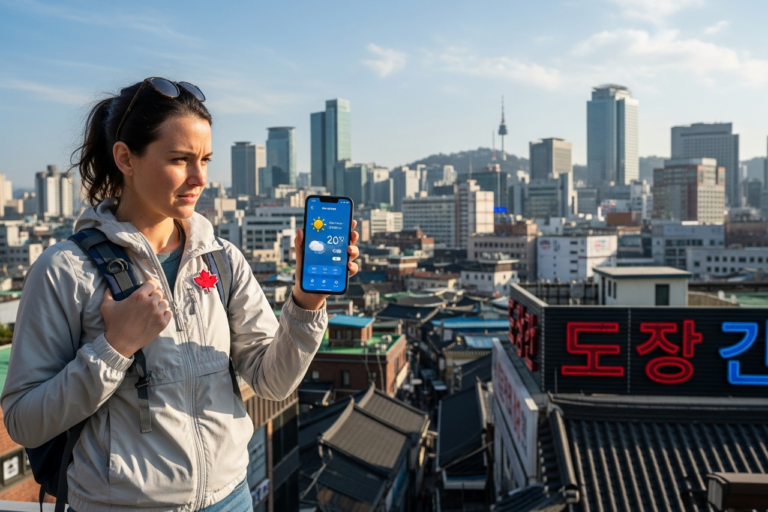
Key Highlights
-
South Korea has four distinct seasons. The weather changes a lot in each season and this gives Canadians something different each time they travel.
-
The best time to go for good weather is in spring (April to June) and autumn (September to November).
-
Summer can get hot and very humid. There are also heavy monsoon rains, mostly in July and August.
-
Winter is cold and dry. The temperature can fall quite a bit. It may feel like winters in Canada, but is often drier.
-
Always look at local forecasts to get real-time updates on the air quality, precipitation, and wind speed.
-
The climate in Seoul will show what the weather is usually like across Korea.
Introduction
Are you getting ready to go from Canada to South Korea? One big thing people think about is the weather. When you know what the weather will be like in Korea, you can pack what you need. You can also plan the things you want to do. Seoul, the country’s busy city, and Busan on the coast, can have different weather during the year. The temperature changes a lot for them. This guide will help you know what kind of weather to expect in Korea. You will be all set for your trip, and you can have a great time no matter when you go.
Understanding South Korea’s Climate: An Overview For Canadians
South Korea has four distinct seasons, and this can feel like what people in Canada know. There is a beautiful spring for all to enjoy. Then, summer gets hot and wet. After that, the autumn shows up, and it is cool and crisp. In winter, it turns cold and dry. The country does not have a lot of regional changes in weather, so what you see in one place is what you get in another part too.
Most precipitation in Korea happens in summer when the monsoon hits. If you check the current weather in Seoul, you will usually know the weather in other areas of South Korea. Now, let’s look at how the weather in the capital shows what is happening across the country and how it is not the same as what you had at home.
How Seoul’s Climate Reflects the Country’s Weather Patterns
The climate in Seoul is a good way to understand the rest of South Korea’s weather. In the capital, there are clear seasons. Summers are hot and humid. Winters are cold and dry. This is much like the weather seen across the country. Because Seoul is an urban place, things like air quality show up more often. Most forecasts will give you updates about temperature, wind speed, and even visibility.
The Han River goes through Seoul, and the nearby mountains can change the weather a little. Still, the change through the seasons—from spring’s cherry blossoms, to heavy rain in summer, and bright autumn leaves—is much the same in all of Korea.
If you watch Seoul’s weather, you can guess what the weather will be in other places too. It helps you to plan, whether you stay in Seoul or travel around South Korea. For the best details, always check the local forecasts before your trip.
Key Differences Between South Korean and Canadian Weather
Both countries go through four seasons, but there are some clear differences between South Korea and Canada when it comes to weather. The biggest change you will notice is in summer, especially with the high humidity and the monsoon. Canadian summers can feel humid, but South Korea’s summer stands out because of the East Asian monsoon. It brings a heavy, wet heat that gives most of the year’s precipitation.
Another key difference is the kinds of severe weather you get. Canada often faces storms like tornadoes, while South Korea gets more typhoons.
-
Humidity and Precipitation: In South Korea, summers are very humid, and most of the rain falls from June to September. In the winter, it can be quite dry—a dry winter is common in Korea. Many places in Canada, though, have snowy winters.
-
Severe Storms: South Korea has one or two typhoons most years in summer with strong winds and lots of heavy rain. That type of storm is different from what you usually get in Canada.
Seasonal Weather in South Korea: What Canadians Should Expect
The Korean weather cycle gives you something new in each season. Spring and autumn are the best times to go. You can walk around with comfort, since the weather is mild and skies are clear. But the summer months are not like this at all. Most days are really hot, the air is full of humidity, and you can get heavy monsoon rains.
On the other hand, winter is not wet but instead a dry winter. It is cold and fresh, and snow falls sometimes, more so in the north. The land looks quiet and pretty during this time. It is not like the messy thaw that you get in Canada. Here is what you can look forward to for temperatures and weather during each season.
Spring, Summer, Autumn, and Winter: Comparing Temperatures and Conditions
Each of South Korea’s four seasons presents a unique climate. Spring (April-June) and autumn (September-November) offer the most pleasant temperatures and lowest precipitation, making them ideal for travel. In spring, expect average daily temperatures around 15-18°C. Autumn is similarly mild, with averages of 19-21°C.
Summer (July-August) is the hottest and wettest period. Temperatures can range from 23°C to 30°C, but high humidity makes it feel warmer. This is also when monsoon rains deliver about half of the country’s annual rainfall. Winter (December-March) is cold, with temperatures in Seoul dropping below freezing, though coastal areas like Busan are milder.
|
Season |
Average Temperature Range (Seoul) |
Key Conditions |
|---|---|---|
|
Spring (April-June) |
15°C – 18°C |
Sunny, dry, comfortable |
|
Summer (July-August) |
23°C – 30°C |
Hot, very high humidity, heavy rain |
|
Autumn (Sept-Nov) |
19°C – 21°C |
Mild, sunny, low rainfall |
|
Winter (Dec-March) |
-6°C – 4°C |
Cold, dry, occasional snow |
The Monsoon Season and Its Impact on Travel Plans
Yes, South Korea gets a rainy season called ‘jangma’. It can start at the end of June and last until the end of July. During this time, most of the country’s rainfall comes all at once. This means your travel can be affected by the weather.
If you travel in the rainy season, get ready for heavy rain. Doing things outside can be tough. You may end up spending more time in places like indoor spots around Seoul. You should check news and weather forecasts, using trusted sources like the Korea Meteorological Administration (KMA). This is very helpful for finding out about rain probability and warnings for storms, mainly if you want to see places close to Incheon.
-
Bring waterproof things, like a good raincoat and an umbrella.
-
Have some indoor things planned in case you run into a very rainy day.
-
Keep an eye on local weather forecasts to stay up to date about wind and storms.
[https://www.kma.go.kr]
Conclusion
To sum up, it is important for Canadians to know about south korea’s weather before they go. The four seasons in korea each bring something different. There is also a monsoon season you should know about. When you learn more, you can plan your trip in a better way and enjoy your time there. Be ready for all kinds of things, from cherry blossoms in spring to cold air in winter. When you know what kind of weather to expect, your trip will be better. This will help you get ready for whatever comes. If you want more help with your plans for korea, you can always ask your questions!
Frequently Asked Questions
What is the average temperature in Seoul during winter, and how does it feel compared to Canada?
The average winter temperature in Seoul is about -2°C in January. It can go down to -10°C or even lower when it gets colder. In many places in Canada, you may find the same kind of cold weather. But in Seoul, the winter air is much drier. You will find that the cold in Seoul feels crisp and sharp. There is not as much heavy or steady snowfall as what people get in Canada.
When is the best time for Canadians to visit South Korea for good weather?
The best time for Canadians to go to South Korea is in April and May or during the autumn months like September and October. The weather will be sunny and dry. It is not too hot or too cold. That makes it good for walking around and doing things outside. If you want the nicest weather in Korea, spring or autumn is the best time.
How reliable are weather forecasts in South Korea for planning your trip?
Weather forecasts in South Korea are good for short-term plans. If you want to know about sunrise and sunset in Korea, you can check the forecasts from the Korea Meteorological Administration (KMA) or AccuWeather. These sources will give you a good idea of the probability of rain. They can help you know what to expect in your day. Make sure you look at these sites before your day starts for the most up-to-date weather in South Korea.



