

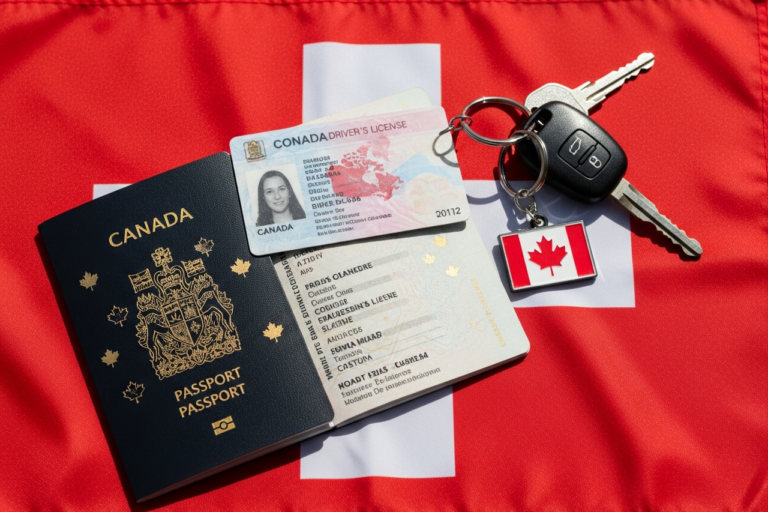
Key Highlights
Here are the key things to know for Canadians who want to drive in Switzerland:
-
You can use your Canadian driving licence in Switzerland for up to 12 months if you are there as a tourist.
-
It is a good idea to get an International Driving Permit, especially if your licence does not show English, French, German, or Italian.
-
If you are going to stay for more than 12 months, you need to exchange your Canadian driving licence for a Swiss one.
-
Car rental companies often have rules about your age and how much experience you have. Most of them ask you to be over 20 and have had your licence for at least one year.
-
You must keep the right papers with you. This means your passport, your driving licence, and your car registration.
-
Follow the Swiss road traffic rules at all times. This includes obeying speed limits, being careful with alcohol, and having all the required things in your vehicle.
Introduction
Are you planning to take a road trip across Switzerland? The alpine roads and quiet lakes are a sight you will not forget. If you are from Canada, driving here is a good way to see what the country has to offer. You want your trip to be safe and simple. So, it helps to know the basic rules of driving in Switzerland.
This guide shares everything you must know. You will learn if your Canadian driving licence works here, and if you need an international driving permit. We want to help you get set for a great and easy time in Switzerland while you are behind the wheel.
Canadian Driver’s License Validity in Switzerland
Good news! If you are a Canadian tourist, you can drive in Switzerland with your Canadian driving licence. The swiss authorities will let you use your own driving licence for some time. It is easy for you to drive and see the country without doing a lot of paper work right away.
You will have time to enjoy driving on the roads there. You can rent a car or even use one from a friend. But there are limits for time and rules you must follow, mostly when you plan to stay longer. We will look at these rules soon.
Recognition of Canadian Licenses by Swiss Authorities
The Swiss authorities will usually accept a valid Canadian driving licence for tourists. If you are in Switzerland for a short visit, you can show your Canadian licence if you get stopped by police or when you want to rent a car. This is great for foreign drivers since it helps you get around the country. You don’t have to get a Swiss driving license right away.
This is possible because of international rules on road traffic. If your foreign driving license is still good, and you are at least 18, you can drive any kind of vehicle mentioned on your licence. The system is made so tourism is easier for everyone.
But you should still be ready and have what you need. Even though they accept your licence, there are some rules and other papers you need to have. You should also remember to check how long you can use your Canadian licence before you need to switch to a local one. This will help you plan your trip well.
Duration Canadians Can Drive Before Exchange is Required
As a Canadian tourist, you can use your driving license from your home country to drive in Switzerland for up to 12 consecutive months. This should be enough time for most people who are just visiting for a holiday or a short trip. You will be able to see all of the beautiful places in the country without any problems about your license.
If you plan to stay longer than 12 months, or if you decide to live in Switzerland, things will change. After this, you need to exchange your foreign licence for a Swiss license. You will have to get in touch with the road traffic office in your local canton and fill out an application for this.
If you do not exchange your license after 12 consecutive months, you will not be able to drive legally in Switzerland anymore. So, if you know that you want to stay for a long time, make sure to start the process with the road traffic office before your year is up. This will help you to follow the road traffic rules and keep you on the right side of the law.
Understanding International Driving Permits (IDP)
An International Driving Permit (IDP), also known as an international driving licence, helps the people in other countries read your Canadian driving licence. This document puts your licence details in many languages. The IDP is not a full licence by itself. You have to carry the international driving permit with your real, valid driving licence.
The international driving licence is meant to help police and car rental companies understand your driving record in their country. You might not always need this document, but it can stop problems when people don’t speak your language. It also makes it easier to deal with other people while you travel. Let’s see when you need an international driving permit in Switzerland.
When Canadians Need an International Driving Permit in Switzerland
While your Canadian driving licence will work in Switzerland, it is a good idea to get an international driving permit before you go. The main reason for this is the language that swiss authorities need on any driving license or documentation. It has to be in Roman script. Also, the license has to be in one of the official languages for Switzerland, like German, French, Italian, or English. If your licence is not in these languages or script, you must have an IDP.
Even if your licence is in English, bringing the international driving permit is still helpful. It will give a clear translation of your driving licence in more than one language. This makes things easier if you talk to the police or deal with rental companies. It helps those people check fast that your foreign driving licence is real and all good.
Get an international driving permit if:
-
Your driving license does not use English, French, German, or Italian.
-
You want to make sure there are no mix-ups with swiss authorities or rental companies.
-
The car rental company wants to see one, which can happen even if swiss law doesn’t say you need it.
How to Apply for an International Driving Permit in Canada
Applying for an international driving permit in Canada is easy. The Canadian Automobile Association (CAA) is the only group that can give out international driving permits to Canadians. You need to apply before you travel. You will not get the permit if you are already out of the country.
To get your international driving licence, you can go to a CAA office or use their website. You have to fill out an application form and bring a few things with you. The whole process does not take long. Many people can get the international driving permit the same day they go in person.
Here’s what you have to give:
-
A filled-out IDP application form.
-
Two photos that are passport-size.
-
A copy of the front and back sides of your Canadian provincial driving licence.
-
The fee that’s needed to process your application.
Essential Documents Canadians Must Carry While Driving
When you drive in Switzerland, you must have the right papers with you. It is just as important as knowing the road traffic rules. If the police stop you, you have to show some key papers right away. When you have all your papers in order, you will not have a problem on the road and your drive will be smooth.
You must carry your valid license and an identity document at all times. But the rules on road traffic in Switzerland say you need a few other things in your car, too. Here is what you need to have with you.
List of Mandatory Documents for Driving in Switzerland
To follow Swiss law and stay away from trouble, you need to keep a certain group of documents in your car at all times. It is not just the car rental companies that will ask for them. The police can stop you at any time when you are driving on the Swiss roads and want to see these papers. Make sure all these are original documents and that you can get to them easily if you need to show them.
It is very important to have these with you when you drive. If you do not have the right documents, you can get fined or face more problems. By putting them in your car and keeping them safe, you make your trip worry-free and easy, so you can enjoy the time on Swiss roads.
Here is the list of mandatory documents you must carry:
-
Your valid Canadian provincial driving licence.
-
An International Driving Permit (IDP), especially if your licence isn’t in a recognized language.
-
Your passport as a primary identity document.
-
The vehicle’s registration documents (V5 certificate).
-
Proof of valid third-party liability insurance.
Additional Proofs and Recommendations for Canadian Drivers
Besides the main documents you must have, you can bring a few more things to make your drive in Switzerland easier. These extra items are not a must by law, but they help you handle surprises, especially when you are in a foreign country.
Think about carrying a translated version of your most important papers if they are only in English. Even though English is often understood, having your documents in German, French, or Italian may make things easier in some towns or more remote spots. You can get these translations through an official service before you go.
Below are some other good things to bring with you:
-
Contact details for your insurance provider and the Canadian embassy.
-
A copy of your car rental agreement if you’re using a rental vehicle.
-
Proof of European breakdown cover, which is useful if your car has a problem.
Renting a Car in Switzerland with a Canadian License
Renting a car is a good choice if you are a Canadian and want to see Switzerland on your own time. Many car rental companies in Switzerland will take your Canadian license, so it is easy for you to book a car and get moving.
You can find most of the top international rental companies here, as well as local brands. They have many types of cars you can pick from. To rent a car, you need to meet a few rules and show the right papers. We will talk about those next.
Eligibility Requirements for Canadian Tourists
When you want to rent a car in Switzerland with your Canadian driving licence, there are some rules from the car rental companies you have to follow. Your foreign license is fine, but each rental company can have their own rules. They look at things like your age and how long you have had your licence to make sure you fit what they want.
Most of the time, you must be at least 20 years old to get a car. But if you are under 25, you might have to pay a young driver fee. Also, many rental companies want you to have had your driving licence for at least one year. It is a good idea to look at the rules of the car rental companies before you book a car.
Here is what most rental companies ask for:
-
You need a Canadian driving licence that you have had for at least one year.
-
You must be at least 20 years old, but this could change depending on the company and the car.
-
You have to give a credit card in your name, and this will be used for the security deposit.
Popular Car Rental Providers and Insurance Options
You’ll find a wide selection of car rental companies in Switzerland, with desks at major airports, train stations, and city centres. Familiar names like Hertz, Avis, Europcar, and Sixt are widely available, alongside reputable local providers. It’s often best to book your vehicle in advance, especially during peak tourist season, to secure better rates and your preferred car model.
When renting, you will be offered various insurance options. Basic third-party liability insurance is mandatory and included in the rental price. However, you’ll also be offered Collision Damage Waiver (CDW) and Theft Protection (TP), which reduce your financial liability in case of an accident or theft. Consider purchasing excess insurance separately before your trip, as it’s often much cheaper than buying it at the rental counter.
Here’s a look at some popular providers:
|
Provider |
Known For |
|---|---|
|
Sixt |
Wide range of premium vehicles and good coverage across the country. |
|
Hertz |
Global presence and a reliable choice for international travellers. |
|
Avis |
Strong customer service and loyalty programs. |
|
Europcar |
Competitive pricing and a large fleet of vehicles. |
Driving a Private or Friend’s Vehicle as a Canadian Visitor
Are you planning to use a car that belongs to your friend or family while you’re in Switzerland? A Canadian visitor can drive a private car there, but you can’t just ask for the keys and go. You have to get the right permission from the owner, and make sure the insurance is good enough.
It’s very important to follow the process so you stay legal. If you drive without the right documents or insurance, it can cause big problems. Here’s what you should do before you get in the driver’s seat of a car that’s not yours.
Permission and Documentation Needed
If you want to drive a car in Switzerland that belongs to a friend or family member, you need to get clear permission from them first. It is best to have this in writing. This can help stop any trouble, especially if the police pull you over. The letter should say you are allowed to use the car.
Along with the letter, you must carry the same papers needed when you drive your own car. You must have your valid Canadian driving licence, your passport as your identity document, and the car’s real registration papers. If the police ask, you need to show these papers.
To make sure you are ready, you should have:
-
A signed letter of permission from the person who owns the car.
-
Your valid Canadian driving licence and your passport.
-
The car’s real registration and insurance papers. Keep these in the car at all times.
Liability and Insurance Considerations
Before you drive a friend’s car, make sure you check the insurance coverage. In Switzerland, every driver must have third-party liability insurance. This helps cover damage you could cause to other people or cars. But, this does not pay for damage done to the car you are driving. So, you and the owner need to find out if the policy will cover the car when it is driven by someone else.
The owner of the car should call their insurance provider. They need to check if the coverage extends to someone who has a foreign licence, like a Canadian one. Some policies may not cover this, or they may need the visiting driver to be added by name. If you do not check this, the owner could end up with a big bill for repairs if there is an accident.
Here are key things to ask the insurance provider:
-
Does the policy cover drivers who are not the main person named in the policy?
-
Does the insurance have any rules for people driving with a foreign licence?
-
What is the deductible if there is a claim, and who has to pay it?
Exchanging a Canadian Driver’s License for a Swiss License
If you stay in Switzerland for a long time, or if you want to make it your home, you have to exchange your Canadian driving license for a Swiss licence. Once you are a resident, you must do this within 12 months of getting there. The road traffic office in your canton will help you with this.
The good news is that Canada has a deal with Switzerland. This makes things easier for people with a Canadian license. In most cases, you do not need to do a theory test or a practical driving test. Here are the steps for trading your license.
Step-by-Step Guide to the Exchange Process
Switching your Canadian driving license for a Swiss one can be a simple job. Start by getting in touch with the road traffic office in the canton where you live. The staff at the office will give you the application form along with a clear list of what you need to provide.
After you get the form, fill it out. You need to collect all the papers they ask for. Because Canada has a deal with Switzerland about licenses, you will not have to write a theory test or do a practical driving test. This makes the whole process faster and easier for you.
You can follow these road traffic steps:
-
Get the application form from your local cantonal road traffic office.
-
Book an eye test with an approved optician and have the results filled in on your form.
-
Put together everything you need, like your Canadian driving license and your Swiss residence permit.
-
Bring the finished application form and all your papers in person to the road traffic office.
-
Pay the fee for exchanging your license.
This is how you take care of your driving license in Switzerland. It lets you drive here without doing any road traffic or theory tests again.
Required Documents and Processing Times
When you turn in your application at the local road traffic office, you need to bring the right papers. Having these ready will help make sure your application is done fast, with no hold-ups. Most cantons ask for the same things, but it is always smart to check with your own road traffic office just to be sure.
How long it takes will change from canton to canton and depends on the time of year. Most of the time, getting your new Swiss driving licence in the mail can take a few weeks. While you wait, they might give you a paper that says you can still drive. The office will take your Canadian driving licence for now, and it could be sent back to Canada when you get your Swiss one.
Here’s what you should give:
-
The filled-out application form with your eye test results.
-
Your real Canadian driving licence.
-
Your Swiss residence permit.
-
A new photo that is passport size.
Special Rules and Requirements for Canadian Drivers
Driving in a foreign country can feel different, and the same goes for Switzerland. Most road safety rules are the same everywhere, but Switzerland does have a few rules just for motor vehicles and foreign drivers. You have to know these things to be safe and follow the law when you drive there.
These rules help keep Switzerland’s roads safe. There is some equipment that must be in your vehicle, and there are rules about how old you need to be to drive. If you are a foreign driver, you really need to know and follow these rules. Let’s talk about what you have to know before hitting the road.
Road Safety Equipment and Vehicle Standards
Every car that you drive in Switzerland must have some safety items. This is not just good advice, it is the law. The police in Switzerland can check your car for these things during a traffic stop. If you do not have them, you could get a fine right away. So, before you go, make sure your car has what it needs to follow the law.
One important thing you need is a warning triangle. By law, this must be easy for the driver to get, so do not put it in the trunk. If your car breaks down, you need to put the triangle out fast. Also, you need to have a motorway vignette sticker on your car’s windshield when you’re driving on highways.
Here are the safety items you must have:
-
A warning triangle (keep it where the driver can reach it).
-
A valid motorway vignette for highways.
-
Headlamp converters to stop your lights from shining in other drivers’ eyes.
-
Snow chains could be needed during winter if road signs say so.
Age Restrictions and Vehicle Classes Recognized
You have to be at least 18 to drive a car in Switzerland. If you are in Switzerland as a visitor from Canada, you must be at least this age and have a full, valid driving licence. Your Canadian licence lets you drive the same kind of vehicles in Switzerland as you can drive back in Canada.
But rules are different when you want to rent a car. Many car rental companies want drivers to be at least 20 years old. If you are under 25, you may also have to pay a “young driver” fee. This rule comes from rental companies, not the road traffic law.
Key points about age and vehicle types:
-
The legal driving age in Switzerland is 18.
-
Car rental companies often say you must be at least 20 or 21.
-
Your Canadian licence lets you drive the same kinds of vehicles in Switzerland as you do in Canada.
Important Swiss Driving Laws and Regulations for Canadians
To drive safely and with confidence in Switzerland, you should get to know the local rules of the road. Many traffic rules are much the same as they are in Canada, but there are some key differences. You should pay attention to speed limits, right of way, and some other road traffic rules before you start driving.
Following Swiss driving laws is not only for avoiding tickets. It helps you stay safe and also keeps other people safe. The Swiss road traffic system works well, and people respect the rules as part of everyday driving. These are some of the most important rules of the road you should know.
Speed Limits, Alcohol Limits, and Seatbelt Rules
Switzerland is strict with its traffic laws, especially when it comes to speed limits. The fines for breaking these rules can be very high. You need to pay close attention to signs you see when you drive. Speed limits in Switzerland are shown in kilometres per hour (km/h), and the number you see will change depending on the kind of road you are on.
Switzerland also has tough rules about drinking and driving. The amount of alcohol you can have in your system is lower than in many parts of Canada. If you are one of the newly qualified drivers, you will see there is almost no room for error here. You must not drive if you have had even a little alcohol if you have only had your licence for a short time. You will also need to use your seatbelt at all times, and that rule goes for everyone in the car.
Here are the main rules about speed limits and other traffic laws you should know:
-
Speed Limits: 50 km/h when you are in built-up areas, 80 km/h on main roads outside those areas, and 120 km/h when you travel on motorways.
-
Alcohol Limit: The blood alcohol limit is 0.05%. If you have had your licence for less than three years, it drops to 0.01%.
-
Seatbelts: The driver and all passengers must wear seatbelts every time they are in the car.
-
Children: Any child under 12
Unique Features of the Swiss Highway Code
Besides the usual rules, the Swiss highway code has some things that can be new for Canadian drivers. For example, you must always let public transport, like buses and trams, go first if they start to signal and pull out from a stop. When you drive on mountain roads, the vehicle going uphill gets the right of way over the one going down.
There is also a special rule about headlights. In Switzerland, you have to drive with your headlights on all the time, whether it is day or night. This is to help people see better and make roads safer. You should also know that using radar detection equipment is not allowed. If you do, you could get into trouble and face big fines.
Here are some unique Swiss road rules:
-
Headlights must be on 24/7.
-
At intersections with no signs, cars coming from the right have the right of way.
-
On mountain passes, cars going uphill have the right of way instead of those going down (except postal buses, which always have priority).
-
Making too much noise, like slamming car doors or making your engine loud, is not allowed at night.
Conclusion
To sum up, Canadians can drive on Swiss roads without trouble if they know the basic rules and what they need to bring. Make sure you understand when your driver’s license is enough, and when you need an international driving permit. When you have the right documents and follow the local laws, it will make your trip better. Take time to read about the rules, so you can have a good time seeing the views and small towns in Switzerland. If you want answers to more questions or need help that fits your needs, just ask for a free consultation!
Frequently Asked Questions
Can Canadians use their Canadian driver’s license alone in Switzerland?
You can use your Canadian driving licence in Switzerland for up to 12 months as a tourist. The swiss authorities accept it if it is still valid. It is a good idea to also carry an international driving permit, especially if your foreign licence is not in English, French, German, or Italian. This will help at the road traffic office or if you meet road traffic police.
Do Canadians need special insurance to drive in Switzerland?
You need to have third-party liability insurance before you start to drive. If you have your own car, ask your insurance provider in Canada about your coverage for road traffic. If you rent a car, rental companies add this insurance to their offer, but there may be other waivers too. Foreign drivers should check the car owner’s policy with their driving licence.
How long can Canadians stay and drive before getting a Swiss license?
Canadians can use their home country driving licence in Switzerland for up to 12 consecutive months. If you live in Switzerland longer or make it your home, you need to go to your local canton’s road traffic office to swap your licence for a Swiss one before the end of those 12 months.



