

Key Highlights
-
Canadians can drive in Japan if they have the right driver’s license and an International Driving Permit (IDP).
-
You have to get your IDP while still in Canada, before going to Japan.
-
If you stay in Japan for a long time, you will need an official Japanese translation of your license from the Japan Automobile Federation (JAF).
-
There are rules of the road in Japan that are not like the ones in Canada. For example, you drive on the left side there.
-
If you live in Japan, you need to change your Canadian license for a Japanese license at a driver’s license center.
Introduction
Are you a Canadian who wants to travel to Japan? If you want to see more of the country, going by car can give you a lot of freedom. You get to enjoy the views and go at your own pace. You might ask if you can use your Canadian driver’s license in Japan. The good news is, you can drive there! Canadians are allowed to drive in Japan.
This guide will show you what you need to do. You will learn how to get an International Driving Permit. It will also help you understand the rules for driving in Japan. You will also know how to get a Japanese translation through the Japan Automobile Federation.
Overview of Driving in Japan as a Canadian Visitor
Driving in Japan is simple for Canadian visitors, but you must prepare before you go. You cannot use your Canadian driver’s license alone. To drive in Japan, you need both your driver’s license from your home country and an international driving permit.
It is important to know the rules of the road in Japan before you start to drive. If you plan to stay for a long time, you will need to change your foreign driver’s license into a Japanese one. Here is what you need to know about who can drive and how long you can drive in Japan.
Who Can Drive in Japan? Nationality and Residency Basics
Japan’s driving rules for foreigners can change based on where you come from and how long you plan to stay. The main thing is not just your nationality. It’s about which treaties your country has signed for road traffic. For people from Canada, since Canada signed the 1949 Geneva Convention, you can use your Canadian license in Japan if you bring an International Driving Permit.
Visitors from some countries, like Germany, France, Switzerland, and Taiwan, do not need an IDP. Instead, they must have their foreign license along with an official Japanese translation of your license. This shows that the rules for driving in Japan change based on your country of origin.
If you start to live in Japan for a longer time and your name is put on the Basic Resident Register, the law is different. In this case, you have to switch your foreign license to a Japanese one. An International Driving Permit is for short-term visits only. How you do this and the papers you need can change depending on your country.
Restrictions and Allowed Duration for Foreign Drivers
As a Canadian visitor, you can drive in Japan for up to one year if you have an international driving permit (IDP). But the time you can drive depends on which date comes first. You need to follow these legal requirements so you do not get in trouble for driving with no valid license.
The time you can drive will end on the earlier of these two dates:
-
One year from your date of entry into Japan.
-
One year from the issue date of your IDP.
If you are on the basic resident register, there is a “three-month rule.” If you leave Japan and come back in less than three months, your one-year driving period does not start again. You must stay out of Japan for at least three months in a row. Only then, when you return, can you begin a new one-year valid driving period.
Valid Licenses and Legal Requirements for Canadians
If you are from Canada, you need to get an International Driving Permit (IDP) before you go to Japan. This is because Canada is part of the 1949 Geneva Convention. The IDP is an official translation of your Canadian driver’s license. You have to keep the IDP with your original license at all times when you drive in Japan.
People from some other countries need an official Japanese translation of the license instead of an IDP. It is important to know these details. This way, you can stay on the right side of the law. Next, let’s find out if Canadians always need an IDP or if an official Japanese translation might be okay in some cases.
Do Canadians Need an International Driving Permit (IDP) in Japan?
Yes, if you want to drive in Japan, you will need an international driving permit. This is true for all Canadian visitors. You can’t use just your Canadian driver’s license. You need to get the valid international driving permit in your issuing country, which is Canada. It is given based on the 1949 Geneva Convention on Road Traffic.
The international driving permit takes what is on your Canadian license and puts it in a way that people in Japan can read and use. You must have both your Canadian license and your international driving permit together whenever you drive. The international driving permit will not be good on its own.
If you don’t have this permit when you drive in Japan, the police will treat it like you have no license at all. This can lead to serious trouble or fines. You can look up more rules and details on the Tokyo Metropolitan Police Department website. Be sure to get your international driving permit from an approved place in Canada like the Canadian Automobile Association before you go. This will make sure you can drive in Japan without problems.
Validity and Conditions for Using a Canadian Driver’s Licence
If you have a Canadian driver’s license, you can use it to drive in Japan, but you must follow some rules. You need both your original Canadian driver’s license and a valid international driving permit. These must go with you, and you need to show them if asked. You can drive in Japan for up to one year from when you arrive, or until your international driving permit is no longer good, whichever happens first.
If you are one of the foreign residents who plan to stay in Japan for more than a year, the rules change. The international driving permit is not good forever. After one year, you need to switch your Canadian driver’s license to a Japanese one. You do this at the license center.
Here are some key things to remember about using your Canadian driver’s license in Japan:
-
You need to get a valid international driving permit in Canada and take it with you.
-
You can drive only if you are in Japan for less than one year.
-
Your Canadian driver’s license must still be good and not expired.
If you live in Japan and you do not switch your license after your first year, you are driving against the law.
Rules of the Road: What Canadians Should Know
Getting used to the rules of the road in Japan is very important for a safe and good drive. The biggest difference for people from Canada is that traffic goes on the left side of the road. Also, cars have their steering wheel on the right. It might take a little while for you to get used to this.
Other than that, Japanese traffic rules are watched closely to keep everyone safe. Speed limits are not as high as those in Canada. There is no drinking and driving allowed at all in Japan. Let’s talk more about the main laws and what documents you will need.
Key Japanese Traffic Laws and Common Differences
When you drive in Japan, you will see that some road traffic rules are different from what you know in Canada. It is very important to follow Japanese traffic rules, as police take them very seriously. One big difference is at railway crossings. You must come to a full stop every time you get to one, even when the barriers are up.
Speed limits are a lot lower, too. On expressways, speed limits are usually 80 to 100 km/h. In cities, the limit is about 40 km/h, and on side streets, it often goes down to 30 km/h, unless the signs say otherwise. There is also a strict rule about drinking and driving. The blood alcohol limit is set so low that you should not drink at all if you have to drive.
Other key points to know are:
-
Traffic Lights: When it is red, everyone must stop. Unlike some parts of Canada, you are not allowed to turn left at a red light unless you see an arrow that says you can.
-
Parking: If you park where you are not supposed to, you can face high fines. Always park your car in marked spots or special parking lots.
-
Horns: Only use the car horn when you need to prevent something bad from happening. You should not use it if you are annoyed.
So, when you drive in Japan, remember to follow these signs and rules about speed limits and more. This keeps you and other people safe
Required Documents to Carry While Driving in Japan
When you drive in Japan, you have to keep some important documents with you all the time. If you do not show these when asked, you may get a fine or other trouble. So, be sure you keep these papers easy to find.
If you visit from Canada, you must have your valid driver’s license and your International Driving Permit. Both documents need to be the original copies. If your country needs a Japanese translation of your license instead of an International Driving Permit, you need to carry the Japanese translation with your original license.
If you live in Japan as a foreigner, you also have to bring your Residence Card. On top of that, all drivers must have proof of insurance coverage. Rental cars in Japan will give you basic insurance, but you should know what the insurance covers.
Renting a Car in Japan as a Canadian
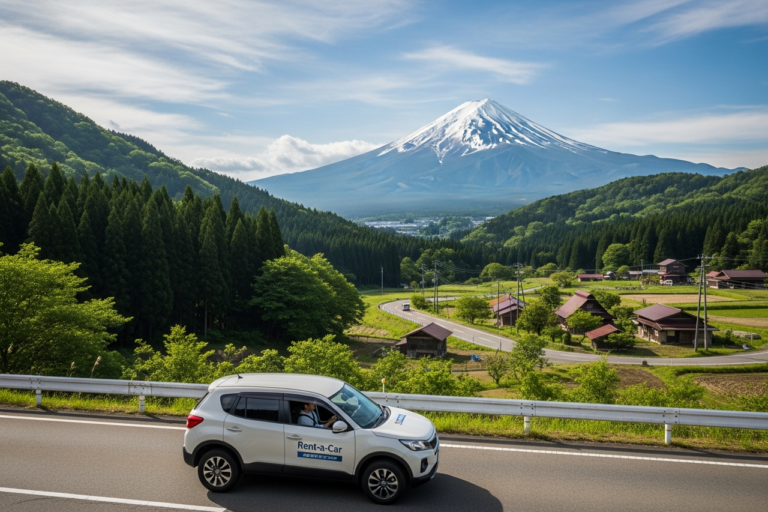
Renting a car in Japan is a good way to get around the country. The steps are simple for people from Canada. You will need to show a few papers when you get the car. You must have your valid driver’s license from Canada, your passport, and your international driving permit.
Most rental companies have websites with English choices. This helps you book your car ahead of time. Each rental car has basic insurance coverage. Still, it is a good idea to look into extra protection. Now, let’s talk about how to book and what you get with your insurance coverage.
Eligibility, Booking Process, and Accepted Documents
To be eligible for renting a car in Japan, you must be at least 18 years old and hold a valid driver’s license. The booking process is simple and can usually be done online through the rental company’s website. You will need to provide your personal details, rental dates, and preferred vehicle type.
When you arrive to pick up your car, you must present the required documents. For Canadians, this means your original license from your issuing country, your passport, and your International Driving Permit. Photocopies are not accepted, so be sure to have the physical documents with you.
Here is a summary of the documents you will need:
|
Document Type |
Requirement for Canadians |
|---|---|
|
Driver’s License |
Your original, valid driver’s license issued in Canada. |
|
International Driving Permit |
The IDP must be issued in Canada. |
|
Passport |
A valid passport is required for identification. |
|
Credit Card |
For payment and security deposit. |
Insurance Considerations and Local Rental Restrictions
When you rent a car in Japan, you need to know about the insurance coverage. Every rental fee includes basic insurance that is required by law. But this usually comes with a cost that you must pay if there is an accident. Many car rental companies give the choice of adding a Collision Damage Waiver (CDW) or Non-Operation Charge (NOC) coverage. These give you extra protection so you might not have to pay out of your pocket.
There are also some rules you should know in Japan before you rent a car. Some companies ask for a higher age if you want a certain kind of car, like a big van or a nice car. Remember, you need a current driver’s license and an international permit for renting a car in Japan.
Here are a few key points:
-
Always find out what the basic insurance coverage gives you and think about getting extra coverage for peace of mind.
-
Some small or out-of-the-way rental offices do not have staff who speak English. It is often easier to book a car with a big, well-known company.
-
You can’t drive in certain areas that are protected or in some old towns, so check your route before you go.
Converting a Canadian Driver’s Licence to a Japanese Licence
If you want to live in Japan for a long time, you will need to change your Canadian driver’s licence to a Japanese driver’s license. This is called “Gaimen Kirikae.” You can do this at a license center in your area. The process asks for an application form. You also need some other documents for them to check.
The good news is that Canadians do not need to take the full written test. You also do not need to take the full practical driving test, like folks from other countries. Still, there are some steps you have to follow. Let’s look at what the application process is like and what will happen when you go to the license center.
Application Steps and Paperwork Needed
The first thing you need to do to convert your driver’s license is to get all the paperwork. The most important document is the official Japanese translation of the license. You can get this from the Japan Automobile Federation (JAF). You can apply for this online, or you can go to a JAF office in person.
After you have the Japanese translation of your license, you must go to the license center in your prefecture. Take your completed application form and all other needed papers with you. You must show that you lived in Canada for three months or more after you got your original driver’s license. You can do this by showing passport stamps.
Here is a list of the needed documents:
-
Your original driver’s license from Canada.
-
The official Japanese translation of your license.
-
Your passport, a copy of your “jumin-hyo” (residence record from the Basic Resident Register), and your Residence Card.
-
A passport-sized photo (3 cm x 2.4 cm).
Tests, Procedures, and Special Considerations for Canadians
One of the big advantages for Canadians who want to switch their license to a Japanese license is that, because of the agreement between Japan and Canada, you don’t have to do the full written test or the practical driving test. This makes things much easier for you than for people from another country of origin. They have to pass Japan’s well-known, tough driving test.
Even though you don’t need to take the main tests, you still have to do a short aptitude check and an eye exam at the license center. The eye exam is there to make sure you have basic visual abilities. They will check if you can see well, tell the difference between red, yellow, and blue, and see how wide your field of vision is. Most of the time, the whole thing will be done on the same day right at the license center.
Once the staff checks your documents and you pass the eye exam, you will usually get your Japanese license on the spot. The whole process can take a few hours, so it’s good to get to the license center early in the day.
Age and Medical Requirements for Driving in Japan
To get a driving license in Japan, and to drive legally, you need to meet certain age and health rules. This is the same for Japanese people and those with a foreign license. You must be at least 18 years old to drive a standard car. This age rule is for everyone, whether you plan to rent a car or switch your foreign license to a Japanese one.
Besides age, there are some health checks too. These rules help make sure all drivers are fit to drive and safe on the road. One of the main checks is an eye exam. Let’s take a closer look at these health requirements.
Minimum Age Limit and Specific Health Criteria
The minimum age to drive a regular car in Japan is 18. For motorcycles under 400cc, you need to be at least 16. This rule is for everyone, including Canadians who want to rent a car or get a japanese license. Rental car companies will check your age and see your valid driver’s license.
There are other things drivers need to meet besides age. All drivers must be in good health. One main rule is you must pass an eye exam. For a standard license, you should have vision of 0.7 or better with both eyes, and each eye must see at least 0.3. You can use glasses or contact lenses to help you pass.
You also need to see red, yellow, and blue without trouble. There is a hearing test too. You need to hear a 90-decibel sound from 10 meters away. Drivers must be able to use the car’s controls in a safe way.
Provisions for Senior Canadian Drivers and Young Visitors
Japan has rules for both young and older drivers to keep road safety in mind. If you are a young Canadian and want to rent and drive a car in Japan, you need to be at least 18 years old and have all the right documents. Some car rental companies will need you to be even older for some types of cars.
For senior drivers, there are rules that make sure they still meet health standards. If you are over 70 years old, you need to do driving skill tests and memory tests when you renew your license. Canadian seniors who have a japanese license must follow these rules too.
Key things to remember:
-
Young Drivers: You have to be 18 or older to drive a car.
-
Senior Drivers: If you are over 70, you need to put a special sticker (koreisha mark) on your car so people know how old you are.
-
License Renewal for Seniors: You have to take memory checks and road safety classes to make sure you can keep on driving.
Frequently Asked Questions (FAQ)
Driving in Japan brings up many questions for people who are new here. Some want to know if an international driving permit is needed or if their foreign license works for short stays. Others ask about getting a Japanese driver’s license. This includes what documents they need, like proof of residency and a true Japanese translation of their license. It is also important to know how traffic rules work and what vehicle insurance covers. This will help keep you safe and follow the rules when you drive in Japan.
Can Canadians drive in Japan without an IDP?
No, Canadians can’t drive in Japan unless they have an International Driving Permit (IDP). You need to show your Canadian driver’s license, and you must also bring an IDP that was given to you in Canada. The IDP acts as a japanese translation of your Canadian license and is required for Canadian visitors.
How long can Canadians drive in Japan before needing a Japanese licence?
Canadians can drive in Japan for up to one year from the date of entry. Or, they can drive until their valid international driving permit runs out, whichever time is shorter. If foreign residents want to stay for more than a year, they have to switch to a Japanese license. The valid driving period for an international driving permit will not be longer than a year.
Are there different driving rules for Canadians compared to other foreigners?
The biggest difference is about your country of origin. If you are from Canada, you must use an international driving permit with your driving license. People who come from countries like Germany or France need to carry a japanese translation instead. No matter where you come from though, everyone has to follow the same japanese traffic rules. This is important for road safety.
Conclusion
To sum up, if you are from Canada, driving in Japan can be easy when you know what is needed. You should learn about how your Canadian driver’s license works there, why you need an international driving permit, and what makes Japan’s traffic rules different. This helps you stay safe and have a good trip.
You should know how to rent a car in Japan and what papers you must carry. This will give you confidence while you drive. When you plan your trip, always put safety first and follow local road rules.
If you are not sure about something or need more help, you can always ask for more info. Have a safe trip!



