

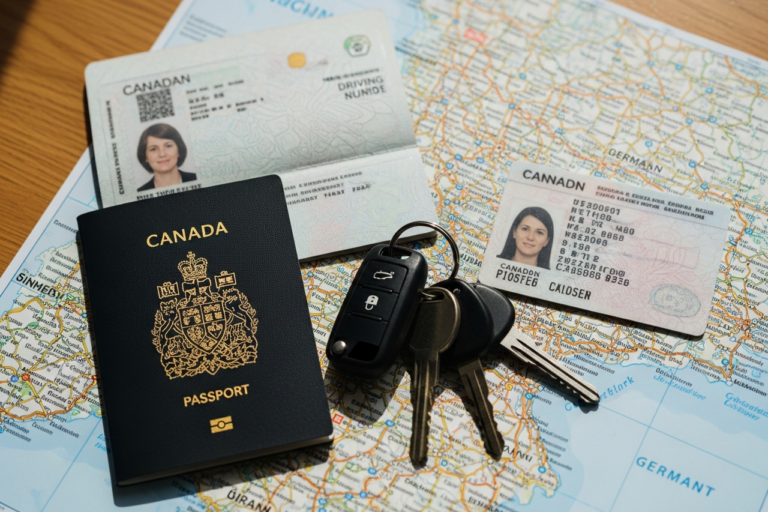
Key Highlights
-
You can drive in the country with your Canadian driving licence for up to six months if you are a tourist.
-
You will often need an international driving permit. This works as a translation of your driving licence.
-
If you stay in the country and become a resident, you must switch your Canadian driving licence to a German one in six months.
-
It is important to know about German road traffic rules. You should also know the speed limits before you drive.
-
Make sure you have the right car insurance, for a rental car or your own car.
-
You should always carry your driving licence, international driving permit, and your car insurance papers when driving in the country.
Introduction
If you are thinking about going to Germany, you might want to know if you can drive there. The good news is, you can. Canadians can drive in the country. Driving in Germany can be a good way to see the country. You can check out lots of nice places and even the Autobahn if you want to.
But you should know all the rules. This guide will help you learn about using your Canadian driving licence in Germany. It will also explain when you may need an international driving permit. This way, you can get ready for your trip and not worry on the road.
Overview of Driving in Germany for Canadians
Driving in the Federal Republic of Germany with a foreign driving licence from your home country is easy, especially for Canadians on short trips. When you are a tourist, your Canadian driving licence is often fine for driving. This lets you see the great views, towns, and cities in the republic of germany.
Still, it is a good idea to get an international driving permit with your driving licence from home. The international driving permit gives a translation of your driving licence, so it helps if you run into any language trouble with the police or other people. This also makes things easier if there are any questions about your licence while you travel. The next part will talk more about the difference between driving in germany as a tourist or as a resident.
Driving as a Tourist vs. Resident
As a tourist in Germany, you can use your foreign driving licence from home for a short stay. This lets you rent a car and drive while you are on vacation. You will not need a german driving licence. If you have a Canadian licence, it is good enough. It is also a good idea to carry an IDP.
Things change if you decide to live in Germany. When you register your address, your Canadian driving licence stays valid for only six months. After that, you need to switch to a german driving licence. You may have to follow some steps, but you might not have to take a full driving test every time.
If you do not convert your licence after six months, you can’t drive in Germany with your foreign driving licence. Driving after this could bring fines or other trouble. So, it is important to start getting a german licence before the six months finish.
Recognized Foreign Driving Licences in Germany
Germany says it’s okay to use driving licences from many countries outside the European Union. If you got your driving licence in an EU or EEA country, it will be good in Germany until it runs out. You do not need a translation or an International Driving Permit.
For some drivers from other countries, the rules are simple too. If you have a licence from Hong Kong, Monaco, Andorra, San Marino, New Zealand, Senegal, or Switzerland, you will not need a translation. This means people from those places can drive in Germany without any big problems. The United States has deals with Germany as well, but each state can have its own requirements.
If your foreign driving licence is not from one of the countries listed above, or if it does not match the layout in the Vienna Convention on Road Traffic, you will need a certified translation or an international driving permit. This is important so that German officers can read and check your driving details.
Validity of a Canadian Driving Licence in Germany
Your Canadian driving licence lets you drive in Germany. The time you can use it there will depend on your status in the country. If you are a tourist or only staying for a short time, you can use your driving licence from your home country during your stay. This is allowed for up to six months.
To make sure you do not face any trouble, it is a good idea to also bring an International Driving Permit (IDP). The IDP is not a licence by itself. It is a paper that gives an official translation of your driving licence. If you want to know more about rules for short stays and how long you can drive, keep reading.
Short-Term Visits and Licence Recognition
If you visit Germany for a short trip, you can use your valid Canadian foreign driving licence to drive there. You must meet the minimum age to drive in the country, which is 18 years old. This rule is for people who come as tourists or for quick business trips.
You can use the driving licence from your home country, but the police in Germany really suggest getting an international driving permit. The international driving permit translates your licence into German and other languages. This helps a lot if you get stopped by police or are in an accident, because it makes it much easier to talk with the officers.
Your international driving permit goes with your Canadian licence. You can’t use it alone; you always need your main licence with it. You may not need an international driving permit in every case, but having one may help you avoid trouble or any mix-ups while on the road in the country. This can make your trip easier and better.
Duration You Can Drive in Germany with a Canadian Licence
As a Canadian visiting the country, you can use your home country driving licence to drive in Germany for up to six months. This lets you travel around the country as a tourist, and you do not have to get a German licence right away.
But once you have normal residence in Germany, the six-month rule will change. The time starts from the day you register your address to live, work, or study in the country. After six months, you will not be able to use your Canadian driving licence to drive on German roads.
You will need to switch your home country licence for a German licence if you want to keep driving after this period of time. Be sure to know about this deadline and start the process early. If you drive without a licence after the six months, you will be breaking the law.
International Driving Permit (IDP) Requirements
While your Canadian driving licence works in Germany, it is a good idea to also have an International Driving Permit. The International Driving Permit is not your main licence. It is a translation of your normal licence, and people know what it means all over the world. You still need your foreign driving licence with you because the IDP goes with it.
Many car rental places in Germany want you to show an International Driving Permit. If you get stopped by the police, having it can help a lot. When you show the permit, it can help explain things if the officer does not speak English. This way, you and the police can understand each other much better. The sections below go into when you need an IDP and how you can get one.
When a Canadian Needs an IDP for Germany
A Canadian driver should get an International Driving Permit before planning to go to Germany. This helps keep things easy and smooth. Your Canadian driving licence works in Germany, but the international driving permit is an official translation. That matters because your licence is only in English. There are times when people in the country may want to see your papers in German.
The main reason to have the international driving permit is to help the people there read and know your licence. If you get stopped, get in trouble on the road, or just need to show ID, having both your driving licence and the international driving permit from your home country will be really helpful. It can stop big problems and keep you from getting fined.
Car rental places in Germany will often ask to see an International Driving Permit before you can drive away. If you don’t have one, you can be turned away or face other problems. To have peace of mind, get this permit before you go. It is a small thing to do that can help you in many ways.
How to Obtain an International Driving Permit in Canada
Getting an international driving permit in Canada is easy. You do not have to take a written test or any exam. The permit is just a way to show your valid Canadian driving licence in other places.
The Canadian Automobile Association (CAA) is the only group allowed to give out international driving permits in Canada. You can apply at any CAA Travel Centre. You need to be at least 18 years old. You also need to have a valid driving licence from your home country.
To get your permit, you will have to give:
-
A filled out application form.
-
Two small photos for passports.
-
A photo copy of the front and back of your Canadian driving licence.
-
The fee to apply.
Most people can apply in person, by mail, or through a Canadian embassy or consulate if you are already in another country. It is best to apply a few weeks before you go, so you get your international driving permit on time.
Rules and Regulations for Foreign Drivers
When you are in Germany and driving, you need to follow the rules for road traffic. This means drive on the right side of the road. You must pay attention to all the traffic lights. Stay within the speed limits that are posted. German roads are kept in good shape. The rules can be strict, so you should be ready.
You must carry the right papers when you drive. Keep your licence and car insurance documents with you at all times. If you know these rules, your drive will be safe and more fun. The next sections will tell you about the right documents you need and other rules you should know.
Mandatory Documents to Carry While Driving
When you are driving in Germany, you need to have the right papers with you all the time. If the police stop you, they will ask you to show these documents right away. Being ready can help you save time and keep out of trouble.
The main thing you need is a valid driving licence. For Canadians, that is your licence from your home province. You also have to carry your International Driving Permit (IDP). The IDP is there to work as a translation of your driving licence. If you have both, you should not have any problems with the law.
You also need proof of car insurance. For those who are driving a rental car, you must have the rental agreement and the insurance papers too. Keep this checklist in your car all the time:
-
Your valid Canadian driving licence.
-
Your International Driving Permit (IDP) or a certified translation.
-
Vehicle registration and proof of car insurance.
Age and Licence Restrictions for Canadians
To drive in the country, you have to be at least 18 years of age and have a valid driving licence. This is the rule for all people, even if you are Canadian. If you want to get a rental car, there may be more rules about age.
A lot of rental car companies in Germany ask that you be at least 21 years old. Some even ask for you to be 25. If you are under 25, you might have to pay more money for a “young driver surcharge.” This can make the price of your rental car go up a lot. It’s always a good idea to look at the rules of the company before you book a car.
Some companies also want to know how long you have had your driving licence. You may have to show that you have had your licence for one or two years. Always check the details before you go to get your rental car so that you will not have any problems when you get there.
Converting a Canadian Licence to a German Licence
If you go to live in Germany and you become a resident there, you need to change your Canadian foreign driving licence to a German driving licence. You have six months to do this after you start living in Germany. What you need to do can change based on which Canadian province your driving licence comes from.
Sometimes, you can trade your foreign driving licence for a German driving licence right away. In other cases, you will have to pass a theory test, or maybe you will need to take a short driving exam. You don’t have to take a full written test like someone who is trying to get their first driving licence. Here’s what you need to know about who can get the German driving licence, and the steps you have to follow.
Eligibility Criteria for Exchange
Your chance to swap your Canadian driving licence for a German one depends on deals between Germany and each Canadian province. The German Federal Ministry of Transport has a list of countries and states that have these deals. This tells you the way you can exchange your driving licence.
To be able to exchange it, you must get your driving licence in your home country before you come to Germany. You cannot move to Germany, get a driving licence somewhere else, and then try to change it to a German one. The licence you want to swap must be given to you while your normal residence was in Canada.
This means the date on your Canadian driving licence should be from before you register in Germany (Anmeldung). If you renewed your driving licence after you got to Germany, you might have to show proof that you had your licence before you moved. Old licences or a letter from your driving school could help. An international driving permit is not used for the exchange, but it can come in handy for driving in the meantime.
Step-by-Step Process for Converting Your Licence
Converting your Canadian driving licence to a German one involves several steps. First, you must register your address in Germany (Anmeldung). Once that’s done, you’ll need to book an appointment at your local Bürgeramt (citizens’ office).
Depending on your province of origin, you may need to take a first aid course and pass an eye test. While full driving lessons at a driving school are optional, they are highly recommended, as German road rules can be very different from those in Canada. For some, a theory (written test) or practical driving exam might be required.
You will need to gather several documents for your appointment. The process can take a few weeks to months, so it is best to start early.
|
Step |
Action |
|---|---|
|
1. Register Address |
Complete your Anmeldung at the local Bürgeramt. |
|
2. Book Appointment |
Schedule an appointment to submit your licence exchange application. |
|
3. Complete Courses |
Take a first aid course and an eye test if required. |
|
4. Gather Documents |
Collect your passport, photo, current driving licence, and other required paperwork. |
|
5. Attend Appointment |
Submit your application and pay the fee. |
|
6. Wait for Processing |
Your application will be sent to the driver’s licence authority (Fahrerlaubnisbehörde). |
|
7. Pick Up Licence |
You will be notified when your new German driving licence is ready for collection. |
Car Insurance for Canadians Driving in Germany
Having the right car insurance is a must when you drive in Germany. This is true if you are using your own car or a rental car. In most cases, the rental car comes with some insurance included in the deal. But, you need to look at the kind of coverage you get. This will help you know what is covered.
To get more peace of mind, think about getting European breakdown cover. This can really help if your car breaks down. When you make sure you have breakdown cover and car insurance, you protect your money and follow the law at the same time.
The next part will talk about insurance for a rental car and using a Canadian policy when you drive in Europe.
Rental Car Insurance Requirements
When you rent a car in Germany, basic liability car insurance is needed by law. This will be part of the price you pay for your rental car. The insurance helps cover any damage you may cause to other cars, people’s things, and people if there is an accident and it is your fault. But, this does not give you cover for damage to your own rental car.
Because of this, the rental company will let you buy more insurance like Collision Damage Waiver (CDW) and Theft Protection. You do not have to buy these, but it is a good idea to get them. If you drive without them, you might have to pay for all the repairs or even buy a new car if the rental car is broken or stolen.
To be safe, you can think about buying more breakdown cover. This is a smart idea if you want to drive long distances in the country. Here are some important insurance things to know for a rental car:
-
Basic liability insurance is a must and comes with the car.
-
Collision Damage Waiver (CDW) is really a good thing to have.
-
You may want to check if your credit card gives you car insurance for rental cars.
Using Canadian Insurance Policies Abroad
Most of the time, a standard Canadian car insurance plan will not cover you when you drive in the country of Germany. Usually, the plan you have in your home country works only in Canada and the United States. That is why it is good to call or check with your provider before you go.
It’s not a good idea to think your Canadian car insurance will work as soon as you reach Germany. If you get in a bad crash, you may face big bills and even run into legal trouble. Make sure you know the limits of your car insurance and ask about the time you will be covered—or not—when you are away.
If you want real peace of mind for your trip, use the car insurance that comes with your rental car. You can also buy travel insurance for the periods of time you are in another country and using a rental car. You do not want to guess about protection; bring the right car insurance to Germany and enjoy your journey.
Essential German Traffic Laws for Canadians
To drive safely in the country, you need to know the traffic laws. Some main rules are following all speed limits and knowing the road signs. You have to stop at a red light. You must not drive if you are under the influence of alcohol, because the penalty for that is very strict.
All people in the car need to wear seat belts. You also can’t use a mobile phone when you drive. Knowing these laws will not only help you stay away from fines, but also help keep you and other people safe. Now let’s look at some of the most key laws you will find.
Speed Limits and Road Signs You Should Know
Germany is well known for the Autobahn. Some parts of this road have no official speed limits set by the government. Still, the suggested top speed is 130 km/h. There are many places where speed limits are closely watched. In cities and towns, the speed limit is usually 50 km/h. On roads outside the city, you can drive at 100 km/h unless another speed sign says something different.
German road signs use pictures, and they follow the style used in the rest of Europe. The sign might be different for you. If you see a circular white sign with a red border, it means there is a rule or limit, like a speed limit. Another important sign is the end of restriction sign. This one is a circular white sign with diagonal black lines. When you see it, the last rule or limit is no longer there.
Watch traffic lights when you drive in Germany. If a traffic light is red and you see a green arrow on the right, you can turn right. You must first stop, then check for people walking and cars coming your way, before you go. Here are the key speed limits and signs to remember:
-
Urban areas: 50 km/h
-
Rural roads: 100 km/h
-
Autobahn: Advisory 130 km/h, but watch for posted limits.
Seat Belt, Alcohol, and Mobile Phone Regulations
German law is very tough when it comes to safety rules. Seat belts must be worn by the driver and all people in the car. This means both the front and back seats. If the police see you without a seat belt, you will get a fine right there. This rule is checked often and is there for every person’s protection.
Driving while under the influence of alcohol is not allowed. The blood alcohol level you can have is 0.05%. There is a different rule for new drivers who have less than two years of driving or are younger than 21. For them, the blood alcohol level must be 0.00%. At any time, officers can stop you and do a breath test. If you say no to this breath test, you could get in big trouble.
If you use a hand-held phone when you drive, that is not allowed at all. If you want or need to make a call, you must use a hands-free tool. Police watch this closely and if they catch you using your phone, the punishment is heavy. It is best to keep your phone away and keep your mind on the road.
Common Challenges for Canadians Driving in Germany
Your road trip in Germany can be great, but you need to be aware of some things that could be hard. Driving on roads you do not know and not knowing the language can make it tough. Even if you have a lot of years of driving, you should take extra care when you have to get used to a new place to drive.
The way people drive and act on the road, for example on the Autobahn, may also be new to you. Taking a few driving lessons or reading about the local ways is a good idea because there is not a probationary period to help you get used to it. The next parts will give tips about how to find your way and what to expect on the road.
Language Barriers and Road Navigation
Even though many Germans know English, you should not always expect that, especially if you end up in a small town or talk to the police. Most of the traffic signs in Germany have pictures or symbols on them, so people from other places will get what they mean. But some things, like parking zone or detour signs, have words in German.
When you drive on the road, it is a good idea to use a GPS or a map app on your phone. Apps like Google Maps or Waze work nicely and you can set them in English. Try to download the map ahead of time, because if you lose your phone signal, you can still use it. This makes it easy to stay going the right way and know your arrival time.
Parking is not always easy. Watch for parking zone signs and be sure you know the rules for paying and how long you can stay there. If you are stuck, having a translation app on your phone can help you understand signs and talk to people.
Differences in Driving Culture and Road Etiquette
German road etiquette is all about doing things right and following the rules. Drivers there are disciplined, and you are expected to act the same. One key thing is the right of way. In urban areas, if you come to a crossing with no signs, cars that come from the right go first.
On the Autobahn, things are different from North America. The left lane is only for passing. When you pass a car, move back to the right lane. If you stay in the left lane, that is a big problem and it can be risky because fast cars may come up from behind.
People driving in Germany want you to act quickly and in a way they can see. Use your signal each time you change lanes or turn. Drivers are bold, but if you follow the rules, they will be polite. Be ready to keep up the pace, especially when you are not in urban areas. Always watch what is happening around you, as the road can be busy and there could be fast cars close by.
Conclusion
To sum up, driving in Germany as a Canadian can be a great adventure. But you have to be ready before you go. It’s important to know the rules and what you need, like an International Driving Permit. This will help things go well for you on the road. You should learn to spot traffic signs and get used to how people drive there. Paying attention to these things can make your time behind the wheel a lot better. Whether you are in Germany for a short stay or if you plan to live there for a while, it is good to know the facts first. If you want more help or have questions, you can ask for a free talk with someone who knows. Have a safe trip!
Frequently Asked Questions
What happens if I drive without a proper permit in Germany?
If you drive without a valid driving licence or the right permit, you can get into big trouble. You might have to pay large fines, get penalty points added to your record, or face a driving ban for periods of time. The police could even take your car. This could also bring up problems with your car insurance back in your home country.
Can Canadians rent a car in Germany, and what do I need?
Yes, people from Canada can get a rental car in Germany. You should have your Canadian driving licence, an international driving permit, your passport, and a credit card with you. You also need to be old enough for the rental car company’s rules. For car insurance, most of the time, it will be set up when you book the car.
How do I exchange my Canadian licence for a German one if I stay long-term?
To get a German driving licence, you need to visit your local authority. You have to bring your Canadian driving licence, your passport, a photo, and your eye test certificate if you have one. Depending on which province you are from, you might also need to take a theory test or do a practical exam. In many cases, you will not need to join a new driving school.



